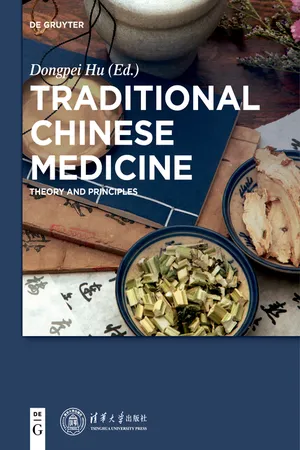
Derived from ancient Chinese philosophy, Traditional Chinese Medicine is considered to be difficult to understand. This book provides an overview of Traditional Chinese Medicine by illustrating the topics of visceral manifestation, etiology and pathology in a clear manner to readers. Clinical treatments are included to serve as references for practice. This book is well-suited for both researchers and practitioners.
- 189 pages
- English
- ePUB (mobile friendly)
- Available on iOS & Android
eBook - ePub
About this book
Information
Topic
Médecine1Introduction
1.1The discipline, nature, and properties of traditional Chinese medicine
Key points
–TCM belongs to the category of natural science.
–TCM has the characteristics of social science.
–TCM is profoundly influenced by ancient Chinese philosophy.
–TCM is the product of multidisciplinary interactions.
Traditional Chinese medicine (TCM) is a life science that originated from ancient China, focusing on researching human health, illness, and disease prevention. It has a close relationship with the geographic culture in China and belongs to the traditional-science category of the Orient. TCM is an important part of the world’s knowledge of medical science; its characteristics and properties are discussed in the following sections.
1.1.1TCM is characterized by its natural science nature
Natural science is a subject which studies the law or nature of material movement and change and development in nature. Medical science is a scientific system which studies the process of life and its fight against disease. It belongs to the category of natural science. The study of TCM is focused on human beings, especially on the basic law of birth, growth, aging, and death. TCM also emphasizes the mechanism of physiology, pathology, and disease prevention. It has the characteristics of medical science. Therefore, TCM belongs to the category of natural science.
1.1.2TCM has the characteristics of social science
Social science is a subject which studies the change of human society and its development. Human beings are not only the highest product of natural evolution but also have social attributes. TCM focuses on studying different physiological functions from different angles of the social background. It also studies the social roots and the personal relationship and how they affect the physical as well as the mental health of human beings. These features reflect distinctively the social and scientific characteristics of TCM.
1.1.3The mutual influences of TCM and ancient Chinese philosophy
Philosophy is a science which studies the general rules of the common movement in nature, society, and thoughts. The development of any object is related to philosophy. The interactive relationship between TCM and philosophy is reflected in two aspects.
Firstly, TCM was constantly receiving the development of philosophical research during its process of formation and development. Since its initiation, TCM has unceasingly absorbed research progress from ancient Chinese philosophy; a series of TCM phenomena may be explained through important philosophical concepts. For example, yin-yang, a philosophical concept in Huangdi Nei Jing, is used to explain the relative attributes and their relationships of the two opposite aspects of correlative things or two opposite aspects within one thing. Combining with the other terms, it formulates the special TCM terms which are used to explain the physiological functions and pathological changes of the human body. Therefore, yin-yang is a methodology which is used to direct the development of TCM theory and is also applied repeatedly in TCM research. The same concept is applied to the theories of yuan-qi and the five elements.
Secondly, TCM enriched and developed ancient Chinese philosophy. For example, the relationships between yin and yang and the laws of promotion, restriction, counter-restriction, and over-restriction among the five elements were first put forward and fully discussed in the TCM literature. Many philosophers also used the TCM theory to do philosophical research. Therefore, TCM not only enriched ancient Chinese philosophy but also promoted the development of the ancient philosophy.
1.1.4TCM is a product of multidisciplinary interactions
To a certain extent, the development of TCM is also the medical application history of multidisciplinary knowledge. Besides ancient Chinese philosophy, our ancient astronomy, geography, meteorology, phenology, agronomy, biology, botany, mineralogy, specialties, mathematics, and metallurgy played an important role in the initiation and development of TCM. For example, meteorological knowledge is an important factor in the development of the initial theory of the six climatic pathogens. By comparing the four seasons, TCM recognized the differences in pulse according to the changes of the four seasons. With knowledge of geography, ancient TCM scholars developed the theory of treatment according to environmental changes. Therefore, TCM is a product of multidisciplinary interactions. Multidisciplinary knowledge promotes the development of TCM.
1.2The main characteristics of TCM theory
The theoretical system of TCM is influenced by ancient philosophical thought and developed over long-term clinical practice. TCM theory consists of two aspects: holism and differential diagnosis and treatment.
Key points
–The main characteristics of the theoretical system of TCM:
–Concept of holism
–Differential diagnosis and treatment
1.2.1Concept of holism
Key points
–The concept of holism includes the following:
–The human body as an organic whole
–The unity between human and environment
Wholeness signifies the unity and integrity of an object. TCM holds that the human body is an organic whole in which all constituent parts are structurally inseparable, functionally coordinative and interactive as well as pathologically interinfluencing. The human body is closely related to the natural and social environments. Through the process of adaptation, it maintains its balanced activities. The concepts of unity between the internal and external environment, the connection, the integrity of the body itself as well as the balance represent the wholeness of TCM theory. The wholeness concept is an important thinking method permeating in various areas such as physiology, pathology, diagnosis, health care and treatment.
1.The human body as an organic whole
The human body is composed of different viscera and tissues. Each of them has different functions which are the constituent part of the whole activity. A human’s normal physiological activity is affected by the whole activity. On the other hand, it also influences the functions of other viscera and tissues. This kind of function is the whole activity. From the viewpoint of TCM, integral unity is established by connecting the five zang-viscera, six fu-viscera, the five body constituents, the sensory organs, the nine orifices, the four limbs, and the bones through the meridian systems: The liver, gallbladder, tendon, and eye constitute the liver system; the heart, small intestine, vessel, and tongue constitute the heart system; the spleen, stomach, muscle, and mouth constitute the spleen system; the lung, large intestine, skin, and nose constitute the lung system; and the kidney, urinary bladder, bone, ear, and anus constitute the kidney system. These constituents form the whole unity and accomplish its functional activities.
The human body is composed of different viscera and tissues. Each of them has different functions which are the constituent part of the whole activity. A human’s normal physiological activity is affected by the whole activity. On the other hand, it also influences the functions of other viscera and tissues. This kind of function is the whole activity. From the viewpoint of TCM, integral unity is established by connecting the five zang-viscera, six fu-viscera, the five body constituents, the sensory organs, the nine orifices, the four limbs, and the bones through the meridian systems: The liver, gallbladder, tendon, and eye constitute the liver system; the heart, small intestine, vessel, and tongue constitute the heart system; the spleen, stomach, muscle, and mouth constitute the spleen system; the lung, large intestine, skin, and nose constitute the lung system; and the kidney, urinary bladder, bone, ear, and anus constitute the kidney system. These constituents form the whole unity and accomplish its functional activities.
Any local areas belong to the parts of the whole unity. Local illness, diagnosis, and treatment must be based on the concept of wholeness. Otherwise, whole pathological changes will affect local disorder.
2.The unity between human being and external environment Human being is a by-product of natural evolution. From the TCM point of view, a human being is materially connected with the external environment. Human beings live in nature. Therefore, the external environment will directly or indirectly affect the functional activities of the human body. The body’s beneficial adaptations to environmental changes belong to the category of physiologically adaptive adjustments. Otherwise, they are called pathological reactions and will result in diseases. This idea is referred to as the unity between the human being and the external environment.
A.The unity between human being and nature
Human beings live in nature. Natural factors, for example, seasonal and climatic changes, day and night as well as the geographical differences, can directly or indirectly affect the body’s physiological functions and pathological changes.
Human beings live in nature. Natural factors, for example, seasonal and climatic changes, day and night as well as the geographical differences, can directly or indirectly affect the body’s physiological functions and pathological changes.
In general, it is warm in spring, hot in summer, damp in late summer, dry in autumn, and cold in winter. Under the influence of these climatic changes, there are many adaptation changes for living things: germination in spring, growth in summer, change in late summer, reap in autumn, and storage in winter. Just as any other living thing, human beings must also adapt themselves to climatic changes. For example, in spring and summer, yang-qi rises upward and flourishes whereas qi-blood of the body trends to circulate superficially, which often results in loose skin, profuse sweating, and less urination. During autumn and winter, yang-qi goes inward and becomes astringent whereas qi-blood of the body trends to go internally, which often results in tight skin, less sweating, and more urination. These adaptations indicate that seasonal climatic changes can influence the body’s physiological functions.
Although daily temperature changes are not as obvious or regular as seasonal changes, long-term regular changes will result in the same rhythmic change as the day and night to adapt to the changes in the environment.
Geographical differences in living environment are also an important factor, which can directly influence the physiological function of the human body. Regional climate and different cultures and customs are all geographical differences. They can affect the body’s physiological function and mental activities to a certain degree. For instance, the southern region of China is usually damp and hot, and the striae of the human body tends to be loose and body shape thin; the northern part of China is dry and cold, and the striae of the human body tends to be tight and the body shape is stronger.
B.The close relation between human beings and society
Human beings live in society. Different social environments also result in different physical and mental functions.
Human beings live in society. Different social environments also result in different physical and mental functions.
The change of social status definitely brings differences to the individual’s spiritual life. Social development enriches humans, widens living room, elevates levels of health care and promotes human living conditions and lengthens life span. On the other hand, with a turbulent society or war occurring frequently, an individual’s physical and mental functions will be affected more. The progress that society makes will undoubtedly bring many benefits to human health.
Due to the relationships of unity and opposition between the human being and the external environment, the principles of treatment according to time, different locations and each individual have become the important rules in the TCM treatment. Therefore, more attention should be paid to the organic relationships between the external environment and the overall functional activity during the treatment process.
1.2.2Differential diagnosis and treatment
Key points
–Syndrome
–A syndrome is a pathological summary during a stage of disease onset. It includes etiology, the location of the disease, the pathology as well as the relationship between right and evil pathogen.
–Differential diagnosis
–Differential diagnosis refers to the analysis, differentiation, recognition, and summarizing of the syndrome of a disease by the collection of medical history, symptoms and signs through the four traditional methods of inspection, olfaction, inquiry, and palpation. – Treatment determination
–Treatment determination refers to the choice and formulation of the corresponding therapeutic principle as well as the method according to the result of the differential diagnosis.
–Same disease but different treatment
–This method refers to the different treatment principles due to different disease onsets, different disease locations, different body reactions or different stages of the disease originating from the same kind of a disease. In other words, treatments are based on the different syndromes.
–Different diseases but same treatment
–This method refers to the same treatment principle based on diseases with similar etiology, and pathology.
There are fundamental differences among the syndromes, symptoms, and diseases. Symptoms refer to the complaints by a patient, such as headache and abdominal pain. The same symptom may have different reasons. And ...
Table of contents
- Cover
- Title
- Copyright
- Preface
- Table of Contents
- 1 Introduction
- 2 The Philosophical Basis of Traditional Chinese Medicine
- 3 Visceral Manifestation
- 4 The Theory of Qi, Blood, and Body Fluids
- 5 Theory of Meridians and Collaterals
- 6 Constitutional Theory
- 7 Onset of Disease
- 8 Etiology
- 9 Pathogenesis
- 10 Principles of Prevention and Treatment of Diseases
- References
Trusted by 375,005 students
Access to over 1.5 million titles for a fair monthly price.
Study more efficiently using our study tools.
Frequently asked questions
Yes, you can cancel anytime from the Subscription tab in your account settings on the Perlego website. Your subscription will stay active until the end of your current billing period. Learn how to cancel your subscription
No, books cannot be downloaded as external files, such as PDFs, for use outside of Perlego. However, you can download books within the Perlego app for offline reading on mobile or tablet. Learn how to download books offline
Perlego offers two plans: Essential and Complete
- Essential is ideal for learners and professionals who enjoy exploring a wide range of subjects. Access the Essential Library with 800,000+ trusted titles and best-sellers across business, personal growth, and the humanities. Includes unlimited reading time and Standard Read Aloud voice.
- Complete: Perfect for advanced learners and researchers needing full, unrestricted access. Unlock 1.5M+ books across hundreds of subjects, including academic and specialized titles. The Complete Plan also includes advanced features like Premium Read Aloud and Research Assistant.
We are an online textbook subscription service, where you can get access to an entire online library for less than the price of a single book per month. With over 1.5 million books across 990+ topics, we’ve got you covered! Learn about our mission
Look out for the read-aloud symbol on your next book to see if you can listen to it. The read-aloud tool reads text aloud for you, highlighting the text as it is being read. You can pause it, speed it up and slow it down. Learn more about Read Aloud
Yes! You can use the Perlego app on both iOS and Android devices to read anytime, anywhere — even offline. Perfect for commutes or when you’re on the go.
Please note we cannot support devices running on iOS 13 and Android 7 or earlier. Learn more about using the app
Please note we cannot support devices running on iOS 13 and Android 7 or earlier. Learn more about using the app
Yes, you can access Traditional Chinese Medicine by Dongpei Hu in PDF and/or ePUB format, as well as other popular books in Médecine & Médecine alternative et complémentaire. We have over 1.5 million books available in our catalogue for you to explore.