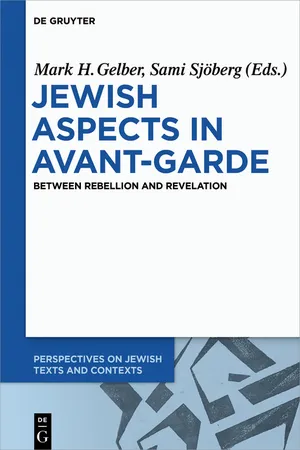
This volume deals with the significance of the avant-garde(s) for modern Jewish culture and the impact of the Jewish tradition on the artistic production of the avant-garde, be they reinterpretations of literary, artistic, philosophical or theological texts/traditions, or novel theoretical openings linked to elements from Judaism or Jewish culture, thought, or history.
eBook - ePub
Jewish Aspects in Avant-Garde
Between Rebellion and Revelation
- 284 pages
- English
- ePUB (mobile friendly)
- Available on iOS & Android
eBook - ePub
Jewish Aspects in Avant-Garde
Between Rebellion and Revelation
About this book
Information

Messianism, Syncretism, and Vanguard Philosophy
Małgorzata Stolarska-Fronia
Saints and Tsadikim – The Religious
Syncretism of Jewish Expressionism
Note: The background research for this article was financed by the National Science Centre through a post-doctoral internship grant. Project title: Ekspresjonizm żydowski – w poszukiwaniu przestrzeni kulturowej (Jewish Expressionism – A Quest for Cultural Space). I would like to thank Professors Ziva Amishai-Maisels, Haim Finkelstein, Jerzy Malinowski, and Moshe Rosman for carefully reading this article and for their valuable comments and suggestions.
Jewish expressionism was a transnational cultural movement of artists who were active between 1912 and 1939 within Polish, Ukrainian, Lithuanian, and German societies. They included Ludwig Meidner and Jakob Steinhardt, members of “Die Pathetiker” group (1912); members of the Yung-yidish and Di Khalyastre groups (1919); and various artists from the Kultur-lige milieu, as well as artists whose contacts with most of the aforementioned groups were less formal (e.g., Lasar Segall, Heinrich Tischler). This informal group of artists occupied a separate cultural space within the European avant-garde, sharing its general worldview yet also expressing their own stance as modern Jewish artists. Thus, aside from the characteristic features of the expressionist movement as a whole – such as opposition to bourgeois values, a programmatic break with earlier styles of painting, a revolutionary attitude and declaration of creating new art, apocalyptic moods and messianic hopes in the face of the crisis of European culture (especially after the First World War), primitive art as a source of inspiration – Jewish expressionism involved typical Jewish motifs: a fascination with Hasidism and Kabbalah, the landscape of Eastern European Jewish towns and its mystical rendition, Jewish customs and religion, Jewish festivals, events in the Jewish life cycle, as well as a relationship with the Yiddish culture and literature of the day. Jewish artists were involved in searching for “Jewish means of expression” (Aronson and Ryback 1919, 123), and expressionism – as an opposing naturalistic representation of reality, allowing for far-reaching deformation, freedom of form and color, and forging to reveal inner, irrational and dynamic spirituality – was at this point the most appealing to young Jewish artists. The revolutionary ideas of changing values, opposing bourgeois life and assimilation, and proclaiming the rebirth of the Jewish spirit, as well as strong messianic and apocalyptic elements in the expressionist worldview, strengthened this relationship.
This phenomenon gave rise to a specific discourse, including a debate regarding the influence of the artists’ origins on both their choices of artistic language and the development of expressionism as an art movement. Central elements that dominated the discourse on Jewish expressionism in the visual arts included the connection between expressionism and religion; Jewish avant-garde engagement in the paradigm of national art; and the dilemma of choosing between style and subject matter. Discussion of the so-called “Jewish roots of expressionism” among theorists, philosophers, art critics, and the artists (both Jewish and non-Jewish) was part of this discourse.85
The search for authentic religious experience, a return to the original values of the Bible and Jewish mystical texts, was an important impulse behind the expressionists’ output. For Jewish artists, this was a complex process, since, being familiar with and living amidst two religious cultures, Judaism and Christianity, they combined in their quest ideas and themes from both theologies. Some questions, such as the connection between Pauline teachings and Judaism, were the subjects of dissertations and articles published in the Jewish press (Kellermann 1903a, 1903b; Rappeport 1917–1918, 276–279; Strauß 1923, 1, 32–44). Themes and motifs from Christian iconography appear in expressionist art quite frequently. This coincided with a fascination with the Christian religion and with a specific manner of presenting mystical themes.
The expressionists’ worldview of such artists as Ludwig Meidner and Jakob Steinhard as well as members of the Yung-yidish group (to mention only a few) was steeped in Jewish philosophy. This included Martin Buber’s concept of the Jewish renaissance (Buber 1920), his philosophy of dialogue (Buber 1992), and his concept of Hasidism (Buber 1963, 1999), as well as the concepts of revelation, messianism and apocalypse that were developed, after the First World War, by Franz Rosenzweig (Rosenzweig 1998), Ernst Bloch (Bloch 1918), and Walter Benjamin (Benjamin 1971–1989), and Gershom Scholem’sworks on Kabbalah and Jewish mysticism (Scholem 1997). The Jewish artists were surely familiar with these works, whose excerpts were published in the contemporary Jewish press, as were related reviews and discussions.
This essay will examine the Jewish expressionists’ quest for religious identity with the ultimate goal of depicting a cultural space86 within the general expressionist movement, or, more precisely, within the values represented by the second generation of expressionists.87 It will be based on the assumption that, while the expressionists sought religious experience in order to re-sacralize art,88 the spiritual quest of Jewish expressionists is inseparable from the search for a new, national art. Their avant-garde aesthetic experiment went hand in hand with a cultural and religious experiment. The latter constituted a search for the roots of Jewish spirituality and communality within the Hasidic movement as well as an internalization of ideas and figures from Buddhist and Christian art. I will focus on two main topics related to the Jewish expressionists’ religious syncretism. The first is inspiration from Hasidic spirituality, especially the idea of ecstatic prayer, which Jewish artists identified with the creative act. Visions of religious ecstasy and the figures of tsadikim (biblical figures and spiritual masters of Hasidism), apart from conventional images of rabbis,89 do not have a developed tradition in earlier, pre-modern traditions of Jewish art; hence depictions of these scenes often derive from patterns of Christian art, especially Baroque painting, and even art of the East. The second important issue – the very basis for constructing a religious worldview – was the messianic idea. Its reception and representation by Jewish artists is an interesting example of correspondence between, on one hand, the philosophical and literary recognition of this issue and, on the other, its portrayal in the visual arts. It is important to find a reference to the similarities and differences between an intense Christological element in the art of Jewish expressionists and expressionist art in general. In tracing this transformation I will focus primarily on artworks by members of the Yung-yidish group, and those of German-Jewish expressionism.
1In Search of an Aesthetic Paradigm – Jewish Soul and New Jewish Art
The quest for religious identity was a key element of Jewish expressionism. Clearly, intense religious pursuit and its articulation in expressionist art was a generational experience stemming from the attitudes and cultural currents typical of the early twentieth century. In 1918, the famous Neue Religiöse Kunst (New Religious Art) exhibition, which cemented the relationship between expressionism and religion, was displayed at the Kunsthalle in Mannheim. A year later, Gustav Hartlaub published Religion und Kunst (Religion and Art). In his view, “Der Expressionismus als Stil bildet die Grundlage alles religiösen Gefühlsausdruckes […]” [Expressionism as a style provides the basis for expressing all religious feelings] (Hartlaub 1919, 36). Nevertheless, Hartlaub comments on “[…] idealistischen Versuchen moderner Theologen und Denker zur Erneuerung des religiösen Lebens […]” [idealist attempts at renewing religious life by modern theologians and thinkers] (Hartlaub 1919, 107); such figures included none other than Buber, whom he labelled a “chassidische Mystiker” [Hasidic mystic]. Hartlaub made his observations ten years after publication of Buber’s Ekstatische Konfessionen (Ecstatic Confessions), a synthesis of the thinker’s mystical investigations. Buber confessed to an early fascination with German mysticism – the teachings of Meister Eckhart, Jakob Böhme, and Angelus Silesius – which subsequently evolved into fascination with the Kabbalah and Hasidism, culminating in publication of his tales of the Hasidim.90 His religious thought combined with his views on art was fundamental in raising spiritual awareness among the young generation of Jews, including artists belonging to avant-garde movements.
The Jewish expressionists saw in their work a mission to reinstate proper order, to re-establish contact with lost spiritual values, with the Absolute, nature, and God, whom they understood and referred to by a variety of names, including Logos and “shekhinah.” Often, in commenting on their art, they applied the notion of revelation – a phenomenon that in their view endowed them with cognitive powers, embodied dialogue, and allowed truth to be given a form. In their interpretation, this notion became universal, and grew into an act of cultural and artistic renewal, not only deriving from one of the most important events of Judaism, namely, the revelation at Sinai as described in the Bible, but also influenced by the apocalyptic visions of John the Apostle. The concept of revelation also appeared in the context of a new Jewish national culture. Revelation, in this sense, had both a mystical and a social dimension. It was seen to naturally lead to a spiritual revolution which would produce a new quality – rebirth of Jewish culture, referred to by some explicitly as “expressionistisches Judentum” [expressionist Judaism] (Fuchs 1924) – and it is not without reason that this notion appears in expressionist rhetoric in connection with the idea of Jewish Renaissance introduced by Buber, as well as in German Jewish thought as represented by Rosenzweig.
Avant-garde artists felt they were creating art in a cultural void, and thus their aesthetic experimentation went hand in hand with religious experimentation. This was especially the case for artists active in the independent Polish state (e.g., members of the group Eskpresjoniści Polscy (Polish Expressionists, established in 1917), the Poznań group BUNT (Rebellion, established in 1918), and the Jewish Yung-yidish group (established in 1919)). For Jewish artists the First World War and its aftermath was not only a catastrophic experience; it also created the possibility to find their own cultural space within a victorious state. According to artists from the Łodź-based Yung-yidish group, the best means of achieving the latter was expressionist art. As Yankl Adler (1895–1949) stated in his manifesto:
We, the young, have almost forsaken the relationship with the God of our Fathers; we have lost what people satisfied with themselves possess – half sin, half virtue; our trust in people was poisoned while we were still young, and in our hearts we are weighed down with the burden of a great, great longing for God and Eternity, for the power that made Creation happen, for Logos. The art of the twentieth century, Expressionist art, was born of this longing, and it is the seventh day, and the week of the commonplace is over.
(Adler 1920, 180)
Besides the artist’s own statement, Yankl Adler’s art was described by contemporary critics as one that realized the paradigm of expressionist form according to Max Deri, namely, the “symboliczno-emocjonalne odejście od natury” [symbolicemotional withdrawal from nature] (Zimmermann 1919, 3). Adler’s manifesto proves the influence of Buberian thought. His idea of “ideal relation” had been expressed in a wish to unite with God, whereas expressionist art signified the fulfilment of this longing.91
Besides artistic manifestos and personal declarations by Jewish expressionists, a universal understanding of Judaism and its inclusion in the discourse on the significance of religious spirituality in expressionist art influenced the development of the notion and features of Jewish avant-garde art. In an article published in Die Aktion in 1917, Iwan Goll acknowledged the primacy of Judaism, having compared Catholicism and Judaism, and each religion’s natural ability to capture “the...
Table of contents
- Cover
- Title Page
- Copyright
- Contents
- Acknowledgements
- Introduction
- The Avant-Garde and Jewish Traditions
- Community Building and Cultural Conflicts
- Self-Representation and Anti-Semitism
- Messianism, Syncretism, and Vanguard Philosophy
- Jews in the Avant-Garde: A Historical Perspective
- Notes on Contributors
Trusted by 375,005 students
Access to over 1.5 million titles for a fair monthly price.
Study more efficiently using our study tools.
Frequently asked questions
Yes, you can cancel anytime from the Subscription tab in your account settings on the Perlego website. Your subscription will stay active until the end of your current billing period. Learn how to cancel your subscription
No, books cannot be downloaded as external files, such as PDFs, for use outside of Perlego. However, you can download books within the Perlego app for offline reading on mobile or tablet. Learn how to download books offline
Perlego offers two plans: Essential and Complete
- Essential is ideal for learners and professionals who enjoy exploring a wide range of subjects. Access the Essential Library with 800,000+ trusted titles and best-sellers across business, personal growth, and the humanities. Includes unlimited reading time and Standard Read Aloud voice.
- Complete: Perfect for advanced learners and researchers needing full, unrestricted access. Unlock 1.5M+ books across hundreds of subjects, including academic and specialized titles. The Complete Plan also includes advanced features like Premium Read Aloud and Research Assistant.
We are an online textbook subscription service, where you can get access to an entire online library for less than the price of a single book per month. With over 1.5 million books across 990+ topics, we’ve got you covered! Learn about our mission
Look out for the read-aloud symbol on your next book to see if you can listen to it. The read-aloud tool reads text aloud for you, highlighting the text as it is being read. You can pause it, speed it up and slow it down. Learn more about Read Aloud
Yes! You can use the Perlego app on both iOS and Android devices to read anytime, anywhere — even offline. Perfect for commutes or when you’re on the go.
Please note we cannot support devices running on iOS 13 and Android 7 or earlier. Learn more about using the app
Please note we cannot support devices running on iOS 13 and Android 7 or earlier. Learn more about using the app
Yes, you can access Jewish Aspects in Avant-Garde by Mark H. Gelber, Sami Sjöberg, Mark H. Gelber,Sami Sjöberg in PDF and/or ePUB format, as well as other popular books in Literature & Jewish Literary Criticism. We have over 1.5 million books available in our catalogue for you to explore.