In many European languages the National Standard Variety is converging with spoken, informal, and socially marked varieties. In Italian this process is giving rise to a new standard variety called Neo-standard Italian, which partly consists of regional features.
This book contributes to current research on standardization in Europe by offering a comprehensive overview of the re-standardization dynamics in Italian. Each chapter investigates a specific dynamic shaping the emergence of Neo-standard Italian and Regional Standard Varieties, such as the acceptance of previously non-standard features, the reception of Old Italian features excluded from the standard variety, the changing standard language ideology, the retention of features from Italo-Romance dialects, the standardization of patterns borrowed from English, and the developmental tendencies of standard Italian in Switzerland. The contributions investigate phonetic/phonological, prosodic, morphosyntactic, and lexical phenomena, addressed by several empirical methodologies and theoretical vantage points.
This work is of interest to scholars and students working on language variation and change, especially those focusing on standard languages and standardization dynamics.
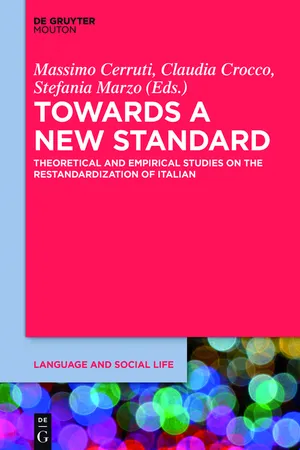
eBook - ePub
Towards a New Standard
Theoretical and Empirical Studies on the Restandardization of Italian
- 393 pages
- English
- ePUB (mobile friendly)
- Available on iOS & Android
eBook - ePub
Towards a New Standard
Theoretical and Empirical Studies on the Restandardization of Italian
About this book
Information

Part I: Restandardization tendencies
Gaetano Berruto
What is changing in Italian today? Phenomena of restandardization in syntax and morphology: an overview
Gaetano Berruto, University of Turin
Abstract: Since the 1980s, many authors have pointed out a series of phenomena involving linguistic traits that represent a somewhat new trend in the development of contemporary Italian. Most of these phenomena, which usually imply a larger amount of variation, are interpretable as a change in the sociolinguistic value of the trait itself. Forms and structures already existing in sub-standard Italian lost their markedness as elements of low, spoken social and situational varieties, becoming common in the usage of educated people and to a certain extent in written language, particularly in newspapers, nowadays an important vehicle of standardization. A few further phenomena represent cases of true innovation, mainly influenced by contact with English. On the whole, a partially renewed norm of Italian, a neo-standard Italian, has emerged.
This chapter aims at discussing some aspects of this restandardization on the background of the present sociolinguistic situation of Italy, and giving an overall picture of their main morpho-syntactic phenomena. A commented list of features involved in that dynamics will be provided, serving as a frame of reference for other chapters of the volume. The list includes amongst other things: left and right dislocation; restructuration in pronominal system; various dynamics in the use of verb forms; overextension of the complementizer che [‘that’]; formation of new syntactic patterns (as an interrogative wh-clause with a double focus or an ordinal relative superlative); diffusion of prefixation with formatives such as super-, iper-, mega-, euro-, -poli. Some phenomena pertaining to the “linguistic custom” will also be considered, e.g. the grammaticalization of tipo [‘like’] as an adverb.
Keywords: standard Italian, restandardization, syntax, lexicon, word formation
1What is neo-standard Italian?
Neo-standard Italian is one of the expressions used by linguists since the end of the 1980s to refer to a partially renewed standard norm of the Italian language. Here, norm is basically to be understood in the Coserian, statistical, social, and not in the prescriptive sense, i.e. not explicitly codified by institutions or codices (Ammon 1986: 42–50, 2003; cf. also Auer and Spiekermann 2011). This new social norm, representing the shape of the Italian language as it is normally spoken and written by fluent, educated speakers today, mainly consists of a series of phenomena involving linguistic traits which characterize a somewhat new trend in the development of modern Italian.
Most of these phenomena, which usually imply a considerable degree of variation, are interpretable as a change in the sociolinguistic value of the traits themselves. Only a small number of phenomena can be considered cases of true innovation. Forms and structures already existing in sub-standard Italian8 lose their markedness as elements characterizing low, only spoken, social and situational varieties, becoming, at least to a certain extent, common also in the usage of educated people and in written language (particularly by the newspapers, an important vehicle of standardization today). Such a shift in the sociolinguistic position of linguistic items is altogether analogous to the well-known process that, in historical linguistics, is often called “markedness shift”.
The interaction of several sociolinguistic facts forms the background of the rising of such a partially new norm. First of all, under the pressure of various sociocultural and socio-economic factors, between 1950 and 1980 (De Mauro 2014), the national language has gained more and more domains of use to the detriment of the many Italo-Romance and non Italo-Romance dialects existing in the linguistic landscape of Italy, and a large number of people have shifted from a dialect, their vernacular variety, to Italian as the language usually employed in all domains and classes of uses, even in ordinary conversation. For most Italian people born in these decades, and a fortiori later, Italian was their language of primary socialization, i.e. their real mother tongue.9 Such a “nativization” of Italian is unprecedented and is bound to be reflected in the shaping of the language norm. Analogous reshaping effects originate in the extension of the use of Italian to most informal domains, as well as in the rise and quick spreading of new, mostly speech-oriented domains (e.g. computer mediated communication). In sum, these social phenomena have fostered a restandardization of Italian towards a new standard norm.
The term italiano neo-standard was used by Berruto (2012a [1987]: 27) for indicating a set of features that, in comparison to the traditional literary standard, called in the same work ‘ancien régime standard’, consists in “un abbassamento e un consolidamento della nuova norma, leggermente variata in diatopia, più vicina al parlato in diamesia, e più prossima agli stili non aulico-burocratici in diafasia” [‘a lowering and a consolidation of the new norm, regionally slightly varied, closer to the spoken varieties and to the non-learned and non-bureaucratic styles’]. Other expressions employed in the 1980s for designating this new entity in the range of varieties of Italian were italiano dell’uso medio parlato e scritto (lit. ‘Italian of average spoken and written usage’, i.e. Italian as commonly employed, by educated people, in neither particularly formal, nor particularly informal situations; Sabatini 1985), and italiano tendenziale (lit. ‘tendential Italian’, Mioni 1983), the latter term focusing on the character of change-in-progress of the phenomenon. Another expression employed for referring to the dynamic of significant linguistic features observed in present-day standard Italian was italiano in movimento (‘moving Italian’, ‘Italian on the move’), which also emphasizes inherent aspects of language change. Later, Lepschy (2002: 66) simply named “ordinary Italian” a variety with seemingly much in common with what we have termed neo-standard Italian: “modern ordinary Italian can actually be defined as the language used by Italians, who often are not native speakers of a dialect and also may not be competent users of the literary idiom”.
The existence of such a new variety is not uncontroversial among Italian linguists. A certain perplexity towards its acknowledgement was manifested especially by some historians of the Italian language. Castellani (1991) e.g. pointed out that none of the set of linguistic features representing the so-called italiano dell’uso medio was really new to the structure of Italian.10 This is essentially true; but what matters here is the change in the sociolinguistic characterization of existing forms and structures, rather than the rise or introduction of totally new forms and structures so far inexistent in Italian. However, the notion of neo-standard Italian has gained in importance and is today largely agreed upon in Italian linguistics (cf. for instance D’Achille 2003, 2010, 2012; Antonelli 2011).
2Restandardization in Italian
Restandardization (German Umstandardisierung, Mattheier 1997) is a somewhat unusual term in Romance sociolinguistics, but since Berruto (1987) it is increasingly used in recent work in Italian linguistics. Recently, after observing that “il concetto di ‘ristandardizzazione’ è finora poco usato in linguistica” [‘the concept of ‘restandardization’ has so far been little used in linguistics’], Koch (2014: 91–92) states that it corresponds perfectly to the Italian scenario in the last decades. Koch understands the present restandardization in terms of “distance” (Distanz) vs. “immediacy” (Nähe): the new standard is the outcome of an adaptation of the old standard, traditionally more oriented towards the typical written varieties of distance, to the spoken varieties of immediacy, i.e. implying a widespread acceptation of features proper to typically spoken varieties (Koch 2014: 92).
Some authors (for instance Radtke 2000) prefer to capture the same state of affairs under the term “destandardization”, emphasizing its inherent aspects of “debuilding” of a fixed standard norm and the strengthening of various regional standards to a certain extent, as opposed to a unitary national standard. The concept of destandardization, however, does not correspond fully to what has happened to Italian since approximately 1970 as the term is used normally “to refer to a possible development whereby the established standard language loses its position as the one and only ‘best language’” (Coupland and Kristiansen 2011: 28).
According to Auer and Spiekermann (2011: 164–165), “standardness” of a language variety can mean at least three different things: a. to be a common language, valid across a whole territory in which also other non-standard varieties are spoken; b. to be taught in school and used for writing and in formal public domains, having (therefore) official prestige; c. to be codified. Destandardization would correspondingly mean that: a. there are regions within the territory roofed by a standard in which other competing standard varieties have established themselves; or b. the standard variety loses official prestige; or c. the standard variety reduces its degree of codification and increases in variability, accepting regional and former sub-standard features as norm-conforming. Now, neither the general sense of the term “destandardization”, nor...
Table of contents
- Cover
- Title
- Copyright
- Contents
- Preface
- Notes on Contributors
- List of Figures
- List of Tables
- Introduction
- Part I: Restandardization tendencies
- Part II: Regional standards
- Part III: Crossing the borders
- Epilogue
- Index
Trusted by 375,005 students
Access to over 1.5 million titles for a fair monthly price.
Study more efficiently using our study tools.
Frequently asked questions
Yes, you can cancel anytime from the Subscription tab in your account settings on the Perlego website. Your subscription will stay active until the end of your current billing period. Learn how to cancel your subscription
No, books cannot be downloaded as external files, such as PDFs, for use outside of Perlego. However, you can download books within the Perlego app for offline reading on mobile or tablet. Learn how to download books offline
Perlego offers two plans: Essential and Complete
- Essential is ideal for learners and professionals who enjoy exploring a wide range of subjects. Access the Essential Library with 800,000+ trusted titles and best-sellers across business, personal growth, and the humanities. Includes unlimited reading time and Standard Read Aloud voice.
- Complete: Perfect for advanced learners and researchers needing full, unrestricted access. Unlock 1.5M+ books across hundreds of subjects, including academic and specialized titles. The Complete Plan also includes advanced features like Premium Read Aloud and Research Assistant.
We are an online textbook subscription service, where you can get access to an entire online library for less than the price of a single book per month. With over 1.5 million books across 990+ topics, we’ve got you covered! Learn about our mission
Look out for the read-aloud symbol on your next book to see if you can listen to it. The read-aloud tool reads text aloud for you, highlighting the text as it is being read. You can pause it, speed it up and slow it down. Learn more about Read Aloud
Yes! You can use the Perlego app on both iOS and Android devices to read anytime, anywhere — even offline. Perfect for commutes or when you’re on the go.
Please note we cannot support devices running on iOS 13 and Android 7 or earlier. Learn more about using the app
Please note we cannot support devices running on iOS 13 and Android 7 or earlier. Learn more about using the app
Yes, you can access Towards a New Standard by Massimo Cerruti, Claudia Crocco, Stefania Marzo, Massimo Cerruti,Claudia Crocco,Stefania Marzo in PDF and/or ePUB format, as well as other popular books in Languages & Linguistics & Historical & Comparative Linguistics. We have over 1.5 million books available in our catalogue for you to explore.