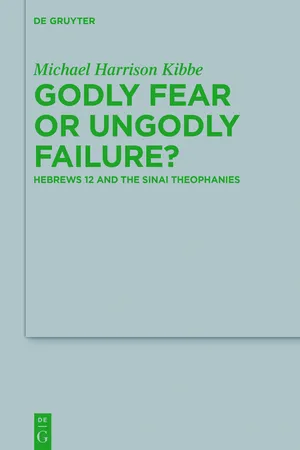
A cursory glance at Hebrews' critique of Israel's fear at Sinai in Heb 12:18-29 suggests that the author has misunderstood or manipulated his sources. In the Pentateuch, the appointment of Moses as Israel's mediator receives explicit approval (Exod 19:9; Deut 5:28), while Heb 12:25 labels their request for mediation a "refusal" to heed the word of God. This book argues that Hebrews' use of the Sinai narratives resides on a complex trajectory established by four points: the Sinai covenant according to Exodus, the reenactment of that covenant according to Deuteronomy, the call for a NEW covenant according to Jeremiah, and the present reality of that covenant established by God and mediated by Jesus Christ.
The basis for Hebrews' critique arises from its insight that while Israel's request established covenant-from-a-distance, Jesus demonstrates that true covenant mediation brings two parties into a single space. The purpose for Hebrews critique lies in its summons to Zion, the mountain on which Jesus sits at the right hand of God as the high priestly mediator of the new covenant.
- 296 pages
- English
- ePUB (mobile friendly)
- Available on iOS & Android
eBook - ePub
About this book
Information
1.Moses feared and Israel Fled: The Sinai Theophany According to Hebrews
The impetus for this project can be stated rather simply: Hebrews 12 draws upon Exodus and Deuteronomy to paint a picture of Israel’s response to the Sinai theophany, but appears to disagree with them regarding the validity of that response. For Exodus and Deuteronomy, Israel’s request for Mosaic mediation is a highlight of the event—Israel promises to obey the one whom God had already appointed to be his spokesman to them (Exod 19:9, 20:18–20; Deut 5:28).1 For Hebrews, on the other hand, Israel’s request was a “refusal” to listen to God that led to inevitable judgment (12:19, 25).
We may respond that Hebrews simply disagrees with Exodus and Deuteronomy, and therein find an end to our inquiry,2 but the care with which Hebrews engages its Septuagintal text elsewhere makes such an abrupt end to the conversation less than satisfying.3 At the very least, if Hebrews disagrees with its Pentateuchal counterparts, there must be a reason why it does so. Then again, the reason for Hebrews’ interpretation of the OT is always relevant; Hebrews’ use of Scripture may be described in many and various ways, but “arbitrary” is not among them. Whatever our solution to the problem posed above, we cannot avoid the “why?” question—why has Hebrews chosen this moment in Israel’s history as his climactic illustration of covenant unfaithfulness? Earlier references to Kadesh Barnea (Numbers 14; Heb 3:7–4:11) make perfect sense, as do the numerous references to Deuteronomy 32 (esp. Heb 10:26–31), in which God testifies to Israel’s inevitable idolatry and judgment. Israel’s request for a mediator, on the other hand, is hardly an obvious foil for Hebrews.
We are faced, therefore, with a set of questions. First, does Hebrews actually criticize Israel’s response to the Sinai theophany? Second, do Exodus and Deuteronomy uphold Israel’s request as an appropriate demonstration of fear of YHWH and faith in Moses (as is usually thought to be the case)? Third, how does Hebrews’ interpretation of this event compare to those of its contemporaries? In these explorations we seek our answer to the “what” question: on what basis does Hebrews present Israel’s fearful response in the way that it does? Finally, we return to the “why” questions: why does the Sinai event appear at this point in Hebrews’ argument? Why does the author of Hebrews warn his audience away from imitating Israel’s withdrawal in such strong terms?
1.1.Outline and Thesis
The chapters that follow answer these questions in order. In this introductory chapter I address challenges to the consensus that Hebrews criticizes Israel’s request and explain why we must continue to see that it does so.4 In Chapters Two and Three I argue that while Exodus evaluates Israel’s request in entirely positive terms, Deuteronomy offers a mixed report. Israel responded correctly insofar as their fear (a critical element of Deuteronomic obedience) established the mediatorial role of Moses and his successors (Deut 5:28; 18:15–18), but the speed with which that fear turns to failure in the golden calf incident and Kadesh Barnea (not to mention their inevitable idolatry once in the land) is a cue that this system of covenant maintenance will ultimately fall short (Deut 5:29). This is not explicit disapproval of the initial request, but it opens the door just enough for Hebrews to gain a toehold for its criticism.
The author of Hebrews is undoubtedly a creature of his time; therefore, we need to examine reception of the Sinai texts in the Second Temple period. The LXX occupies center stage in this fourth chapter, but we must also turn to the retellings of Israel’s reaction to the Sinai theophany found in Philo, Josephus, Pseudo-Philo, and 1 Enoch, as well as other early perspectives on Sinai found in such texts as the Targumim, Samaritan Pentateuch, Jubilees, the Gospel of Matthew, and various Qumran texts. This chapter suggests that while no extant text from this era other than Hebrews explicitly criticizes Israel’s response to the theophany, the crucial ingredients that comprise Hebrews’ critique do appear in texts such as Matthew’s Gospel and Jubilees.
Chapters Five through Seven return to Hebrews. In Chapter Five, I explore Hebrews’ use of Exodus and Deuteronomy in order to ask the question “how has the audience of Hebrews been prepared, in Heb 1:1–12:17, for the claim in 12:18 that they have not come to Sinai?” I argue that Hebrews uses these texts for two primary purposes: to identify the parameters within which covenant relationship with God may take place (for example: the new covenant, like the old, requires a purified sanctuary and a mediator), and to demonstrate the shortcomings of the Sinai version of that covenant relationship. Thus the audience must come to something like Sinai, but not to Sinai itself.
Chapter Six asks the obvious follow-up question: “how has the audience been prepared, in Heb 1:1–12:17, to be informed in 12:22 that they have come to Zion?” Zion, in Hebrews, is one name among many for the heavenly dwelling place of God: it is his sanctuary, his city, his throne room, and his rest. Jesus has entered that heavenly dwelling place and taken his place of authority in the οἰκουμένη (Heb 1:6), and mediates the new covenant from there so as to enable his siblings to join him and take their places of authority in τὴν οἰκουμὲνην τὴν μέλλουσαν (Heb 2:5)—that is, in the eschatological age. To follow Jesus to Zion, therefore, is to enter the eschatological realm.
Chapter Seven returns to the central passage for this study (Heb 12:18–29) and engages more closely the “what” question (on what basis does Hebrews criticize Israel’s response at Sinai?) and the “why” question (to what end does it do so?). The answers to both questions, I argue, arise from Hebrews’ insistence that Jeremiah’s new covenant is a present reality and that Jesus perpetually mediates that covenant from Zion.
First, Jesus displays the true role of a covenant mediator: not to repeatedly traverse the distance between the covenant parties, but to bring them together. Moses, by contrast, was asked by Israel not to bring them into God’s presence, but to go into God’s presence in their place. Thus their request for a mediator was, in a sense, a refusal to do exactly what Moses ought to have brought about. Furthermore, Moses’ inability to accomplish this mediatorial task is most aptly demonstrated in Exodus and Deuteronomy through the golden calf incident. Israel made a commitment to obey Moses permanently, but the calf undermines that commitment (esp. Deut 5:29; 9:7). Hebrews, too, alludes to the calf incident (Heb 12:21//Deut 9:19) in order to color Israel’s initial withdrawal from the presence of God with their refusal to heed his voice, whether spoken directly or through Moses. Thus the basis for Hebrews’ critique, in keeping with Deuteronomy, is the fact that Israel’s request for a mediator is analogous to the calf incident insofar as in both cases Israel pursues covenant proximity with someone other than God himself.
Second, the seriousness of such a pursuit lies in the fact that proximity to God is now available in a way unthinkable to the trembling Moses (Heb 12:21): Jesus, the mediator of the covenant, calls his siblings to join him on Mount Zion. The goal of the new covenant is to draw God’s people into his presence once and for all.
Here we find an interesting irony: the inferiority of the old covenant makes it more accommodating to the sinfulness of its human participants. Sinai came with provisions for maintaining the necessary-but-not-ideal distance between God and Israel: Moses (and his successors) traverse that distance to mediate between the two, and the Levitical cultus maintains the purity of the people as well as the sacred space in which God and his people come together.
The mediator of the new covenant, unlike Moses, climbs the mountain, enters the presence of God, and stays there—not in abandonment of the people standing down below but in order to enable them to follow (e.g., Heb 4:14–16). Similarly, the blood of the new covenant has been taken into the heavenly sanctuary so as to make it a suitable covenantal arena (Heb 9:22–23), and there it remains (12:24). The point is this: a new covenant has been established whose sacred space is perpetually purified, and whose mediator sits perpetually at the right hand of God, so there is no excuse for refusing to enter God’s presence. This covenant cannot be maintained from a distance.
The old covenant also compensated for the inevitable failure of its participants to obey its stipulations by leaving room for the eventual establishment of a new covenant (the term belongs to Jeremiah 31, but its seed appears in Deuteronomy 30). Again, no such provision accompanies the new covenant: there will be no “third” covenant. Access to God and covenantal blessing are available, now and forever, only through the Son who sits enthroned in Zion. God’s people turned away from Sinai, but they have now received a new summons to Zion. Those who turn away from Zion, however, will quickly find that there is nowhere else to go. Thus the purpose of Hebrews’ critique of Israel’s response at Sinai is to exhort his audience to persevere in faith and obedience to God’s voice that speaks from Zion and beckons them to take hold of the only means by which they may join him in the “unshakable kingdom” (12:28).
1.2.Further Justification
The relative isolation of the problem addressed by this project may call into question the need for a full-length study. And some may wonder whether we need yet another book on Hebrews’ use of the OT, especially at a time in which Hebrews has taken its place alongside the gospels and the Pauline corpus in terms of scholarly production, especially regarding its use of the OT.5 Beyond the simple questions posed above, what justifies yet another project on such well-trodden ground?
First, Heb 12:18–29 remains largely unexamined despite the frequency with which it is called the “pastoral and theological climax,”6 the “grand finale,”7 and the “hermeneutical key”8 to the book.9 Hundreds of peer-reviewed publications on Hebrews have appeared in print since 2000,10 but only a handful are specifically dedicated to Heb 12:18–29 (or portions thereof),11 and only a few others contain significant discussion of this text.12 We need, therefore, further engagement with Heb 12:18–29 both in its own right and in relation to the whole epistle.
Second, thanks in large part to David M. Allen’s Deuteronomy and Exhortation in Hebrews,13 the importance of Deuteronomy for Hebrews continues to ...
Table of contents
- Cover
- Front Matter
- Title Page
- Copyright Page
- Dedication
- Abstract
- Contents
- Acknowledgements
- List of Abbreviations
- 1. Moses feared and Israel Fled: The Sinai Theophany According to Hebrews
- 2. Israel’s Response at Sinai in Exodus
- 3. Israel’s response at Sinai (Horeb) in Deuteronomy
- 4. Sinai in the Second Temple Period
- 5. Exodus, Deuteronomy, and Hebrews
- 6. A High Priestly Son and the Siblings Who Follow Him: Zion in Hebrews
- 7. The Calf and the Covenant: Hebrews 12:18–29
- 8. Conclusion
- Bibliography
- Index of Ancient Texts
- Fußnoten
Trusted by 375,005 students
Access to over 1.5 million titles for a fair monthly price.
Study more efficiently using our study tools.
Frequently asked questions
Yes, you can cancel anytime from the Subscription tab in your account settings on the Perlego website. Your subscription will stay active until the end of your current billing period. Learn how to cancel your subscription
No, books cannot be downloaded as external files, such as PDFs, for use outside of Perlego. However, you can download books within the Perlego app for offline reading on mobile or tablet. Learn how to download books offline
Perlego offers two plans: Essential and Complete
- Essential is ideal for learners and professionals who enjoy exploring a wide range of subjects. Access the Essential Library with 800,000+ trusted titles and best-sellers across business, personal growth, and the humanities. Includes unlimited reading time and Standard Read Aloud voice.
- Complete: Perfect for advanced learners and researchers needing full, unrestricted access. Unlock 1.5M+ books across hundreds of subjects, including academic and specialized titles. The Complete Plan also includes advanced features like Premium Read Aloud and Research Assistant.
We are an online textbook subscription service, where you can get access to an entire online library for less than the price of a single book per month. With over 1.5 million books across 990+ topics, we’ve got you covered! Learn about our mission
Look out for the read-aloud symbol on your next book to see if you can listen to it. The read-aloud tool reads text aloud for you, highlighting the text as it is being read. You can pause it, speed it up and slow it down. Learn more about Read Aloud
Yes! You can use the Perlego app on both iOS and Android devices to read anytime, anywhere — even offline. Perfect for commutes or when you’re on the go.
Please note we cannot support devices running on iOS 13 and Android 7 or earlier. Learn more about using the app
Please note we cannot support devices running on iOS 13 and Android 7 or earlier. Learn more about using the app
Yes, you can access Godly Fear or Ungodly Failure? by Michael Kibbe in PDF and/or ePUB format, as well as other popular books in Théologie et religion & Critique et interprétation bibliques. We have over 1.5 million books available in our catalogue for you to explore.