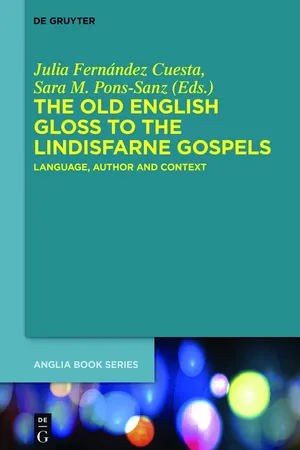
eBook - ePub
The Old English Gloss to the Lindisfarne Gospels
Language, Author and Context
- 444 pages
- English
- ePUB (mobile friendly)
- Available on iOS & Android
eBook - ePub
The Old English Gloss to the Lindisfarne Gospels
Language, Author and Context
About this book
No detailed description available for "The Old English Gloss to the Lindisfarne Gospels".
Information

Part I: The Gloss in Context
Michelle P. Brown
‘A Good Woman’s Son’: Aspects of Aldred’s Agenda in Glossing the Lindisfarne Gospels
Abstract: This paper examines Aldred’s gloss and colophon from the perspective of how his work is to be situated in relation to the Lindisfarne Gospels’ original manufacture and its subsequent role as a focal point of the cult of St. Cuthbert. Aldred’s motivation in ‘completing’ the work and the cultural and political circumstances in which he was operating are discussed, as is his role in establishing the credentials and credibility of the English vernacular as a suitable medium for transmitting Scripture and consolidating cultural cohesion. Aldred, the community of St. Cuthbert, the cult and cult book emerge as key components in attempts to forge a united nation, whilst acknowledging the crucial role of northern England within it.
1The making of the Lindisfarne Gospels, community tradition and Aldred’s place within it
I have previously suggested that, at the time that the Lindisfarne Gospels was made, it was thought in ecclesiastical circles that the scribe could become a channel between God and humanity, like the evangelists themselves (Brown 2003 and 2011a). Writing and painting sacred texts were absorbing acts of meditation, during which the scribe might glimpse the divine. Our artist-scribe undertook his physically and intellectually demanding labours on behalf of all Creation as a hermit, the book becoming his ‘desert’, like Christ in the wilderness and Cuthbert on Inner Farne. Cassiodorus said that each word written was a wound on Satan’s body. This was the spiritual front-line. Such was the tradition within which Aldred was placing himself when he glossed the Lindisfarne Gospels and commemorated his contribution, along with that of others who had laboured on the book previously, in a colophon.
Remarkably, the initial manufacture of this complex book was, essentially, the work of one outstandingly gifted, committed individual. For those dedicated to God’s service, to be entrusted with the transmission of his Word, as preachers and scribes, was amongst the highest of callings. A few Insular Gospel books, notably the Lindisfarne and MacRegol Gospels, are remarkable amongst western tomes in being by single artist-scribes – a primarily eastern phenomenon (Brown 2003, 2006, 2011a and forthcoming a; Rapp 2007). Undertaking such an heroic feat of patience alongside the monastic duties of the Divine Office (celebrated eight times each day and night), prayer, study, and manual labour, suggests that making the Lindisfarne Gospels may have taken closer to five years, depending on how much exemption was granted from other duties, such as that accorded to anchorites. For if, as I have proposed, Bishop Eadfrith of Lindisfarne (698–722) both conceived the vision for its great Gospel book and physically made it himself around 715–720, overseeing one of the largest dioceses in Britain, embracing much of northern England and southern Scotland, would have made such work additionally challenging. Some of the back aching, eye straining work was probably undertaken on ‘Cuddy’s Isle’, a windswept tidal islet near the monastery on Holy Island, where during Lent and Advent the bishop retired on retreat – a wild northern wilderness (Burns 1969; Cramp 1981; Brown 2003). Combining fasting, study and copying during Lent was a practice also favoured by Byzantine churchmen, as recounted in the vitae of Euthymius, patriarch o...
Table of contents
- Cover
- Title Page
- Copyright
- Contents
- Acknowledgements
- Abbreviations
- Editorial conventions
- Illustrations
- Introduction
- Part I: The Gloss in Context
- Part II: The Language of the Gloss
- Part III: Glossing Practice
- References
- Index
- Footnotes
Trusted by 375,005 students
Access to over 1.5 million titles for a fair monthly price.
Study more efficiently using our study tools.
Frequently asked questions
Yes, you can cancel anytime from the Subscription tab in your account settings on the Perlego website. Your subscription will stay active until the end of your current billing period. Learn how to cancel your subscription
No, books cannot be downloaded as external files, such as PDFs, for use outside of Perlego. However, you can download books within the Perlego app for offline reading on mobile or tablet. Learn how to download books offline
We are an online textbook subscription service, where you can get access to an entire online library for less than the price of a single book per month. With over 1.5 million books across 990+ topics, we’ve got you covered! Learn about our mission
Look out for the read-aloud symbol on your next book to see if you can listen to it. The read-aloud tool reads text aloud for you, highlighting the text as it is being read. You can pause it, speed it up and slow it down. Learn more about Read Aloud
Yes! You can use the Perlego app on both iOS and Android devices to read anytime, anywhere — even offline. Perfect for commutes or when you’re on the go.
Please note we cannot support devices running on iOS 13 and Android 7 or earlier. Learn more about using the app
Please note we cannot support devices running on iOS 13 and Android 7 or earlier. Learn more about using the app
Yes, you can access The Old English Gloss to the Lindisfarne Gospels by Julia Fernández Cuesta,Sara M. Pons-Sanz in PDF and/or ePUB format, as well as other popular books in Literatura & Idiomas. We have over 1.5 million books available in our catalogue for you to explore.