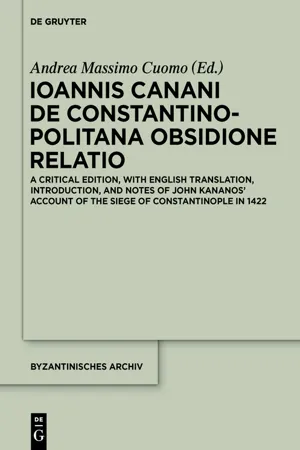
This volume fills the need for a new critical edition and linguistic study of John Kananos' account of the siege of Constantinople in 1422. New research on the manuscripts has produced a new stemma codicum and shown that the oldest witness of this narrative, Vat. gr. 579 (ff. 355r - 364v), was written in Constantinople and belonged to the prolific scribe Phlamules Kontostephanos, who also provided the copy with a title in which the name of John Kananos is mentioned for the first time. The philological approach adopted here explains contradictions among the manuscripts and Kananos' peculiar vernacularisms and reveals a surprisingly realistic and elaborate Greek. The accompanying English translation, a chapter on the language of Kananos, and a complete thesaurus make this volume a valuable contribution to the study of late Byzantine literature.
eBook - ePub
Ioannis Canani de Constantinopolitana obsidione relatio
A Critical Edition, with English Translation, Introduction, and Notes of John Kananos' Account of the Siege of Constantinople in 1422
- 182 pages
- English
- ePUB (mobile friendly)
- Available on iOS & Android
eBook - ePub
Ioannis Canani de Constantinopolitana obsidione relatio
A Critical Edition, with English Translation, Introduction, and Notes of John Kananos' Account of the Siege of Constantinople in 1422
About this book
1Introduction
John Kananos1 offers a vivid eye-witness account of the first serious Turkish attempt at conquering Constantinople. The onslaught led by Murad II did not happen out of the blue; on the contrary, it represented the most striking of a series of maneuvers which the Osmans had launched against the Byzantine Empire for over a century.
In fact, when Osman (1288–1326, see EoI s.v.) came to power, a consistent and inexorable countdown to the fall of Constantinople had already begun. But it was under his son’s reign that the crisis of the Byzantine Empire reached the point of no return. These are the highlights of Urkhan’s reign (1326–1359, see EoI s.v.): 1331, siege and fall of Nikaia. 1336–1337, siege and fall of Nikomedeia and Pergamon. 1340, the Turks reach the Bosphorus. 1344–1346, alliance between John VI Kantakuzenos and Urkhan, who married John’s daughter, Theodora. 1352–1354, the Turks plunder and devastate the regions of Thrace and Macedonia. “After 1354, the Byzantine ‘Empire’ consisted of Constantinople, Thrace, Thessaloniki (which was then accessible to the Byzantines only by sea) and its immediate hinterland, the islands of the northern Aegean and the despotate of the Morea in the Peloponnese2.” 1359, the Turks are at the walls of Constantinople. They would attempt again to conquer the city once more at the end of the 14th century, under the rule of Bayazid I. 1358, the Emperor John V, father of the future emperor Manuel II (1391–1425), acknowledges the Turkish conquests in Thrace. “Raids were soon followed by the conquest of the cities: Didymoteichon, falling in 1361, Philippopolis, in 1363 and Adrianople (Edirne), in 13693.” The only counter-trend can be seen under the sultanate of Mehmed I (1413–1421), who gave Byzantium ten years’ respite.
During the reign of Bayezid I (r. 1389–1403) and during the so-called Ottoman Interregnum (1402–14134), the Byzantines faced two Turkish attacks, in 1394–1402 and in 1411 respectively5.
During these years, moreover, Byzantine emperors were obliged to pay tribute to the Ottoman Sultan. Manuel II, protagonist of the siege of 1422 alongside his son, John VIII, was even forced to follow the Sultan on campaign and became, in effect, one of his vassals. He was well aware of the Turkish danger6: “Given the city’s isolation in the midst of the Turkish territory, it was inevitable that sooner or later the Ottoman Sultans would attempt to capture it and so remove what had become an anomalous enclave within their domains7.” In a desperate attempt to save his capital, Manuel II tried everything he could. For example, he was active in diplomatic missions in the West, while he tried to establish and reinforce neighborly relationships with the Turks8.
It was within this framework of decline that Murad II (r. 1421–1451) besieged Constantinople, firmly determined to conquer it. Kananos, who must have been old enough to have experienced the two previous sieges9, does not explain the causes which led to the Turkish attack. After all, he only aims to “give an account of the extraordinarily famous miracle of the Panagia and of the Turkish attack on us and of the siege of the city”, starting from “the decisive phase of that very cruel conflict”. He also explicitly declares he would not handle “the hows, and wherefores, and whys” of the siege. After a short preface and a prologue, Kananos brings his audience directly in medias res; the opening scene presents Michal Bey and his incursions10, paving the way for the arrival of Murad II.
The opening quotation11 may indicate a critique, in which Kananos addresses the imperial policy12. There is a common belief among historians that Murad II attacked Constantinople because he wanted to take revenge on Byzantium. See for example, Bartusis (1992: 117): “When Mehmed I died in 1421, the emperors put forth the pretender Mustafa as the Byzantine candidate in the tussle for the Ottoman throne. The next year, after Mustafa was defeated and executed by Mehmet’s son Murad II, it was necessary to teach Byzantium a lesson.” And also Barker 2010: “Following the Ottoman Turkish wars of succession […], the Byzantine government enjoyed outwardly friendly relations with the victorious Sultan Mehmed I (r. 1412– 1421). Upon his death, a ‘war’ faction, led by young John VIII Palaiologos, co-emperor and regent for his aged father, Manuel II […], rashly chose to intervene in Turkish affairs. Disdaining the legal successor, Murad II […], John backed a rival claimant to the Ottoman throne. However, John misjudged both the ungrateful pretender and the formidable young Sultan. In January 1420 Murad brought his forces against the pretender, who was quickly suppressed. Now would avenge himself on Byzantium by attacking the great city of Constantinople.”
This thesis appears in HistTurk (59,36) and Dukas (27,7; 28,1–2) as well. The latter extensively narrates the Byzantine interference in the Turkish Wars of Succession. When Dukas recounts the death of Mustafa, the pretender to the throne of Murad who was executed by hanging as a common criminal, he reports that Murad wanted to convince his people “that 〈Mustafa〉 was not Bayezid’s son, and therefore a descendant of Othman, but an impostor created by Emperor Manuel Palaiologos13.”
As we have seen, Kananos’ account focuses on the final phase of the siege and on the liberation of the city at the hands of the Mother of God. Nevertheless, Kananos narrates with great accuracy, the arrival of the Turkish vanguard and its plundering force on June 10, as well as the appearance of Murad II with the greater part of the army, about 10,000 men, ten days later. Generally, we can consider John Kananos to be one of the most reliable and interesting sources of the Constantinopolitan siege in 1422. In the following pages, we will look more closely at the value of his historical account, and to compare it with other Greek sources.
The siege lasted from June until the end of August; the blockade was only broken when Murad II had to subdue a revolt caused by a pretender to the throne14. That is not, of course, the cause described by Kananos, who ascribes the victory of the Romans solely to the miraculous intervention of the Mother of God15. The special protection of God and of the Virgin Mary, which Constantinople enjoyed in 1422, was also echoed in later accounts, such as those by Sphrantzes, ChronMioni nr. 39 and by Pero Tafur16; as well as in ChronBrev17.
Before sketching Kananos’ profile and analyzing the historical and literary value of his account later in this chapter, I briefly describe the manuscript witnesses and explain how I edited Kananos’ Diegesis.
2The Manuscript Tradition and Ratio Edendi
The text of Ioannes Kananos’s Diegesis, which I present here, is essentially based on the oldest copy of the Διήγησις, which is preserved in the Vaticanus graecus 579 ff. 355r–364v (hereafter Vaticanus or V). In fact, the other two surviving manuscripts of Kananos’ narrative (in)directly descend from V, namely, the Neapolitanus III B 26, ff. 1r–10r (hereafter Neapolitanus or N), written by Alexandros Laskaris18 in Rome in the milieu of the Collegio Greco between the end of the 16th and the beginning of the 17th century and the Vallicellianus ms. Allacci CIX, dossier number 19, ff. 196r– 200v (hereafter Vallicellianus or A), written by Leon Allatios shortly after the Neapolitanus, in the same cultural context. The latter is the direct apographon of N.
In this chapter, I firstly describe the three manuscripts and their relationships. Then I demonstrate that the best text of Kananos has been transmitted by V. In addition, I elucidate the criteria I followed in preparing my edition and in presenting the critical text. I focus particularly on the problems of editing vernacular texts and explain why I have opted for being a conservative editor, declining to ‘standardize’ and ‘classicize’ Kananos’ use of Greek.
Later in this chapter, I also illustrate why I set the punctuation according to the Dionysian rules – which are the same rules followed by Kananos and the scribe of V – and how this system works. Additionally, I describe how I designed the apparatus of the references and the apparatus criticus. This gives me the opportunity to focus on intra- and intertextuality in Kananos’ account. I am aware that this information is usually found in its own chapter – maybe entitled something like ‘The Author’s Library’ – but I prefer to deal with those issues at that point, when I describe the apparatus locorum comparandorum.
2.1The Manuscripts
2.1.1Vaticanus graecus 579 fols. 355r – 364v = Vaticanus = V
The oldest copy of Kananos’ Diegesis is now preserved in the miscellaneous manuscript V19. More precisely, it is about a binio, 2 × 2, fols. 355–358, and a quaternio, 3 × 4 fols. 359–36520. There is not any direct evidence that the present composition of the quires is original; an invasive restoration of the manuscript under the papacy of Pius IX not only provided the entire manuscripts with a new binding but also pruned the margins of several folios, maybe even cutting out any trace of original numbering of the quires21. Although we can detect Greek crosses in the upper margins of fols. 356r, 359r, 362r and 365r, they do not seem to indicate anything. However, the position of the Diegesis within the miscellaneous Vatican manuscript (i.e. the penultimate quire of V) seems not to have changed throughout the centuries.
Watermarks are detectable on fols. 356–357; 359–364; 360–363; but it is very hard to sketch them precisely. The example on fol. 356, nevertheless, is very similar to “Fleur 118” of Harlfinger 1978 (a. 1425 in the codex Marc. gr. Z 575 [= 849]; scribe: Nikolaos Phagi...
Table of contents
- Cover
- Titelseite
- Impressum
- Dedication
- Foreword
- Inhaltsverzeichnis
- Works cited in abbreviation
- 1 Introduction
- 2 The Manuscript Tradition and Ratio Edendi
- Critical edition and English translation
- Thesaurus
- Fußnoten
Trusted by 375,005 students
Access to over 1.5 million titles for a fair monthly price.
Study more efficiently using our study tools.
Information
Publisher
De GruyterYear
2016Topic
HistoryPrint ISBN
9781501510908
Subtopic
Ancient HistoryeBook ISBN
9781501502903
Index
HistoryFrequently asked questions
Yes, you can cancel anytime from the Subscription tab in your account settings on the Perlego website. Your subscription will stay active until the end of your current billing period. Learn how to cancel your subscription
No, books cannot be downloaded as external files, such as PDFs, for use outside of Perlego. However, you can download books within the Perlego app for offline reading on mobile or tablet. Learn how to download books offline
Perlego offers two plans: Essential and Complete
- Essential is ideal for learners and professionals who enjoy exploring a wide range of subjects. Access the Essential Library with 800,000+ trusted titles and best-sellers across business, personal growth, and the humanities. Includes unlimited reading time and Standard Read Aloud voice.
- Complete: Perfect for advanced learners and researchers needing full, unrestricted access. Unlock 1.5M+ books across hundreds of subjects, including academic and specialized titles. The Complete Plan also includes advanced features like Premium Read Aloud and Research Assistant.
We are an online textbook subscription service, where you can get access to an entire online library for less than the price of a single book per month. With over 1.5 million books across 990+ topics, we’ve got you covered! Learn about our mission
Look out for the read-aloud symbol on your next book to see if you can listen to it. The read-aloud tool reads text aloud for you, highlighting the text as it is being read. You can pause it, speed it up and slow it down. Learn more about Read Aloud
Yes! You can use the Perlego app on both iOS and Android devices to read anytime, anywhere — even offline. Perfect for commutes or when you’re on the go.
Please note we cannot support devices running on iOS 13 and Android 7 or earlier. Learn more about using the app
Please note we cannot support devices running on iOS 13 and Android 7 or earlier. Learn more about using the app
Yes, you can access Ioannis Canani de Constantinopolitana obsidione relatio by Andrea Massimo Cuomo in PDF and/or ePUB format, as well as other popular books in History & Ancient History. We have over 1.5 million books available in our catalogue for you to explore.