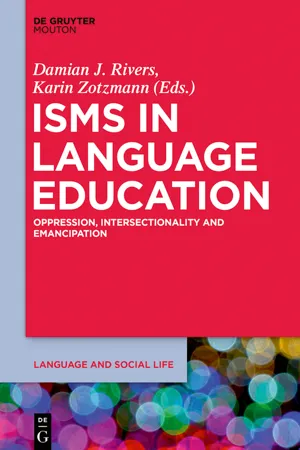
This volume develops a comprehensive understanding of the manner in which dominant/emergent ideologies, discourses and social structures impact language education. The 17 chapters analyze the complex social dynamics of "isms" within language education and detail how such dynamics influence language education pedagogies and practices, institutional policies, intergroup subjectivities in addition to language proficiency achievements.
eBook - ePub
Isms in Language Education
Oppression, Intersectionality and Emancipation
- 282 pages
- English
- ePUB (mobile friendly)
- Available on iOS & Android
eBook - ePub
Isms in Language Education
Oppression, Intersectionality and Emancipation
About this book
Information
Subtopic
Teaching Language ArtsCynthia D. Nelson
1The -isms as interpretive prisms: A pedagogically useful concept
I don’t want people to be bigoted towards lesbians and gays or hateful towards them … Or any kind of related hatred based on race or religion or … that kind of thing. So whenever I bring topics like that up, I do hope to have people open their eyes wider and perhaps take on a more accepting or tolerant attitude.
– Paige, an English as a Second Language (ESL) teacher
The more I teach the more I don’t feel like I’m God and I can change their attitudes and I should change their attitudes.
– Jo, an ESL teacher
(Nelson, 2009: 58)
Introduction: Discussing the -isms in language classes
It has become commonplace in the language classroom to discuss social identities and social inequities, including those pertaining to “race, gender, and sexual orientation”, Canagarajah (2006: 19) contends. Language teachers are now expected to engage students in problematising these issues and developing “critical and more inclusive representations” (Canagarajah, 2006: 19). A number of studies shed light on the necessity, but also the complexities, of framing and managing such discussions effectively in the language classroom (whether face-to-face or virtual) (see, e.g., Appleby, 2010; Kubota, 2014; Kubota & Lin, 2009; Morgan, 1997; Motha, 2014; see also Luk & Lin, 2007).
In my own research (Nelson, 2009) I have found that when teachers or their students sought to incorporate sexual identities (and thus often sexual inequities) as subject matter into language pedagogies, teachers often took what I called a counseling approach, with ‘personal growth’ as the aim, or a controversies approach, which involved debating contemporary social issues. Far fewer took what I called a discourse inquiry approach, unpacking and analysing acts of language/culture, though this was the approach that I found to be most effective for language learners (Nelson, 2009; for a table summarising these three approaches, see p. 210).
Drawing on data from that study, this chapter builds on and further articulates a discourse inquiry approach. However, it diverges from my previous research in two important respects. Firstly, its main focus is -isms of oppression rather than identities, and secondly, it focuses on the -isms in general, even though most of my examples pertain to heterosexism in particular (which is still woefully under-acknowledged and under-researched; see Rhodes, this volume). Despite significant distinctions between the various social -isms, such as sexism, racism, classism and the like, my aim here is to propose a way of thinking about the -isms that has broad applications across domains of inequity.
From existing studies, it is clear that while ‘identity’ and its significance to language education have been heavily theorized, the same cannot be said for the ‘-isms’. Accordingly, developing more nuanced theoretical understandings of the -isms in/as language pedagogy is the broad aim of this chapter.
Here I ask how teachers (and, for that matter, students) are currently conceptualising the -isms and their relevance (or otherwise) to language learning; how these conceptions are informing ways of teaching about the -isms; how effective these teaching practices are at fostering learners’ language and literacy development; and what alternative conceptions of the -isms might prove more useful in the language classroom. To explore these questions I draw on learner and teacher interview data from my research into sexual identities in English language education (Nelson, 2009; see also Nelson, 2004, 2010).
To understand some of the key issues, consider the two quotes with which I opened this chapter. Although both of the teachers taught English at the same university-affiliated language programme in the United States, they had opposing views about discussing social identities and social -isms in their classes. ‘Paige’ (all names are pseudonyms) hoped that students with bigoted or hate-based attitudes would become more socially tolerant, whereas Jo did not see attitude change as her role or goal. Moreover, Paige found it “really fun” to teach these topics because her students “get really engaged” and have “very lively” discussions, whereas Jo was reluctant to broach such topics as she found them uncomfortable and feared “a lot of negative resistance” from her students (Nelson, 2009: 58).
Through my research I have found that when it comes to talking in class about social discrimination or social inequities, most language teachers align with the views of either Paige or Jo. That is, some teachers consider class discussions of social -isms to be meaningful and worthy, especially when the aim is to dissuade discriminatory acts and speech in the interest of advancing social harmony and equity, while others prefers to avoid classroom talk of the -isms, often taking the view that such topics are irrelevant to students or likely to generate too much discomfort in class.
This bifurcation of views can result in some practical dilemmas for teachers. Those who, like Paige, seek to effect change with regard to the -isms may have students who find that uncomfortable or inappropriate, while those who, like Jo, feel squeamish or hesitant about discussing the -isms in class may have students who raise these topics. In addition, many teachers, whether open to discussing the -isms or not, consider themselves ill equipped to broach the topic or to respond when a student does. Feeling underprepared is commonly reported by teachers, whether they themselves self-identify with the ‘oppressor’ group or the ‘oppressed’ group of a given social -ism; for example, teachers who self-identify as straight, as gay, or as fluid and unlabelled all report feeling unsure of how to respond when heterosexism emerges in classroom talk (albeit for different reasons) (Nelson, 2009).
Yet despite the clear contrasts between Paige and Jo, they also share something important: For both, the central concern seemed to be their students’ attitudes, opinions or feelings towards the -isms, not their students’ ability to communicate effectively or think critically in relation to the -isms. I have found this view to be common among language teachers. When social identities and social -isms arise as class topics, or when these topics are dissuaded or silenced, for many teachers the main concern seems to be their students’ feelings or views about the subject matter (or the social group in question), rather than their language and literacy development (Nelson, 2009). For example, teachers would consider an -isms lesson or discussion to be successful if no ‘negative attitudes’ were raised, or if students changed their ‘negative attitudes’ about, in this case, gay and lesbian people, to become more ‘socially tolerant’. Few teachers in my research focused on what their students were learning about language through discussion of the -isms, such as the language of communicating and decoding social identities, the language through which social inequities are reinforced or challenged, the language of silencing, the language of self-defense (when a target of oppression), and so on.
In an era when social identities and social inequities are at the forefront of public life and everyday social discourse, the contrasting-yet-congruent perspectives as exemplified in this chapter’s two opening quotes raise some important questions that warrant more scholarly attention in language education, namely:
–How are language teachers (and learners) conceptualizing the identity-related inequities – racism, heterosexism, and the like – and their place in language learning and classroom talk?
–How do teachers’ ideas about the -isms and about their ir/relevance to language learning inform their teaching practices and their perceptions of student needs and classroom dynamics?
–How do students experience learning activities that focus on, or at least touch on, the -isms, and how might such activities – or their absence – affect students’ language acquisition and learning?
–What conceptual-pedagogic tools can equip language teachers to prepare their students for negotiating inequitable communicative interactions in the classroom and beyond?
In this chapter I touch briefly on all of these questions but attempt to shed light on that last in particular. It is my contention that language education would benefit from a conceptual understanding of the social -isms that is specifically geared toward the promotion of language learning, and that is what I seek to provide in this chapter. The case I make is that it may be useful pedagogically to consider the -isms conceptually as interpretive prisms.
Having set out this chapter’s key questions and main aim in this introductory section, I turn next to theory. In order to develop the -isms-as-prisms notion, I outline some key ideas about the -isms, drawing on literature from education and higher education as well as language education and applied linguistics. Then, after briefly explaining my data collection and analysis procedures and rationale, I present some data that shows why the -isms-as-prisms notion is needed in the real-world arenas of language education. I quote nine research participants – five learners (from China, Korea, Laos, Mexico and Vietnam) studying English in tertiary-level language programmes in the US and four English language teachers (from the US) – as they reflect on, or take part in, specific class discussions of social identities/-isms (drawing on Nelson, 2004, 2009, 2010). My concluding section integrates theory and data by outlining some key features and benefits of what I am proposing here: an -isms-as-prisms approach to pedagogy.
Theorising the -isms as interpretive prisms
In this section I highlight some notions that seem especially pertinent to language education and to the pedagogic theory that I seek to build here.
In theorising the -isms, one important point is that the -isms are broadly relevant. Everyone is simultaneously both oppressed and oppressor, albeit along different axes of oppression; thus, potentially anyone is implicated in any given system of oppression, though this is experienced differently depending on one’s position or vantage point. What constitutes an -ism and how significant it is seen to be are far from universal, but vary by geographic and cultural milieu. For example, Ramanathan (2005) explains that in presenting her research on the uses of English versus vernacular languages in education in India, audiences in (or from) India are far more likely than Western audiences to perceive the salience of caste issues.
The -isms are also understood to vary by type, function, scope, and scale. With racism, for example, Kubota and Lin (2009) differentiate institutional or structural racism, which “shapes social relations, practices, and institutional structures”, from epistemological racism, which concerns knowledge practices “that privilege the European modernist white civilization”, and both types of racism from individuals beliefs and prejudices (Kubota & Lin: 6–7; see also Motha, 2014). The -isms can be understood to be operating at micro-, macro- and meta-levels (see Canagarajah, 2002) and to have spatial and scalar dimensions as well (see Blommaert, Collins and Slembrouck, 2005; see also Appleby, 2010).
What do these ideas mean for language pedagogy?
The -isms can be understood as a sort of analytic tool-kit that can yield especially rich insights when more than one interpretive lens is applied. This shifts the pedagogic focus from “states of knowledge” to “ways of knowing” (Bernstein, 1971: 57). Following Gee (1990), the pedagogic focus is not on discovering what meanings reside in spoken or written texts but how meanings are made of these texts. Crucially, people can learn to consciously identify which -ism lens they are using to interpret something through. This involves, as Kumashiro (2002: 117; italics added) has described it in his work on ‘antioppressive pedagogy’, “putting our routes of reading themselves under analysis”. An education scholar makes a pertinent point:
Encouraging analysis that doesn’t explore the interpretive frameworks on which we and our students rely is counterproductive, for it does not engage with the ways that processes of normalization work; instead, it allows the ways that knowledge is produced within a discourse community to be overlooked, thereby allowing that knowledge to function as an unquestioned or de facto norm. (Winans, 2006: 119; italics added)
In the field of language education, unlike the field of education, the focus is less on developing knowledge and questioning norms than on building learners’ capacities for effective communication in an additional language. Thus, one might ask how ‘questioning norms’ can help language learners and teachers. As Canagarajah (2006) explains, in this increasingly globalised and digitalised era: “[L]anguage norms are relative, variable, and heterogeneous. A proficient speaker of English today needs to shuttle between different communities… [R]ather than teaching rules in a normative way, we should teach strategies – creative ways to negotiate the norms operating in different contexts” (Canagarajah, 2006: 26–27).
Thus, building language proficiency these days means becoming more adept at identifying, analysing, appropriating and critiquing rules and norms pertaining to social systems, social interactions, and language systems; hence the need to be cognizant of the interpretive frameworks that one is using to read the world and through which one is being read by others. See, for example, Fujimoto’s (2010) reflective narrative about her own experiences as a sansei, a third generation Japanese-American, teaching English in Japan. She recounts how the notion of ‘perceptual frames’ helped her to adapt to a new language and culture and to cope with prejudice.
A similar point is made, albeit in a different scholarly context, by Cherryholmes (1993: 1), in a paper that illustrates different ways of reading the same research text (in his case, a widely cited journal article from education). Cherryholmes performs one feminist, one critical, and one deconstructive reading of the journal article (pointedly using ‘one’ instead of ‘a’, to indicate that his reading is in no way definitive as there could be diverse feminist readings, for instance). He makes the point that “A naïve reading is deficient in informed judgment” and if researchers “fail to develop and use a wide-ranging repertoire of reading strategies their naiveté is reinforced”.
A similar case could be made with regard to language education, namely, that unless learners develop and use a wide-ranging repertoire of interpretive strategies (whether in reading, writing, speaking or listening), their ability to make informed choices will be diminished. Or to restate this affirmatively: Developing a diverse repertoire of interpretive strategies – or ways of ‘reading’ situations, interactions and texts, in this case, those pertaining to -isms – can strengthen learners’ language capacities and learning strategies, and thus their active participation in discourse communities.
The -isms in classroom talk: Learners’ and teachers’ perspectives
...Table of contents
- Cover
- Title Page
- Copyright
- Acknowledgements
- Contents
- Contributors
- Introduction. Bringing the ISMs into focus
- 1 The -isms as interpretive prisms: A pedagogically useful concept
- 2 Intersectionality from a critical realist perspective: A case study of Mexican teachers of English
- 3 Elitism in language learning in the UK
- 4 Native-speakerism and the betrayal of the native speaker language-teaching professional
- 5 Against ethnocentrism and toward translanguaging in literacy and English education
- 6 Cutting across the ideological split of capitalism/communism: Shcherba’s insights on foreign language education
- 7 Methodism versus teacher agency in TESOL
- 8 Academicism in language: “A Shelob’s web that devours and kills from inside”
- 9 Scientism as a linchpin of oppressing isms in language education research
- 10 Languaging and isms of reinforced boundaries across settings: Multidisciplinary ethnographical explorations
- 11 Heterosexism: A pedagogy of homophobic oppression
- 12 Occidental romanticism and English language education
- Index
- Addresses
Trusted by 375,005 students
Access to over 1.5 million titles for a fair monthly price.
Study more efficiently using our study tools.
Frequently asked questions
Yes, you can cancel anytime from the Subscription tab in your account settings on the Perlego website. Your subscription will stay active until the end of your current billing period. Learn how to cancel your subscription
No, books cannot be downloaded as external files, such as PDFs, for use outside of Perlego. However, you can download books within the Perlego app for offline reading on mobile or tablet. Learn how to download books offline
Perlego offers two plans: Essential and Complete
- Essential is ideal for learners and professionals who enjoy exploring a wide range of subjects. Access the Essential Library with 800,000+ trusted titles and best-sellers across business, personal growth, and the humanities. Includes unlimited reading time and Standard Read Aloud voice.
- Complete: Perfect for advanced learners and researchers needing full, unrestricted access. Unlock 1.5M+ books across hundreds of subjects, including academic and specialized titles. The Complete Plan also includes advanced features like Premium Read Aloud and Research Assistant.
We are an online textbook subscription service, where you can get access to an entire online library for less than the price of a single book per month. With over 1.5 million books across 990+ topics, we’ve got you covered! Learn about our mission
Look out for the read-aloud symbol on your next book to see if you can listen to it. The read-aloud tool reads text aloud for you, highlighting the text as it is being read. You can pause it, speed it up and slow it down. Learn more about Read Aloud
Yes! You can use the Perlego app on both iOS and Android devices to read anytime, anywhere — even offline. Perfect for commutes or when you’re on the go.
Please note we cannot support devices running on iOS 13 and Android 7 or earlier. Learn more about using the app
Please note we cannot support devices running on iOS 13 and Android 7 or earlier. Learn more about using the app
Yes, you can access Isms in Language Education by Damian J. Rivers, Karin Zotzmann, Damian J. Rivers,Karin Zotzmann in PDF and/or ePUB format, as well as other popular books in Languages & Linguistics & Teaching Language Arts. We have over 1.5 million books available in our catalogue for you to explore.