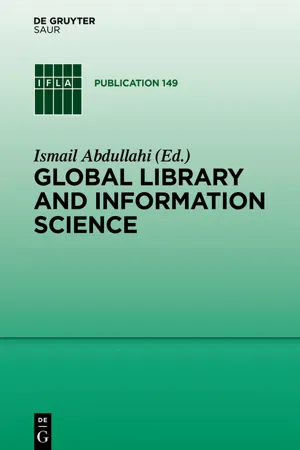
This 2nd edition of the highly successful Global Library and Information Science presents an up-to-date review of international librarianship and library science through insightful and well written chapters contributed by experts and scholars from all regions of the world. The role of public, academic, special, school libraries, as well as library and information science education are presented from the early development to the present time. Its lively, readable approach will help the reader to understand librarianship in Africa, Asia, Australia and New Zealand, Europe, Latin America and the Caribbean, and North America.
Edited by Ismail Abdullahi, Professor of Global Library and Information Science, this book is a must-read by library science students and teachers, librarians, and anyone interested in Global Librarianship.
- 729 pages
- English
- ePUB (mobile friendly)
- Available on iOS & Android
eBook - ePub
Global Library and Information Science
About this book
Information

Part 1:Africa
Dennis Ocholla
1Introduction
Africa is the second largest continent in land size and the first in terms of the number of nations in the world, with 54 independent countries and a population of approximately 1.24 billion people,1 but also the poorest in economical terms. Most African countries only received their political independence from colonialists (France, Britain, and Portugal) during the second decade of the 20th century. It is therefore not surprising that libraries in Africa have always tended to serve the privileged, i.e. the colonialists during the colonial period, and the educated, and economically sated urban “settlers” of the present. According to my knowledge and observation that is perhaps also shared by others, the view of library services is based on the assumption that library users know how to read and write, or are functionally literate in at least a non-African language (such as English, French, Portuguese), reside in urban areas (where they are closer to the library), and are aware of what the library provides even if the content is not relevant to their needs. A 2007 speech by Pallo Jordan, Minister of Arts and Culture South Africa, painted a bleak picture of literacy in South Africa thus: “51% of South Africans have no books in their homes. A mere 14% of the population read books and only 5% of these read to their children” (Jordan 2007). This situation changed only slightly today. Pallo Jordan’s speech hinges on human rights, particularly freedom of access to information, which is hindered by cultural and social marginalization through illiteracy. Yet even though colonial ideas still dictate literacy in the form of reading and writing, oral traditions still co-exist with modern knowledge acquisition, storage, dissemination and sharing before, during and post colonial rule amongst most of the African populace. These oral traditions have not been sufficiently exploited in combination with modern technologies in attempts to make libraries more relevant to those who are destitute or marginalized in their own countries due to political, economic, social and technological deprivation. The marginalized include rural people who are often geographically isolated because of poor communication and transportation systems; those disadvantaged by cultural and social poverty and deprivation, especially the illiterate; the elderly, women, and children; those who are discriminated against because of their race, ethnicity, creed or religion; and the physically disabled. Oral traditions require librarians to involve knowledgeable community members, for example by scheduling a “speakers’ day” in the library to enable community knowledge holders to share their experiences with active and potential library users, or providing multimedia forums that showcase the visual and performing arts together with textual media. The chapters in this publication focus on academic, public and school libraries and LIS research, education and training in Africa. Fundamentally, information access and information literacy are critical to ensure library development in Africa occurs in order for libraries to fulfil their social role, which is to inform, entertain, enlighten, educate, entertain ,empower and equip individuals and communities with knowledge and information for lifelong learning. Thus, libraries inadvertently enable individuals to fulfil their social roles and obligations in society knowingly and responsibly.
Academic libraries are relatively better equipped and resourced than other libraries in Africa. Their establishment and development is growing because academic institutions or Higher Education Institutions (HEIs) in most African countries are compelled by their governments to establish libraries and maintain them as a requirement for accreditation. Beyond this, HEIs have been left alone to equip the libraries as they wish with a fraction of the subsidization they receive from government or other affiliations, and there is therefore significant variation in their development and growth, both in quantity and quality. For example, South African university libraries seem to quite well established and supported by government (Sengoor 2015) which makes them unique in terms of resource and access support. While there is a general consensus in many studies that academic libraries in Africa do not have a staffing problem, most studies agree with the problems identified in a study on the status of academic libraries in Africa by Rosenberg (1997). The study revealed that libraries are poorly funded with budgets that are either non-existent, declining or rarely honoured; collection development is often either minimal or non existent; there is too much expenditure on staff (some libraries are overstaffed) at the expense of acquisitions; there is over dependence on (foreign) external funding, which is sometimes estimated to be as high as 90–100% in some libraries; ICTs aren’t sufficiently utilized and networks suffer poor connectivity; and resource sharing is not a common practice. Reggie Raju and Jaya Raju, both from the University of Cape Town, discuss the issues and challenges of academic libraries in the first chapter, and while agreeing with studies focusing on this library category, they ponder a conceptual question thus “Does the African academic library have the capacity in terms of resources (information and physical) and relevantly skilled librarians, to provide the necessary support for the teaching and learning and, research agenda of a 21st-century university?” The answer to this question points to the challenges of academic libraries in Africa noted by Rosenberg (1997) almost two decades ago. Reggie and Jaya note political instability and, economic and social challenges (which includes transformation of higher education in Africa and the incorporation of the decolonialization of the curriculum); poor information resources – “woefully inadequate and deteriorating”, dilapidated spaces; poor IT infrastructure; limited confidence in the library to support its parent institution to embrace collaborative learning; access to the world’s open-access knowledge is a challenge as the IT infrastructure is inadequate and lack of funding. While the authors acknowledge that not all academic libraries in Africa are the same as some are well resourced and provide adequate services, more work is required to improve access to information through technology support, improvement of facility, knowledge sharing, income generation (e.g., fund raising), celebration of excellence and role models, funding, provision of new services (such as bibliometric services, RDM services, self-directed learning services, research landscape analysis and relatively in-depth open-access services is testimony to a strong library programme) and note that some of the services that South African libraries provide with regard to open access can be considered world class. They ponder the last question that is how do we distribute “relevant skills for Africa as a continent to benefit from these innovations”.
Most public libraries in Africa play a dual role as public libraries and national libraries, with the exception of countries such as South Africa where the two types of libraries are separate. Public libraries receive significant attention worldwide, and the UNESCO Public Library Manifesto provides guidelines and moral support for their development. The Manifesto states that “The public library, the local gateway to knowledge, provides a basic condition for lifelong learning, independent decision – making and cultural development of the individual and social groups. The Manifesto proclaims UNESCO’s belief in the public library as a living force for education, culture and information, as an essential agent for the fostering of peace and spiritual welfare through the minds of men and women” (IFLA 1994). Unfortunately, public library development in Africa has received strong criticism. For example, in a report by Issak (2000), which is still relevant today, on public librarianship in a segment of Africa (10 Anglophone countries), the findings echoed poor services, declining budgets, lack of resources, outdated materials, lack of planning, inadequate knowledge of the information needs of the users, and poverty. This report partly blamed the western model of the public library system on the poor state of the libraries. The ongoing discourse in Africa on decolonization of – for example education – also applies to public library services. Decolonisation dabate could focus largely on library collection and services for relevance. Other studies concur with Issak report and perhaps the decolonization discourse stating that most of Africa’s population has yet to experience the library and its services because of a long history of elitism, urban-centrism and Euro-centrism (e.g., Sturges and Neill 1990). The argument presented by these authors is that libraries in Africa still remain largely stocked with Western literature, most of which is written in non-African languages. Several authors in this collected work suggest the need for alternative services such as community information services, and impact assessments of public library services. Government commitment, improvements in the professional commitment of librarians, and the provision of resources were also considered essential areas of focus. The community library concept discussed by Mostert and Vermeulen (1998) is also, by all appearances, a viable way to deliver information to the poor and marginalized from a public library platform. But I would strongly concur with Rosenberg that “Originating from the initiative of a group from the community or an aid agency, their birth is followed by a year or two of rapid growth and a good deal of local publicity and attention. This is followed by a period of slow decline, accompanied by theft, the departure of the initiators, loss of interest among staff and users – the library still exists but signs of life are barely discernible. Sometimes this period continues indefinitely, but often a final stage is reached when all remaining books are removed, stolen, or damaged beyond repair and the premises and staff are allocated to another activity” (Rosenberg cited in Mostert 2001, [9]). However, this does not mean that community libraries or information resource centres are irrelevant. Mchombu (2004) demonstrates how they should work in his chapter on the content of information and knowledge in community resource centres, information sharing and processing, and how to keep the community information resource centres alive; and also provides four interesting case studies and lessons learnt at grassroots level on setting up community information resource centre. Isaac Kigongo-Bukenya (2009), a Professor Emeritus from the East African School of Library and Information Science, Uganda, in a crucial chapter on public libraries in Africa addressed the issues and challenges of an institution that is highly regarded and trusted by the international information community for changing lives of many people in the world by providing a facility for life long learning. He remarked that although public libraries have existed in Africa for a reasonably long time: their development in different parts of the continent is not uniform; support for public libraries by African governments and civil society is minimal; and in many countries, public library provision and services have declined to an alarming extent. Kigongo-Bukenya, like many critics of public library development in Africa, associates the decline with what he calls the “alien and elitist nature of the public library; the failure of the public library to identify with community needs and therefore offering irrelevant services; lack of appropriate information materials; lack of proper staffing; and finally lack of committed institutional budgets and consequently donor funding dependency” (Kigongo-Bukenya 2009, 41). He recognized new, sometimes politicized initiatives, such as Reading Tents – Uganda; The Village Reading Rooms Programmed (VRRP) – Botswana; Rural Libraries and Resource Development Programme (RLRDP) – Zimbabwe; and in Kenya, the Camel Library Service (CLS), to name a few. However, whether these initiatives are practical, sustainable, apolitical, and address the gaps created by Western oriented public libraries depends on the outcome of their evaluation or impact assessment, if they last that long. The present chapter on Public libraries written by Collence Chisita and Blessing Chiparansha adds to what Kigongo-Bukenya wrote in 2009. The two authors recognize the role of oral traditions, colonialism, spread of religion such as Christianity,cultural influence largely from Asia and Western Europe, UNESCO, philanthropists and government involvement to the development of public libraries in Africa. Collence and Blessing concur with the challenges of public libraries in Africa in the literature and acknowledge un uniform development of public libraries within and between countries and support their existence and support as important social institutions.
School libraries, as outlined in the School Library Manifesto, are to provide “information and ideas that are fundamental to functioning successfully in today’s information and knowledge-based society. The school library equips students with life-long learning skills and develops the imagination, enabling them to live as responsible citizens” (IFLA 1999). While most countries in Africa have embraced the creation of libraries in tertiary or higher education institutions both as a government requirement and to enable accreditation, schools in Africa are not compelled to establish schools libraries as a statutory requirement. Ultimately, most schools in Africa do not have schools libraries. Therefore the golden objectives of school libraries expressed in the IFLA/UNESCO School Library Manifesto are irrelevant to most schools on the continent. Even relatively well developed African countries, such as South Africa, have less than 30% (some sources quote approximately 20%) of school libraries. The most commonly cited reason is the absence of school library policies, the argument being that if library policies work for academic institutions, why not for schools. On this type of libraries, Robert Ikoja-Odongo (2009), then a Professor at the School of Library and Information Science at Makerere University, Uganda provided an insightful account into the development of school libraries in parts of Africa, and concluded by stating that governments should consider developing and implementing genuine school library policies in every country, recognizing and employing trained professionals for the management of the libraries and the provision of services, providing space and accommodation for the libraries and restoring them appropriately, promoting a local languages publishing programme, and developing a curriculum that demands resource based and learner-centred education. Collence Takaingenhamo Chisita, Munyaradzi Shoko and Miranda Muradzi echo these recommendations in their chapter while recognizing the contribution made to school li...
Table of contents
- Cover
- Title Page
- Copyright
- Dedication
- Contents
- About IFLA
- Introduction
- Acknowledgements
- Part 1: Africa
- Part 2: Asia
- Part 3: Australasia
- Part 4: Europe
- Part 5: Latin America
- Part 6: North America
- Part 7: Library Associations
- Contributors
Trusted by 375,005 students
Access to over 1.5 million titles for a fair monthly price.
Study more efficiently using our study tools.
Frequently asked questions
Yes, you can cancel anytime from the Subscription tab in your account settings on the Perlego website. Your subscription will stay active until the end of your current billing period. Learn how to cancel your subscription
No, books cannot be downloaded as external files, such as PDFs, for use outside of Perlego. However, you can download books within the Perlego app for offline reading on mobile or tablet. Learn how to download books offline
Perlego offers two plans: Essential and Complete
- Essential is ideal for learners and professionals who enjoy exploring a wide range of subjects. Access the Essential Library with 800,000+ trusted titles and best-sellers across business, personal growth, and the humanities. Includes unlimited reading time and Standard Read Aloud voice.
- Complete: Perfect for advanced learners and researchers needing full, unrestricted access. Unlock 1.5M+ books across hundreds of subjects, including academic and specialized titles. The Complete Plan also includes advanced features like Premium Read Aloud and Research Assistant.
We are an online textbook subscription service, where you can get access to an entire online library for less than the price of a single book per month. With over 1.5 million books across 990+ topics, we’ve got you covered! Learn about our mission
Look out for the read-aloud symbol on your next book to see if you can listen to it. The read-aloud tool reads text aloud for you, highlighting the text as it is being read. You can pause it, speed it up and slow it down. Learn more about Read Aloud
Yes! You can use the Perlego app on both iOS and Android devices to read anytime, anywhere — even offline. Perfect for commutes or when you’re on the go.
Please note we cannot support devices running on iOS 13 and Android 7 or earlier. Learn more about using the app
Please note we cannot support devices running on iOS 13 and Android 7 or earlier. Learn more about using the app
Yes, you can access Global Library and Information Science by Ismail Abdullahi in PDF and/or ePUB format, as well as other popular books in Languages & Linguistics & Library & Information Science. We have over 1.5 million books available in our catalogue for you to explore.