In the wake of World War II and the Holocaust, it seemed there was no place for German in Israel and no trace of Hebrew in Germany — the two languages and their cultures appeared as divergent as the directions of their scripts. Yet when placed side by side on opposing pages, German and Hebrew converge in the middle. Comprised of essays on literature, history, philosophy, and the visual and performing arts, this volume explores the mutual influence of two linguistic cultures long held as separate or even as diametrically opposed. From Moses Mendelssohn's arrival in Berlin in 1748 to the recent wave of Israeli migration to Berlin, the essays gathered here shed new light on the painful yet productive relationship between modern German and Hebrew cultures.
Part One:German-Hebrew Exchange in Modernist Literature
Abigail Gillman
Not like Cherries, but like Peaches: Mendelssohn and Rosenzweig Translate Yehuda Halevi’s “Ode to Zion”
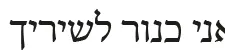
I am a harp to your songs
In my research on the history and practice of translation in German Jewish society, I relish the (rare) occasions when translators explicitly address the choices of their predecessors. At such moments, translators who pride themselves on their originality reveal an awareness of their historicity. A famous example is Franz Rosenzweig’s provocative essay, “Der Ewige: Mendelssohn und der Gottesname” of 1929, in which he argues, in essence, that Moses Mendelssohn got God’s Name wrong in his Pentateuch translation of 1780–83: the proper name of the biblical God (Tetragrammaton) should not be rendered der Ewige (the Eternal One), since this appellation is too abstract, too Calvinist, too cold.4 Rosenzweig’s dispute with Mendelssohn had a polemical subtext: rejecting der Ewige, which had been adopted in so many subsequent Jewish Bibles and prayer books, was part of an effort to dissociate the Buber and Rosenzweig Bible translation from its precursors, and distinguish their method from the scholarly and aesthetic approaches to translation that had dominated the one-hundred-fifty-year-long history of German Jewry.
A less well-known chapter in the dialogue between these two towering philosopher-translators of Hebrew scripture concerns their reception of a third figure: the towering philosopher-poet of medieval al-Andalus, Yehuda Halevi. This essay takes as its starting point the irresistible fact, noted as such by Dominique Bourel, that both Mendelssohn and Rosenzweig published German translations of Halevi’s most famous poem, the Zionide
(hereafter referred to as Ode to Zion; Bourel 2007, 145–146). Comparing their translations of just the first eight lines of Halevi’s poem enables us to flesh out the radically different approaches to translation which also underlie their German versions of the Hebrew Bible – two of the most famous and influential Bible translations in Jewish history.
The cherries and peaches in my title come from a passage towards the end of Rosenzweig’s Nachwort (Afterword) – the essay included as an afterword to both editions of poems by Halevi in German. Rosenzweig wonders how he might lead the reader to enjoy the poems not like cherries, but like peaches; “nicht wie Kirschen, sondern wie Pfirsiche”:
Wie konnte ich den Leser dieser Übersetzungssammlung verhindern, sich als Leser zu benehmen, mit anderen Worten, wie konnte ich ihn dazu bringen, die Gedichte nicht wie Kirschen, sondern wie Pfirsiche zu verspeisen, also nicht das nächste schon anzufangen, wenn er noch das vorige kaum herunter hätte, sondern jedes hübsch einzeln und mit Bedacht und mit der Vorstellung: so bald gibts nun vielleicht keins wieder.
[...]
Also den Leser aus einem Leser und Vertilger zu einem Gast und Freund des Gedichts zu machen. (Rosenzweig 1927, 167–168)
[How could I prevent the reader of this collection of translations from behaving as a reader, in other words, how could I bring him to consume the poems not like cherries but like peaches, that is not to begin the next one when he still has hardly finished the previous one and with deliberation and with the idea: perhaps there will not be one like this again so soon.
Thus, to change the reader from a reader and a consumer into a guest and friend of the poem.] (Galli 184)
Rosenzweig urges his reader not to read Halevi’s poems one after the other, in haste, but to savor and “befriend” each one. Cherries, moreover, are native to Germany; peaches were an imported fruit, like the exotic lemons in Mignon’s song from Goethe’s novel.5 A translator who favors peaches over cherries prefers a foreignizing approach to a domesticating one – the difference, in a word, between Rosenzweig and Mendelssohn. But I also wish to call attention to something important which Mendelssohn and Rosenzweig have in common. Both cherries and peaches have a hard kernel, which corresponds to the religious core of Halevi’s artistry. Albeit in different ways, both translators sought to acquaint their readers with this “Godkissed” poet, to use Heinrich Heine’s phrase, this “great Jewish poet in Hebrew,” as Rosenzweig called him; and, through poetry, to Judaism.6
*****
Jews the world over admired and engaged with the medieval poet, physician and philosopher known to us as Yehuda Halevi (Toledo, 1075 – Alexandria, 1141). Halevi is regarded as the exemplary Hebrew poet, and mythologized as the first Jew who travelled to the Land of Israel not simply as a pilgrim, “to visit Jerusalem and the other holy sites and return, but rather to die there and mingle his body with the stones and soil of the land of Israel” (Scheindlin 2008, 4). Until the nineteenth century, Halevi was known for the Arabic philosophical dialogue Kitab-al-Khazari7 (translated into Hebrew as Sefer ha-Kuzari in 1506), and also, by the Ode to Zion, which had been incorporated into the Ashkenazi liturgy for the Ninth of Av. Only in the mid-nineteenth century was the corpus of religious and secular poetry – Zion poems, wine songs, riddles, panegyrics and epithalamia, written in Hebrew in Arabic genres and meter – collected and published by Samuel David Luzatto. Translation into a vast array of languages proliferated. One of Halevi’s most recent English translators, Peter Cole, writes that “Yehuda HaLevi is perhaps the most famous and certainly the most revered of all the medieval poets”; “[t]he poetry Halevi wrote is prized for its fusion of a pure Hebrew lyricism and religio-historical concerns” (2007, 143, 144). The poems lament past troubles and also contemporary ones. As well acquainted as he was with Arabic and Castilian poetry, “his muse spoke to him in the old and sacred language of the Bible,”8 and his poems exemplify the shibbutz (German: Musivstil), “the use of recognizable scriptural verses or fragments of verse,” whether as “charged” literary allusions or more “neutral” ornaments in poems (Cole 2007, 542–543).9 Late in his career, Halevi developed reservations about the Jewish adoption of Arabic poetics. “He continued composing in the classical style in the last years of his life, but also began experimenting with an alternative poetics that would de-Arabize Hebrew verse and return it to exclusively Jewish sources” (Cole 2007, 144).
Like many Halevi elegies, the poem under discussion “combin[es] an ode to Zion with a lament for its fall,” even as it ends with a prayer for the redemption of Jerusalem (Weinberger 1998, 131). It “won special distinction and many imitators” throughout Jewish history who copied its form and in particular the rhetorical question with which the poem begins (Weinberger 1998, 131; also 186 and 400). Among Ashkenazi Jews, the Ode to Zion was the best-known of the kinot (dirges or elegies lamenting historical persecutions and martyrdoms). It was also widely known during the Ottoman period, in South Asia and the Mediterranean Basin. French-German poets imitated Halevi in their dirges written after the murder of Jews in the Rhineland in the twelfth century. The most famous Jerusalem song of the twentieth century, Naomi Shemer’s “Yerushalayim Shel Zahav” (Jerusalem of Gold) of 1967, crafted its refrain from the eighth line of Halevi’s Ode: ha-lo’ le-khol shirayikh, ’ani kinor; am I not, for all your songs, a harp?
Among German Jewish intellectuals, our two translators’ fascination with Yehuda Halevi was hardly anomalous. From the beginning of the Haskalah, Halevi took on an additional role as the most famous representative of Sephardic Judaism that became the adopted heritage, the usable past par excellence, of modern German Jewry. His work and biography touched on, or directly influenced, the worlds of liturgy, philosophy, poetry, classical religious thought and popular literature, as well as debates over the role of Hebrew in bilingual Jewish diaspora and Zionism. The German Jewish engagement with medieval Hebrew poetry was part of a quest for new paradigms of Jewish cultural production in the German language. As Ismar Schorsch argues (with particular reference to synagogue liturgy), “Without the embrace of Sephardic culture, the rebellion against Ashkenaz was hardly possible”; drawing inspiration from abroad made it possible to create a rupture with the immediate, local past (1994, 78). What this means for our purposes is that between Mendelssohn’s translation of 1755 and Rosenzweig’s of 1922 there existed an enormous corpus by nineteenth-century Hebraists and scholars of Wissenschaft des Judentums who translated and edited medieval Spanish-Hebrew poems and piyyutim (liturgical poems) and regarded them as superior to their native Ashkenazi piyyutim.10 Groundbreaking publications included Michael Sachs’ 1845 collection, Die religiöse Poesie der Juden in Spanien (2nd ed. Berlin 1901), and the very first German-language divan: Abraham Geiger’s Divan des Casteliers Abu’l–Hassan Juda ha-Levi (Breslau 1851; Schirmann 1938–1939, 360–367). The roster of scholarly works noted in Heinrich Brody’s preface to Die neuhebräische Dichterschule der Spanish-Arabischen Epoche (Leipzig 1905) includes pioneering studies by Delitszch, Dukes, Zunz, Kaempf, and Sulzbach. In Berlin in 1894, the Hebrew periodical of Ha-ḥevra mekitze nirdamim (The Society to Awaken the Sleepers) began to publish Brody’s editions of the poems in consecutive volumes. By 1920, in Chaim Schirmann’s estimate, there were seventeen different German translations of the Ode to Zion. Halevi’s overall import in German Jewish culture may be summed up by Gustav Karpeles’ paean in the preface to an 1893 edition of the Diwan (which included two different renderings of the Ode to Zion):
In Jehudah b. Samuel Halevi (arabisch Abul Hassan ibn Allavi, 1086) hat die Entwickelung des in der neuhebräischen Litteratur maßgebenden Princips ihren Höhepunkt erreicht; er ist das dichterisch verklärte Bild der jüdischen Volksseele in ihrem poetischen Empfinden, in ihrem geschichtlichen Ringen, in ihren patriotischen Stammesgefühlen und in ihrem weltgeschichtlichen Martyrium ohne Gleichen. (Karpeles 1893, 1)
[In Yehuda b. Samuel Halevi (Arabic: Abul Hassan ibn Allavi, 1086) the development of the authoritative principle of modern Hebrew literature has reached its apex; he is unrivaled as the poetically transfigured image of the Jewish people’s soul in their po...
Table of contents
Cover
Title Page
Copyright
Contents
Editors’ Introduction
Part One: German-Hebrew Exchange in Modernist Literature
Part Two: German-Hebrew Encounters in the Arts Today
Trusted by 375,005 students
Access to over 1.5 million titles for a fair monthly price.
Study more efficiently using our study tools.
Frequently asked questions
Yes, you can cancel anytime from the Subscription tab in your account settings on the Perlego website. Your subscription will stay active until the end of your current billing period. Learn how to cancel your subscription
No, books cannot be downloaded as external files, such as PDFs, for use outside of Perlego. However, you can download books within the Perlego app for offline reading on mobile or tablet. Learn how to download books offline
Perlego offers two plans: Essential and Complete
Essential is ideal for learners and professionals who enjoy exploring a wide range of subjects. Access the Essential Library with 800,000+ trusted titles and best-sellers across business, personal growth, and the humanities. Includes unlimited reading time and Standard Read Aloud voice.
Complete: Perfect for advanced learners and researchers needing full, unrestricted access. Unlock 1.5M+ books across hundreds of subjects, including academic and specialized titles. The Complete Plan also includes advanced features like Premium Read Aloud and Research Assistant.
Both plans are available with monthly, semester, or annual billing cycles.
We are an online textbook subscription service, where you can get access to an entire online library for less than the price of a single book per month. With over 1.5 million books across 990+ topics, we’ve got you covered! Learn about our mission
Look out for the read-aloud symbol on your next book to see if you can listen to it. The read-aloud tool reads text aloud for you, highlighting the text as it is being read. You can pause it, speed it up and slow it down. Learn more about Read Aloud
Yes! You can use the Perlego app on both iOS and Android devices to read anytime, anywhere — even offline. Perfect for commutes or when you’re on the go. Please note we cannot support devices running on iOS 13 and Android 7 or earlier. Learn more about using the app
Yes, you can access The German-Hebrew Dialogue by Amir Eshel, Rachel Seelig, Amir Eshel,Rachel Seelig in PDF and/or ePUB format, as well as other popular books in Théologie et religion & Histoire du peuple juif. We have over 1.5 million books available in our catalogue for you to explore.