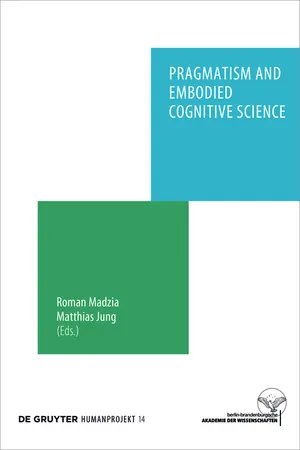
This book endeavors to fill the conceptual gap in theorizing about embodied cognition. The theories of mind and cognition which one could generally call "situated" or "embodied cognition" have gained much attention in the recent decades. However, it has been mostly phenomenology (Heidegger, Merleau-Ponty, etc.), which has served as a philosophical background for their research program. The main goal of this book is to bring the philosophy of classical American pragmatism firmly into play. Although pragmatism has been arguably the first intellectual current which systematically built its theories of knowledge, mind and valuation upon the model of a bodily interaction between an organism and its environment, as the editors and authors argue, it has not been given sufficient attention in the debate and, consequently, its conceptual resources for enriching the embodied mind project are far from being exhausted. In this book, the authors propose concrete subject-areas in which the philosophy of pragmatism can be of help when dealing with particular problems the philosophy of the embodied mind nowadays faces - a prominent example being the inevitable tension between bodily situatedness and the potential universality of symbolic meaning.
eBook - ePub
Pragmatism and Embodied Cognitive Science
From Bodily Intersubjectivity to Symbolic Articulation
- 312 pages
- English
- ePUB (mobile friendly)
- Available on iOS & Android
eBook - ePub
Pragmatism and Embodied Cognitive Science
From Bodily Intersubjectivity to Symbolic Articulation
About this book
Information
Topic
PhilosophySubtopic
Epistemology in Philosophy
Part I:Pragmatism as a Philosophical Foundation of Cognitive Science
Shaun Gallagher
Pragmatic Interventions into Enactive and Extended Conceptions of Cognition
Abstract: Clear statements of both extended and enactive conceptions of cognition can be found in John Dewey and other pragmatists. In this paper I’ll argue that we can find resources in the pragmatists to address two ongoing debates: (1) in contrast to recent disagreements between proponents of extended vs enactive cognition, pragmatism supports a more integrative view—an enactive conception of extended cognition, and (2) pragmatist views suggest ways to answer the main objections raised against extended and enactive conceptions—specifically objections focused on constitution versus causal factors, and the mark of the mental.
Recently developed enactive and extended approaches to cognition have different roots. Enactive approaches typically point to phenomenology and theoretical biology; extended mind approaches are more influenced by analytic philosophy of mind, computational models and cognitive science more generally. Rarely noted, however, or sometimes only noted in passing, pragmatism is something of a forerunner of both of these approaches. Clear statements of both extended and enactive conceptions of cognition can be found in Charles Sanders Pierce, John Dewey, Georg Herbert Mead, and other pragmatists. Although today enactive and extended approaches disagree with each other on a number of issues, the fact that pragmatists could embrace both views suggests that there may be resources in pragmatism that can help to adjudicate some of the current debate and to develop a more integrated perspective.
I will also suggest that one can draw on the same resources to address some of the objections that have been leveled at enactive and extended models of the mind. My aim is not to provide a full historical account of how pragmatism anticipates the more recent developments; rather, my aim is to put pragmatism to work on clarifying and integrating these approaches, and thereby resolving some objections that have been raised against them. I’ll begin, however, with some brief indication of the pragmatic anticipation of enactive and extended approaches.
1Pragmatism and enactive perception
The origin of the concept of enactive perception, and more generally, enactive cognition is often indicated by pointing to the work of Francisco Varela, (e. g., Varela, Thompson and Rosch 1991), and then back to its phenomenological roots in Husserl, Heidegger, and Merleau-Ponty. Husserl (1989) had developed the idea of the “I can” as part of the structure of embodied perception. On his view, I perceive things in my environment in terms of what I can do with them. Heidegger (1962) went further toward a pragmatic view in suggesting that our primary way of being-in-the-world—our way of relating to various events and objects—is in the mode of the ready-to-hand (Zuhanden) attitude. In almost all everyday engagements, I understand the world in terms of pre-reflective pragmatic, action-oriented use, rather than in reflective terms of an intellectual or overly cognitive attitude of conceptual contemplation or scientific observation. Merleau-Ponty (1962), drawing on both Husserl and Heidegger, works this out in some detail in his analysis of perception, and focuses on the important role played by the embodied motor system. A number of theorists who help to develop an enactivist view of cognition were influenced by Merleau-Ponty’s account— not only Varela et al. (1991), but also J. J. Gibson (1977), who developed the notion of affordances,1 Hubert Dreyfus (1992), both in his critique of classical cognitivism and his emphasis on embodied practice, and Marc Jeannerod, who attended Merleau-Ponty’s lectures and later developed a distinction between semantic and pragmatic perception (Jeannerod 1994; 1997; also see Noë 2004; Gallagher 2005a; Thompson 2007).2
That the roots of enactivism are to be found in phenomenology is an uncontroversial claim; the enactivists explicitly acknowledge this. Moreover, anyone familiar with the phenomenologists will clearly see that certain pragmatic aspects of phenomenological philosophy are the ones that lead forward to the development of the enactivist approach. For that reason it is surprising that the philosophical tradition of pragmatism is hardly ever mentioned by the enactivists. With the exception of William James (and usually his Principles of Psychology) the pragmatists are rarely cited. There is no mention of Peirce, Dewey, or Mead, for example, in Noë (2004), Thompson (2007) or Hutto and Myin (2013). Varela et al. make one general and undeveloped reference to pragmatism (Varela et al. 1991, 30 –31), but without direct relevance to the enactive aspects of this work.3
Notwithstanding this lack of acknowledgment for the pragmatists, however, it’s very clear that one can find the central concepts of enactivism already discussed by Peirce, Dewey and Mead. Peirce, for example, foreshadows the externalist turn that is so important for enactivism: “just as we say that a body is in motion, and not that motion is in a body, we ought to say that we are in thought, and not that thoughts are in us” (Peirce, CP 5.289, n. 1). Dewey, in turn, argues for an understanding of perception starting “not with a sensory stimulus, but with a sensori-motor coordination […] it is the movement which is primary, and the sensation which is secondary, the movement of body, head and eye muscles determining the quality of what is experienced” (Dewey 1896, 358–359). Here, sensory-motor contingencies, which play a most obvious role in Noë’s (Noë 2004; O’Regan and Noë 2001) version of enactivism, are given a primacy in perception.
Re-echoing this idea, and building on the insight found in his famous essay, “The reflex arc concept in Psychology,” that one’s active response defines the nature of what the organism takes as a stimulus, Dewey offers a characterization of the role of the brain in cognition that comes close to embodied-enactivist views today.
The advance of physiology and the psychology associated with it have shown the connection of mental activity with that of the nervous system. Too often recognition of connection has stopped short at this point; the older dualism of soul and body has been replaced by that of the brain and the rest of the body. But in fact the nervous system is only a specialized mechanism for keeping all bodily activities working together. Instead of being isolated from them, as an organ of knowing from organs of motor response, it is the organ by which they interact responsively with one another. The brain is essentially an organ for effecting the reciprocal adjustment to each other of the stimuli received from the environment and responses directed upon it. Note that the adjusting is reciprocal; the brain not only enables organic activity to be brought to bear upon any object of the environment in response to a sensory stimulation, but this response also determines what the next stimulus will be. (Dewey 1916, 336–337)
This is fully consistent, for example, with enactivist arguments that cognition is not just a matter of brain processes—the cognitive agent is more than a brain in a vat; rather, the brain is one part of a body in which dynamical regulation goes both ways, with the brain both biologically and functionally dependent on the rest of the body which is in dynamical interaction with the environment (see, e. g., Cosmelli and Thompson 2010; Gallagher 2005b).
Part of what it means for the body to be dynamically interacting, or as Dewey would say, transacting with the environment is captured by George Herbert Mead in his characterization of the reachable peripersonal space around the body, or what he called the “manipulatory area.” He suggested, very much in the spirit of enactivism, that what is present in perception is not a copy (or representation) of the perceived, but “the readiness to grasp” what is seen (Mead 1938, 103). Accordingly, the perception of objects outside of the manipulatory area is always relative to
the readiness of the organism to act toward them as they will be if they come within the manipulatory area […].We see the objects as we will handle them […]. We are only ‘conscious of’ that in the perceptual world which suggests confirmation, direct or indirect, in fulfilled manipulation (Mead 1938, 104–105).
Just as concepts like the manipulatory area, response dependent stimulation, the contingent nature of sensory-motor coordination, and Peircean externalism prefigure related concepts in recent enactivism, other pragmatist concepts anticipate recent work on the extended mind.
2Pragmatism and the extended mind
If extended mind theorists are somewhat better at acknowledging their prefigurement in the pragmatists, this only goes so far. Although the classic paper by Clark and Chalmers (1998) makes no mention of the pragmatists, Clark’s book begins with an invocation from Dewey.
Hands and feet, apparatus and appliances of all kinds are as much a part of it [thinking] as changes in the brain. Since these physical operations (including the cerebral events) and equipments are a part of thinking, thinking is mental, not because of a peculiar stuff which enters into it or of peculiar non-natural activities which constitute it, but because of what physical acts and appliances do: the distinctive purpose for which they are employed and the distinctive results which they accomplish. (Dewey 1916, 8–9)
But this beginning is the end of it—there is no further discussion of Dewey or other pragmatists in Supersizing the Mind.4 Dewey’s quote foreshadows much of what Clark wants to say, however. Richard Menary (2007) is perhaps the one figure closely associated with extended mind approaches who understands the pragmatic connections. Indeed, in his book, Cognitive Integration, he appeals to Dewey’s notion of organism-environment transactions to work out a characterization of how embodied cognition incorporates the environment. I’ll return to his analysis below. Menary also points to Peirce’s ‘continuity principle’, which requires that there be no deep metaphysical discontinuity between the mind and the world, as an important source for understanding a neutral ground between internalist and externalist conceptions of representation (Menary 2007, 129). Indeed, I think it’s quite clear that Peirce anticipates what was to become the extended mind.
A psychologistcuts out a lobe of my brain (nihil animale a me alienum puto) and then, when I find I cannot express myself, he says, ‘You see, your faculty of language was localized in that lobe.’ No doubt it was; and so, if he had filched my inkstand, I should not have been able to continue my discussion until I had got another. Yea, the very thoughts would not come to me. So my faculty of discussion is equally localized in my inkstand. (Peirce CP, 7.366)
It is a short distance from the inkstand to Clark and Chalmers’ example of Otto’s notebook. Peirce anticipates something similar. “In my opinion it is much more true that the thoughts of a living writer are in any printed copy of his book than they are in his brain” (Peirce, CP 7.364).
Indeed, Peirce’s notion that artifacts can play a cognitive role suggests an extension of thought into social practices and institutions, such as the institution of science (see Gallagher 2013a and the special issue of Cognitive Systems Research Vols. 25–26 for more on the socially extended mind). For Peirce, “it is no figure of speech to say that the alembics and cucurbits of the chemist are instruments of thought, or logical machines” (Peirce 1887, 168). The manipulation of artefacts such as chemical flasks and tubing evoke a very specific way of thinking in the chemist. In this regard, “thought is not just expressed in work, it is executed in work.”5 For Peirce, as Aydin (Aydin 2013, 16) explains, “the mind has an artifactual character.”
Although Karl Popper is not usually considered a pragmatist in the classical sense, he was very much influenced by just these Peircean ideas, as Skagestad (1993; 1999) and Aydin (2013) suggest, and this is clearly reflected in a number of his statements, which may be considered an extension of Peirce. For example, Popper suggests that some cognition is exo- (but not necessarily extra‐) somatic.
Yet the kind of exosomatic evolution which interests me here is this: instead of growing better memories and brains, we grow paper, pens, pencils, typewriters, dictaphones, the printing press, and libraries. […] The latest development (used mainly in support of our argumentative abilities) is the growth of computers. (Popper 1972, 238–239; also see 225, n. 39)
Dewey’s contention that the mind involves more than “armchair” cognition follows directly from Peirce’s artifactual externalism since not only the body but “apparatus and appliances of all kinds” are involved, as much as the brain is. F. Thomas Burke (2013b) points out that both Dewey and Mead, in the pre-computational age, promoted a more Darwinian conception of functionalism. Agents are inclined to use whatever is available to solve survival problems, and this extends to “apparatus and appliances of all kinds.” The point is not to compute solutions on such instruments, but to incorporate them into the extended phenotype (Dawkins 1982), an idea that may be more consistent with Kim Sterelny’s niche construction model of evolution, which emphasizes active agency in constructing an adaptive fit between agent and world (Sterelny 2010), than with Clark’s functionalism.
3Dewey’s notion of situation
Turning from these historical connections, my focus in this section is on Dewey’s notion of situation. This concept will provide a productive way to effect a rapprochement between enactive and extended theories in the following section.
For Dewey’s understanding of cognition, the unit of explanation is not the biological individual, the body by itself, or the brain, but the organism-environment. Organism and environment are not two self-sufficient or easily distinguishable items. Rather, they are always found together in a dynamical transactional relation.6 They are, in effect, coupled in a way such that to pull them apart is to destroy them, or to treat them as theoretical abstractions. An organism never exists (and can never exist) apart from some environment; an environment is what it is only in conjunction with a particular organism that defines it. “In actual experience, there is never any such isolated singular object or event; an object or event is alwa...
Table of contents
- Cover
- Title Page
- Copyright
- Contents
- Introduction: What a Pragmatist Cognitive Science Is and What It Should Be
- Part I: Pragmatism as a Philosophical Foundation of Cognitive Science
- Part II: Embedding Embodied Cognitive Science: A Larger Picture
- Part III: The Pragmatists as Pioneers of Situated Cognition: Embodied Language, Reasoning, and Feeling
- Index of persons
- Index of subjects
- Endnotes
Trusted by 375,005 students
Access to over 1.5 million titles for a fair monthly price.
Study more efficiently using our study tools.
Frequently asked questions
Yes, you can cancel anytime from the Subscription tab in your account settings on the Perlego website. Your subscription will stay active until the end of your current billing period. Learn how to cancel your subscription
No, books cannot be downloaded as external files, such as PDFs, for use outside of Perlego. However, you can download books within the Perlego app for offline reading on mobile or tablet. Learn how to download books offline
Perlego offers two plans: Essential and Complete
- Essential is ideal for learners and professionals who enjoy exploring a wide range of subjects. Access the Essential Library with 800,000+ trusted titles and best-sellers across business, personal growth, and the humanities. Includes unlimited reading time and Standard Read Aloud voice.
- Complete: Perfect for advanced learners and researchers needing full, unrestricted access. Unlock 1.5M+ books across hundreds of subjects, including academic and specialized titles. The Complete Plan also includes advanced features like Premium Read Aloud and Research Assistant.
We are an online textbook subscription service, where you can get access to an entire online library for less than the price of a single book per month. With over 1.5 million books across 990+ topics, we’ve got you covered! Learn about our mission
Look out for the read-aloud symbol on your next book to see if you can listen to it. The read-aloud tool reads text aloud for you, highlighting the text as it is being read. You can pause it, speed it up and slow it down. Learn more about Read Aloud
Yes! You can use the Perlego app on both iOS and Android devices to read anytime, anywhere — even offline. Perfect for commutes or when you’re on the go.
Please note we cannot support devices running on iOS 13 and Android 7 or earlier. Learn more about using the app
Please note we cannot support devices running on iOS 13 and Android 7 or earlier. Learn more about using the app
Yes, you can access Pragmatism and Embodied Cognitive Science by Roman Madzia, Matthias Jung, Roman Madzia,Matthias Jung in PDF and/or ePUB format, as well as other popular books in Philosophy & Epistemology in Philosophy. We have over 1.5 million books available in our catalogue for you to explore.