The monograph provides the first comprehensive, detailed account of German-speaking refugees in Ireland 1933-1945 - where they came from, immigration policy towards them and how their lives turned out in Ireland and afterwards. Thanks to unprecedented access to thousands of files of the Irish Department of Justice (all still officially closed) as well as extensive archive research in Ireland, Germany, England, Austria as well as the US and numerous interviews it is possible for the first time to give an almost complete overview of how many people came, how they contributed to Ireland, how this fits in with the history of migration to Ireland and what can be learned from it.
While Exile studies are a well-developed research area and have benefited from the work of research centres and archives in Germany, Austria, Great Britain and the USA (Frankfurt/M, Leipzig, Hamburg, Berlin, Innsbruck, Graz, Vienna, London and SUNY Albany and the Leo Baeck Institutes), Ireland was long neglected in this regard. Instead of the usual narrative of "no one was let in" or "only a handful came to Ireland" the authors identified more than 300 refugees through interviews and intensive research in Irish, German and Austrian archives. German-speaking exiles were the first main group of immigrants that came to the young Irish Free State from 1933 onwards and they had a considerable impact on academic, industrial and religious developments in Ireland.
eBook - ePub
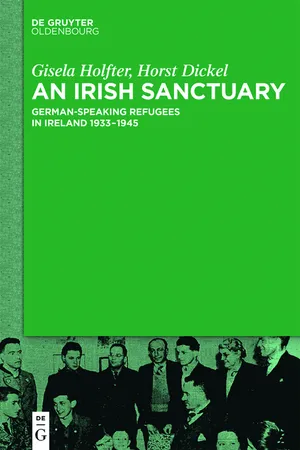
An Irish Sanctuary
German-speaking Refugees in Ireland 1933–1945
- 461 pages
- English
- ePUB (mobile friendly)
- Available on iOS & Android
eBook - ePub
About this book
Information
Subtopic
20th Century HistoryIndex
History
Part IPassages to Ireland
Chapter 1
The Distant Option – German Refugees to Ireland, 1933–1938
When the terror began in 1933 with a large-scale boycott movement against Jewish shop owners, persecution of political opponents and increasing ostracism of Jews and non-Aryans,32 only a minority among the victims were prescient enough to assess their future in Germany realistically. Many hoped against all the evidence for an early end to the regime, and did not develop concrete emigration plans as long as they could eke out an existence, however precarious. The first years seemed to give time for adjustments, delays, hopes (however deferred or frustrated) and possibly better emigration options. Moreover, Jews in the larger area of Germany were more widely scattered than in Austria, for example, which allowed for greater possibilities of domestic migration, mainly to the bigger cities. It has been estimated that of the roughly half-million Jews in Germany in 1933, only 143,000 had by June 1938 left the borders of the Old Reich.33 It was only after the November Pogrom in 1938 that the past six years appeared to many who had stayed as lost time.
The discriminatory rules that drove them from their homeland hit them differently depending on location, age, and economic and social position. All these factors influenced their flight options and the ways they proposed to live in exile.
For the vast majority who attempted to flee the Nazi state in this earlier period (as, indeed, from 1938), Ireland was not a preferred option. It was not, indeed, generally considered as a possibility – even by those who eventually came there. From an average German or Austrian perspective, Ireland was very much terra incognita: it hardly featured in information provided for would-be emigrants.34 For German speakers, Ireland had been in the spotlight only between 1830 and 1850, when romanticism and a Europe-wide fascination with Daniel O’Connell created considerable literary and political interest in and awareness of Ireland.35 Irish-German links in the 20th century, such as the building of the hydroelectric power station in Ardnacrusha, Co. Clare by Siemens-Schuckert, a project on which several hundred German engineers and labourers worked in Ireland from 1925 to 1929, had far more of an impact in Ireland than in Germany.36 German and Austrian perceptions of Ireland in the 1930s were not encouraging. It was seen as a “poor and unstable country on the periphery of Europe”,37 and people’s reactions, when told that Ireland was being considered as a destination, tended to be incredulous: “Are you crazy? [...] People there have in their right coat pocket the liquor bottle, rosary beads in the left and in the hip pocket the revolver.”38
For some, however, there were personal connections. Tenuous though they might have been, these connections were significant for many of the émigrés who came to Ireland, whether for longer or shorter periods.
Some early refugees came to Ireland as visitors, often relying on relatives, or other persons or institutions, to support them during their limited stay. Generally the Irish state allowed their entry as long as they could plausibly demonstrate that they came ‘only’ as visitors and would leave the country after the permitted time (although passport controls were not always enforced strictly in Ireland).39 Among such visitors were, for example, two Jewish sisters, Emmi and Chana Bulka, from Offenbach/Main, and Ruth Eichmann, daughter of a Jewish shop-owner in Remscheid/Rhineland.40 Jewish brothers Leo and Kurt Michel came in January 1934, also from the Rhineland. They had lost their employment due to “present conditions in Cologne” as their aunt Rosa de Lancy, with whom they stayed, explained.41 While she was living in comfortable circumstances as a medical practitioner in Dublin and tried hard to convince the Department of Justice to extend the initial two month visa to at least twelve months,42 it was in vain – the Department held it against the two young men that they had indicated upon landing that they would return to their employment after two months. They had to return to Cologne in mid-March 1934.
Among the visitors there were some prominent persons. The earliest case within this category was Paul Kirchhoff, a distinguished ethnologist and a political radical belonging to the Trotskyist camp of opponents to the established Communist parties in the Soviet Union and Germany. Already in exile in the USA before Hitler’s party took power, he and his wife Johanna were sent on a scholarship from the Rockefeller Foundation to inspect the results of Irish land reform in January 1933. They stayed in Ireland for more than a year, moving in leftist political circles – Peadar O’Donnell and Hanna Sheehy-Skeffington, for example, were among their acquaintances –watched suspiciously by the Irish police who were aware of Paul’s political background. In 1934 they left for Paris.43
Another early visitor was Annette Kolb, one of the best known German writers of the 1920s.44 Born into an artistic and liberal German-French family,45 she had already spent World War I as an exile in Switzerland. She knew Ireland from many visits (it featured, briefly but importantly, in her first novel Exemplar, published in 1913, for which she received the prestigious Fontane prize), as in 1908 her older sister Germaine had married William Stockley, professor of English at University College Cork. Kolb’s pacifist background meant that she had to go into exile again after Hitler came to power. She went first to Switzerland, then to Luxembourg and Paris, and in late May 1933 she came to Ireland. What she especially hoped to find was peace to write,46 her project at that time being a novel with strong autobiographical features and critical references to contemporary events in Germany.47 Kolb was an astute observer of the social and political situation.48 Her stay in Ireland lasted until the end of August, interrupted only by a trip to visit friends in England in July. She returned to Ireland for some weeks in December 1933. That she lived mainly in Paris rather than in Ireland for the next few years was probably due to financial considerations.49 She visited Ireland several times before the outbreak of the war, often staying for several weeks. A talented musician, she played the piano more than once on Irish radio. In that context, she is named in Irish newspapers, though her status as a refugee is never explicitly mentioned.50 Kolb’s trips to Ireland in 1933 and later met with no opposition from the Irish state – in fact, we found no references to her in any files in the National Archives or the Military Archives.51
An Austrian who came to Ireland several times for visits of a few weeks, in 1934, 1936 and again in 1938, should also briefly be mentioned here – Ludwig Wittgenstein. As George Hetherington rightly argues, however, despite his name, his three Jewish grandparents, and the dates he visited, Wittgenstein cannot be called a refugee, having already moved to England in the late 1920s.52
Max Warburg53 came to Ireland in spring 1937, apparently to investigate possible places to emigrate for his brother-in-law, a doctor in Hamburg,54 rather than for himself, as he had already settled in the Netherlands. In a letter from London, Warburg rated the prospects of emigration to Ireland poorly, as the state was pursuing a policy of autarky and unemployment was high. He stressed that on a personal level the Irish were wonderful warm people, more willing than the English to welcome immigrants,55 and that the country was well worth visiting: “Ireland and the Irish are indescribably enchanting, despite the dirt and all deficiencies.”56 His overall impression, however, was “Irland: Entzückend, aber ziemlich aussichtslos!” (Ireland: delightful, but pretty hopeless!) He gave an interesting description of the transfer qualifications necessary to practice medicine – he understood that a one-year diploma would be sufficient, rather than an entire degree having to be repeated. He mentioned that he had heard of another German doctor currently in the process of finishing the diploma in Ireland, and that he hoped to find out more about any requirements. He added, however, that an excellent command of English (which his brother-in-law did not possess) was essential for a practising doctor. In his opinion the diploma would be very worthwhile too for any plans to emigrate to one of the colonies or dominions of the British Empire. He recommended Trinity College Dublin, as it enjoyed a worldwide reputation second only to London. What Warburg had suggested in theory had in fact already been put into practice by a number of students.
The students
In June 1933, 116,961 Jews between six and twenty-five years old lived in Germany; by January 1938 their numbers had fallen to 67,20057 – a demographic decline that was almost totally due to emigration, which set in when the Nazis began to exclude Jews from the racially defined Volksgemeinscha...
Table of contents
- Cover
- Title Page
- Copyright
- Dedication
- Contents
- List of Images
- Tables
- Acknowledgements
- Introduction
- Part I Passages To Ireland
- Part II Exiled in Wartime Ireland
- Part III After the War
- Index of Names
- Index of Places
Trusted by 375,005 students
Access to over 1.5 million titles for a fair monthly price.
Study more efficiently using our study tools.
Frequently asked questions
Yes, you can cancel anytime from the Subscription tab in your account settings on the Perlego website. Your subscription will stay active until the end of your current billing period. Learn how to cancel your subscription
No, books cannot be downloaded as external files, such as PDFs, for use outside of Perlego. However, you can download books within the Perlego app for offline reading on mobile or tablet. Learn how to download books offline
Perlego offers two plans: Essential and Complete
- Essential is ideal for learners and professionals who enjoy exploring a wide range of subjects. Access the Essential Library with 800,000+ trusted titles and best-sellers across business, personal growth, and the humanities. Includes unlimited reading time and Standard Read Aloud voice.
- Complete: Perfect for advanced learners and researchers needing full, unrestricted access. Unlock 1.5M+ books across hundreds of subjects, including academic and specialized titles. The Complete Plan also includes advanced features like Premium Read Aloud and Research Assistant.
We are an online textbook subscription service, where you can get access to an entire online library for less than the price of a single book per month. With over 1.5 million books across 990+ topics, we’ve got you covered! Learn about our mission
Look out for the read-aloud symbol on your next book to see if you can listen to it. The read-aloud tool reads text aloud for you, highlighting the text as it is being read. You can pause it, speed it up and slow it down. Learn more about Read Aloud
Yes! You can use the Perlego app on both iOS and Android devices to read anytime, anywhere — even offline. Perfect for commutes or when you’re on the go.
Please note we cannot support devices running on iOS 13 and Android 7 or earlier. Learn more about using the app
Please note we cannot support devices running on iOS 13 and Android 7 or earlier. Learn more about using the app
Yes, you can access An Irish Sanctuary by Gisela Holfter,Horst Dickel in PDF and/or ePUB format, as well as other popular books in History & 20th Century History. We have over 1.5 million books available in our catalogue for you to explore.