Waardenburg's magisterial essay traces the rise and development of the academic study of religion from the mid-nineteenth to the mid-twentieth century, outlining the establishment of the discipline, its connections with other fields, religion as a subject of research, and perspectives on a phenomenological study of religion. Futhermore a second part comprises an anthology of texts from 41 scholars whose work was programmatic in the evolution of the academic study of religion. Each chapter presents a particular approach, theory, and method relevant to the study of religion. The pieces selected for this volume were taken from the discipline of religious studies as well as from related fields, such as anthropology, sociology, and psychology, to name a few.
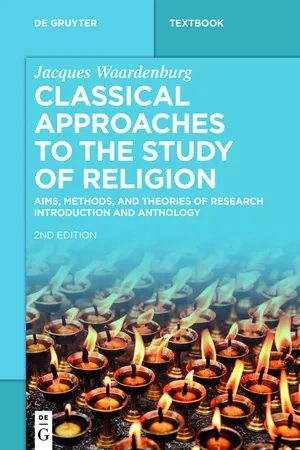
eBook - ePub
Classical Approaches to the Study of Religion
Aims, Methods, and Theories of Research. Introduction and Anthology
- 751 pages
- English
- ePUB (mobile friendly)
- Available on iOS & Android
eBook - ePub
Classical Approaches to the Study of Religion
Aims, Methods, and Theories of Research. Introduction and Anthology
About this book
Information
Topic
Theology & ReligionSubtopic
Comparative Religion
Part One:The Study of Religion Established as an Autonomous Discipline
F. Max Müller
Friedrich Max Müller was born in 1823 in Dessau, Germany, and received his primary and secondary school education in Dessau and in 1836 in Leipzig. In 1841 he enrolled at the University of Leipzig to study classical and other languages, psychology and anthropology. He then chose Sanskrit as his field, worked with Hermann Brockhaus, and obtained his Ph. D. in 1843. In 1844 he continued his studies in Berlin, working under Franz Bopp at comparative philology, and under Schelling at philosophy. After having spent a year in Paris, where he worked with E. Burnouf at Sanskrit and comparative religion, he went to England in 1846, lived in London for two years and went to Oxford in 1848. Here Müller became deputy Taylorian professor of modern European languages in 1850, and in 1854 full professor receiving the M. A. degree by decree of convocation. Having been a member of Christ Church since 1851, he obtained a life fellowship at All Souls College in 1858. In 1868 Müller became professor of comparative philology, but he retired from active duties in 1876 in order to devote himself entirely to the edition of the Sacred Books of the East. He died at Oxford in 1900.
Of Müller’s numerous publications the following may be mentioned here: 1849–1873 edition and translation of the Rigveda-Samhitā with Sāyanākārya’s commentary (6 vol.); 1856 Comparative Mythology; 1867–1875 Chips from a German Workshop (4 vol.); 1873 Introduction to the Science of Religion; 1878 Lectures on the Origin and Growth of Religion as illustrated by the Religions of India; 1881 Selected Essays on Language, Mythology and Religion (2 vol.); 1889 Natural Religion; 1891 Physical Religion; 1892 Anthropological Religion; 1893 Theosophy or Psychological Religion; 1897 Contributions to the Science of Mythology (2 vol.); 1899 The Six Systems of Indian Philosophy.
Müller may be considered a pioneer of the new ‘science of religion’. As a scholar of Sanskrit he also worked on comparative linguistics and wanted to found comparative mythology and comparative religion on that as basis. He held that philological and etymological research can discover the meaning of religion for early man by restoring the original sense to the names of the gods and the stories told about them. Myths being in his view primarily poetry and phantasy Müller tried to explain their substance by means of natural phenomena, and their terminology by what he called a ‘disease of language’. Religion proper would have started with an ‘immediate perception of the infinite’ through nature, apart from the senses and reason.
The following fragments have been chosen from Chips from a German Workshop and from Introduction to the Science of Religion in order to show what Max Müller considered the new science of religion to be, and what expectations he had of it.
Plea for a Science of Religion
I do not wish to disguise these difficulties which are inherent in a comparative study of the religions of the world. I rather dwell on them strongly, in order to show how much care and caution is required in so difficult a subject, and how much indulgence should be shown in judging of the shortcomings and errors that are unavoidable in so comprehensive a study. It was supposed at one time that a comparative analysis of the languages of mankind must transcend the powers of man: and yet by the combined and well directed efforts of many scholars, great results have here been obtained, and the principles that must guide the student of the Science of Language are now firmly established. It will be the same with the Science of Religion. By a proper division of labour, the materials that are still wanting, will be collected and published and translated, and when that is done, surely man will never rest till he has discovered the purpose that runs through the religions of mankind, and till he has reconstructed the true Civitas Dei on foundations as wide as the ends of the world. The Science of Religion may be the last of the sciences which man is destined to elaborate; but when it is elaborated, it will change the aspect of the world, and give a new life to Christianity itself.
The Fathers of the Church, though living in much more dangerous proximity to the ancient religions of the Gentiles, admitted freely that a comparison of Christianity and other religions was useful. ‘If there is any agreement’, Basilius remarked, ‘between their (the Greeks) doctrines and our own, it may benefit us to know them: if not, then to compare them and to learn how they differ, will help not a little towards confirming that which is the better of the two’.12
But this is not the only advantage of a comparative study of religions. The Science of Religion will for the first time assign to Christianity its right place among the religions of the world; it will show for the first time fully what was meant by the fulness of time; it will restore to the whole history of the world, in its unconscious progress towards Christianity, its true and sacred character.
Not many years ago great offence was given by an eminent writer who remarked that the time had come when the history of Christianity should be treated in a truly historical spirit, in the same spirit in which we treat the history of other religions, such as Brahmanism, Buddhism, or Mohammedanism. And yet what can be truer? He must be a man of little faith, who would fear to subject his own religion to the same critical tests to which the historian subjects all other religions. We need not surely crave a tender or merciful treatment for that faith which we hold to be the only true one. We should rather challenge for it the severest tests and trials, as the sailor would for the good ship to which he entrusts his own life, and the lives of those who are most dear to him. In the Science of Religion, we can decline no comparisons, nor claim any immunities for Christianity, as little as the missionary can, when wrestling with the subtle Brahman, or the fanatical Mussulman, or the plain speaking Zulu. And if we send out our missionaries to every part of the world to face every kind of religion, to shrink from no contest, to be appalled by no objections, we must not give way at home or within our own hearts to any misgivings, that a comparative study of the religions of the world could shake the firm foundations on which we must stand or fall.
To the missionary more particularly a comparative study of the religions of mankind will be, I believe, of the greatest assistance. Missionaries are apt to look upon all other religions as something totally distinct from their own, as formerly they used to describe the languages of barbarous nations as something more like the twittering of birds than the articulate speech of men. The Science of Language has taught us that there is order and wisdom in all languages, and that even the most degraded jargons contain the ruins of former greatness and beauty. The Science of Religion, I hope, will produce a similar change in our views of barbarous forms of faith and worship; and missionaries, instead of looking only for points of difference, will look out more anxiously for any common ground, any spark of the true light that may still be revived, any altar that may be dedicated afresh to the true God.
And even to us at home, a wider view of the religious life of the world may teach many a useful lesson. Immense as is the difference between our own and all other religions of the world – and few can know that difference who have not honestly examined the foundations of their own as well as of other religions – the position which believers and unbelievers occupy with regard to their various forms of faith is very much the same all over the world. The difficulties which trouble us, have troubled the hearts and minds of men as far back as we can trace the beginnings of religious life. The great problems touching the relation of the Finite to the Infinite, of the human mind as the recipient, and of the Divine Spirit as the source of truth, are old problems indeed; and while watching their appearance in different countries, and their treatment under varying circumstances, we shall be able, I believe, to profit ourselves, both by the errors which others committed before us, and by the truth which they discovered. We shall know the rocks that threaten every religion in this changing and shifting world of ours, and having watched many a storm of religious controversy and many a shipwreck in distant seas, we shall face with greater calmness and prudence the troubled waters at home.
If there is one thing which a comparative study of religions places in the clearest light, it is the inevitable decay to which every religion is exposed. It may seem almost like a truism, that no religion can continue to be what it was during the lifetime of its founder and its first apostles. Yet it is but seldom borne in mind that without constant reformation, i. e. without a constant return to its fountainhead, every religion, even the most perfect, nay the most perfect on account of its very perfection, more even than others, suffers from its contact with the world, as the purest air suffers from the mere fact of its being breathed.
Whenever we can trace back a religion to its first beginnings, we find it free from many of the blemishes that offend us in its later phases. The founders of the ancient religions of the world, as far as we can judge, were minds of a high stamp, full of noble aspirations, yearning for truth, devoted to the welfare of their neighbours, examples of purity and unselfishness. What they desired to found upon earth was but seldom realised, and their sayings, if preserved in their original form, offer often a strange contrast to the practice of those who profess to be their disciples. As soon as a religion is established, and more particularly when it has become the religion of a powerful state, the foreign and worldly elements encroach more and more on the original foundation, and human interests mar the simplicity and purity of the plan which the founder had conceived in his own heart, and matured in his communings with his God. Even those who lived with Buddha, misunderstood his words, and at the Great Council which had to settle the Buddhist canon, Asoka, the Indian Constantine, had to remind the assembled priests that ‘what had been said by Buddha, that alone was well said’; and that certain works ascribed to Buddha, as, for instance, the instruction given to his son, Râhula, were apocryphal, if not heretical.13With every century, Buddhism, when it was accepted by nations, differing as widely as Mongols and Hindus, when its sacred writings were translated into languages as wide apart as Sanskrit and Chinese, assumed widely different aspects, till at last the Buddhism of the Shamans in the steppes of Tatary is as different from the teaching of the original Samana, as the Christianity of the leader of the Chinese rebels is from the teaching of Christ.
[…]
There is a strong feeling, I know, in the minds of all people against any attempt to treat their own religion as a member of a class, and, in one sense, that feeling is perfectly justified. To each individual, his own religion, if he really believes in it, is something quite inseparable from himself, something unique, that cannot be compared to anything else, or replaced by anything else. Our own religion is, in that respect, something like our own language. In its form it may be like other languages; in its essence and in its relation to ourselves, it stands alone and admits of no peer or rival.
But in the history of the world, our religion, like our own language, is but one out of many; and in order to understand fully the position of Christianity in the history of the world, and its true place among the religions of mankind, we must compare it, not with Judaeism only, but with the religious aspirations of the whole world, with all, in fact, that Christianity came either to destroy or to fulfil. From this point of view Christianity forms part, no doubt, of what people call profane history, but by that very fact, profane history ceases to be profane, and regains throughout that sacred character of which it had been deprived by a false distinction. […].
The Comparative Study of Religions
In beginning to-day a course of lectures on the Science of Religion, – or I should rather say on some preliminary points that have to be settled before we can enter upon a truly scientific study of the religions of the world, – I feel as I felt when first pleading in this very place for the Science of Language.
I know that I shall have to meet determined antagonists who will deny the possibility of a scientific treatment of religions as they denied the possibility of a scientific treatment of languages. I foresee even a far more serious conflict with familiar prejudices and deep-rooted convictions; but I feel at the same time that I am prepared to meet my antagonists, and I have such faith in their honesty and love of truth, that I doubt not of a patient and impartial hearing on their part, and of a verdict influenced by nothing but by the evidence that I shall have to place before them.
In these our days it is almost impossible to speak of religion without giving offence either on the right or on the left. With some, religion seems too sacred a subject for scientific treatment; with others it stands on a level with alchemy and astrology, as a mere tissue of errors or halucinations, far beneath the notice of the man of science.
In a certain sense, I accept both these views. Religion is a sacred subject, and whether in its most perfect or in its most imperfect form, it has a right to our highest reverence. In this respect we might learn something from those whom we are so ready to teach. I quote from the Declaration of Principles by which the church founded by Keshub Chunder Sen professes to be guided. After stating that no created object shall ever be worshipped, nor any man or inferior being or material object be treated as identical with God, or like unto God, or as an incarnation of God, and that no prayer or hymn shall be said unto or in the name of any one except God, the declaration continues:
‘No created being or object that has been or may hereafter be worshipped by any sect shall be ridiculed or contemned in the course of the divine service to be conducted here.’
‘No book shall be acknowledged or received as the infallible Word of God: yet no book which has been or may hereafter be acknowledged by any sect to be infallible shall be ridiculed or contemned.’
‘No sect shall be vilified, ridiculed, or hated.’
No one – this I can promise – who attends these lectures, be he Christian or Jew, Hindu or Mohammedan, shall hear his own way of serving God spoken of irreverently. But true reverence does not consist in declaring a subject, because it is dear to us, to be unfit for free and honest inquiry: far from it! True reverence is shown in treating every subject, however sacred, however dear to us, with perfect confidence; without fear and without favour; with tenderness and love, by all means, but, before all, with an unflinching and uncompromising loyalty to truth.
On the other hand, I fully admit that religion has stood in former ages, and stands also in our own age, if we look abroad, and if we look into some of the highest and some of the lowest places at home, on a level with alchemy and astrology. There exist superstitions, little short of fetishism; and, what is worse, there exists hypocrisy, as bad as that of the Roman augurs.
In practical life it would be wrong to assume a neutral position between such conflicting views. Where we see that the reverence due to religion is violated, we are bound to protest; where we see that superstition saps the roots of faith, and hypocrisy poisons the springs of morality, we must take sides. But as students of the Science of Religion we move in a higher and more serene atmosphere. We study error, as the physiologist studies a disease, looking for its causes, tracing its influence, speculating on possible remedies, but leaving the application of such remedies to a different class of men, to the surgeon and the practical physician. Diversos diversa juvant applies here as everywhere else, and a division of labour, according to the peculiar abilities and tastes of different individuals, promises always the best results. The student of the history of the physical sciences is not angry with the alchemists, nor does he argue with the astrologists; he rather tries to enter into their view of things, and to discover in the errors of alchemy the seeds of chemistry, and in the halucinations of astronomy a yearning and groping after a true knowledge of the heavenly bodies. It is the same with the student of the Science of Religion. He wants to find out what Religion is, what foundation it has in the soul of man, and what laws it follows in its historical growth. For that purpose the study of errors is to him more instructive than the study of truth, and the smiling augur as interesting a subject as the Roman suppliant who veiled his face in prayer, that he might be alone with his God.
The very title of the Science of Religion will jar, I know, on the ears of many persons, and a comparison of all the religions of the world, in which none can claim a privileged position, will no doubt seem to many dangerous and reprehensible, because ignoring that peculiar reverence which everybody, down to the mere fetish worshipper, feels for his own religion and for his own God. Let me say then at once that I myself have shared these misgivings, but that I have tried to overcome them, because I would not and could not allow myself to surrender either what I hold to be the truth, or what I hold still dearer than truth, the right of testing truth. Nor do I regret it. I do not say that the Science of Religion is all gain. No, it entails losses, and losses of many things which we hold dear. But this I will say, that, as far as my humble judgment goes, it does not entail the loss of anything that is essential to true religion, and that if we strike the balance honestly, the gain is immeasurably greater than the loss.
One of the first questions that was asked by classical scholars when invited to consider the value of the Science of Language, was, ‘What shall we gain by a comparative study of languages?’ Languages, it was said, are wanted for practical purposes, for speaking and reading; and by studying too many languages at once, we run the risk of losing the firm grasp which we ought to have on the few that are really important. Our knowledge, by becoming wider, must needs, it was thought, become shallower, and the gain, if there is any, in knowing the structure of dialects which have never produced any literature at all, would certainly be outweighed by the loss in accurate and practical scholarship.
If this could be said of a comparative study of languages, with how much greater force will it be urged against a comparative study of religions! Though I do not expect that those who study the religious books of Brahmans and Buddhists, of Confucius and Laotse, of Mohammed and Nānak, will be accused of cherishing in their secret heart the doctrines of those anc...
Table of contents
- Cover
- Title Page
- Copyright
- Foreword: Plus ça change
- Preface to the Paperback Edition
- Contents
- Introduction: View of a Hundred Years’ Study of Religion
- Anthology
- Part One: The Study of Religion Established as an Autonomous Discipline
- Part Two: Connections with Other Disciplines
- Part Three: Religion as a Special Subject of Research
- Part Four: Later Contributions from Other Disciplines
- Part Five: Perspectives of a Phenomenological Study of Religion
- Indexes
Trusted by 375,005 students
Access to over 1.5 million titles for a fair monthly price.
Study more efficiently using our study tools.
Frequently asked questions
Yes, you can cancel anytime from the Subscription tab in your account settings on the Perlego website. Your subscription will stay active until the end of your current billing period. Learn how to cancel your subscription
No, books cannot be downloaded as external files, such as PDFs, for use outside of Perlego. However, you can download books within the Perlego app for offline reading on mobile or tablet. Learn how to download books offline
Perlego offers two plans: Essential and Complete
- Essential is ideal for learners and professionals who enjoy exploring a wide range of subjects. Access the Essential Library with 800,000+ trusted titles and best-sellers across business, personal growth, and the humanities. Includes unlimited reading time and Standard Read Aloud voice.
- Complete: Perfect for advanced learners and researchers needing full, unrestricted access. Unlock 1.5M+ books across hundreds of subjects, including academic and specialized titles. The Complete Plan also includes advanced features like Premium Read Aloud and Research Assistant.
We are an online textbook subscription service, where you can get access to an entire online library for less than the price of a single book per month. With over 1.5 million books across 990+ topics, we’ve got you covered! Learn about our mission
Look out for the read-aloud symbol on your next book to see if you can listen to it. The read-aloud tool reads text aloud for you, highlighting the text as it is being read. You can pause it, speed it up and slow it down. Learn more about Read Aloud
Yes! You can use the Perlego app on both iOS and Android devices to read anytime, anywhere — even offline. Perfect for commutes or when you’re on the go.
Please note we cannot support devices running on iOS 13 and Android 7 or earlier. Learn more about using the app
Please note we cannot support devices running on iOS 13 and Android 7 or earlier. Learn more about using the app
Yes, you can access Classical Approaches to the Study of Religion by Jacques Waardenburg in PDF and/or ePUB format, as well as other popular books in Theology & Religion & Comparative Religion. We have over 1.5 million books available in our catalogue for you to explore.