The political allegiances of major Roman poets have been notoriously difficult to pin down, in part because they often shift the onus of political interpretation from themselves to their readers. By the same token, it is often difficult to assess their authorial powerplays in the etymologies, puns, anagrams, telestichs, and acronyms that feature prominently in their poetry. It is the premise of this volume that the contexts of composition, performance, and reception play a critical role in constructing poetic voices as either politically favorable or dissenting, and however much the individual scholars in this volume disagree among themselves, their readings try to do justice collectively to poetry’s power to shape political realities. The book is aimed not only at scholars of Roman poetry, politics, and philosophy, but also at those working in later literary and political traditions influenced by Rome's greatest poets.
eBook - PDF
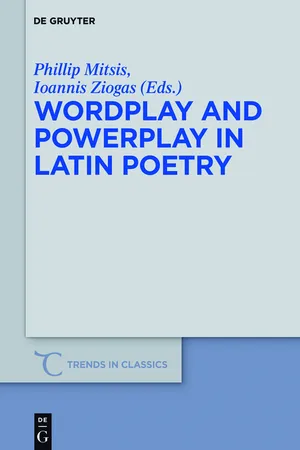
Wordplay and Powerplay in Latin Poetry
- 458 pages
- English
- PDF
- Available on iOS & Android
eBook - PDF
Wordplay and Powerplay in Latin Poetry
About this book
Information
Table of contents
- Table of Contents
- Introduction: Power, Puns, and Politics From Horace to Silius Italicus
- Tacitus and the Poets: In Nemora et Lucos … Secedendum est (Dialogus 9.6)?
- Nominal Intelligence: Conspiracy, Prosopography, and the Secret of Horace, Odes 2.10
- Another Vergilian Signature in the Georgics?
- Mora in the Aeneid
- Dido and the Owl
- Freudian Bullseyes in Classical Perspective: The Psycholinguistics of Guilt in Virgil’s Aeneid
- Virgil and the Achilles of Catullus
- Violent Retribution and Pietas: The Closure of the Aeneid Revisited
- Freedom of Speech in Virgil and Ovid
- Love’s Letters: an Amor-Roma Telestich at Ovid, Ars Amatoria 3.507–10
- Love Elegy and Legal Language in Ovid
- Pythagoras and Numa in Ovid: Exile and Immortality at Rome
- Lucan’s Caesar and Laelius
- A Theory of Violence in Lucan’s Bellum Ciuile
- From Pastoral to Panegyric in Calpurnius Siculus
- Speaking Names in Senecan Drama
- Civil War, the Soul, and the Cosmos at Seneca, Thyestes 547–622: A Tropology
- Doubtful Certainties: The Politics of Reading in Seneca’s Oedipus
- Doubting Domitian’s Divinity: Statius Achilleid 1.1–2
- As if: Reflections on an Exemplary Wife
- Silius Italicus and Greek Epic: Imperial Culture Wars
- List of Contributors
- Publications by Frederick Ahl
- Index of passages discussed
- General Index
Trusted by 375,005 students
Access to over 1.5 million titles for a fair monthly price.
Study more efficiently using our study tools.
Frequently asked questions
Yes, you can cancel anytime from the Subscription tab in your account settings on the Perlego website. Your subscription will stay active until the end of your current billing period. Learn how to cancel your subscription
No, books cannot be downloaded as external files, such as PDFs, for use outside of Perlego. However, you can download books within the Perlego app for offline reading on mobile or tablet. Learn how to download books offline
Perlego offers two plans: Essential and Complete
- Essential is ideal for learners and professionals who enjoy exploring a wide range of subjects. Access the Essential Library with 800,000+ trusted titles and best-sellers across business, personal growth, and the humanities. Includes unlimited reading time and Standard Read Aloud voice.
- Complete: Perfect for advanced learners and researchers needing full, unrestricted access. Unlock 1.5M+ books across hundreds of subjects, including academic and specialized titles. The Complete Plan also includes advanced features like Premium Read Aloud and Research Assistant.
We are an online textbook subscription service, where you can get access to an entire online library for less than the price of a single book per month. With over 1.5 million books across 990+ topics, we’ve got you covered! Learn about our mission
Look out for the read-aloud symbol on your next book to see if you can listen to it. The read-aloud tool reads text aloud for you, highlighting the text as it is being read. You can pause it, speed it up and slow it down. Learn more about Read Aloud
Yes! You can use the Perlego app on both iOS and Android devices to read anytime, anywhere — even offline. Perfect for commutes or when you’re on the go.
Please note we cannot support devices running on iOS 13 and Android 7 or earlier. Learn more about using the app
Please note we cannot support devices running on iOS 13 and Android 7 or earlier. Learn more about using the app
Yes, you can access Wordplay and Powerplay in Latin Poetry by Phillip Mitsis, Ioannis Ziogas, Phillip Mitsis,Ioannis Ziogas in PDF and/or ePUB format, as well as other popular books in History & Ancient History. We have over 1.5 million books available in our catalogue for you to explore.