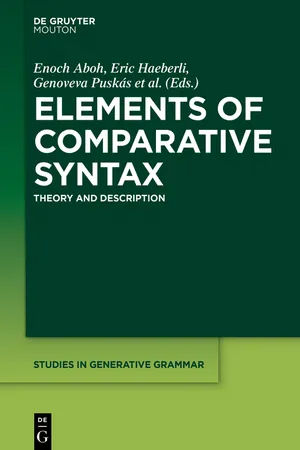
This volume brings together a selection of articles illustrating the multifaceted nature of current research in generative syntax. The authors, including some of the leading figures in the field, present analyses of typologically diverse languages, with some studies drawing on dialectal, acquisitional and diachronic evidence. Set against this rich empirical background, the contributions address an equally wide range of theoretical issues.
eBook - ePub
Elements of Comparative Syntax
Theory and Description
- 541 pages
- English
- ePUB (mobile friendly)
- Available on iOS & Android
eBook - ePub
Elements of Comparative Syntax
Theory and Description
About this book
Trusted by 375,005 students
Access to over 1.5 million titles for a fair monthly price.
Study more efficiently using our study tools.
Information
Enoch O. Aboh, Eric Haeberli, Genoveva Puskás, Manuela Schönenberger
Introduction
The starting point of this volume was the intention of the editors to publish a collection of articles in honour of Liliane Haegeman for her contribution to the field of comparative syntax. A small number of friends and colleagues were invited to contribute to this volume, and the outcome of this selection process, which, from a scientific point of view, was fairly random, provides an excellent testimony of the way in which the field of comparative generative syntax has developed from the beginning of Liliane Haegeman’s academic career in the late 1970s to today. These developments are reflected in the empirical basis of generative theorizing as well as the theoretical issues that are addressed in current work, and they illustrate how “[i]n this new comparative syntax, careful study of empirical data takes a central position with a stimulating two-way interaction between theoretical developments and empirical study” (Haegeman 1997a: 1).
Since the emergence of generative grammar in the middle of the 20th century, its aim has been to provide an explanatory model of grammatical competence and thereby to gain a deeper understanding of the nature of the human language faculty. Initially, this aim was pursued by examining evidence from a very limited number of languages, with standard English playing the most prominent role. This empirical bias is shown for example in the contributions to the first two volumes of Linguistic Inquiry (1970, 1971). Leaving aside work focussing on phonology and morphology, we observe that nearly three fourths of all research papers dealing with transformational grammar contain data that are exclusively drawn from English. Similarly, among over 70 squibs published, only 9 contain data from a language other than English. This empirical focus on a single language can be justified by the complexity of the task of providing a complete account of a speaker’s knowledge of that language, but also in view of identifying the properties of Universal Grammar (UG), the genetic endowment for language hypothesized within the generative framework. According to the ‘poverty of the stimulus’ argument, aspects of linguistic competence that cannot be derived from the language learner’s input must be attributed to properties of UG. To identify such properties, evidence from a single language is arguably sufficient.
However, since the mid-70s, generative work has considerably expanded its empirical scope. Increasing attention has been paid to other languages not only to test earlier theoretical proposals made on the basis of English but also to gain a better understanding of what is common to all languages and what the dimensions are along which they may vary. The present volume illustrates how rich and diversified the empirical basis of generative theorizing has become. Although English has maintained a prominent role (cf. e.g. the contributions by den Dikken, Guéron, O’Connor), other languages have been studied in depth by now, in particular members of the Germanic and Romance families (Vikner; Belletti, Rizzi, Shlonsky, Zanuttini). But generative studies now also cover such typologically diverse languages as Albanian (Hill), Gungbe (Aboh and Westveer), Hungarian (Puskás) or Irish (McCloskey). The last 40 years have also seen an increasing interest in empirical evidence from non-standard varieties (Schönenberger), language acquisition (Lohndal and Thornton), and language change (Danckaert, Haeberli, Lander). Finally, more recently, a certain diversification also emerged with respect to data collection. While the traditional generative method of collecting grammaticality judgments from a few native speakers may remain predominant, increasing numbers of studies also turn to various types of experimental evidence (illustrated in this volume in the acquisition context of Lohndal and Thornton’s paper), naturally occurring examples (O’Connor, McCloskey) and corpus data (Schönenberger, and, by necessity, studies with a diachronic dimension [Danckaert, Haeberli, Hill, Lander]). Overall, whatever one’s theoretical persuasion, there can be little argument that comparative generative syntax over the last 40 years has unearthed a wealth of empirical insights that is unparalleled in its breadth and depth.
Liliane Haegeman’s early career coincides with the publication of Chomsky (1981), which gave rise to what is now generally referred to as the Principles and Parameters approach. Principles capture the syntactic properties common to all languages whereas parameters define areas of variation. The increasing interest in comparative syntax observed above has been closely linked to the goal of identifying the nature of syntactic parametrization. To pursue this goal, it has turned out to be useful not only to compare typologically diverse languages but also to analyze small-scale variation in very closely related languages or dialects (micro-comparative syntax), the idea being that new insights can be gained into the mechanisms of variation if minor contrasts in otherwise very similar grammars are examined (see, for instance, Richard Kayne’s seminal work since the 1970s).
Even though the basic theoretical tenets outlined in Chomsky (1981) still guide current work in generative syntax, the overall model of the grammar has undergone considerable changes (cf. e.g. Chomsky 1995). The studies included in this volume provide a good overview of the major areas in which the Principles and Parameters framework has developed over the last few decades. One important domain of research has focused on determining the exact shape of the clause structure (McCloskey, O’Connor, Rizzi). Furthermore, the concept of movement, which has been central within the generative framework since its beginnings, has been re-evaluated in much recent research, with new hypotheses emerging as to what triggers, constrains and undergoes movement (Belletti, Danckaert, Rizzi, Shlonsky). Generative work since the 1980s has also been characterized by increased attention to interface issues. Various studies have been exploring the interface between syntax and semantics/discourse (Hill, Zanuttini) and the interface between syntax and phonology (Lohndal and Thornton, Schönenberger). Finally, our understanding of a wide range of syntactic issues has been improved through detailed investigations presenting new evidence on long-standing topics such as reflexives (Aboh and Westveer), floating quantifiers (den Dikken), adjuncts (Guéron, Haeberli), grammaticalization (Lander), negation (Puskás), or particles (Vikner).
Like many researchers working within the field of comparative generative syntax, Liliane Haegeman has been pursuing, as one of our contributors succinctly puts it, the goal of “meld[ing] the descriptive care and attention to detail to be found in the best philological work with the intellectual daring and rigor to be found in the best generative work”.1 A highly successful linguist in this enterprise, Liliane Haegeman has made important contributions to many of the empirical and theoretical domains mentioned above. On the empirical side, she was one of the first generative researchers exploring the syntax of a non-standard variety, West Flemish, in depth (Haegeman 1984, 1992 2). But many other languages are covered in her work as well, with English featuring most prominently (Haegeman 2012). Liliane Haegeman has also extended her research to domains such as first language acquisition (Haegeman 1995a), second language acquisition (Haegeman 1985) or register variation (Haegeman 1987, 1997). Having started her career with corpus-based descriptive work (Haegeman 1983, which draws on material from the Survey of English Usage), she has always been aware of the value of naturally occurring data and has used them extensively in her work.
Liliane Haegeman has played an important role in several of the theoretical debates that have marked the development of generative syntax over the last few decades. Topics addressed in her research include the properties of movement in the contexts of negation (Haegeman 1995b) or the left periphery (Haegeman 2012), the structural analysis of verb-final word order (Haegeman 2001), and aspects of the syntax-discourse interface (Haegeman 2014). Furthermore, Liliane Haegeman’s work has provided new insights into a wide range of phenomena such as cliticization (Haegeman 1993), complementizer agreement (Haegeman 1992), double object constructions (Haegeman 1986), and Verb (Projection) Raising (Haegeman and van Riemsdijk 1986, Haegeman 1994).
It is not possible, within a few paragraphs, to do justice to the full scope and impact of Liliane Haegeman’s research as presented in her approximately 200 single- and co-authored publications. Even a brief overview of Liliane Haegeman’s work should not omit the substantial pedagogical contribution that she has made to the field of comparative syntax. Her unique ability to make theoretical concepts accessible to the beginning student and to transmit her enthusiasm for the subject have made her not only an inspiring teacher but also a successful author of textbooks (Haegeman 1991, Haegeman and Guéron 1999, Haegeman 2006). A considerable number of today’s researchers were first exposed to the excitement of doing comparative generative syntax in courses based on Liliane Haegeman’s textbooks. As for the editors of this volume, who also had the privilege of being her students, it is quite likely that they would not be doing what they have the pleasure of doing today had it not been for Liliane’s pedagogical skills and her enthusiasm for comparative syntax.
The contributions in this volume are divided into three major parts, the divisions being based on the empirical material covered by the studies. Part I includes papers treating aspects of the syntax of a specific language. Although the focus of these studies is primarily on one language, the analyses proposed also integrate, to a greater or lesser extent, comparative considerations. Adriana Belletti (Chapter 2 – Labeling (Romance) causatives) discusses causatives with a focus on Italian and observes that causatives in different languages typically involve displacement of constituents of different kinds: a verbal constituent in Romance/Italian-type languages and a DP in English-type languages. She takes the fundamental labeling requirement to be the driving force behind the derivation of causatives and suggests that the movement-triggering property of the causative head is parametrized. In languages like Italian a chunk of the verb phrase is attracted by the criterial causative voice head and undergoes movement of the smuggling type. The constituent remaining after movement is labeled as DP. In English-type languages the constituent that is attracted is the DP external argument of the lexical verb rather than a vP-chunk, which yields labeling of the remaining constituent as vP.
Marcel den Dikken (Chapter 3 – Quantifier float and predicate inversion) explores the internal structure of the floating quantifier all. He takes as a starting point the observation that a quantifier can float off a nominal subject of predication, while, in very similar conditions, quantifier float is blocked with predicate nominals. He argues that this contrast derives from the internal composition of the quantified expression. Adopting Doetjes’ analysis, which essentially argues that floating quantifiers contain a silent (pro)nominal element, den Dikken proposes that the null nominal element is a PRO, which stands in a control relation with the nominal the quantifier is associated with.
Jacqueline Guéron (Chapter 4 – Beyond narrative: On the syntax and semantics of ly-Adverbs) discusses the interpretation and syntactic distribution of adverbials, focusing on the set of adverbs formed with -ly in English. She shows that many of these adverbials exhibit various construal possibilities and may occupy various syntactic positions. Rather than assuming a unique position/interpretation for each of the possible occurrences of adverbials, she proposes that they adjoin to different functional projections. The adverbials contribute aspectual as well as descriptive content to the maximal projection to which they adjoin, and may modify the truth conditions of the sentence. The -ly suffix of these adverbials is argued to carry a formal Tense feature which needs to be checked via adjunction of the adverbial to a maximal projection bearing the same formal feature. Any maximal projection which is marked with this feature within what Guéron calls the sentential T(-ense) chain is a potential host. As opposed to a Cinquean hierarchy for adverbials, she thus defends an adjunction approach based on semantic contribution.
Jim McCloskey (Chapter 5 – Ellipsis, polarity, and the cartography of verb-initial orders in Irish) offers a new analysis of word order in Irish according to which basic VSO order involves verb movement to a high functional head right below C, labeled Pol(arity)P. This proposal is supported by several empirical observations related to ellipsis in responses to yes-no questions (Responsive Ellipsis), the distribution of negation in finite and non-finite clauses, the licensing of NPIs, or Verum Focus interpretations of the verb. In addition, McCloskey postulates two tense heads, one below PolP and one above, with the higher head hosting copular-like elements and preverbal tense particles. This enriched structure enables him to account for various seemingly disjoint phenomena such as the lack of subject agreement in copular constructions or the requirement of strict verbal identity in ellipsis. McCloskey argues that his account of the verbal syntax in Irish provides support for the hypothesis that at least some instances of head movement are post-syntactic.
Genoveva Puskás (Chapter 6 – Negation and modality: On negative purposive and “avertive” complementizers) proposes a new account of a phenomenon at the crossroads between complementation and ne...
Table of contents
- Cover
- Title Page
- Copyright
- Dedication
- Contents
- 1 Introduction
- Part I: Comparative syntax: Focus on one language
- Part II: Comparative syntax: Cross-linguistic studies
- Part III: Comparative syntax: Language acquisition and change
- Index
Frequently asked questions
Yes, you can cancel anytime from the Subscription tab in your account settings on the Perlego website. Your subscription will stay active until the end of your current billing period. Learn how to cancel your subscription
No, books cannot be downloaded as external files, such as PDFs, for use outside of Perlego. However, you can download books within the Perlego app for offline reading on mobile or tablet. Learn how to download books offline
Perlego offers two plans: Essential and Complete
- Essential is ideal for learners and professionals who enjoy exploring a wide range of subjects. Access the Essential Library with 800,000+ trusted titles and best-sellers across business, personal growth, and the humanities. Includes unlimited reading time and Standard Read Aloud voice.
- Complete: Perfect for advanced learners and researchers needing full, unrestricted access. Unlock 1.5M+ books across hundreds of subjects, including academic and specialized titles. The Complete Plan also includes advanced features like Premium Read Aloud and Research Assistant.
We are an online textbook subscription service, where you can get access to an entire online library for less than the price of a single book per month. With over 1.5 million books across 990+ topics, we’ve got you covered! Learn about our mission
Look out for the read-aloud symbol on your next book to see if you can listen to it. The read-aloud tool reads text aloud for you, highlighting the text as it is being read. You can pause it, speed it up and slow it down. Learn more about Read Aloud
Yes! You can use the Perlego app on both iOS and Android devices to read anytime, anywhere — even offline. Perfect for commutes or when you’re on the go.
Please note we cannot support devices running on iOS 13 and Android 7 or earlier. Learn more about using the app
Please note we cannot support devices running on iOS 13 and Android 7 or earlier. Learn more about using the app
Yes, you can access Elements of Comparative Syntax by Enoch Aboh, Eric Haeberli, Genoveva Puskás, Manuela Schönenberger, Enoch Aboh,Eric Haeberli,Genoveva Puskás,Manuela Schönenberger in PDF and/or ePUB format, as well as other popular books in Languages & Linguistics & Syntax in Linguistics. We have over 1.5 million books available in our catalogue for you to explore.