- 515 pages
- English
- ePUB (mobile friendly)
- Available on iOS & Android
eBook - ePub
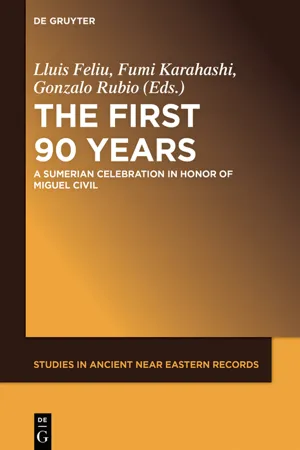
The First Ninety Years
About this book
This volume is dedicated to Miguel Civil in celebration of his 90th birthday. Civil has been one of the most influential scholars in the field of Sumerian studies over the course of his long career. This anniversary presents a welcome occasion to reflect on some aspects of the field in which he has been such a driving force.
Tools to learn more effectively

Saving Books

Keyword Search

Annotating Text

Listen to it instead
Information
Index of personal names discussed
This index does not generally include the names of major and well-known rulers who are repeatedly mentioned throughout the volume; e.g., Gudea is not listed, but Namhani is.
- A’akala 1 n. 2
- Abī-simtī 1, 2 n. 3
- A-bu-ba-qar 1
- A-da-lal3 1
- Aḫ-dam-ì-lí 1
- Aḫušuni 1
- Al-tuš 1
- A-lu-lu 1
- Ama-ša6 1
- A-pi-la-núm 1
- Aradmu 1
- Arad-Nanna 1, 2
- Ašgi-tillat-su(2) 1
- Ayakalla 1
- Babati 1
- Ba-ab-bu 1
- Baranamtarra 1
- Bazi 1, 2 n. 3
- Bēl-aḫḫā-iddina 1
- Bēlī-ašarēd 1
- Dukra 1
- E2-dag-ga 1 n. 2
- E2-mete 1
- En-Amar-Suenara-ki’ag-Anna 1
- Engar-zi 1, 2
- Enheduanna 1, 2
- En-me-šar2-ra 1
- Erra-ḫābiš 1 n. 2
- Erra-ḫābit 1
- Gan-ezem 1, 2
- Geme2-e2-dam 1
- Geme2-id2-edin-na 1
- Geme2-dNanše 1
- Geme2-šu 1
- Gisadu 1
- Ḫabit-Sîn 1
- IGI.RU?-NUN 1
- Iḫbit-alsin 1
- Iḫbit-elšunu 1
- Ibni-Adad 1
- Ilalum 1
- Ilum-ḫābil 1 n. 2
- Ilšu-muballiṭ 1
- Ip-qú-ša 1
- i-re-eb 1
- Itti-ilīya-aḫbut 1
- Karaindaš 1
- Ki-na-at-e2-a 1
- Ku8-ba-tum 1
- Kubātum 1
- Kudur-mabuk 1
- Kuli 1
- La-ma-ša 1 n. 2
- Lu-Enlila 1 n. 2
- Lu-Nanna 1 n. 2, 3
- Lū-šalim-belī 1
- Lugal-amar-ku3 1
- Lugal-ebansa 1 n n. 2
- Lugalkugzu 1, 2
- Lugal-niglagare 1
- Lu-kala 1 n. 2, 3 n. 4
- Lumma 1
- Lu-Nin-Šubur 1 n. 2
- Marduk-balāssu-ereš 1, 2
- Munus-sa6-ga 1
- Namhani 1, 2
- Nanna-kam 1
- Nanna-manšum 1
- Nanna-zišagal 1
- Namzitara 1
- dnanna-i3-gi 1
- Naplanum 1
- Nidupae 1
- Nin-guru7 1
- Nin-hedu 1
- Nin-munuszida 1, 2
- Ninšatapada 1, 2, 3, 4
- Nin-uru-da-kuš2 1
- Puduhepa 1
- Pu-lu-lu 1
- puzur4-ma-ma 1
- Rīm-Sîn 1
- Si-du3 1 n. 2
- Simat-Ištarān 1
- Sîn-šuma-iddina 1
- sú-me-ed-dingir 1
- Šaninga 1
- Šara-kam 1, 2 n. 3
- Šaratigubisin 1
- Šat-Suen 1
- Šaza-igizi-Abzu 1
- Šeš-kal-la 1
- d.aššir-gi4-al-su 1
- Šu-eš4-tár 1
- dŠu-Sîn-walid-dŠulgi 1 n. 2
- Šuziana 1
- Taddin-Eštar 1
- Takunai 1
- Tarām-Uram 1
- Tikla-ana-Marduk 1
- Tu-ra-a 1
- U3-dag-ga 1 n. 2
- Uqnitum 1
- Ur-gar 1
- Ur-Lama 1
- Ur-li 1
- Ur-Lisi 1
- Ur-meme 1, 2, 3, 4, 5
- Ur-mes 1
- Ur-nigar 1, 2, 3
- Ur-Nanše (dumu ur-li) 1, 2, 3
- Ur-Nungal 1 n. 2
- Ur-dšu-dsuen-an-dul3 1
- Ušumgal 1
- Zamena 1
- Zu-zu 1, 2 n. 3
1 It is no accident that this is the second volume devoted to honor him: see P. Michalowski, P. Steinkeller, E.C.Stone & R. L. Zettler, Velles paraules: Ancient Near Eastern Studies in Honor of Miguel Civil on the Occasion of his Sixty-Fifth Birthday (AuOr 9. Sabadell: Ausa, 1991).
2 Charles Fossey, Manuel d’assyriologie, II: Évolution des cuneiformes (Paris: Louis Conard, 1926).
3 Rykle Borger, Assyrisch-babylonische Zeichenliste (AOAT 33. Neukirchen-Vluyn: Neukirchener, 1978), p. VII.
4 This introduction draws from the biographical profile by Lluís Feliu, “Miquel Civil: d’exiliat cultural a sumeròleg,” Afers: Fulls de recerca i pensament 85 (2016): 631–663.
5 For a list of Miguel Civil’s publications prior to 1991, see his 65th-birthday Festschrift (Velles Paraules) in AuOr 9 (1991): 283–290.
6 Kleinerman (2014) explored mainly aspects of the role that literary letters played as part of the Old Babylonian school curriculum.
7 It is unclear, though, if such a thing is possible.
8 Ainsi LFBD Nr. 15 = AbB 10 : 15 etc.
9 L’expression ḫabtāk(u) « au secours ! » fait partie de la langue courante, comme le montrent les nombreux exemples cités par F. Joannès, ARM 26/2, p. 299 et Durand (1993), qui rendent librement l’expression par « quel scandale ! ». On entend encore très bien le sens littéral dans Eidem 2011 : 374, l. 9′′, où c’est un cri poussé par des prisonniers! Il me semble qu’on peut rattacher aussi à cet emploi šumma ana eqlim urrad lu ḫabitkum « s’il descend pour revendiquer le champ, qu’il soit ton prisonnier! », c’est à dire « fais-en ce que tu veux! » (de l’adversaire, et non du champ) PBS 7 : 11 = AbB 11 : 11, 22.
10 Le sumérien šub est ambigu : ‹ faire tomber › semble signifier «quand tu les mets sur l’aire » ou peut-être « quand tu les fais jouer de leur poids pour écraser les épis ». Comme dans ce témoin l’akkadien est primaire, on peut soupçonner – horresco referens – que c’est la proximité entre šuḫbut (akk.) et šubud (sum.), qui motive cette équivalence, qui semble unique! Comme le remarque Civil (1994 : 45), l’auteur force, dans les additions, la syntaxe sumérienne dans le moule de l’akkadien; il pourrait aussi avoir forgé ad hoc des monstres lexicaux. Comparer munu4 ḫu-bu-uš dug4-ab : buqlam ḫubuš « broie le malt » TIM 9 : 88, 11.
11 Tout comme dans la citation précédente (ex. 1a), l’akkadien n’est pas cohérent avec le sumérien, qui semble dire « les pattes des bœufs ne doivent pas être cassées » ou « elle (l’orge) est écrasée par les pattes des bœufs ». La correspondance n’est donc pas syntaxique mais purement lexicale (entre gaz et ḫabātu, encore une innovation, peu...
Table of contents
- Cover
- Title Page
- Copyright
- Andrew George, Edition of MS 3370
- Contents
- Preface
- Bibliography of Miguel Civil (1991–2016)
- Tabula Gratulatoria
- “As I write this letter to you”: An Attempt at the Letter from Nanna-manšum to Rīm-Sîn?
- À tâtons dans le noir : À la recherche du sens de ḫabātum
- “Enlil and Namzitara” Reconsidered
- ‘Let me be your canal’: some thoughts on agricultural landscape and female bodies in Sumero-Akkadian sources
- The Eridu Project (AMEr) and a Singular Brick-Inscription of Amar-Suena from Abū Šahrain
- The Silences of the Scribes, Pt. II: An Unfinished Enlil Lament from Nippur
- A New Seal of the Scribe Ur-Nanše from Girsu
- Texts and Workers
- Emesal studies today: a preliminary assessment
- Royal Nurses and Midwives in Presargonic Lagaš Texts
- The Hymn to the Ekur: Its Literary Structure and Cultic Background
- Game of Thrones: the Years when Šu-Sin Succeeded Amar-Suen in the Kingdom of Ur
- Literary Journeys from Babylonia to Assyria: Second Millennium Copies of a Bilingual Poem Concerning Ninurta
- New Data on Garšana and the Border Zone between Umma and Girsu/Lagaš
- A New Silver Balanced Merchant Account from Umma
- A Middle Babylonian Sumerian Fragment of the Adapa Myth from Nippur and an Overview of the Middle Babylonian Sumerian Literary Corpus at Nippur
- Sumerian Temples and Arabian Horses: On Sumerian e2-gal
- To Carry Coals to Newcastle or Observations Concerning Sign Formation as an Early Concept in Mesopotamian “Commentaries”
- Cuneiform Tablets and Other Inscribed Objects from Collections in Jerusalem
- On Images, Visibility, and Agency of Early Mesopotamian Royal Women
- Words and Grammar: Two Old Babylonian Lists
- The Seven Attendants of Hendursaĝa: A study of animal symbolism in Mesopotamian cultures
- The Abacus in Mesopotamia: Considerations from a Comparative Perspective
- Index of texts and compositions discussed
- Index of words and terms discussed
- Index of personal names discussed
Frequently asked questions
Yes, you can cancel anytime from the Subscription tab in your account settings on the Perlego website. Your subscription will stay active until the end of your current billing period. Learn how to cancel your subscription
No, books cannot be downloaded as external files, such as PDFs, for use outside of Perlego. However, you can download books within the Perlego app for offline reading on mobile or tablet. Learn how to download books offline
Perlego offers two plans: Essential and Complete
- Essential is ideal for learners and professionals who enjoy exploring a wide range of subjects. Access the Essential Library with 800,000+ trusted titles and best-sellers across business, personal growth, and the humanities. Includes unlimited reading time and Standard Read Aloud voice.
- Complete: Perfect for advanced learners and researchers needing full, unrestricted access. Unlock 1.4M+ books across hundreds of subjects, including academic and specialized titles. The Complete Plan also includes advanced features like Premium Read Aloud and Research Assistant.
We are an online textbook subscription service, where you can get access to an entire online library for less than the price of a single book per month. With over 1 million books across 990+ topics, we’ve got you covered! Learn about our mission
Look out for the read-aloud symbol on your next book to see if you can listen to it. The read-aloud tool reads text aloud for you, highlighting the text as it is being read. You can pause it, speed it up and slow it down. Learn more about Read Aloud
Yes! You can use the Perlego app on both iOS and Android devices to read anytime, anywhere — even offline. Perfect for commutes or when you’re on the go.
Please note we cannot support devices running on iOS 13 and Android 7 or earlier. Learn more about using the app
Please note we cannot support devices running on iOS 13 and Android 7 or earlier. Learn more about using the app
Yes, you can access The First Ninety Years by Lluís Feliu, Fumi Karahashi, Gonzalo Rubio in PDF and/or ePUB format, as well as other popular books in History & Middle Eastern History. We have over one million books available in our catalogue for you to explore.