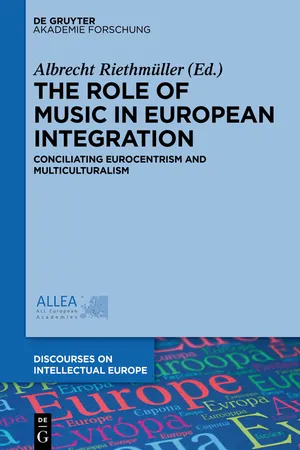
The volume focuses on music during the process of European integration since the Second World War. Often music in Europe is defined by its relation to the concept of Occidentalism (Musik im Abendland; western music). The emphasis here turns rather to recent manifestations of its evolvement in ensembles, events, musical organisations and ideas; questions of unity and diversity from Bergen to Tel Aviv, from Lisbon to Baku; and deals with the tension between local, regional and national music within the larger confluence of European music. The status of classical and avante-garde music, and to a degree rock and pop, during Europe's development the past sixty years are also reviewed within the context of eurocentrism – the domination of European music within world music, a term propagated by anthropologists and ethnomusicologists several decades ago and based on multiculturalism. Conversely, the search for a musical European identity and the ways in which this search has in turn been influenced by multiculturalism is an ongoing, dynamic process.
eBook - ePub
The Role of Music in European Integration
Conciliating Eurocentrism and Multiculturalism
- 267 pages
- English
- ePUB (mobile friendly)
- Available on iOS & Android
eBook - ePub
The Role of Music in European Integration
Conciliating Eurocentrism and Multiculturalism
About this book
Information
Subtopic
European Literary CriticismMusic in Europe Today – A Dialogue
Welcome, Introduction and Opening Statements
Günter Stock: As President of both the Berlin-Brandenburg Academy of Sciences and Humanities, where we are gathered, and of ALLEA, under whose auspices we are assembled today, I want to welcome you to this interesting and, as I hope, impactful meeting. Allow me to start by introducing ALLEA, and I will then say a few words about why I am pleased to see you all here.
ALLEA – All European Academies, the European Federation of Academies of Sciences and Humanities – is composed of almost sixty academies from more than forty countries in the Council of Europe region. Fundamentally, this means that our understanding of Europe goes beyond the political Europe as delineated by the EU. Our member academies include learned societies and think-tanks, but also research organisations of the type that Leibniz, the founding father of this academy’s predecessor, created. Our uniquely diverse membership structure becomes evident when we look at our member academies from countries like Ukraine or indeed other eastern European countries, which are all members, but whose academy system often differs from what we in Germany consider a ‘normal’ academy. Yet in the end, the structure of our academies is second to ALLEA’s understanding of Europe, bound together by historical, social and political factors, as well as for scientific and economic reasons. This effectively describes the mission of ALLEA, which was founded in 1994, much to the appreciation of the European Commission, which at the time encouraged a kind of Europe-wide cooperation of academies; this is why ALLEA often provides advice to the European Institutions on a wide range of policy matters. However, what we principally do is the promotion of exchange of knowledge between our member academies, encourage excellence and emphasise the necessity of high ethical standards in research conduct. We firmly believe that if we want to provide sound advice to political leaders, it must be grounded on inter- and transdisciplinary research.
Another pillar of our mission is safeguarding the autonomy of science. You might have noticed that recently many countries seem to have put a dangerous amount of stress on the autonomy of researchers, and even in Germany questions arose about the meaning of autonomy for universities. This autonomy is threatened in Turkey currently, it is threatened in Ukraine and it is threatened in Russia. These are all places where we try with words and arguments to help and to make proposals to consider how to gain and to regain the autonomy of science and scientists. We have found that in these situations it is often necessary to remind governments of the importance of autonomous science systems, and we have yielded good results with our discursive approach.
One of our primary interests is in what we call ‘policy for science’, in order to maintain and improve the conditions for science in Europe. When we say science, we don’t refer to the Anglo-Saxon understanding of science; we regard science in the sense of Wissenschaft as we do in Germany, where humanities, social sciences and, thus of course, also musicology is included. We have recently initiated a series of activities which we consider vital in raising the profile of the role of academia for European unity. For the first time we are sponsoring a prize this year, dedicated to an eminent scholar whose work is primarily concerned with European values and identity. The prize will be named in honour of Mme Anne Louise Germaine de Staël, a truly European woman whose contributions to European culture and international exchanges set an example to us all. We have come to the realisation that there are prizes for politicians and for intellectuals, but that there is not a prize for real scholars working in and working towards Europe. This prize, the first of many I hope, will be awarded by the President of the European Commission José Manuel Barroso in Brussels in April.
In addition to the Mme de Staël Prize, we seek to promote European social sciences and humanities through activities such as the one you are attending today. The results of this workshop will then become a book, as part of the series entitled Discourses on Intellectual Europe, where we illuminate the different facets of European identity creation in the wide variety of faculties within the social sciences and humanities.
To finish let me voice my appreciation for your attendance today and a big thank you to Prof. Riethmüller for undertaking this endeavour, including managing to gain funding for this workshop. I fully trust Prof. Riethmüller to deliver an outstanding product. After all, he has been a delegate to ALLEA for the Union of the German Academies of Sciences and Humanities for much longer than I have been around. We are already looking forward to what your contributions to ALLEA will look like in the future. So thank you very much for being here, thank you very much for what you have done and even more for what you are going to do.
Albrecht Riethmüller: Thank you very much, President Stock, for your warm welcome. Some 2000 years ago, the Plutarchian treatise On Music began with the statement that even the best military achievements are only able to guarantee safety for a single army, city or land but can do nothing to contribute to people’s character, the pursuit of happiness or to help all of mankind, which are only possible as a result of a zealous quest for education. The treatise was written in the form of a symposium in the Platonic tradition. Onesicrates hosted several such symposia, one of them on music, for which he invited experts in the field to join the discussion. The treatise is the only source from ancient Greece that comprehensively deals with the history of music – unique in European antiquity. We want to recall this to our memory when we now begin our dialogue on the state of music in Europe today, in order to examine its contribution to the European unification processes. In search of this goal, experts on music are gathered here together, as was the case with Onesicrates, and I thank all of you for coming and taking part in our discussion.
When we attempt to determine the position of music in the course of European integration, our concern is not to merely rely on history and tradition reaching back to the Middle Ages or even antiquity. On the contrary, we will be focussing on the years since the Second World War and the Holocaust – prerequisites for an ongoing economic, political and, finally, cultural process toward European assimilation, integration and unification. It is generally understood that European integration is at times beyond the political arena of the European Union: With respect to music, it would be nonsensical to exclude Russian art music from Europe as a result of the conflict between European East and West. Sacred orthodox or Byzantine music would be expelled from Europe if a certain concept of European music were to be limited to western music. And even in the first half of the twentieth century – as part of the racist Nazi perspective – Slavic music was banned from the European tradition.
We are assembled here together as a group of experts in a certain segment of the field of music – as musicologists. But a topic such as music and European integration does not merely require expertise in a certain field but also the consciousness of what Aristotle called ‘Zoon Politikon’ – the citizen as a social animal. Beyond being experts in the field, each of us should also feel responsibility in a political space. This is even more valid, since, with one exception, each of us holds the same passport as a citizen of the European Union. One doesn’t talk much anymore about the European passport, but rather after decades, takes it for granted. We hope that in our discussion, each one of us keeps both of these aspects in mind – that of being experts as well as citizens.
Let me briefly introduce the participants in our discussion in alphabetical order:
Thomas Betzwieser, Professor at the University of Frankfurt, is internationally renowned for his expertise in European opera and music theatre. His work on exoticism in music serves to complement our inclusion of multiculturalism in these talks. He is head of the OPERA project, which produces editions of selected European operatic works. Within the Academies’ Programme of the Union of the German Academies of Sciences and Humanities, it is the first project for the edition of musical scores of a transnational European character. The Academies’ Programme with a budget of ca. €60 million a year is earmarked for the social sciences and humanities, while a strong percentage of ca. 10 % goes exclusively to musicology. While most of the projects consist of complete editions of the scores of composers such as Bach, Weber, Schumann and Brahms, one of them is composed of several national branches of a post-war project of a transnational character: the Répertoire des Sources Musicales (RISM), a worldwide catalogue of musical manuscripts. When RISM was founded in Paris in 1952, the world and Europe (including the USA) were still regarded musically as being nearly synonymous. In recent years, another transnational European project has been included into the Academies’ Programme, namely Corpus monodicum, which deals with the monody, as opposed to the polyphony, of medieval music.
Federico Celestini began his university studies in his hometown of Rome and in the meantime is Professor and head of the musicology department at the University of Innsbruck. For several years he worked for projects at the University of Graz, specifically for the first Austrian Collaborative Research Center in the humanities, which was devoted to the analysis of modernism. The speaker of this Center and member of the Austrian Academy of Sciences, historian Moritz Csáky, never left any doubt that he saw in the multi-ethnic Austrian Hungarian monarchy a sort of blueprint or model for today’s European integration. In Innsbruck Federico is situated between middle and southern Europe, between Austria, Germany and Italy.
John Deathridge, Professor of Music at King’s College London and former president of the Royal Musical Association, is, aside from his specialization in music theory, sociology and the works of Theodor W. Adorno, most renowned as a Wagner expert. No composer since Richard Wagner has matched his strong impact on stage music, but also on European art and culture in general. In musical matters, the relationship between England and the continent has been somewhat unusual. In the middle of the nineteenth century there were still voices from the island proclaiming Great Britain to be the land without music due to a lack of internationally leading composers and compositions. On the other hand, London has always been if not the true centre then one of the most important centres of European musical life and of the European music market and industry.
Frank Hentschel, Professor at the University of Cologne, serves our round less because of his efforts on medieval music and theory, music of the twentieth century, or his most recent book on music in horror films. It is rather his work regarding the politics of the historiography of music in the nineteenth century that promises to assert an influence on our methodological questions in view of the concept of a European music, and likewise to provide critical assessments of our thoughts concerning such historical constructions.
Lawrence Kramer hails from New York City, where he is Distinguished Professor of English and Music at Fordham University, and is, so to speak, the control factor of our endeavor. He has a broad basis for this role, starting with the fifteen books he has written, his multidisciplinary approach, his creative talents as a composer, and, particularly for our purposes, his concern for art music in present day culture. His 2007 title Why Classical Music Still Matters is a landmark for this process of evaluation. To what extent does he, being a New Yorker, belong to European culture? It is said that New Yorkers are somehow foreign to the rest of America. When some thirty years ago a front page article in The New York Times appeared with the diagnosis of a general shift in American cultural, it asked whether in the near future at North American universities all piano professorships would be replaced by sitar professors. Several colleagues from the University of Illinois’s history department promptly replied that they viewed the USA still as a European colony. And until today, a shift from piano to sitar is nowhere to be seen.
Helga de la Motte-Haber, former Professor at the Technical University Berlin, is internationally acclaimed for her work in the fields of the psychology and aesthetics of music while embracing systematic and historical branches of musicology. She is predestined to join the round for a particular reason. In the fall of 1989, a few weeks after the fall of the Berlin wall with its enormous consequences for Europe and its integration, she hosted a conference at the European University Institute in Florence on national style and European dimension in music around 1900. During the exceptional situation of those weeks in 1989, none of the participants could foresee what would happen in the following tumultuous months.
Siegfried Oechsle is Professor at the University of Kiel, member of the Hamburg Academy of Sciences, the Royal Danish Academy of Sciences and Letters and of Academia Europaea. He also serves as acting head of the scientific committee of the Union of German Academies of Sciences and Humanities that decides which applications of new projects will be part of the Academies’ Programme mentioned above. In a certain way he is a counterpoint to Federico Celestini, due to his focus on the Scandianavian north, especially Denmark. Before his Kiel appointment, he was professor at Copenhagen University.
Mario Vieira de Carvalho joins us from Portugal, where he is Professor at the Nova University of Lisbon. He founded the Centre for the Studies of Sociology and Aesthetics of Music, served the Portuguese government as secretary for culture and is a member of the Academy of Sciences of Lisbon. Aside from his personal research agenda, situated at the most southwestern part of Europe, he is familiar with the traditional ties between Europe and Latin America, which in a post-colonial age gains new importance with respect to music.
Alongside these participants, several individuals are simultaneously hosts and organisers. Matthias Johannsen, the Academic Director of ALLEA and a graduate of political science, is someone I would like to address as a musician, knowing that he will modestly correct this to amateur musician. Frédéric Döhl, Franziska Kollinger and Julia H. Schröder are members of our musicology project within the Collaborative Research Center on aesthetic experience at the Free University Berlin, which is also a co-host to our workshop. Frédéric Döhl specialises in crossover and various cross-cultural issues, as seen by his dissertation on the performance practice of barbershop quartets and his 2012 monograph on Berlin-born composer, conductor, pianist and cosmopolitan Sir André Previn. In an age of both multiculturalism and globalisation, how do European and cosmopolitan attitudes relate to each other? Franziska Kollinger has worked on the musical interaction between France and Germany in the twentieth century, and Julia H. Schröder pursues the current musical avantgarde. Our project, initiated in 2003, dealt with the question of whether the diversification of music is able to save the classical music tradition and likewise combine it with musical innovations beyond its standard genres. The question of diversification and the role of music in European integration converge on the interrelationship between local, regional, national and global issues. Music is not a universal language, cannot be compared to a lingua franca and is definitely not an Esperanto of the soul. It is, however, shaped by ethnic diversity and the multifariousness of languages and cultures.
*****
The question often arises about the waning enthusiasm for Europe. Apparently many people sense a decline. However, to me it seems that this question has occurred permanently for the past fifty years. Since the very beginning of European unification, complaints about a lack of enthusiasm were widespread. Around his seventieth birthday in 2014, former German chancellor Gerhard Schröder insisted in a television interview that not only politics but also other fields are responsible for this deterioration. Culture and journalism, for example, should demonstrate that they are in favour of Europe and demonstrate what Europe means to us and what we can do for it. It is a crucial point, perfectly observed. For our discussion we only have to replace culture by music. What is this field willing and able to contribute to Europe? Is it an economic or a non-profit contribution? The music industry is not to be underestimated. Neither are the differences with regard to the varying importance of musical genres in individual countries. In the Anglo-Saxon world including Ireland, vocal music, songs and popular music in general have traditionally been world successes, while in German-speaking countries folkloristic and popular music hardly extend beyond regional exposure, while in the nineteenth century the German music industry did extremely well marketing Beethoven, Wagner and Brahms. In other words, where do we expect to place our musical contributions to Europe? Will the contribution gravitate more toward popular music or the elitist avant-garde? And is the encouragement for contributions to Europe in any way related to the complex question of identity?
Helga de la Motte-Haber: In asking about the relevance of music for cultural identity, I want to touch upon the question of the existence of a common cultural European identity, and how it can or cannot be enhanced by music. The Second World War, with the strong involvement of the USA as well as Japan, broadened a large proportion of the world’s view toward Europe. A single European nation is only a small section on the globe, a microscope is even needed to find it on the map. It is an oversimplification, but not a trivial one, to say that the idea of a unified Europe became a necessity due to a change in the proportions of the world. We are far away from a real cultural identity, for which a common language would be a guarantee. There’s no question that Germans, born in the centre of Europe in a country bordering many nations, should speak several languages. However, an...
Table of contents
- Cover
- Title Page
- Copyright
- Foreword by the Series Editor
- Contents
- Preface
- Music in Europe Today – A Dialogue
- Seid umschlungen, Millionen! – Zur Rezeption von Beethovens 9. Symphonie
- Be embraced, Millions! – On the Reception of Beethoven’s Ninth Symphony
- Europa-Hymnen – Musikalische Insignien von Verständigung und Identität
- European Anthems – Musical Insignia of Understanding and Identity
- Musikerausbildung in Deutschland und Frankreich/La formation du musicien en France et en Allemagne
- Musical Education in Germany and France
- Alternative Identitäten und popkulturelle Integration auf der Bühne des Eurovision Song Contest
- Alternative Identities and Pop Cultural Integration on the Stage of the Eurovision Song Contest
- European Opera as Viewed from a Distance
- Epilogue
- Appendices
- About the Authors
Trusted by 375,005 students
Access to over 1.5 million titles for a fair monthly price.
Study more efficiently using our study tools.
Frequently asked questions
Yes, you can cancel anytime from the Subscription tab in your account settings on the Perlego website. Your subscription will stay active until the end of your current billing period. Learn how to cancel your subscription
No, books cannot be downloaded as external files, such as PDFs, for use outside of Perlego. However, you can download books within the Perlego app for offline reading on mobile or tablet. Learn how to download books offline
Perlego offers two plans: Essential and Complete
- Essential is ideal for learners and professionals who enjoy exploring a wide range of subjects. Access the Essential Library with 800,000+ trusted titles and best-sellers across business, personal growth, and the humanities. Includes unlimited reading time and Standard Read Aloud voice.
- Complete: Perfect for advanced learners and researchers needing full, unrestricted access. Unlock 1.5M+ books across hundreds of subjects, including academic and specialized titles. The Complete Plan also includes advanced features like Premium Read Aloud and Research Assistant.
We are an online textbook subscription service, where you can get access to an entire online library for less than the price of a single book per month. With over 1.5 million books across 990+ topics, we’ve got you covered! Learn about our mission
Look out for the read-aloud symbol on your next book to see if you can listen to it. The read-aloud tool reads text aloud for you, highlighting the text as it is being read. You can pause it, speed it up and slow it down. Learn more about Read Aloud
Yes! You can use the Perlego app on both iOS and Android devices to read anytime, anywhere — even offline. Perfect for commutes or when you’re on the go.
Please note we cannot support devices running on iOS 13 and Android 7 or earlier. Learn more about using the app
Please note we cannot support devices running on iOS 13 and Android 7 or earlier. Learn more about using the app
Yes, you can access The Role of Music in European Integration by Albrecht Riethmüller in PDF and/or ePUB format, as well as other popular books in Media & Performing Arts & European Literary Criticism. We have over 1.5 million books available in our catalogue for you to explore.