- 314 pages
- English
- ePUB (mobile friendly)
- Available on iOS & Android
eBook - ePub
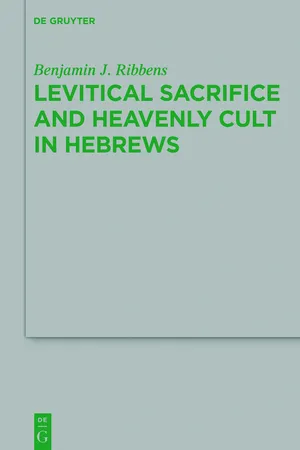
Levitical Sacrifice and Heavenly Cult in Hebrews
About this book
This monograph examines Hebrews' understanding of the relationship between old covenant sacrifices and Christ's new covenant sacrifice, especially as it relates to the question of efficacy. Most scholars think the author of Hebrews strips the levitical sacrifices of most, if not all, efficacy, but this work affirms a more positive depiction of the levitical sacrifices. A mystical apocalyptic tradition stands behind Hebrews' description of the heavenly cult , which establishes the framework for relating the levitical sacrifice to Christ's sacrifice. The earthly, levitical cult was efficacious when it corresponded to or synchronized with the heavenly sacrifice of Christ. Still, the author of Hebrews develops the notion of the heavenly cult in unique ways, as Christ's sacrifice both validates the earthly practice but also, due to his new covenant theology, calls for its end. Ribbens' bold proposal joins a growing number of scholars that place Hebrews in the mystical apocalyptic tradition, highlights positive statements in Hebrews related to the efficacy of levitical sacrifices that are often overlooked, and relies on the heavenly cult to reconcile the positive and negative descriptions of the levitical cult.
Information
1The Efficacy of Levitical Sacrifice Compared to Christ’s Sacrifice in Hebrews
Hebrews uses several comparisons between the old and new covenants to demonstrate that the new covenant inaugurated by Jesus is superior to the old covenant: the message spoken by the “Son” is superior to that spoken by the prophets (1:1–4); the Son is superior to the angels (1:5–14; 2:5–18); Jesus is greater than Moses (3:1–6); Jesus’s priesthood is superior to Aaron’s and the Levites’ (4:14–5:10; 7:1–28; 8:6); the heavenly sanctuary is greater and more perfect than the earthly sanctuary (8:4–6; 9:1–5, 11); the new covenant is better than the old (7:22; 8:6–13) and contains a better hope (7:19) and better promises (8:6); and Christ’s sacrifice is better than animal sacrifices (9:1–10:14). The comparison of sacrifices is the culmination of Hebrews’s comparisons, as it incorporates and is built upon previous comparisons. Christ, the high priest after the order of Melchizedek, offers a sacrifice of his own blood in the heavenly tabernacle, thereby inaugurating the new covenant, and his sacrifice is better than the animal sacrifices offered under the old covenant by the levitical high priest in the earthly tabernacle.
To compare the old covenant animal sacrifices with the new covenant sacrifice of Christ, the author of Hebrews must establish several points of continuity that indicate a legitimate comparison of similar things. For this reason, Hebrews goes to great lengths to pattern Christ’s sacrifice after the Day of Atonement, which, because it is the supreme atoning sacrifice, functions synecdochically to represent all atoning sacrifices. Since only the levitical high priest could perform the Day of Atonement rituals, Hebrews argues that Christ is a high priest after the order of Melchizedek (4:14–5:10; 7:1–28). Just as the levitical high priest passed through the tabernacle to enter the earthly Holy of Holies (9:7), so Christ passed through the heavenly tabernacle to enter the heavenly Holy of Holies (9:11–12). Jesus offered blood, just like the earthly high priest, to achieve purification (9:13–14), and, as the Day of Atonement was once a year, so Jesus’s sacrifice was once-for-all (ἅπαξ/ἐφάπαξ; 9:7, 12, 26–28).1
Yet, in the midst of this continuity, Hebrews also must establish several points of discontinuity to ultimately conclude that Christ’s sacrifice is better than the old covenant sacrifices. Christ’s sacrifice was not merely analogous to, but better than, levitical sacrifices. Several discontinuities are apparent within the particulars of the parallel sacrifices: (1) Christ’s sacrifice is in the heavenly sanctuary as opposed to the earthly (9:11–12); (2) Christ offers his own blood as opposed to the blood of animals (9:12–28); and (3) Christ’s sacrifice is once-for-all rather than repeated (9:12, 26–28; 10:11–14). Still, these points of discontinuity are only significant because they result in superior efficacy. Christ’s sacrifice is better than old covenant sacrifices because it accomplishes something that the old covenant sacrifices were not able to accomplish. Hebrews proclaims that the old covenant sacrifices were never able to perfect (τελειοῦν) the worshipers or their consciences (7:11, 19; 9:9; 10:1), they could not ultimately cleanse (καθαρίζειν) the one offering the sacrifice (10:2), and they were unable to take away sins (10:4,11) or the consciousness of sins (10:2). Christ’s sacrifice, in contrast, cleanses (καθαρίζειν) the conscience (9:14), takes away sins (9:26, 28), and makes perfect (τελειοῦν) those being sanctified (10:14). Based on these contrasting statements, most scholars quickly conclude that Hebrews considers old covenant sacrifices to be unable to atone for and forgive sins in contrast to Christ’s sacrifice, which accomplishes these salvific realities.2
1.1Two Tensions in Hebrews’s Cult Criticism
Hebrews’s statements regarding the inefficacy of the levitical sacrifices are a sharp criticism of the levitical institution, and two considerations make the severity of Hebrews’s cult criticism somewhat surprising and have led to negative evaluations of Hebrews’s sacrifice theology.
1.1.1Self-Contradictory Sacrifice Theology?
First, Hebrews’s cult criticism is surprising based on the fact that Christ’s sacrifice is patterned after the levitical sacrifices. One might expect the author to argue that Christ’s sacrifice had efficacy after the pattern of the levitical sacrifices, but the author emphasizes the inability of the levitical sacrifices. As a result, many scholars have noted the tension between Hebrews’s cult criticism and the employment of cultic imagery for Christ,3 and A. J. M. Wedderburn goes so far as to conclude that Hebrews’s sacrifice theology is self-contradictory. He picturesquely opens his article by stating, “It is not to be recommended when pruning or lopping trees: one should not saw off the branch on which one is sitting or supported.”4 Yet, Hebrews commits this exact error with its sacrifice theology according to Wedderburn. He argues that, based on Hebrews’s adoption of cultic imagery, “one gets the impression that the earthly cult of the Old Testament is along the right lines and follows the right principles and valid ones, as indeed one might expect if it was ordained by God.”5 However, the author of Hebrews later concludes that the old covenant sacrifices could not take away sins (10:4) and that God did not take pleasure in sacrifice (Ps 40:6–8 in Heb 10:5–10). In light of these critiques, “it becomes harder to treat Jesus’ offering of his body as in continuity with, and analogous to, those offerings, if indeed God wants nothing of the sort.”6 Thus, Hebrews, on the one hand, uses cultic imagery to explain the death of Christ, but, on the other hand, dismisses and criticizes the cult, thereby, as Wedderburn asserts, lopping off the branch it once sat on.7
1.1.2Malicious Reinterpretation of the LXX?
Second, the severity of Hebrews’s cult criticism is also surprising considering the author’s knowledge of and reverence for the LXX.8 Hebrews repeatedly quotes and alludes to the LXX, and it even introduces LXX quotations as the words of God.9 Further, Hebrews evidences a thorough knowledge of the levitical sacrifices as described in the LXX, and the LXX declares that the sin offering, burnt offering, and guilt offering made atonement (ἐξιλάσκεσθαι) and forgave (ἀφιέναι) sin.10 Further, the sin offering on the Day of Atonement atoned for all their sins (περὶ πασῶν τῶν ἁμαρτιῶν αὐτῶν) (Lev 16:16; cf. 16:30, 34). Thus, the LXX, which the author of Hebrews considers to be the words of God, ascribes to old covenant sacrifices an efficacy that Hebrews’s cult criticism appears to disallow.11 Whereas Hebrews states that the old covenant sacrifices could not take away sins (ἀφαιρεῖν ἁμαρτίας [10:4]; περιελεῖν ἁμαρτίας [10:11]), Leviticus states that the very purpose of sacrifice, specifically the sin offering, was to take away sins (ἀφέλητε τὴν ἁμαρτίαν [LXX Lev 10:17]). In addition, the author of Hebrews at times conflates sacrificial practices or speaks about sacrifice in general without distinguishing between different types of sacrifices. As a result of these issues, some scholars have concluded that Hebrews either ignored certain parts of the Pentateuch’s descriptions of the sacrifices,12 did not fully understand them,13 or manipulated them to present a negative view of Judaism and the superiority of Christianity.14
1.2Proposals
The tensions in Hebrews’s cult theology, which have led some to view Hebrews as self-contradictory and others to view the author as intentionally misinterpreting the Old Testament, raise several important questions. How does Hebrews understand the efficacy of the levitical sacrifices? How does Hebrews depict the efficacy of Christ’s sacrifice in comparison to the levitical sacrifices? What are the continuities and discontinuities between the old and new covenants as they relate to sacrifice?
Scholars have answered these questions in a variety of ways, and their proposals are listed below. While some of the proposals are mutually exclusive, many are not, and virtually no scholar holds only one of the following proposals. Instead, scholars mix and match the following possibilities.
1.2.1Different Kinds of Cleansing
Many scholars explain the relationship between old and new covenant sacrifices by ascribing different kinds of cleansing to each. Several such distinctions have been proposed.
1.2.1.1External v. Internal
The most common distinction is between external and internal purification. Hebrews describes the levitical ceremonies as “regulations for the body [σαρκός]” (9:10) and further contrasts old and new covenant sacrifices, stating, “For if the blood of goats and bulls, with the sprinkling of the ashes of a heifer, sanctifies those who have been defiled so that their flesh [σαρκός] is purified, how much more will the blood of Christ … purify our conscience [συνείδησιν] from dead works” (9:13–14).15 Based on these statements, many scholars conclude that old covenant sacrifices purified believers from external ceremonial pollution or defilement, whereas Christ’s new covenant sacrifice ...
Table of contents
- Cover
- Title Page
- Copyright
- Dedication
- Acknowledgements
- Contents
- List of Abbreviations
- 1 The Efficacy of Levitical Sacrifice Compared to Christ’s Sacrifice in Hebrews
- 2 Sacrifice Theology in Second Temple Judaism
- 3 Heavenly Cult in Second Temple Judaism
- 4 Heavenly Tabernacle and Cult in Hebrews
- 5 Old Covenant Sacrifices
- 6 New Covenant Sacrifice
- 7 Conclusion
- Appendix: Perfection in Second Temple Literature and the New TestamentLXX
- BibliographyPrimary Sources
- Index of References
- Index of Authors
- Index of Subjects
- Endnotes
Trusted by 375,005 students
Access to over 1.5 million titles for a fair monthly price.
Study more efficiently using our study tools.
Frequently asked questions
Yes, you can cancel anytime from the Subscription tab in your account settings on the Perlego website. Your subscription will stay active until the end of your current billing period. Learn how to cancel your subscription
No, books cannot be downloaded as external files, such as PDFs, for use outside of Perlego. However, you can download books within the Perlego app for offline reading on mobile or tablet. Learn how to download books offline
Perlego offers two plans: Essential and Complete
- Essential is ideal for learners and professionals who enjoy exploring a wide range of subjects. Access the Essential Library with 800,000+ trusted titles and best-sellers across business, personal growth, and the humanities. Includes unlimited reading time and Standard Read Aloud voice.
- Complete: Perfect for advanced learners and researchers needing full, unrestricted access. Unlock 1.5M+ books across hundreds of subjects, including academic and specialized titles. The Complete Plan also includes advanced features like Premium Read Aloud and Research Assistant.
We are an online textbook subscription service, where you can get access to an entire online library for less than the price of a single book per month. With over 1.5 million books across 990+ topics, we’ve got you covered! Learn about our mission
Look out for the read-aloud symbol on your next book to see if you can listen to it. The read-aloud tool reads text aloud for you, highlighting the text as it is being read. You can pause it, speed it up and slow it down. Learn more about Read Aloud
Yes! You can use the Perlego app on both iOS and Android devices to read anytime, anywhere — even offline. Perfect for commutes or when you’re on the go.
Please note we cannot support devices running on iOS 13 and Android 7 or earlier. Learn more about using the app
Please note we cannot support devices running on iOS 13 and Android 7 or earlier. Learn more about using the app
Yes, you can access Levitical Sacrifice and Heavenly Cult in Hebrews by Benjamin J. Ribbens in PDF and/or ePUB format, as well as other popular books in Theology & Religion & Biblical Criticism & Interpretation. We have over 1.5 million books available in our catalogue for you to explore.