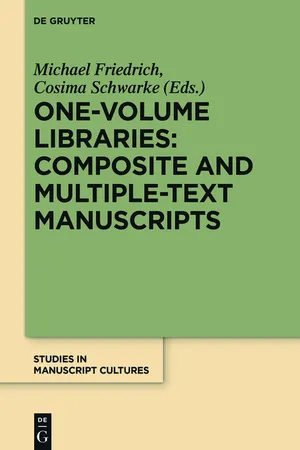
One-Volume Libraries: Composite and Multiple-Text Manuscripts
eBook - ePub

One-Volume Libraries: Composite and Multiple-Text Manuscripts

  1. 386 pages
  2. English
  3. ePUB (mobile friendly)
  4. Available on iOS & Android
eBook - ePub

One-Volume Libraries: Composite and Multiple-Text Manuscripts

About this book

Composite and multiple-text manuscripts are traditionally studied for their individual texts, but recent trends in codicology have paved the way for a more comprehensive approach: Manuscripts are unique artefacts which reveal how they were produced and used as physical objects.

While multiple-text manuscripts codicologically are to be considered as production units, i.e. they were originally planned and realized in order to carry more than one text, composites consist of formerly independent codicological units and were put together at a later stage with intentions that might be completely different from those of its original parts. Both sub-types of manuscripts are still sometimes called "miscellanies", a term relating to the texts only. The codicological difference is important for reconstructing why and how these manuscripts which in many cases resemble (or contain) a small library were produced and used.

Contributions on the manuscript cultures of China, India, Africa, the Islamic world and European traditions lead not only to the conclusion that "one-volume libraries" have been produced in many manuscript cultures, but allow also for the identification of certain types of uses.

Trusted by 375,005 students

Access to over 1 million titles for a fair monthly price.

Study more efficiently using our study tools.

Information

Publisher
De Gruyter
Year
2016
Print ISBN
9783110496932
eBook ISBN
9783110495591

Endnotes

1Gumbert 2004a, 21. A few days before this book went into print, the editors learned of the passing away of Johan Peter Gumbert. We dedicate this volume to his memory.
2Rosenthal 1955, 15.
3Thorndike 1946, 93–96.
4This distinction resembles the one given much earlier by the German medievalist Edward Schröder (1858–1942) in 1939 who distinguished between ‘Sammelhandschriften’ and ‘Miszellanhandschriften’: ‘[Miszellanhandschriften sind durch] Einreihung und Zusammenbinden, jedenfalls aber durch Mitwirkung mehrerer Schreiber zustandegekommen’, 169–70. Schröder suggested this classification already in 1924: ‘Von diesen sammelhandschriften im engern sinne, […], möchte ich unterscheiden die miscellanhandschriften, in denen man stücke ganz verschiedenen charakters […] zusammenfasste’ (1924, viii.). It was taken up by Arend Mihm, another German medievalist, in 1967 who introduced the terms ‘Faszikel’ for the components for the latter and ‘Zäsur’ for the borders between them, where discontinuity is observable. For an independent approach see the works by Pamela Robinson starting in 1978 with “The ‘Booklet’: Self-contained units in composite manuscripts of the Anglo-Saxon period” until up to 2008: “The Format of Books – Books, Booklets and Rolls”. – Further digging would probably unearth more observations of this kind, long before the more recent interest in codicology.
5‘Composite manuscript’ is still used in the same sense and with only limited attention to codicological features by Murray Evans 1995.
6For the first, see e.g. Arthur Bahr 2015, 182: ‘“miscellany” offers a practical way of designating a multi-text manuscript book whose contents exhibit a substantial degree of variety (of languages, genres, authors, literary forms, etc.).’
7In German studies, for example, the composite has come to be called ‘zusammengesetzte Handschrift’, while the other type retains the name ‘Sammelhandschrift’, but even this is not unambiguous, see Richtlinien Handschriftenkatalogisierung 1992, 12: ‘Sammelhandschriften, deren Teile zwar verschieden angelegt sind, sich aber doch dem Buchganzen einfügen (der Unterschied zu zusammengesetzten Handschriften ist oft nicht eindeutig zu fixieren) […].’ See, for instance, in recent studies: ‘“Sammelhandschrift” und “zusammengesetzte Handschrift” sind nicht synonyme Begriffe’. Karin Kranich-Hofbauer 2010, 320–21.
8Zumthor 1972, id. 1986, 96, fn. 49: ‘By mouvance I mean to indicate that any work, in its manuscript tradition, appears as a constellation of elements, each of which may be the object of variations in the course of time or across space. The notion of mouvance implies that the work has no authentic text properly speaking, but that it is constituted by an abstract scheme, materialized in an unstable way from manuscript to manuscript, from performance to performance.’
9Cerquiglini 1989 and 1999 (English translation).
10Nichols 1997, 10–11. – See an earlier article by the same author (“Introduction: Philology in a Manuscript Culture” (1990), where another context is provided: the marginalization of medieval studies by ‘modernist colleagues’ (1990, 2).
11Nichols and Wenzel 1996, 1.
12Nichols and Wenzel 1996, 2.
13Nichols and Wenzel 1996, 3.
14Shailor 1996, 153.
15Nichols has written several articles on what he calls the ‘manuscript matrix’, basically meaning the layout and the doubling of meaning by adding illuminations to the written text, see for example his contribution “What is a manuscript culture? Technologies of the manuscript matrix”, in Johnston and Van Dussen 2015, 34–59.
16Joshua Eckhardt 2009 is a fine example with detailed descriptions of selected manuscripts but again mainly focussing on texts.
17Conolly and Radulescu 2015, 1.
18Conolly and Radulescu 2015, 5.
19Conolly and Radulescu 2015, 15–16.
20Boffey and Edwards 2015, 264–265.
21Boffey and Edwards 2015, 278.
22Boffey and Edwards 2015, 273.
23Johnston and Van Dussen 2015, 3.
24Johnston and Van Duss...

Table of contents

  1. Cover
  2. Title Page
  3. Copyright
  4. Contents
  5. Introduction – Manuscripts as Evolving Entities
  6. The Medieval Codex as a Complex Container: The Greek and Latin Traditions
  7. Mravaltavi – A Special Type of Old Georgian Multiple-Text Manuscripts
  8. From Single-Text to Multiple-Text Manuscripts: Transmission Changes in Coptic Literary Tradition. Some Case-Studies from the White Monastery Library
  9. Composite and Multiple-Text Manuscripts: The Ethiopian Evidence
  10. Some Observations on Composite and Multiple-Text Manuscripts in the Islamic Tradition of the Horn of Africa
  11. ‘One-Volume Libraries’ and the Traditions of Learning in Medieval Arabic Islamic Culture
  12. From ‘One-Volume-Libraries’ to Scrapbooks. Ottoman Multiple-Text and Composite Manuscripts in the Early Modern Age (1400–1800)
  13. Śivadharma Manuscripts from Nepal and the Making of a Śaiva Corpus
  14. Manuscripts and Practices: Investigating the Tibetan Chan Compendium (P. Tib. 116)
  15. The Textual Form of Knowledge: Occult Miscellanies in Ancient and Medieval Chinese Manuscripts, 4th Century BCE to 10th Century CE
  16. Composite Manuscripts in Medieval China: The Case of Scroll P.3720 from Dunhuang
  17. Index
  18. Endnotes

Frequently asked questions

Yes, you can cancel anytime from the Subscription tab in your account settings on the Perlego website. Your subscription will stay active until the end of your current billing period. Learn how to cancel your subscription
No, books cannot be downloaded as external files, such as PDFs, for use outside of Perlego. However, you can download books within the Perlego app for offline reading on mobile or tablet. Learn how to download books offline
Perlego offers two plans: Essential and Complete
  • Essential is ideal for learners and professionals who enjoy exploring a wide range of subjects. Access the Essential Library with 800,000+ trusted titles and best-sellers across business, personal growth, and the humanities. Includes unlimited reading time and Standard Read Aloud voice.
  • Complete: Perfect for advanced learners and researchers needing full, unrestricted access. Unlock 1.4M+ books across hundreds of subjects, including academic and specialized titles. The Complete Plan also includes advanced features like Premium Read Aloud and Research Assistant.
Both plans are available with monthly, semester, or annual billing cycles.
We are an online textbook subscription service, where you can get access to an entire online library for less than the price of a single book per month. With over 1 million books across 990+ topics, we’ve got you covered! Learn about our mission
Look out for the read-aloud symbol on your next book to see if you can listen to it. The read-aloud tool reads text aloud for you, highlighting the text as it is being read. You can pause it, speed it up and slow it down. Learn more about Read Aloud
Yes! You can use the Perlego app on both iOS and Android devices to read anytime, anywhere — even offline. Perfect for commutes or when you’re on the go.
Please note we cannot support devices running on iOS 13 and Android 7 or earlier. Learn more about using the app
Yes, you can access One-Volume Libraries: Composite and Multiple-Text Manuscripts by Michael Friedrich, Cosima Schwarke, Michael Friedrich,Cosima Schwarke in PDF and/or ePUB format, as well as other popular books in Literature & Asian Literary Criticism. We have over one million books available in our catalogue for you to explore.