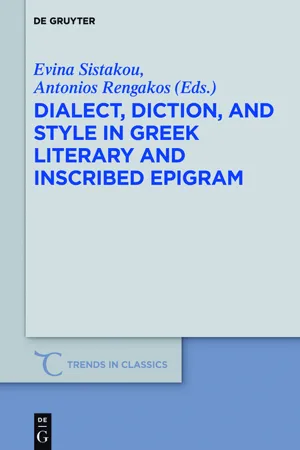
Language and style of epigram is a topic scarcely discussed in the related bibliography. This edition aspires to fill the gap by offering an in-depth study of dialect, diction, and style in Greek literary and inscribed epigram in a collection of twenty-one contributions authored by international scholars. The authors explore the epigrammatic Kunstsprache and matters of dialectical variation, the interchange between poetic and colloquial vocabulary, the employment of hapax legomena, the formalistic uses of the epigrammatic discourse (meter, syntactical patterns, arrangement of words, riddles), the various categories of style in sepulchral, philosophical and pastoral contexts of literary epigrams, and the idiosyncratic diction of inscriptions. This is a book intended for classicists who want to review the connection between the stylistic features of epigram and its interpretation, as well as for scholars keen to understand how rhetoric and linguistics can be used as a heuristic tool for the study of literature.?
eBook - ePub
Dialect, Diction, and Style in Greek Literary and Inscribed Epigram
- 435 pages
- English
- ePUB (mobile friendly)
- Available on iOS & Android
eBook - ePub
Dialect, Diction, and Style in Greek Literary and Inscribed Epigram
About this book
Information
Index
LiteratureEndnotes
| 1 | For Honestus see Jones 2004, 93–6; Bowie 2008 [2012], 236. |
| 2 | But for the absence of local dialect features from the works of both Theophanes and Crinagoras see Bowie 2011, esp. 195. |
| 3 | Cf. Magnelli 2007, 178. |
| 4 | οἷον δὴ τόκα πῶμα διεκρανάσατε, Νύμφαι, | βωμῷ πὰρ Δάματρος ἁλωίδος; ἇς ἐπὶ σωρῷ | αὖτις ἐγὼ πάξαιμι μέγα πτύον, ἃ δὲ γελάσσαι | δράγματα καὶ μάκωνας ἐν ἀμφοτέραισιν ἔχοισα. |
| 5 | Merkelbach-Stauber 2001, 08/01/36 = GVI 806. |
| 6 | The Doric forms are φιλωρείτᾳ (3) and ἅλῳ, ποτὶ, and ἔπαξαν (5). For a succinct and judicious statement of the debated relationship between this poem and the Arcades ambo of Vergil, Eclogue 7.1–5 see Clausen 1994. |
| 7 | Epic colour noted by Gow-Page 1968, 2.282–282. For a defence of the Palatinus’ αὐτᾶς and a rejection of Gow-Page’s emendation αἰπᾶς see Giangrande 1975, 41–42. |
| 8 | Merkelbach-Stauber 2001, 08/01/47 = GVI 1792 = IK 18.520: [τᾶς] ᾿Aφροδίτας ναός (1), ἐτερπόμαν (3), Ματροδώρου (8): ναός, regular in Attic tragedy, might well not be perceived as Doric. For the special case of personal names see Sens 2004, 73 with n.38. |
| 9 | Merkelbach-Stauber 2001, 08/01/45 (assigning to the late Hellenistic period) = GVI 1585 (assigning to the second or first century BC) = IK 18.516: Φερσεφόνα (1), θνατοὺς ἁλικίαν θεμένα (2), τᾷ (3), ἀλλοδαπὰν (5), δεικνυμένα (6), γενόμαν … λειπομένα (8), Φερσεφόνας (9), Λάθας λουσαμένα (10). |
| 10 | Merkelbach-Stauber 2001, 08/01/46 = GVI 1552 = IK 18.519 τὰν (1), ἀνδρολέταν (6). |
| 11 | Merkelbach-Stauber 2001, 08/01/33 = GVI 1816 = IK 18.492: δμαθεὶς (1), Λάθας (2) |
| 12 | Merkelbach-Stauber 2001, 08/01/34 = GVI 1610 = IK 18.494: ἁ … ποτὶ (1). |
| 13 | Merkelbach-Stauber 2001, 08/01/04. |
| 14 | CIG 3671 = Merkelbach-Stauber 2001, 08/01/07. On Nestor of Laranda see Ma 2007. |
| 15 | I set aside the sporadically Doric poems describing to mythological scenes represented on columns of the early second century BC temple of Apollonis, mother of Attalus and Eumenes of Pergamum: it seems clear that the 19 poems, constituting Book Three of the Palatine Anthology, are late, perhaps as late as Nonnus, cf. Demoen 1988, Cameron 1993, 148. |
| 16 | Gow-Page 1968, 2.117 rightly see his geographical references as confirming the ethnic ‘Byzantine’ attached to 24 poems, though they miss the mise-en-scène of Elaeous at xxiii (= AP 7.141). See also Robert 1979. |
| 17 | On these other dedications see Ypsilanti 2006. For an interesting proposal that Antiphilus xi GP (= AP 10.17) was a programmatic first poem in an Antiphilan collection and xvi (= AP 6.199) an epilogue see Höschele 2007, 360–361. |
| 18 | Gow-Page see this as an adaptation of the ‘proverbial phrase’ comparing the singing of larks and swans, AP 9.380.1 and Dioscorides xxxvi 5–6 Gow-Page (= AP 11.195.5–6). Konstan 2008, 296–7 suggests that Antiphilus’ point is that like Zeus he will be a singing bird – not indeed a swan, but ‘at all events’ a lark. This still lacks force, and I suggest there may also be a pun – with itacism κόρυδος can sound like κόρη δός, ‘Give, girl’. |
| 19 | Or perhaps Antiphilus has been reading the Iliou Persis of Stesichorus, a well-known poem, or that of the Argive poet Sacadas, still known to Athenaeus 13.610c some 150 years after Antiphilus, cf. Bowie 2014a. |
| 20 | For a discussion of this and the three other epigrams on Timomachus’ Medea see Gurd 2007. |
| 21 | IK 58.30 |
| 22 | IK 58.10. |
| 23 | IK 58.103.2. |
| 24 | Merkelbach-Stauber 2001, 09/05/04, 05, 06, 07 and 08 (on pages 159–163). |
| 25 | Cameron 1993, 316. |
| 26 | IK 9.85: Γ. Κάσσιος Φιλίσ|κος, Γ. Κασ|σίου ᾿Aσκληπιοδότου υἱός,| ζήσας ἔτη πγ. Cf. Bekker-Nielsen 2008, 112, |
| 27 | Bowie 2014b, 42–5. |
| 28 | But it does appear as a name in other provinces, e. g. in Egypt, Baillet 1920–1926, no. 1742. |
| 29 | C. Cassius Chrestus is described on his late first-century sarcophagus, found outside Nicaea’s East (Lefke) gate (for whose reconstruction between AD 70 and 81 he was responsible, IK 9.25), as πρέσβυ[ς καὶ] (or πρεσβύ̣[τερος]) | ἀρχιερεὺς καὶ σεβαστοφάντης̣ | ἐτῶν νηʹ, IK 9.116. |
| 30 | Merkelbach 1987, repeated Merkelbach and Stauber 2001, 159. |
| 31 | In this line the Palatinus reads ἢ, ‘or’, giving the feeble sense ‘who attained the highest honours for mind or for tongue’. Merkelbach-Stauber 2001, 160 translate ἢ ‘und’. I print and translate ᾗ, ‘just as’, which will of course have been indistinguishable from ἢ in the epigraphic text copied at Nicaea. |
| 32 | Bekker-Nielsen 2008, 28 n.3. Note also the Doric form γυνά in IK 9.225 Ὀλυμπιὰς Διονυσίου γυνὰ ἐτῶν σεʹ χαῖρε of which Robert Bull. 1980 no. 562 wrote that the woman ... |
Table of contents
- Cover
- Title
- Copyright
- Preface
- Table of Contents
- Dialect and Diction
- Form and Design
- Style in Literary Epigram
- Style in Inscribed Epigram
- List of Contributors
- Index
- Endnotes
Trusted by 375,005 students
Access to over 1.5 million titles for a fair monthly price.
Study more efficiently using our study tools.
Frequently asked questions
Yes, you can cancel anytime from the Subscription tab in your account settings on the Perlego website. Your subscription will stay active until the end of your current billing period. Learn how to cancel your subscription
No, books cannot be downloaded as external files, such as PDFs, for use outside of Perlego. However, you can download books within the Perlego app for offline reading on mobile or tablet. Learn how to download books offline
Perlego offers two plans: Essential and Complete
- Essential is ideal for learners and professionals who enjoy exploring a wide range of subjects. Access the Essential Library with 800,000+ trusted titles and best-sellers across business, personal growth, and the humanities. Includes unlimited reading time and Standard Read Aloud voice.
- Complete: Perfect for advanced learners and researchers needing full, unrestricted access. Unlock 1.5M+ books across hundreds of subjects, including academic and specialized titles. The Complete Plan also includes advanced features like Premium Read Aloud and Research Assistant.
We are an online textbook subscription service, where you can get access to an entire online library for less than the price of a single book per month. With over 1.5 million books across 990+ topics, we’ve got you covered! Learn about our mission
Look out for the read-aloud symbol on your next book to see if you can listen to it. The read-aloud tool reads text aloud for you, highlighting the text as it is being read. You can pause it, speed it up and slow it down. Learn more about Read Aloud
Yes! You can use the Perlego app on both iOS and Android devices to read anytime, anywhere — even offline. Perfect for commutes or when you’re on the go.
Please note we cannot support devices running on iOS 13 and Android 7 or earlier. Learn more about using the app
Please note we cannot support devices running on iOS 13 and Android 7 or earlier. Learn more about using the app
Yes, you can access Dialect, Diction, and Style in Greek Literary and Inscribed Epigram by Evina Sistakou, Antonios Rengakos, Evina Sistakou,Antonios Rengakos in PDF and/or ePUB format, as well as other popular books in Literature & Ancient & Classical Literary Criticism. We have over 1.5 million books available in our catalogue for you to explore.