This book is first of its kind to deal with the interwar Jewish emigration from Germany in a comparative framework and follows the entire migration process from the point of view of the emigrants. It combines the usage of social and economic measures with the individual stories of the immigrants, thereby revealing the complex connection between the socio-economic profile varieties and the decisions regarding emigration – if, when and where to. The encounter between the various immigrant-refugee groups and the different host societies in different times produced diverse stories of presence, function, absorption and self-awareness in the three major overseas destinations – Palestine, the USA, and Great Britain -- despite the ostensibly common German-Jewish heritage. Thus German-Jewish immigrants created a new and nuanced fabric of the German-Jewish Diaspora in its main three centers, and shaped distinct identifications and legacies in Israel, Britain, and the United States.
eBook - ePub
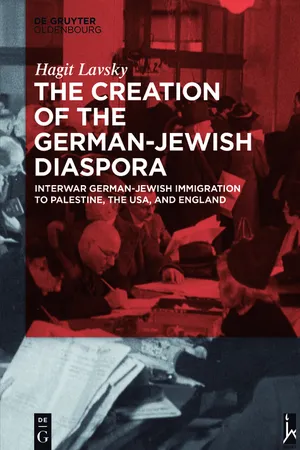
The Creation of the German-Jewish Diaspora
Interwar German-Jewish Immigration to Palestine, the USA, and England
- 166 pages
- English
- ePUB (mobile friendly)
- Available on iOS & Android
eBook - ePub
The Creation of the German-Jewish Diaspora
Interwar German-Jewish Immigration to Palestine, the USA, and England
About this book
Information
Chapter 1
History and Memory
In May 2004 an international conference took place in Mishkenot Sha’ananim, Jerusalem. Under the title “The Yekkes” (nickname used in Israel in reference to Jews of German origin), this conference was dedicated to the legacy of German Jews in Israel. The organizers had not anticipated the wide reverberations this conference would have among the older German-Jewish immigrants and their offspring. Hundreds of them, with their children and grandchildren, descendants of the wide German-speaking population in Israel, showed up to declare in public their German affiliation and to enjoy the recognition and reputation of their significance in Israel that this conference indeed expressed. Many of them could not find seats in the large conference hall; elderly men sat on the steps, others gathered in adjacent rooms with closed circuit television. Indeed, many expressed their anger regarding the organizers, and endeavored to discipline – quite typical for Yekkes – those who tried to squeeze themselves to the head of the queue.
The lectures delivered in this conference were published a year later.24 The title of the collection is a citation from the poem “Oren” (Pine Tree) by Lea Goldberg, which appears on the front page:
Perhaps only the wandering birds
While hanging between earth and sky
Do know this pain of two homelands25
Both the title of the conference and that of the volume share the feeling of uniqueness and incomplete integration of the immigrants in Israel, but differ in perspective. The conference title meant to emphasize the cultural significance of the German sector within the broad Israeli culture as viewed by others – negatively or positively – and expressed by the term “Yekkes.” The book’s title, however, transmits the editors’ perception that the German immigrants (like other immigrants, indeed, Goldberg refers to homelands other than Germany) never abandoned their loving connection with their German homeland, and never completely integrated in their new homeland, Israel. Indeed, the volume’s various parts reflect both approaches. On the one hand, the first part is titled “German-Jewish identity” and is dedicated to the baggage brought from there, from Germany, but the majority of the articles appear under the two following parts (German-Jewish identity in migration; The realms of Yekkes’ memory) are dedicated to the contribution of German immigrants to the cultural modernization in Israel, in the fields of art, theater, music, sports, the media, economics, and even in the realm of political diplomacy, and many more.
Until the 1990s, the epithet “Yekke” was used to express disrespect. It was meant to characterize the German Jews as totally different from the Eastern European Jews, as being restrained, square, pedant, arrogant and alienated. The source for this nickname is not clear. Some argue that it derives from the word Jacke in German (pronounced yakke), which means jacket, since the Yekkes always wore them with a tie despite the country’s summer heat. Others jokingly explain that the term is an acronym for yehudi keshe havana (slow-witted Jew). This epithet circulated only in Israel and not in other German-Jewish locales. This manifestation alludes to the unparalleled self-awareness of the immigrants from Germany. Yekke was directed exclusively to those who came from Germany, and not to any other German-speaking immigrant who originated in former regions of the Austro-Hungarian Empire whose everyday culture differed from that of the Germans, and who did not shoulder the baggage of mutual antipathy toward Eastern European Jews, the “Ostjuden.” The children of Yekkes did whatever they could to hide their origin and to wipe out any sign in their norms and manners that could identify them with what they considered to be the shameful alienation of their parents.26 Now, all of a sudden, the conference manifested that the Yekkes began to take pride of their title, and, moreover, descendants of German-speaking parents streamed to the conference, eager to be included among the Yekkes, to wear the title as a token of honor, apparently to declare – “we are not ashamed anymore but proud to be Yekkes, we enjoy its positive recognition and wish to continue to bear it gloriously into the future.”
The conference was the most outstanding in a series of expressions of this new pride pronounced by members of the second generation with the wish to promote recognition of their parents’ legacy as German Jews and their contribution to the building of the Jewish state, and to follow in their footsteps by implementing their cultural and social norms in Israeli society. The first event in this series was an exhibition on the German immigrants, inaugurated in 1993 to mark the 60th anniversary of the Central European immigration in the Fifth Aliya. The exhibition travelled between the three main cities – Tel Aviv, Jerusalem, and Haifa – accompanied by an illustrated catalogue.27 The titles in the catalogue testify to the spirit of the exhibition: Almost 30 percent turned to agriculture; Youth Aliya – a rescue and educational enterprise; Innovative initiative: the middle-class agricultural settlements; Nahariya – the pioneer of Western Galilee; New impetus of industrial development; Guesthouses and hotels; Reinvigoration of the health system; Pioneers of the welfare system; A place of honor in the judicial system; In all fields of academic research – a crucial contribution to the development of the Yishuv (the Palestine Jewish community); Outstanding intellectuals and educators; Central European immigrants in the Israeli media; The Yekkes in the arts; Prosperity in musical life; Volunteering for security services; In the service of state and society; In the diplomatic service. Only one title indicated the limits of pride: In politics – limited impact. Many observers were annoyed by the avoidance of many more areas of Yekke imprint, such as their share in the Kibbutz movement in general, and that of the religious Kibbutz in particular.
A decade later, in 2003, a new initiative appeared, the journal Yakinton (Hyacinth, the Hebrew term alludes to Yekke) of the Association of Israelis of Central European Origin (Yakinton: Mitteilungsblatt (MB) der Vereinigung der Israelis Mitteleuropäischer Herkunft. Hebrew: Irgun Yots’ei Merkaz Eropa). The greater part of the journal appears in Hebrew, but it also includes a German section. The founding editor was the journalist Micha Limor, a second generation descendent. It appears approximately every two months, and its issues include articles, memories, book reviews and testimonies mainly relating to the important contribution of the Yekkes to the country.
The journal reflects the dominating aspiration of the Association of Israelis of Central European Origin, headed by Reuven Merhav (also second generation) to bequeath the German-Jewish legacy to Israeli society. The Association launched a website, much of which aimed at documenting the German-Jewish imprint in Israel. One of many projects is the “Yekkes book” meant to collect, preserve and perpetuate the contribution of the Yekkes to the building and development of Israel.28 Other projects of the Association include the Museum at Tefen, originally established in 2004 by the industrialist Stef Wertheimer, which presents the activities and impact of the Yekkes and the German-Jewish culture on Israeli society. The Association also developed an educational program for teachers and instructors, focusing on German-Jewish legacy’s social and moral values relevant for implementation today: mutual responsibility, aspiration for excellence, education, public service based on proper, honest and transparent management, tolerance, and the acceptation of the Other.
All these initiatives signify the effort made by the second and third generations to reassure that the German immigration was a significant contribution to the Zionist epopee of building the national home, not less than their predecessors, the acclaimed pioneers of former immigration waves, in particular the Second Aliya (1904–1914) and the Third Aliya (1919–1923) from Russia. To regain Zionist dignity has become the basis for the on-going project to construct the Central European legacy as an indispensable asset for the present Israeli society. The publication of German-Jewish immigrant reminiscences opens their stories to the wider public and might compensate for past contempt and properly integrate their special individual and communal stories within the fabric of Israeli self-awareness. This trend is not unique to the Central European case in Israel, and exists in a variety of Israeli immigrant societies in the era of privatization and pluralism. What is special in the German-Jewish case is that the intention is not to repair and compensate for discrimination by the veteran elite, but to demand the integration of the German story within the heroic national narrative, to emphasize its importance in the Zionist epic and promote its potential for the general society, present and future.
The American and the British scenarios are totally different. In America it is difficult to find any obvious sign of German-Jewish identity. Indeed, the German-Jewish newspaper, Aufbau, established in 1934, continued to appear until 2004, but its distribution was extremely limited. Public events concerning the German-Jewish immigrants are rare. In 2004/5 the Jewish Museum in Baltimore displayed an exhibition documenting the history of the German refugees in that city.29 The Leo Baeck Institute in New York occasionally presents exhibitions or lectures concerning German-Jewish culture in general, not necessarily in connection with the German-Jewish immigration and life in the U.S.A. Groups that emphasize self-identity are limited to small circles, such as the Stammtisch (German for “regulars’ table,” an informal group meeting held on a regular basis) in New York where old German Jews meet with young Germans who are allowed to substitute their military service for national service aimed at supporting elderly Holocaust survivors; or the circle of Central-Europeans in Los Angeles.30 Other than these small contributions there are no visible efforts to emphasize or to foster accounts of the German-Jewish element as a unique component within pluralistic American society,31 except for books and exhibitions dedicated to the intellectual and artistic contribution of refugees from Nazi Germany to the American cultural and academic scene.32
The British situation is different. Here it is possible to see the intensive activity that documented and propagated information about the saga of German-Jewish refugees and their absorption and integration. In 2002 the Association of Jewish Refugees (AJR) presented an exhibition titled “Continental Britons,” based on 150 video interviews with Central Europeans who told their stories of immigration and integration. The exhibition, along with accompanying lectures and discussions, transmitted the following message clearly: “We came here as refugees, we have experienced all sort of difficulties getting out from Germany and getting settled in Britain, and we are grateful to the English people who welcomed us despite the difficulties and we are happy to have become British, although we admit that our origins and culture are quite part of us and noticeable to others.”33
In Britain, like in Israel, the German-Jewish organizations are actively documenting their immigration and settlement experiences, but the messages of their endeavors are extremely different. In Israel they strive to integrate their story into the national epic and to highlight their extraordinary contribution in the past and its potential contribution for the future. In Britain the message is the recognition of the British generosity and the gratefulness of refugees who will never forget their being refugees despite the success of integration.
Although there was much in common in the cultural and social character of the immigrants from Germany and much in common in their experiences in their various destinations, the different timings and circumstances of their emigration and of the social, cultural, economic and political situations at their destinations were more significant in creating the differences between these three German-Jewish Diasporas. Israel and Britain represent the two opposing poles on the absorption axis: the one is the outcome of self-perception of superiority and pride mixed with a sort of disappointment and drive for correction; the other is the outcome of refugee complex that is there to stay. The American case stands in between – no superiority and no complex. It is almost a disappearing historical chapter in the American-Jewish narrative. The different ways in constructing collective memory and in Landsmannschaft activity are directly connected with the processes of immigration and integration in the three destinations of the interwar German-Jewish migration, discussed in the following chapters
Chapter 2
Interwar Overseas Jewish Migration: An Overview
Changing Origins and Refugee Movements
World War I was a major turning point in the history of Jewish migration movement. The prewar era was marked by Jewish mass overseas immigration from Eastern Europe to the West. Within 40 years (1875–1914) about 2,200,000 Jews immigrated to overseas destinations, of whom about two thirds – 1,300,000 – went to the United States.34
The war hit the great Jewish settlement center in Eastern Europe directly and hard. In 1915 and 1916, Russian military authorities drove tens of thousands of Jews and German-speaking Protestants as potential collaborators into the interior of the country, German occupation troops conscripted thousands of Jews and Poles as forced laborers, and in the Habsburg monarchy, a refugee wave to Vienna and Budapest began after massive destruction in Galicia. Although the war ended in the West in 1918, a series of armed conflicts began after the collapse of the multiethnic empires in Eastern Europe that would last into the early 1920s. Millions of Eastern Europeans lost their homes, among them several hundred thousand Jews. Large groups succeeded in fleeing to the West, but there most of them stood before closed doors.35
The war interrupted the process of overseas migration for 68,000 immigrants, and immediately after the war it seemed that the mass immigration, particularly to the United States, was resumed, with 135,000 Jewish immigrants.36 However, fear of the spread of Bolshevism as well as explicit racist and anti-Semitic prejudices brought about a new restriction policy by the U.S.A. Other traditional immigration countries such as Cana...
Table of contents
- Cover
- Title Page
- Copyright
- Table of Contents
- List of Figures, Tables and Graphs
- Preface
- Introduction
- Chapter 1 History and Memory
- Chapter 2 Interwar Overseas Jewish Migration: An Overview
- Chapter 3 German Jewry in the Interwar Period and the Push Factors for Emigration
- Chapter 4 German-Jewish Emigration: Dimensions, Timing, Destinations
- Chapter 5 Demographic and Occupational Profile of the Immigrants
- Chapter 6 Towards Absorption of Mass Immigration from Germany: The Destination Perspective
- Chapter 7 The Encounter and Integration in Palestine
- Chapter 8 Encounter and Integration in the United States
- Chapter 9 Encounter and Integration in Britain
- Conclusion: A Comparative Analysis of Three Immigration Stories
- Sources and Bibliography
- Index
Trusted by 375,005 students
Access to over 1.5 million titles for a fair monthly price.
Study more efficiently using our study tools.
Frequently asked questions
Yes, you can cancel anytime from the Subscription tab in your account settings on the Perlego website. Your subscription will stay active until the end of your current billing period. Learn how to cancel your subscription
No, books cannot be downloaded as external files, such as PDFs, for use outside of Perlego. However, you can download books within the Perlego app for offline reading on mobile or tablet. Learn how to download books offline
Perlego offers two plans: Essential and Complete
- Essential is ideal for learners and professionals who enjoy exploring a wide range of subjects. Access the Essential Library with 800,000+ trusted titles and best-sellers across business, personal growth, and the humanities. Includes unlimited reading time and Standard Read Aloud voice.
- Complete: Perfect for advanced learners and researchers needing full, unrestricted access. Unlock 1.5M+ books across hundreds of subjects, including academic and specialized titles. The Complete Plan also includes advanced features like Premium Read Aloud and Research Assistant.
We are an online textbook subscription service, where you can get access to an entire online library for less than the price of a single book per month. With over 1.5 million books across 990+ topics, we’ve got you covered! Learn about our mission
Look out for the read-aloud symbol on your next book to see if you can listen to it. The read-aloud tool reads text aloud for you, highlighting the text as it is being read. You can pause it, speed it up and slow it down. Learn more about Read Aloud
Yes! You can use the Perlego app on both iOS and Android devices to read anytime, anywhere — even offline. Perfect for commutes or when you’re on the go.
Please note we cannot support devices running on iOS 13 and Android 7 or earlier. Learn more about using the app
Please note we cannot support devices running on iOS 13 and Android 7 or earlier. Learn more about using the app
Yes, you can access The Creation of the German-Jewish Diaspora by Hagit Hadassa Lavsky in PDF and/or ePUB format, as well as other popular books in History & 20th Century History. We have over 1.5 million books available in our catalogue for you to explore.