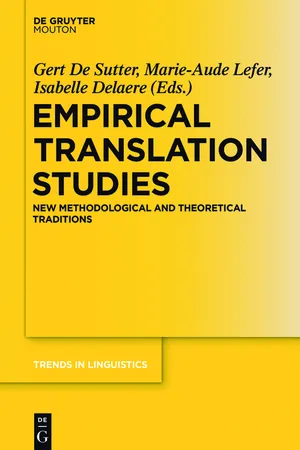
The present volume is devoted to the study of language use in translated texts as a function of various linguistic, contextual and cognitive factors. It contributes to the recent trend in empirical translation studies towards more methodological sophistication, including mixed methodology designs and multivariate statistical analyses, ultimately leading to a more accurate understanding of language use in translations.
eBook - ePub
Empirical Translation Studies
New Methodological and Theoretical Traditions
- 322 pages
- English
- ePUB (mobile friendly)
- Available on iOS & Android
eBook - ePub
Empirical Translation Studies
New Methodological and Theoretical Traditions
About this book
Information
Subtopic
LinguisticsSandra L. Halverson
1Gravitational pull in translation. Testing a revised model1
Abstract: The gravitational pull hypothesis was introduced as a possible explanation for some general features of translated language (Halverson 2003, 2010a), building on the cognitive semantic concept of semasiological salience in linguistic categories. The basic idea is that highly salient linguistic items (lexis or grammatical constructions) would be more likely to be chosen by translators and thus be overrepresented in translational corpus data. The hypothesis is being developed into a more comprehensive and detailed cognitive linguistic model to incorporate salience phenomena in both source and target language categories as well as the effects of entrenched links between translation pairs. This chapter presents preliminary investigations of central elements of the model using the polysemous verb get as a test case. Following a presentation of the revised model, the first stage of the analysis involves using independent empirical studies of get (Berez and Gries 2008; Johansson and Oksefjell 1996; Gronemeyer 1999) and of get and its Norwegian counterparts (Ebeling 2003) to establish a viable model of a bilingual (Norwegian-English) schematic network for this verb. In order to test this model in an online non-translation task, an elicitation test is run on Norwegian-English bilinguals. This provides further evidence of the salience structure within the target language category in these bilinguals. In the second stage, corpus data from the English-Norwegian parallel corpus and Translog performance data are analyzed to look for evidence of the hypothesized effects. The empirical results are discussed both in terms of the evolving cognitive model and in terms of the contribution of various data types to testing cognitive theoretic notions.
1Introduction
Twenty-odd years have passed since Baker’s (1993) call for corpus linguistic investigation of aggregate patterns in, or features of, translated language (‘translation universals’). In that period, a body of research has provided evidence of some of the proposed features, e.g. simplification, generalization, normalization/conventionalization, interference (see Laviosa 2009, 2011; Chesterman 2011a for overviews). While the empirical results are not conclusive on all accounts, the viability of this research paradigm seems evident. As the field develops, the fundamental starting point of the research paradigm remains constant: the idea that translated language is in some way distinct, that it demonstrates characteristics that make it different from language that is not the result of a translation process. This idea underlies Toury’s laws of translational behavior (1995) as well as Baker’s universals (see Pym 2008). It is also related to the concept of so-called translationese (Gellerstam 1986; Santos 1995) and the notion of a third code (Frawley 1984) or hybrid text (Schäffner and Adab 2001).
As part of the emerging paradigm of Corpus-Based Translation Studies (CBTS), empirical investigations have been accompanied by work querying some aspects of the universals framework (see especially the papers in Anderman and Rogers 2008; Kruger et al. 2011, Mauranen and Kujamäki 2004; Oakes and Ji 2012; Xiao 2010). The question of whether or not the postulated features are unique to translated language is one that has also been the subject of some discussion, and this question too is receiving renewed attention (e.g. Halverson 2003, 2010b, 2015b; Lanstyák and Heltai 2012; Mauranen 2004/5), though the issue remains unresolved empirically.
Quite recently, corpus-based translation studies (CBTS) has emerged as the locus of a new phase of methodological innovation. This innovation is characterized by the use of advanced statistical methods (see e.g. current volume and Oakes and Ji 2012; Delaere et al. 2012; Cappelle and Loock 2013; Delaere and De Sutter 2013; Vandevoorde 2016) and mixed methods research (e.g. Alves et al 2010; Hansen 2003).
While much has happened since the late 1990s and early 2000s, it is fair to say that the most substantial gains have been empirical and methodological ones. The addition of individual studies has meant that more patterns have been studied across additional language pairs. More advanced statistical tools are facilitating more in-depth and robust investigations of the linguistic data. It is also fair to say, however, that these empirical gains have not been accompanied by equally striking developments in theory. Here progress has been more modest and incremental.
At present there are two main approaches taken to the problem of explaining translational patterns. These two are socially and cognitively oriented, respectively. In the former domain, Pym (2005) has suggested that translators are risk averse, and that this may account for some of the patterns demonstrated, e.g. explicitation. This is described as a socially motivated explanation because the propensity for risk aversion is motivated by employment conditions, status, features of the communicative situation, and other social contingencies (2005: 34). With a basis in systemic functional linguistics, Steiner (2001, 2012), Alves et al (2010), Neumann (2014), and Teich (1999, 2003) seek explanations in either register (in what might be considered a proxy for social forces) or in characteristics of a language system or a pair of systems. For instance, in Teich (2003), patterns of normalization and shining-through in translated text are linked to register characteristics and to particulars of the differences between German and English. Register is also a key variable in Kruger and van Rooy (2012) and Delaere and De Sutter (2013).
As regards cognitive explanations, there are two main alternatives: the relevance-theoretical account advanced by Alves and Gonçalves (2003, 2007) and the cognitive grammatical one proposed in Halverson (2003, 2007, 2010b). There are fundamental differences in the two approaches, despite their common cognitive orientation and a shared interest in developing a “psychologically plausible account of communication” (Evans and Green 2006: 463). The most important differences lie in a set of underlying assumptions concerning learning mechanisms (relevance theory adopts a nativist assumption, and cognitive grammar does not), and the relationship between language and general cognitive processes (relevance theory assumes a separate language module, while cognitive grammar does not). The two also differ in that relevance theory requires a distinction between linguistic and non-linguistic knowledge, while cognitive grammar assumes the converse (for comparison of the two approaches, see Evans and Green 2006: 463–465). For the present author, the case for a cognitive grammar approach is more compelling, and it is this framework that is adopted.
The aim of this chapter is to present preliminary tests of the expanded model that is emerging from the original gravitational pull hypothesis. The tests are to be considered preliminary in that the key relationships are not modelled in their full complexity, and in that new data types are being tried in this type of investigation (an elicitation test and keystroke logs). Finally, the statistical tests used are quite simplistic. The objective is to use these rather simple tools to inform more refined statistical modelling at a later stage.
In section 2, the current, expanded version of the gravitational pull hypothesis will be sketched out. In section 3, a test case is outlined, and a network structure is postulated for the selected bilingual verbal category on the basis of non-translational data. Section 4 presents predictions based on the posited structure and tests of these predictions using translational corpus and keystroke data. The results are discussed in section 4.4, and section 5 includes concluding remarks.
2The gravitational pull hypothesis revised: three sources of translational effects
The gravitational pull hypothesis was originally derived from the theory of Cognitive Grammar and certain assumptions about how this theory could be extrapolated to make it compatible with relevant models of bilingual semantic and syntactic representation (Halverson 2003). Later revisions have also incorporated findings from studies of bilingualism (Brysbaert et al. 2014; Halverson 2010a; Hartsuiker et al. 2004; Hartsuiker 2013; Kroll and Stewart 1994; Pavlenko 2009). Particular emphasis is also placed on current knowledge of bilingual cognition and crosslinguistic influence (Bassetti and Cook 2011; Jarvis and Pavlenko 2008). As a consequence, the current version of the hypothesis is more firmly grounded in the multicompetence perspective (Cook 2003), which emphasizes that linguistic cognition in bilinguals is qualitatively different from that in monolinguals. On this view, “[. . .] people who know more than one language have different knowledge of both their first and second languages from monolingual speakers of either (Cook 2003) [. . .]” (Bassetti and Cook 2011: 144). Within this framework, it has been demonstrated that not only do linguistic categories in bilingual speakers differ from those of monolingual speakers, they also change structure throughout these speakers’ linguistic life history. This dynamically developing competence is reflected in language performance at all linguistic levels (Bassetti and Cook 2011; Jarvis and Pavlenko 2008; Pavlenko 2009). The methodological consequence of this starting point is that in modelling linguistic categories in bilinguals, it is not sufficient to consider monolingual data alone.
As originally presented, the gravitational pull hypothesis assumed a cognitive grammatical model of semantic structure. In this account, all linguistic items constitute form-meaning pairings (Langacker 1987: 76), and both form and meaning are represented cognitively. Form is taken to be either graphemic or phonological, and meaning (conceptualization), in turn, is accounted for through reference to conceptual content and processes of construal (Langacker 1987: 99–146). Conceptualizations which have been used enough to become entr...
Table of contents
- Cover
- Title
- Copyright
- Table of contents
- Introduction
- 1 Gravitational pull in translation. Testing a revised model
- 2 The impact of translation direction on characteristics of translated texts. A multivariate analysis for English and German
- 3 Variability of English loanword use in Belgian Dutch translations. Measuring the effect of source language and register
- 4 The effects of editorial intervention. Implications for studies of the features of translated language
- 5 Phraseological patterns in interpreting and translation. Similar or different?
- 6 Contrasting Terminological Variation in Post-Editing and Human Translation of Texts from the Technical and Medical Domain
- 7 Exploratory Analysis of Dimensions Influencing Variation in Translation. The case of text register and translation method
- 8 Typological differences shining through. The case of phrasal verbs in translated English
- 9 English-German contrasts in cohesion and implications for translation
- Index
Trusted by 375,005 students
Access to over 1.5 million titles for a fair monthly price.
Study more efficiently using our study tools.
Frequently asked questions
Yes, you can cancel anytime from the Subscription tab in your account settings on the Perlego website. Your subscription will stay active until the end of your current billing period. Learn how to cancel your subscription
No, books cannot be downloaded as external files, such as PDFs, for use outside of Perlego. However, you can download books within the Perlego app for offline reading on mobile or tablet. Learn how to download books offline
Perlego offers two plans: Essential and Complete
- Essential is ideal for learners and professionals who enjoy exploring a wide range of subjects. Access the Essential Library with 800,000+ trusted titles and best-sellers across business, personal growth, and the humanities. Includes unlimited reading time and Standard Read Aloud voice.
- Complete: Perfect for advanced learners and researchers needing full, unrestricted access. Unlock 1.5M+ books across hundreds of subjects, including academic and specialized titles. The Complete Plan also includes advanced features like Premium Read Aloud and Research Assistant.
We are an online textbook subscription service, where you can get access to an entire online library for less than the price of a single book per month. With over 1.5 million books across 990+ topics, we’ve got you covered! Learn about our mission
Look out for the read-aloud symbol on your next book to see if you can listen to it. The read-aloud tool reads text aloud for you, highlighting the text as it is being read. You can pause it, speed it up and slow it down. Learn more about Read Aloud
Yes! You can use the Perlego app on both iOS and Android devices to read anytime, anywhere — even offline. Perfect for commutes or when you’re on the go.
Please note we cannot support devices running on iOS 13 and Android 7 or earlier. Learn more about using the app
Please note we cannot support devices running on iOS 13 and Android 7 or earlier. Learn more about using the app
Yes, you can access Empirical Translation Studies by Gert De Sutter, Marie-Aude Lefer, Isabelle Delaere, Gert De Sutter,Marie-Aude Lefer,Isabelle Delaere in PDF and/or ePUB format, as well as other popular books in Languages & Linguistics & Linguistics. We have over 1.5 million books available in our catalogue for you to explore.