- 321 pages
- English
- ePUB (mobile friendly)
- Available on iOS & Android
eBook - ePub
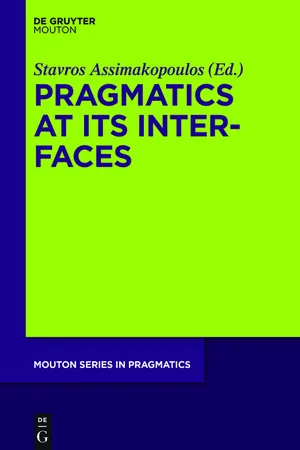
Pragmatics at its Interfaces
About this book
All of the papers included in this volume offer some novel and/or updated perspective on issues of central importance in pragmatics, suggesting original ways in which research in the particular areas they adhere to could advance. Apart from the obvious aim of motivating further discussion on the topics it touches on, a central objective of this volume is to underline that research in pragmatics can and does substantially inform research in numerous other fields of enquiry, namely philosophy, cognitive science, linguistics and conversation analysis, revealing in this way the truly interdisciplinary nature of pragmatics theorizing. In this respect, and given that most of the contributions in this volume are from leading scholars in their respective fields, it is clearly expected that the ideas put forth in this volume will have a profound and long-lasting impact for future research in the area.
Information

IIIPragmatics and linguistic analysis
Enikő Németh T.
9Theoretical and methodological issues in the research into implicit arguments in Hungarian
Acknowledgements: The research reported on in the present paper was supported by the Hungarian Scientific Research Fund OTKA NK 100804 Comprehensive grammar resources: Hungarian, as well as by the MTA-DE Research Group for Theoretical Linguistics. I wish to thank Csilla Rákosi for her remarks and suggestions which helped me clarify some issues. I also want to express my gratitude to Anna Fenyvesi and Stavros Assimakopoulos for correcting my English.
Enikő Németh T., University of Szeged, Hungary
Abstract: Based on my research in the area, the present paper intends to argue for a complex approach which can provide an adequate theoretical background for the explanation of the occurrence and identification of verbal implicit arguments in Hungarian. This complex approach analyses implicit arguments in utterances of language use, taking into consideration the interaction between grammatical and contextual factors. So, it makes available those implicit arguments which are usually excluded from the description in sentence-oriented accounts. Apart from this, the proposed complex approach integrates data from various data sources as well. All in all, it is argued that the assumption of an interaction between grammar and pragmatics, the investigation of implicit arguments in utterances rather than just sentences, and the use of data from various sources can result in a more complete and plausible account of implicit arguments in Hungarian.
1Introduction
Critical evaluation of the literature on implicit arguments in different languages has attested that purely syntactic, pragmatic and lexical-semantic explanations are inadequate to account for the occurrence of verbs with implicit arguments and the interpretation possibilities of lexically unrealised arguments (cf. Cote 1996; Goldberg 2005a, 2005b; Németh T. 2010). The criticism put forth in these explanations has led researchers to develop complex approaches, which consider both grammatical and contextual information (cf. García Velasco and Portero Muñoz 2002; Goldberg 2005a, 2005b; Németh T. 2010, 2012, 2014a, 2014b). Arguably, the examination of implicit arguments in such complex approaches makes it possible to explain various phenomena which cannot be accounted for in purely syntactic, pragmatic and lexical-semantic approaches, as complex approaches can provide an adequate theoretical background for the description of the interaction between grammatical and contextual factors, by combining contextual factors and grammatical requirements. Furthermore, they also make it possible to extend the scope of the relevant investigation beyond the boundaries of the sentence, considering implicit arguments in utterances of language use, which are typically excluded from purely syntactic and lexical-semantic explanations. So, a significant amount of previously non-supporting evidence can become supporting data for theoretical purposes.
In the present paper, I aim to discuss three issues related to research into implicit arguments in Hungarian. First, if contextual factors influence the occurrence and identification of implicit arguments, we have to accept that there is an intensive interaction between grammar and pragmatics in the course of the use and interpretation of implicit arguments. Second, assuming that such an interaction exists, implicit arguments cannot be accounted for in sentential environments. So, various occurrences of implicit arguments in Hungarian, which are judged ungrammatical in sentence-oriented accounts, can be easily interpreted in utterance contexts. Moreover, even if the utterance context cannot provide the necessary information for the identification of implicit arguments, it can be extended by incorporating information from previous discourse, physical, and/or encyclopedic context.74 And, third, if implicit arguments are investigated in the context of their utterance, it seems appropriate to research them on the basis of data collected from various sources, such as intuition, spoken and written corpora, as well as thought experiments.
Against this background, the organisation of my paper is as follows. In Section 2, I present the terminological diversity that is characteristic of the literature on implicit arguments and critically discuss some aspects of purely syntactic, pragmatic and lexical-semantic explanations of verb occurrences with implicit arguments with a view to showing that complex approaches are necessary. In Section 3, I discuss the three aforementioned theoretical and methodological reasons for opting for a complex approach and exemplify them on the basis of my research into implicit arguments in Hungarian. Finally, in Section 4, I summarise my conclusions.
2Purely syntactic, pragmatic and lexical-semantic explanations
2.1Terminological diversity
Since the well-known seminal papers by Fodor and Fodor (1980), Dowty (1981), and Fillmore (1986), a wide range of contributions have focused on the behaviour of verbs with lexically unrealised, syntactically missing complements/arguments in English. The term verbal complement is mostly applied in syntactically-oriented approaches to indicate syntactically required verbal constituents such as subject, direct object, and indirect object arguments (see, for example, Haegeman and Guéron 1999). In this picture, the syntactic valence of a verb determines what syntactic complements are needed in order for it to form a grammatical sentence (Cornish 2005: 21−23). For instance, in a grammatical sentence, the English verb lock requires two syntactic constituents, a subject and a direct object complement, as in (1), where Mary is the subject and the noun phrase the door is the direct object.
(1)Mary locked the door.
That said, the term complement cannot only be used in the sense of a syntactic constituent but also in that of a semantic one (see, for example, Fillmore 1986; Cornish 2005). In the semantic sense, a verbal complement is a lexical-semantic entity which is determined by the semantic valence of the verb as a predicate (Cornish 2005: 21−23). The semantic valence of a verb, now, refers to the number and role of the participants of the event or situation described by it.
Naturally, it is not necessary to have a one-to-one correspondence between the syntactic and semantic valences of a verb. For example, from the point of view of semantic valence, the verb eat is a two-place predicate which can be syntactically instantiated as a verb with a subject and a direct object.
(2)John is eating an apple.
In the occurrence of the verb eat in (2), there is a one-to-one correspondence between semantic and syntactic valences, since both participants of the event that eat denotes are syntactically realised and lexically instantiated. However, eat can also be instantiated syntactically with a subject and no direct object, as in (3):
(3)John is eating.
Here, the semantic and the syntactic valences of the verb eat diverge. The syntactic valence is reduced to one, while the semantic one remains at two, as the meaning of the verb eat always involves that participant of the eating event which is the object of eating, even when this is not syntactically realised.
Similar to the twofold interpretation of the term verbal complement, the term verbal argument – very often used as a synonym to verbal complement – is also ambiguously used in linguistics. The ve...
Table of contents
- Cover
- Title Page
- Copyright
- Contents
- I Pragmatics and philosophy
- II Pragmatics and cognition
- III Pragmatics and linguistic analysis
- IV Conversation analysis
- Index
Trusted by 375,005 students
Access to over 1.5 million titles for a fair monthly price.
Study more efficiently using our study tools.
Frequently asked questions
Yes, you can cancel anytime from the Subscription tab in your account settings on the Perlego website. Your subscription will stay active until the end of your current billing period. Learn how to cancel your subscription
No, books cannot be downloaded as external files, such as PDFs, for use outside of Perlego. However, you can download books within the Perlego app for offline reading on mobile or tablet. Learn how to download books offline
Perlego offers two plans: Essential and Complete
- Essential is ideal for learners and professionals who enjoy exploring a wide range of subjects. Access the Essential Library with 800,000+ trusted titles and best-sellers across business, personal growth, and the humanities. Includes unlimited reading time and Standard Read Aloud voice.
- Complete: Perfect for advanced learners and researchers needing full, unrestricted access. Unlock 1.5M+ books across hundreds of subjects, including academic and specialized titles. The Complete Plan also includes advanced features like Premium Read Aloud and Research Assistant.
We are an online textbook subscription service, where you can get access to an entire online library for less than the price of a single book per month. With over 1.5 million books across 990+ topics, we’ve got you covered! Learn about our mission
Look out for the read-aloud symbol on your next book to see if you can listen to it. The read-aloud tool reads text aloud for you, highlighting the text as it is being read. You can pause it, speed it up and slow it down. Learn more about Read Aloud
Yes! You can use the Perlego app on both iOS and Android devices to read anytime, anywhere — even offline. Perfect for commutes or when you’re on the go.
Please note we cannot support devices running on iOS 13 and Android 7 or earlier. Learn more about using the app
Please note we cannot support devices running on iOS 13 and Android 7 or earlier. Learn more about using the app
Yes, you can access Pragmatics at its Interfaces by Stavros Assimakopoulos in PDF and/or ePUB format, as well as other popular books in Languages & Linguistics & Linguistics. We have over 1.5 million books available in our catalogue for you to explore.