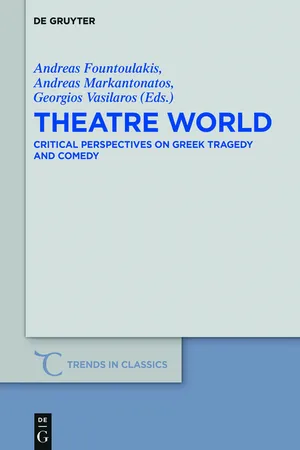
This collection of essays, published in honour of Professor Georgia Xanthakis-Karamanos, addresses topics which lie at the forefront of current research on the fields of Greek drama and classical reception studies. It brings together internationally distinguished scholars who provide fresh insights into issues pertaining to the origins of Greek tragedy and comedy, their generic identity, the structure, the morality or the divine and human characters emerging from individual plays, the presence of Greek drama outside Athens in post-classical times, the associations between drama and genres such as epic and oratory or even the reception of Greek drama in operatic works such as Wagner's Tristan und Isolde. Related art forms, such as music, receive particular attention. Focusing on either broader topics or specific texts, the essays of this volume provide a wide range of theoretical perspectives often combining modern critical trends such as reception studies, narratology or cultural studies with close and acute readings of individual passages. The volume is of particular interest to scholars and students of Greek drama and its reception as well as to anyone interested in Greek culture and its various manifestations.
eBook - ePub
Theatre World
Critical Perspectives on Greek Tragedy and Comedy. Studies in Honour of Georgia Xanthakis-Karamanos
- 387 pages
- English
- ePUB (mobile friendly)
- Available on iOS & Android
eBook - ePub
Theatre World
Critical Perspectives on Greek Tragedy and Comedy. Studies in Honour of Georgia Xanthakis-Karamanos
About this book
Information
Topic
LittératureIndex of Greek Words
- ἀγαθὴ φύσις 1
- ἀγοραῖος 1
- ἁμαρτία 1, 2
- ἀναγνώρισις 1, 2
- ἀθέμιτα / ἀθέμιστα 1
- ἀμαθία 1
- ἀστεῖος 1
- ἀστός 1
- ἄστυ 1
- ἀτημελέες 1
- αὐτουργός 1
- αὐτόχθονες 1
- δάμιος 1
- δεξιός 1
- δήμιος 1
- δῆμος 1, 2
- δόμος 1
- δράσαντα παθεῖν 1
- δῶμα 1
- εἱμαρμένη 1
- ἔλεος 1
- ἔνδοξος δουλεία 1
- ἑστία 1
- εὐγενεῖς 1
- εὐριπιδαριστοφανίζων 1
- εὐτυχία 1
- ἦθος 1
- κάθαρσις 1, 2, 3, 4, 5, 6
- κακοστένακτος 1
- κενὰ δοξάσματα 1
- κεφάλαια 1
- λαός 1, 2
- λεπτολογία 1
- λεώς 1, 2, 3
- Λύκειος 1
- μείζονες 1
- μοῖρα 1
- οἱ ἐκ πάλαι πλούσιοι 1
- οἱ ἐξ ἀγαθῶν πάλαι 1
- οἶκος 1
- ὅμιλος 1
- ὀνομαστὶ κωμῳδεῖν 1
- ὄχλος 1, 2
- παλλακή 1
- παρθενικαὶ ἀδμῆτες 1
- περιπέτεια 1, 2
- πολιήτης / πολίτης 1, 2
- πόλις 1, 2, 3
- πόλισμα 1
- πολιτικῶς 1
- πόντος Σικελός 1
- προαίρεσις 1
- προστατήριος 1
- πρόσωπον 1, 2
- ῥητορικῶς 1
- σοφός / σοφώτερος 1, 2
- στράτευμα 1
- στρατιά 1
- στρατός 1, 2, 3
- Σωτήρ 1
- Σωτηρία 1
- τρίγωνον 1
- τρυγῳδία 1
- τυραννοφιλία 1
- ὕβρις (see also hubris) 1
- φόβος 1
- χιονώδης 1
- ὠμοβόρος 1
1 Adrados 1967.
2 Adrados 1972a. This book, published by a well-known publisher (1975), Brill of Leiden, is not cited by my colleagues in classical philology, as far as I can discern, nor are its ideas discussed, with at least one exception, that of Ghiron-Bistagne 1985.
3 I repeat what I say in Adrados 2013a, 223 on the practice of not citing the ideas that differ from those that have become almost dogma. There I say: ‘I must admit that this book (mine, the one I have just cited), although well known and well considered in Spain, especially among people of the theatre, is scarcely mentioned abroad, neither in the Spanish version nor in the English one’. No one has written a critique of it; it seems no one has read it. This is worrying, not only for me but also for classical philology worldwide, which seems to lack interest in anything that breaks the old routines and is not written in English or German. I see no reason to keep silent on this. But it seems that not even English, to which my book was translated, helps: apparently one must accept obligatory dogmas like the ideas of Aristotle and Wilamowitz on the origins of Greek theatre. This is not good for the future of our discipline. Apart from this, I shall discuss the ideas presented in this book later.
4 Thus Latacz 1993, 56 ff.
5 Leonhardt 1991.
6Adrados 2005 and 2008. And several articles in Adrados 1999a, especially Adrados 1999b. Also, among others, see Adrados 1962, 1969, 1972b, and 1974.
7See, apart from some of the things that I have already indicated, my recent article on Socrates, Adrados 2013b, where I point out the difference between the ideas of the philosophers, right from Socrates himself, and the traditional Greek religion, whatever Socrates might have said in his own defense. The tragedians, however, especially Aeschylus and Sophocles, base their work on traditional religion as does what precedes them in cult and traditional komoi.
8It is well-known, for example, that Wilamowitz’s enormous erudition often went hand in hand with a great ignorance of the habitual feelings of the Greeks of the archaic and classical period and their society. Famous are, for example, Wilamowitz’s criticisms of Medea’s feminist speech in Medea, because of simple ignorance of what Greek society was like, or his interpretation of the poetic group of Sappho in Lesbos as a ‘German residence for young ladies’. The mentality that corresponded to Greek tragedy and society was foreign to him.
92002.
10See, for example, Vernant 1972; Duchemin 1969; Markantonatos 1971.
111985.
12See Rothwell 2006. But on the animal komos there is much more material in an unpublished book: a thesis for the Licenciatura in Madrid that I directed in 1978 (Danzas de Imitación de animales en la Grecia Antigua by Helena Torres Huertas); I keep the original like a treasure. It was the time when I had just published my book, in Spanish (1972a) and English (1975), Fiesta, Comedia y Tragedia, and I was interested in these themes, as I am now.
131972a, 369ff.
141987.
15On the tragedies of supplication, see Adrados 1986.
16See Adrados 1971.
17See, for example, Duchemin 1945 and Adrados 1974.
18Gupta 20063. See Adrados 2012.
19See Adrados 2013a, 467ff. (‘La fiesta mimética y sus desarrollos teatrales’). I shall return to this theme later.
20See Adrados 1996.
21The only important myth that we can call Attic is that of Theseus; see Calame 1990. We have news of cults (especially of the festivals of the Oscophoria and the Pyanopsia) and myths, but there are hardly any allusions in the theatre, there being one in Sophocles’ Oedipus at Colonus.
22 Menelaus, standing over the corpse of Peisander, does tell the Trojans that they ‘did not fear the hea...
Table of contents
- Cover
- Title Page
- Copyright
- Table of Contents
- Preface
- I Tragedy and Comedy
- II Individual Plays
- III Reception
- IV Theatre and Music
- Notes on Contributors
- Academic Publications of Georgia Xanthakis-Karamanos
- Index Locorum
- General Index
- Index of Greek Words
Trusted by 375,005 students
Access to over 1.5 million titles for a fair monthly price.
Study more efficiently using our study tools.
Frequently asked questions
Yes, you can cancel anytime from the Subscription tab in your account settings on the Perlego website. Your subscription will stay active until the end of your current billing period. Learn how to cancel your subscription
No, books cannot be downloaded as external files, such as PDFs, for use outside of Perlego. However, you can download books within the Perlego app for offline reading on mobile or tablet. Learn how to download books offline
Perlego offers two plans: Essential and Complete
- Essential is ideal for learners and professionals who enjoy exploring a wide range of subjects. Access the Essential Library with 800,000+ trusted titles and best-sellers across business, personal growth, and the humanities. Includes unlimited reading time and Standard Read Aloud voice.
- Complete: Perfect for advanced learners and researchers needing full, unrestricted access. Unlock 1.5M+ books across hundreds of subjects, including academic and specialized titles. The Complete Plan also includes advanced features like Premium Read Aloud and Research Assistant.
We are an online textbook subscription service, where you can get access to an entire online library for less than the price of a single book per month. With over 1.5 million books across 990+ topics, we’ve got you covered! Learn about our mission
Look out for the read-aloud symbol on your next book to see if you can listen to it. The read-aloud tool reads text aloud for you, highlighting the text as it is being read. You can pause it, speed it up and slow it down. Learn more about Read Aloud
Yes! You can use the Perlego app on both iOS and Android devices to read anytime, anywhere — even offline. Perfect for commutes or when you’re on the go.
Please note we cannot support devices running on iOS 13 and Android 7 or earlier. Learn more about using the app
Please note we cannot support devices running on iOS 13 and Android 7 or earlier. Learn more about using the app
Yes, you can access Theatre World by Andreas Fountoulakis, Andreas Markantonatos, Georgios Vasilaros, Andreas Fountoulakis,Andreas Markantonatos,Georgios Vasilaros in PDF and/or ePUB format, as well as other popular books in Littérature & Critique littéraire ancienne et classique. We have over 1.5 million books available in our catalogue for you to explore.