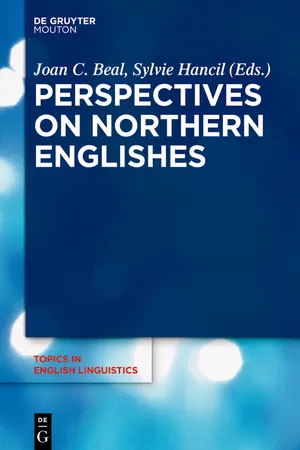
Northern English has been the object of much attention linguistically over the last thirty years but scholars have had a tendency to focus on the phonology of the dialects and varieties encountered. The purpose of the present volume is to complement and enrich the existing studies by providing readers with a kaleidoscopic perspective, allowing for a holistic interpretation and understanding of Northern English. It includes studies not only on phonology but also on semantics, syntax and sociolinguistics from a synchronic and diachronic point of view, with a special emphasis on the process of enregisterment. The varieties covered include Scottish Standard English, Shetland and Northern Ireland as well as varieties from the North of England.
eBook - ePub
Perspectives on Northern Englishes
- 315 pages
- English
- ePUB (mobile friendly)
- Available on iOS & Android
eBook - ePub
Perspectives on Northern Englishes
About this book
Information
Subtopic
LinguisticsSylvie Hancil and Joan C. Beal
1Introduction
Sylvie Hancil, University of Rouen Normandie
Joan C. Beal, University of Sheffield
Abstract: Northern English has been the object of much attention linguistically over the last thirty years but scholars have had a tendency to focus on the phonology of the dialects and varieties encountered. The purpose of the present volume is to complement and enrich the existing studies by providing readers with a kaleidoscopic perspective, allowing for a holistic interpretation and understanding of northern English. It is based on a selection of papers delivered at the International Conference on Northern British English on May 12–13, 2014, Rouen. It includes studies not only on phonology but also on semantics, syntax and sociolinguistics from a synchronic and diachronic point of view, with a special emphasis on the process of enregisterment. The varieties covered include Scottish Standard English, Shetland as well as varieties from the North of England.
1Background
The ‘North-South Divide’ is a phrase that has been used with reference to Britain in a wide variety of fields including human geography (Baker and Billinge 2004, Dorling 2010), public health (CLES 2014), economics (Mason and Harrison 1991) and cultural studies (Morley 2013). In terms of dialectology, sociolinguistics and typology, the North of England, and the North of Britain more widely (including Scotland and Northern Ireland) have been widely researched in recent years. There has been a major study by Wales (2006) and chapters by Beal (1993, 2008a/b) on northern English; volumes on specific varieties within the North of Britain (Millar 2007, Corrigan 2010, Beal et al 2012) and a perceptual study of the “North-South divide” in English dialects (Montgomery 2006). The vitality of research in this area is reflected in the existence of a biennial Northern Englishes Workshop, which had its seventh meeting in Edinburgh in 2016. The workshop at which many of the chapters in this volume were presented also testifies to a growing awareness of the importance of northern Englishes amongst anglicists in France. Whilst research on northern Englishes presented at conferences such as the Northern Englishes Workshops has tended to be dominated by variationist studies and by sociophonetics in particular, this volume presents a wider range of perspectives with an overarching emphasis on data-based studies. In this respect, it also differs from the recent volume edited by Hickey (2015), which provides more extensive geographical coverage of dialects of the North of England, but largely from a sociophonetic and/ or variationist perspective.
Linguistic diversity in Britain was first extensively discussed in Higden of Chester’s Latin history Polychronicon (Wales 2006: 64), which was then elaborated by John of Trevisa (1385) who remarks how the Northumbrian “ys so scharp, slyttyng, and frotyng, and unsschape” that “we southern men (nos australes) can hardly understand it” (cited Sisam 1967: 150). It is not until the sixteenth and the seventeenth centuries that scholars offered a fuller description of the prevailing dialectal situation. Carew (1595) discussed the binary opposition in the dialects in Britain in these terms: “Wee have Northern and Southerne [. . .] which differ from each other, not only in the terminacions, but also in the words, terms and phrases” (cited Görlach 1990: 243). Under the entry ‘dialect’ in his dictionary, John Bullokar (1616: 65–6) claims that “the dialect, or manner of speech, in the north is different from that in the south”.
Wales argues that there has been “both a metropolitan bias, and a southern one: what I shall term metrocentrism and austrocentrism respectively” (2006: 2). There are essentially three reasons for this: first, the emergence of the standard written English out of London in the late fifteenth century; second, London’s influence on ‘correct’ pronunciation; and third, the enregisterment of a variety based on southern English as Received Pronunciation. Therefore, northern English has mainly been defined in relation to, if not against southern standards, offering a negative view of the variety examined.
The perception of the North as being “alien and barbaric” (Wales 2006: 65) dates back to the medieval period, as underlined by Pollard (1997: 39): “This frightening north was a cultural construct, a state of mind”. Wakelin (1972: 35) quotes the use of northern dialect by Chaucer for the characterization of two Cambridge students John and Aleyn as being “comic because they speak a regional, non-Standard, dialect”, which anticipates the view of superiority and inferiority in varieties of English starting to emerge in the mid sixteenth century, with London English being particularly associated with the prestige of courtly English and the other types of English with lower social status, i.e. “provincial boorishness and country bumpkins” (Wales 2006: 77). John Hart wrote “of the farre West, or north Countryes, which use differing terms from those of the Court, and London, where the flower of the English tongue is used” (cited Blank 1996: 106 in Wales 2006: 75). These derogatory remarks contributed to the movement among grammarians in favour of “the Proper, or London language” (Hugh Jones 1724) to the disparagement of regional dialect.
Nevertheless, the perception of northern dialect does not boil down to a condescending attitude in the literature of the period. Boorishness can be synonymous with plain speaking and honesty without the affectation of courtly speech and northern speech can be praised for its “antiquity, purity and also rusticity” (Wales 2006: 80), as in the so-called ‘Scottish Chaucerian’ poets, from John Barbour in the fourteenth century and James I of Scotland (1394–1437), through to Robert Henryson and William Dunbar (d. 1516). Katie Wales’s study in this volume pays homage to the way Dickens re-created and created northern English in his works.
The late nineteenth century provided crucial developments in education, which contributed to help Northerners climb the social ladder, especially from the 1930s onwards, when the industries of weaving, ship-building and mining started to decline. School-educated Northerners have had to redefine their sociolinguistic defining criteria, along with being confronted with the requirement to meet the expected norms of the Received Pronunciation instilled by dialectologist Ellis (1890) and associated with social advancement and mobility. This feeling of “being in social limbo” (Wales 2006: 143) is well illustrated by two studies in this volume (Marie Jensen; Mercedes Durham).
The linguistic variation is largely defined in phonological terms. One of the first systematic studies of English dialects was Ellis’s On early English Pronunciation Part V, The existing phonology of English Dialects (1889). Ellis’s isoglosses were based on the following phonological criteria: the pronunciation of words like some; the pronunciation of r; the pronunciation of the definite article; and the pronunciation of words like house. The first, second and fourth criteria are under discussion in the phonological part of this volume (Sandra Jansen; Marten Juskan).
It is Trudgill’s The Dialects of England (1990, 1999) which offers the most often cited classification of dialects, with the northern dialect situated above a line drawn from the Humber to the coast to the north of Lancaster, which is a line slightly to the north of Ellis’s. Over the last ten years, linguists have provided other linguistic variants to set up slightly different frontiers between the North and the South, thereby contributing to the fuzziness of the North-South divide (see Beal, this volume).
There has been an effort over the last thirty years to reveal and underline the characteristics and specificities of the North, relying on almost 1,500 years of history to revive its periods of cultural and literary prestige. The salience of these features is underscored in the part on enregisterment in this volume (Joan Beal; Katie Wales; Michael Pearce, and Patrick Honeybone, Kevin Watson and Sarah van Eyndhoven).
In northern English grammar, there still remain salient characteristic markers such as third person feminine pronoun ho(o), second person pronoun singular thou, reflexives, deictic referents, definite article reduction and negation, which partake of the richness and complexity of sociolinguistic usage in spoken language. There are nevertheless some other areas which remain little or not explored in corpora. Syntax is here illustrated by one study (Sanna Hillberg). Discourse features are exemplified by a corpus-based analysis (Sylvie Hancil), which examines particles that “are in some cases difficult to assign to a word class” (Wales 2006: 190) but remain important-to-grasp aspects of northern colloquial speech. To conclude, the relationship between language and corpus is examined in an article by Ole Schützler, Ulrike Gut and Robert Fuchs on Scottish Standard English.
2Structure of the volume
The first part of the volume opens up with four chapters which deal with the ways in which linguistic features become associated with the North and northern characters.
Joan Beal discusses the sociohistorical processes whereby northern varieties of English became recognised as distinct from those of other parts of the country. The theoretical framework is that of indexicality and enregisterment, the latter term defined by Asif Agha as a set of “processes through which a linguistic repertoire becomes differentiable within a language as a socially recognisable register of forms” (2003: 231). Although histories of English note that differences between ‘northern’ (e.g. Northumbrian) and ‘southern’ (e.g.West Saxon) varieties are apparent from the earliest records of Old English, there is no evidence that speakers and writers were aware of these distinctions. Beal’s account therefore begins in the Middle English period, when, as Katie Wales (2006: 33, 61) points out, authors such as Trevisa (1385, translating Higden (1327), comment disparagingly on the language of Northumbrians. Linguistic commentary in the Middle and Early Modern English period establishes northern English as the ‘other’, in contrast with the emerging standard of the court and London, but neither recognises the northern origin of certain ‘standard’ features, nor singles out specific features of northern English for condemnation. However, Beal demonstrates that literary representations of northern speech were beginning to establish a ‘repertoire’ of northern features along with a stereotyped persona of the Northerner.
As Johnstone et al. (2006) point out, dialect contact is a prerequisite of enregisterment, so the greater social and geographic mobility of the population in the Late Modern period led to increased awareness of northern English, and of distinct dialects within the North. Evidence for this awareness, and the social values associated with northern speech, becomes much richer in this period, so Beal discusses on the one hand, how normative texts such as pronouncing dictionaries stigmatised northern features, and on the other hand how the representation of northern dialect features in literature and popular entertainment disseminated both positive and negative stereotypes of northern English and Northerners.
Katie Wales re-considers stereotyping in the works of Charles Dickens. It is now over 40 years since Stanley Gerson produced the only detailed analysis of sound and spelling in the works of Charles Dickens. In this chapter Wales takes a fresh look at Dickens’ handling of northern British dialect speech (including morphology, syntax and lexis) in the particular context of an approach to literary dialect and linguistic stereotyping that has been so far under-used. So she focusses on social cognition and schema theory, which is concentrated on people’s mental biases and attitudes. Looking at Dickens’ characters Wales shows the beginning of the process of literary formation in the mind of a novelist. She unpicks the creative process by analysing mainly the portrayal of John Browdie, the North Yorkshire corn-factor, in Nicholas Nickleby (1838–9); and of Stephen Blackpool, the Lancashire cotton-mill worker, in Hard Times (1854). She argues that characters like Browdie and Blackpool, far from being either one-dimensional or a hotch-potch of random features, are constructed intertextually though schemas and social ideologies, mental images of common beliefs about the under-classes, and about Northerners in general; and also through cultural practices, including other literary texts. The result for each novel is a different set of schemas, and a different linguistic repertoire. Dickens’ idio-regiolects have their own rules, their own ‘gaps’. Importantly, however, Dickens is not so much ‘representing’ northern speech as creating it, so traditional questions of ‘authenticity’ or ‘accuracy’ are not relevant. There are further implications even for the creative processes of those writers who represent the dialect speech of an area with which they are familiarly associated. Common cultural images can still be influential on the process of ‘representation’.
Michael Pearce’s chapter is a first foray into an under-researched aspect of the region’s local linguistic ecology. Research on language attitudes and perceptual dialectology has shown that North-East English is one of the most widely recognized and positively evaluated varieties in Britain. There is also a rich tradition of dialect writing associated with the region, and a long history of both ‘folk’ and scholarly attention to local forms of language – for example, it is the only part of England to have a major corpus devoted to it – the Diachronic Electronic Corpus of Tyneside English. However, one element is missing from the otherwise well-charted dialectological terrain: an account of localized forms in the ‘linguistic landscape’ (that is, the public display and representation of written language on road signs, advertisements, house names, vehicles, and so on). Pearce’s chapter describes and contextualizes a corpus of signs compiled in 2014–15, showing how they draw extensively on a set of features which previous studies have revealed to be enregistered as part of north-east dialect. The implications of the findings are discussed and the – perhaps surprisingly – infrequent appearance of such forms in the linguistic landscape is addressed.
Patrick Honeybone, Kevin Watson and Sarah van Eyndhoven’s chapter deals with the non-standard spelling practices found in a corpus of Contemporary Humorous Localised Dialect Literature (CHLDL) from Liverpool. Dialect features are represented to different extents in the Contemporary Humorous Localised Dialect Literature (CHLDL) that is commonly published for northern (and other) varieties of English (Honeybone and Watson 2013). In this article, Honeybone and Watson consider a corpus of CHLDL for Liverpool English and show that the notion of differential phonological salience (Trudgill 1986, McMahon 2000, Kerswill and Williams 2002) can account for some of these differences. The authors consider a number of Liverpool English consonantal dialect features which are rep...
Table of contents
- Cover
- Title Page
- Copyright
- Table of Contents
- Contributors
- List of figures and tables
- 1 Introduction
- I Enregisterment
- II Phonology
- III Syntax and discourse features
- IV Sociolinguistics
- V Language and corpus
- Index
Trusted by 375,005 students
Access to over 1.5 million titles for a fair monthly price.
Study more efficiently using our study tools.
Frequently asked questions
Yes, you can cancel anytime from the Subscription tab in your account settings on the Perlego website. Your subscription will stay active until the end of your current billing period. Learn how to cancel your subscription
No, books cannot be downloaded as external files, such as PDFs, for use outside of Perlego. However, you can download books within the Perlego app for offline reading on mobile or tablet. Learn how to download books offline
Perlego offers two plans: Essential and Complete
- Essential is ideal for learners and professionals who enjoy exploring a wide range of subjects. Access the Essential Library with 800,000+ trusted titles and best-sellers across business, personal growth, and the humanities. Includes unlimited reading time and Standard Read Aloud voice.
- Complete: Perfect for advanced learners and researchers needing full, unrestricted access. Unlock 1.5M+ books across hundreds of subjects, including academic and specialized titles. The Complete Plan also includes advanced features like Premium Read Aloud and Research Assistant.
We are an online textbook subscription service, where you can get access to an entire online library for less than the price of a single book per month. With over 1.5 million books across 990+ topics, we’ve got you covered! Learn about our mission
Look out for the read-aloud symbol on your next book to see if you can listen to it. The read-aloud tool reads text aloud for you, highlighting the text as it is being read. You can pause it, speed it up and slow it down. Learn more about Read Aloud
Yes! You can use the Perlego app on both iOS and Android devices to read anytime, anywhere — even offline. Perfect for commutes or when you’re on the go.
Please note we cannot support devices running on iOS 13 and Android 7 or earlier. Learn more about using the app
Please note we cannot support devices running on iOS 13 and Android 7 or earlier. Learn more about using the app
Yes, you can access Perspectives on Northern Englishes by Sylvie Hancil, Joan C. Beal, Sylvie Hancil,Joan C. Beal in PDF and/or ePUB format, as well as other popular books in Languages & Linguistics & Linguistics. We have over 1.5 million books available in our catalogue for you to explore.