The peer-reviewed Anglia Book Series (ANGB) offers a selection of high quality work on all areas and aspects of English philology. It publishes book-length studies and essay collections on English language and linguistics, on English and American literature and culture from the Middle Ages to the present, on the new English literatures, as well as on general and comparative literary studies, including aspects of cultural and literary theory.
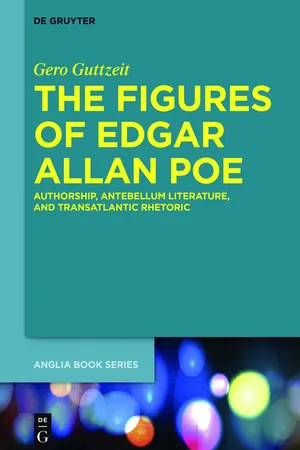
eBook - ePub
The Figures of Edgar Allan Poe
Authorship, Antebellum Literature, and Transatlantic Rhetoric
- 269 pages
- English
- ePUB (mobile friendly)
- Available on iOS & Android
eBook - ePub
The Figures of Edgar Allan Poe
Authorship, Antebellum Literature, and Transatlantic Rhetoric
About this book
Trusted by 375,005 students
Access to over 1.5 million titles for a fair monthly price.
Study more efficiently using our study tools.
Information
Topic
LittératureSubtopic
Critique littéraire anglaise
Part IAuthorship, Antebellum Literature, and Transatlantic Rhetoric
1Towards a Rhetoric of Authorship: Theoretical, Poetical, and Performative Figures of the Author
The success of an author’s rhetoric does not depend on whether he thought about his readers as he wrote; if ‘mere calculation’ cannot insure success, it is equally true that even the most unconscious and Dionysian of writers succeeds only if he makes us join in the dance.
Wayne Booth, The Rhetoric of Fiction, 1983: xiv
In beginning this sketch of the basic principles and concepts of a theoretical rhetoric of authorship, it is worthwhile to revisit the one of the major beginnings of contemporary authorship theories. There is an illustrative – perhaps a symptomatic – coincidence between the author and rhetoric in Roland Barthes’ writings in the late 1960s. Barthes wrote his seminal “La mort de l’auteur” in 1967 and first published it in an English translation in 1968 in the short-lived American art magazine, Aspen. Two years later in 1970, issue no. 16 of the journal Communications was dedicated to “Recherches rhétoriques,” and Barthes contributed his well-known overview of ancient rhetoric, “L’ancienne rhétorique: aide-mémoire” (Barthes 1970), which was based on his 1964/1965 lectures on the history of rhetoric. Barthes’ crucial essay on authorship, then, is framed by his engagement with rhetoric. At first glance, Barthes’ texts on authorship and rhetoric even seem to represent a reversal of the familiar narratives of the death of rhetoric and the birth of the author in the eighteenth and nineteenth centuries, which are discussed in the next chapter. While Barthes attempted to establish écriture and relegate rhetoric to the “rank of a merely historical object” (Barthes [1970] 1988: 93), still it seems that, if Barthes killed the author in 1967, he also lent a maieutic hand in the re-birth of rhetoric in 1970, albeit as a daughter of a “new semiotics of writing” (Barthes [1970] 1988: 11). As the example of other critics such as Gérard Genette shows,16 to a certain extent, Barthes’ critique of the author is indeed contemporaneous with a major reconception of rhetoric within French thought: in terms of the history of critical thought, the death of the author met the re-birth of rhetoric. My attempt in this part of the book is similar to the reconstructive purpose of Barthes’ aide-mémoire, yet also differs substantially, first and foremost in making rhetoric the chief theoretical instrument to conceptualise the author.
This task is complicated by the diverse state of the field of authorship studies and the fact that categories of authorship play a role in law, technology, the media, and the sciences as well as philosophy, literature and culture in general.17 One of the conclusions that can be drawn from the German debate is a non-exhaustive typology of authorship concepts that includes the aspects of authorship as intention, inspiration, competence, individuality, authority, style, copyright as well as gendered and collective authorship.18 In order to meet the dual requisite of historicized theory and theorized history outlined in the introduction, this first part of the book on the rhetoric of authorship contains one systematic and one historical chapter. Complemented in chapter two with an historical reconstruction of the rise of the author, this first chapter builds a heuristic framework for the analysis of authorship, which is based on a fundamental rhetorical triad that distinguishes theoretical, poetical, and performative figures of the author. These dimensions, in turn, will be diversified via recourse to the rhetorical theories of the three classes of the potential effects of discourses (part of the theoretical dimension), the three rhetorical-poetical processes of invention, arrangement, and style (poetical dimension), and the final two processes of memory and performance (performative dimension). The result of these diversifications will be a rhetorically informed theory of the author as both figurer and figured that can be applied to theoretical, poetical, and performative activities and products.
1.1The Figures of the Author
The Deaths and Returns of the Author
Like the critical shadow of Poe that continues to haunt the dominant paradigms of American studies, the category of the author has disappeared from and returned to literary studies many times, long after its modern inception in the idea of the romantic genius. If viewed from a distance, the development of authorship theory over the course of the twentieth and twenty-first centuries evinces an oscillation between arguments pro and contra. In other words: the deaths of the author have always been intimately connected with the returns of the author and vice versa. The debates about the author should thus not be reduced to the poststructuralist critique and its affirmations or refutations, since the relevant discussion begins much earlier with such concepts as the New Critical “intentional fallacy” and Wayne Booth’s “implied author.”19
Nevertheless, Roland Barthes’ argument in “The Death of the Author” remains the best example of an absolute anti-intentionalism.20 Joining his critique of God and Man with a fundamental critique of the Author, Barthes claimed that the meaning of the text does not emanate from a god-like authorial subject but that it is constituted in the act of reading, as the famous last lines of the essay show: “we know that to give writing its future, it is necessary to overthrow the myth: the birth of the reader must be at the cost of the death of the Author” (Barthes [1968] 1977: 148).21 To back up his attack on what is basically a romantic and religious idea of the author, Barthes contrasts the Author-God, the Author with a capital ‘A,’ whose voice determines all meaning, with the scriptor, a writer who is not imbued with authority and who is “born simultaneously with the text, is in no way equipped with a being preceding or exceeding the writing” ([1968] 1977: 145).
The arguments against using a concept of the author as a category of interpretation, which Barthes epitomizes (rather than Focault’s historicist argument that is discussed in chapter two), were countered in debates about the “Return of the Author” in literary and cultural scholarship of the 1980s and 1990s. The proponents of a return to the author have emphasized 1) the gap between author-critical theories and practices of interpretation, 2) the possibility of authorial readings that complicate rather than simplify texts, and 3) the inevitability of the problem of authorship.22
In his seminal reconstruction of the debates within French thought that led to the critique of the author in the 1960s and its translation into British-American academia,23 Seán Burke diagnoses a “massive disjunction […] between the theoretical statement of authorial disappearance and the project of reading without the author” ([1992] 2008: 165). The most striking evidence of this has been produced by Simone Winko (2002). Analyzing a wide selection of academic articles in German studies, she found that a critical stance against the author in an article did not mean that the practices of interpretation in the same article corresponded to this theoretical stance but evinced the same argumentative recurrence to the author as the producing instance of the text (Winko 2002: 353). Interpretations that expressly rely on the author in one way or another are often rejected as biographical or ‘biographistic’ approaches that necessarily reduce literary texts to the lives of their authors, as Jannidis et al. (2000: 24–25) point out.24 In place of such a simplifying rejection, Burke offers a more complex picture of the tension between authorial individuality and the generalising tendency of theory:
The question of the author tends to vary from reading to reading, author to author. […] A theory of the author, or of the absence of the author, cannot withstand the practice of reading, for there is not an absolute cogito of which individual authors are the subalternant manifestations, but authors, many authors, and the differences (in gender, history, class, ethnology, in the nature of scientific, philosophical, and literary authorship, in the degree of authorship itself) that exist between authors – within authorship – defy reduction to any universalising aesthetic […] the essential problem posed by the author is that whilst authorial subjectivity is theoretically unassimilable, it cannot be practically circumvented ([1992] 2008: 183).
Authorship, for Burke, is thus a condition of interpretation that varies in its importance from reading to reading and from situation to situation. The problem of authorship thus calls neither for a dismissal nor an apotheosis of the author, but is to be approached as that which varies in accordance with the type of authorship and historical situation under consideration.
Figuring the Author
This emphasis on the historicity and situatedness of authorial readings cannot serve as a justification for altogether foregoing any systematic attempt to categorize different concepts of authorship. Indeed, the challenge of thinking the author seems to be to conceptualise authorship in terms of both heteronomous constraints and autonomous freedom, to analyse both the cultural impossibilities and individual powers of the writer. Such a systematic attempt is made in the following typology of author functions taken from Ingo Berensmeyer, Gert Buelens, and Marysa Demoor (2012a: 14), which is partly based on my own earlier reading of German critic Heinrich Detering’s typology of authorship models:25
| heteronomy | autonomy | |
| weak | author as originator and communicator of texts, tied to rules and conventions | author as creator of immaterial ‘work’ that is materially represented in the text |
| strong | Barthes’ ‘scripteur’: writer as merely a textual function, a compiler | author as absolute ruler over the work and its meaning, a genius |
The typology distinguishes not only between autonomous and heteronomous aspects of authorship, but also between weak and strong notions of these two aspects. The strong notions encompass Barthes’ scriptor and Author-God, while the two weak notions view the author as a producer of a literary text and a creator of a literary work with all their respective corroborating evaluations. All four concepts are to be understood not as idealised types but as points on a scale the exact location of which can only be determined by an investigation of the specific historical situation in which the model, concept, or idea appears. Both weak and strong notions of authorship can be accommodated within a theoretical rhetoric of authorship premised upon what I call ‘figures of the author,’ a concept that grasps the general dialectic between the heteronomous and autonomous sides of both the author’s fashioning of discourse and the author’s self-fashioning.26
The term ‘figure’ has a long rhetorical and interpretive history. ‘Figure’ (Lat. ‘figura’) is etymologically related to fictor, a Latin word that covers meanings similar to the Greek ποιητής/poietes (and which is also the root of ‘fiction’), as becomes obvious in an early use by the scholar Varro in his work on the Latin language: “the fictor ‘image-maker,’ when he says ‘Fingo “I shape”’ puts a figura ‘shape’ on the object” (Varro 1938: 244–245 = 6.78). Originally meaning ‘plastic form,’ it was used as the translation for the Greek rhetorical term σχῆμα/schema and became a major concept in rhetoric and poetics. The combined sense of plasticity and formedness pertains to both the author’s fashioning of texts as well as her or his self-fashioning, since both remain highly volatile cultural processes. The intimate connections between the notion of the figure and interpretation were famously delineated by Erich Auerbach (1984). Although the Christian, theological mode of figural interpretation used in late Antiquity and the Middle Ages is not directly relevant for all historical epochs, Auerbach’s reconstruction of ‘figura’ as a rhetorical concept in his classic essay of the same name illuminates the term’s flexibility and scope. ‘Figure’ developed through Varro, Lucretius, and Cicero to its canonical formulation in the ninth book of Quintilian (Auerbach 1984: 12–21). Quintilian famously distinguished between tropes as single words that are not used in their proper meaning (such as metaphor) and figures which can be composed from the proper meanings of words (2001d, 11–34 = 9.1).27 Auerbach explains the difference and its implications thus: “The aim of a figure is not, as in all tropes, to substitute words for other words; figures can be formed from words used in their proper meaning and order. Basically all discourse is a forming, a figure, but the word is employed only for formations that are particularly developed in a poetic or rhetorical sense” (1984: 26). This ties in with Nietzsche’s thesis that “[w]hat is usually called language [Rede] is actually all figuration” (Nietzsche 1989: 25). In such a view, rhetoric is an unfolding of the figurative possibilities of language or speech in toto. As Nietzsche argued, “the rhetorical [die Rhetorik] is a further development, guided by the clear light of the understanding, of the artistic means which are already found in language” (Nietzsche 1989: 21).
One of the most pertinent exemplifications of the dialectic between the author as figurer and figured has been developed by Jonathan Elmer in his study of Poe’s relation to mass culture. Elmer argues that “Poe both theorizes and exemplifies ‘the figure of mass culture,’ a phrase in which the ambiguity of the genitive (both subjective and objective) marks the trace of the social limit, that disjunctive relay point between any individual’s figuration of mass culture and mass culture’s figuration of the individual” (Elmer 1995: 21). Poe is thus both a fashioner of mass culture and being fashioned by it: “For if he offers us a rich imagination of the mass culture of the day – a view of the democratic “mob,” a sampler of most of the popular and mass literary forms of antebellum magazin...
Table of contents
- Cover
- Title Page
- Copyright
- Dedication
- Contents
- Acknowledgements
- Abbreviations
- Note on the Text
- Introduction
- Part I Authorship, Antebellum Literature, and Transatlantic Rhetoric
- Part II The Figures of Edgar Allan Poe
- Concluding Remarks
- Works Cited
- Index of Names
- Index of Subjects
Frequently asked questions
Yes, you can cancel anytime from the Subscription tab in your account settings on the Perlego website. Your subscription will stay active until the end of your current billing period. Learn how to cancel your subscription
No, books cannot be downloaded as external files, such as PDFs, for use outside of Perlego. However, you can download books within the Perlego app for offline reading on mobile or tablet. Learn how to download books offline
Perlego offers two plans: Essential and Complete
- Essential is ideal for learners and professionals who enjoy exploring a wide range of subjects. Access the Essential Library with 800,000+ trusted titles and best-sellers across business, personal growth, and the humanities. Includes unlimited reading time and Standard Read Aloud voice.
- Complete: Perfect for advanced learners and researchers needing full, unrestricted access. Unlock 1.5M+ books across hundreds of subjects, including academic and specialized titles. The Complete Plan also includes advanced features like Premium Read Aloud and Research Assistant.
We are an online textbook subscription service, where you can get access to an entire online library for less than the price of a single book per month. With over 1.5 million books across 990+ topics, we’ve got you covered! Learn about our mission
Look out for the read-aloud symbol on your next book to see if you can listen to it. The read-aloud tool reads text aloud for you, highlighting the text as it is being read. You can pause it, speed it up and slow it down. Learn more about Read Aloud
Yes! You can use the Perlego app on both iOS and Android devices to read anytime, anywhere — even offline. Perfect for commutes or when you’re on the go.
Please note we cannot support devices running on iOS 13 and Android 7 or earlier. Learn more about using the app
Please note we cannot support devices running on iOS 13 and Android 7 or earlier. Learn more about using the app
Yes, you can access The Figures of Edgar Allan Poe by Gero Guttzeit in PDF and/or ePUB format, as well as other popular books in Littérature & Critique littéraire anglaise. We have over 1.5 million books available in our catalogue for you to explore.