
eBook - ePub
Materials in Environmental Engineering
Proceedings of the 4th Annual International Conference on Materials Science and Environmental Engineering
- 1,609 pages
- English
- ePUB (mobile friendly)
- Available on iOS & Android
eBook - ePub
Materials in Environmental Engineering
Proceedings of the 4th Annual International Conference on Materials Science and Environmental Engineering
About this book
This contains selected and peer-reviewed papers from the 4th Annual International Conference on Material Science and Environmental Engineering (MSEE), December 16-18 2016, in Chengdu, China. Interactions of building materials, biomaterials, energy materials and nanomaterials with surrounding environment are discussed. With abundant case studies, it is of interests to material scientists and environmental engineers.
Information
Subtopic
Science environnementaleYing-Jie Gan1 and Gang Xiong2
Crystal Structure and Microwave Dielectric Properties of Ca [(Li1/3Nb2/3) 0.9Zr0.1]O3-δ−xTiO2 ceramics
1 Department of Electronic and Information Engineering, Hubei University of Science and Technology, Xianning, China, [email protected]
2 Department of Electronic and Information Engineering, Hubei University of Science and Technology, Xianning, China, xgang68@ aliyun.com
Abstract: Crystal structure and microwave dielectric properties of Ca [(Li1/3Nb2/3) 0.9Zr0.1]O3−δ−xTiO2(0≤x≤0.1) ceramics were investigated. A single phase with orthorhombic perovskite structure was obtained at x=0.0~0.1. With an increasing of Ti4+ content, the Qf value decreased due to a decrease of the degree of B-site 1:2 ordering. However, the τf value increased from-12.8ppm /oC to -6.8ppm/oC. When x=0.05, the optimum microwave dielectric properties: εr=33.1, Qf = 18230GHz and τf =−6.8 ppm/oC.
Keywords: Microwave dielectric ceramics; Microwave dielectric properties
1Introduction
Recently, Ca(Li1/3Nb2/3)O3−δ ceramics have been newly developed and widely investigated because of its excellent microwave dielectric properties and low sintering temperature of about 1150oC [1,2]. Ca [(Li1/3Nb2/3) 0.9Zr0.1] O3−δ show εr of 29.5 and Qf of 21030 GHz, while τf is a large negative value (−12.8ppm/oC). It is important to adjust τf to near zero for application of the microwave device. In order to adjust τf to near zero, two or more compounds having positive and negative τf value are employed to form a solid solutions or mixed phases [3]. TiO2 was reported to possess good microwave dielectric properties: εr =100, τf = 400ppm/oC and Qf ≈ 40000 GHz. Therefore, it is expected that the microwave materials with Near-Zero temperature coefficient, good sinterability and dielectric properties were obtained by combining Ca [(Li1/3Nb2/3)0.9Zr0.1]O3−δ with TiO2. In the present study, the influence of TiO2 addition on microwave dielectric properties and crystal structures of Ca [(Li1/3Nb2/3) 0.9Zr0.1] O3−δ ceramics has been investigated.
2Results and Discussion
Fig. 1 shows part of powder XRD patterns of the Ca [(Li1/3Nb2/3) 0.9Zr0.1]O3−δ−xTiO2 (0.0≤x≤0.1)ceramics varied with TiO2 content sintered at 1170oC for 4h.. With x increases, the peaks of superlattice diffractions of specimen 1:2 decreases until disappear, the degree of B-site 1:2 ordering will decrease, second phase appearence, which means Ti2+ entered the B-site of the ABO3 perovskite structure, and then formed complete solid solution with single perovskite phase. TiO2 addition accelerated the composition of main phase in ceramic systems, but inhibited the degree of 1:2 ordering in Ca [(Li1/3Nb2/3) 0.9Zr0.1]O3−δ-xTiO2 ceramics.
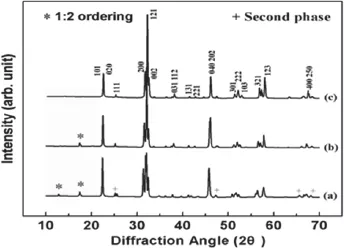
Fig. 2 shows the relationship between the dielectric constant εr and the composition (x). With the increasing content of TiO2 ranged from 0.05 to 1.0, the dielectric constant εr increased almost linearly from 29.5 to 35.7 by the compensation effect, which was due to the formation of complete solid solution with single perovskite phase, CaTiO3 has a high εr of 170[4]. Although the samples are not the mixtures of pure Ca[(Li1/3Nb2/3) 0.9Zr0.1]O3−δ and TiO2, the measured values could still be compared with the theoretical values calculated using the logarithmic mi...
Table of contents
- Cover
- Titlepage
- Copyright
- Contents
- Keynote Speech I Strategies for Improving Hydropower Development
- Keynote Speech II Biotemplated Mesoporous Materials for Wastewater Treatments
- Keynote Speech III Design of Hard and Superhard Nanocomposites for Harsh Environment
- Keynote Speech IV Numerical Simulation of Slag Corrosion Behavior of Lightweight Refractories for Refining Ladles
- Keynote Speech V Precision Plastic Forming of Large Complex Component of Ti-Alloy
- Study about the Landslide Deformation Forecast Model Based on Kalman Filter Method and Taylor Seris and Material Properties
- Effects of Machining Process and Heat Treatment on the Mechanical Properties and Microstructure of TB2 Titanium Alloy Strip
- Study on Compound Characteristics of Oleic Acid, Glycerol and Organic Ester in Grinding Fluid
- Novel Room-Temperature Molten Salt Based on Chlorine Chloride with Hydrogen Bond Donors
- Study on Organic Modification of Aluminum Powder Coating
- Study on Material of Exothermic Insulation Riser Sleeve
- The Efficiency Calculation of Cobalt Oxide for Artificial Photosynthesis with Exponential-Doping
- Microscale Hierarchical Three-Dimensional Flowerlike CuO: Synthesis, Characterization, and its Supernormal Photocatalytic Activity under Visible Light Irradiation
- The Distribution Behavior of Phosphorus at Non-Equilibrium Condition Simulating the Casting Ladle
- Effects of Zr Addition on the Microstructure and Mechanical Properties of AlCoCrFeNiZrx High-Entropy Alloys
- Research and Preparation of Super Hydrophobic and Self-Cleaning PVDF Membrane
- Preparation and Characterization of TiB2 Coatings with Ultra-Low Residual Stress
- Crystal Structure and Microwave Dielectric Properties of Ca [(Li1/3Nb2/3) 0.9Zr0.1]O3-δ−xTiO2 ceramics
- Mechanism of Mechanochemical Reactions in Magnesium-Aluminium Layered Double Hydroxides Systems
- Deposition of Diamond Films on Complex Cutting Tools by Hot-Filament Chemical Vapor Deposition
- The Crystal Unit Model of CsI(Tl) Film with Hexagon Microcolumns and Its Conversion Factor to X-Ray
- Effect of Ion Etching on the Surface Morphology, Structure and Adhesive Strength of the TiN Coating
- Influences of Photocatalytic Activity by TiO2 Doping with Graphene Oxide and Lanthanum on the Carrier of Cenosphere
- Synthesis and Luminescence Properties of Eu3+-Doped NaTb(MoO4)2 Hierarchical Microcrystals
- PtxNi/meso-Al2O3 (x = 0.60–2.07): High-Performance Catalysts for the Hydrogenation of N-Butanal at Low Temperatures
- Hysteretic Behavior of CFT Columns with Semi-Rigid Base Connection under Different Loading Modes
- Behavior of Liquid Phase Generation of High Phosphorus Oolitic Hematite during Sinter
- Influence of the UUV Body on the Performance of the Propeller
- Piezoresistivity of Polyethylene Terephthalate Nickel Powder Composite
- Preparation of Ti-Cu Alloying Surface Layer on Ti6Al4V Substrate via Friction Stir Processing for Flame-Retardant Performance
- Failure Analysis of Escalator Step Induced by the Bolt Surface Defects
- Surface Wear Mechanism of Escalator Step Chain: A Failure Analysis
- Toxicity Reduction Mechanism of ZnO NPs during Sludge Vermicomposting Process
- A Nanocomposite Film of Polyoxometalate and TiO2: Preparation, Characterization and Photochromic Property
- Application of Inductively Couled Plasma-Mass Spectrometry to the Speciation Analysis of Rare Earth Elements in Ion-Adsorption Rare Earth Ore
- Electronic Structure of Cu2ZnSn1-xGexS4 New Energy Materials Probed by Soft X-Ray Absorption Spectroscopy
- Preparation and Performance of a Chitosan/TiO2 Composite Film by Lyer-by-Layer Method
- A Facile Route to Synthetize Lanthanum Doped Titanium Dioxide Films for Improved Photocatalytic Performance
- Contact Property of Au on p-InP
- Effect of Polyethylene Oxide Concentration on Separation Performance of PVDF Hollow Fiber Plasma Separation Membrane
- Influence of Phosphate Concentration and PH Crystallization of Magnesium Ammonium Phosphate (MAP)
- Microstructure and Corrosion Resistance of CrMoVNbFex High-entropy Alloys
- Finite Element Analysis of Composite Shear Walls with Double Steel Plates and Filled Concrete for a Nuclear Island Structure under In-Plane Loading
- Exothermal Combustion Synthesis of the Composites TiB2/Ni from Ni–Ti–B System
- Research on Wetting Characteristics of Normal Acid, Alcohol and Alkane on Surface of Monocrystal Silicon
- Effect of Modified Argon Oxygen Decarburization (AOD) Stainless Steel Slag on Cementitious Properties
- Optimization of structure Design of Physical Vapour Transport Furnace for Silicon Carbide (SiC) Crystal Growth via Numerical Simulation
- Thermodynamical Analysis of the Spontaneous Combustion of FeS
- Cause and Prediction Model of Low Infrared Emissivity for Resin/Flaky Metal Composite Coatings
- Synthesis and Characterization of Modified Carbon Aerogels
- A Review on the Application of Photocatalytic Materials
- The Preparation of Nano ZnO/PVC and the Photocatalytic Degration of Waste Water from Seafood Processing
- Efficient Adsorptive Removal of Arsenic from Water by Titanium-Based Metal-Organic Frameworks (MIL-125)
- The Research of SVG in Three-Phase Four-Wire Power System
- The Application of CDMA Technology in the Measurement of Antenna Array
- Synthesis and Bactericidal Properties of MgO/TiO2 Nano-Composites
- Effects of Assisting Agents Concentrations on Energy Consumption during the Electrokinetic Treatment of Contaminated Kaolin
- Development of a Solid State pH Sensor Based on Electrodeposited Iridium Oxide Films for Water Quality Detection
- Simple Fabrication of ZnO Hierarchical Structures with Enhanced Photocatalytic Activity
- Enhanced Cycling Stability of Multi-Cations Doped Spinel Lithium Manganese Oxide for Rechargeable Lithium Batteries
- Review on the Applications of Phase Change Materials (PCMs) for Building Envelopes
- Damage Analysis of Cast Iron Specimen with Different Crack Forms
- Study on the Performance of a High-Pressure Water Jet Dust Collector in a Powder Feeding Port of Explosive Sites
- Self-Assembled Grapheme / Carbon Nanotube Fibers as Electrodes for Super Capacitors
- Fatigue Life Prediction of a Kind of Frequently-used Bolt under Random Excitations
- Research on Development of Armor Protection Materials and Technology
- Cold forming Cracking Reason and Solution Method of SS400 Hot Rolled Steel
- Effect of Flow Rate of Cooling Water on the Interfacial Heat Transfer Coefficient between Modular Water-Cooled Mold and Casting
- Study on High-Absorption Chrome Tanning Technology Assisted by CO2 Low Temperature Plasma Treatment
- Simulation of Q345 Steel Billet Solidification Microstructure in Continuous Casting Based on Matlab
- Preparation and Properties of Neopentyl Glycol/Epoxy Resin Composite Phase Change Material for Thermal Energy Storage
- Hysteric Property Analysis for Semi-Rigid Base Connection of Concrete-Filled Square Steel Tubular Columns
- An Adaptive Harmonic Current Detection for Improving the Power Quality in Power Grid
- Paper Fiber Paper-Based ZnO Piezoelectric Nanogenerator for Self-Powered Energy Scavenging
- Fabrication of Super-Hydrophobic Surface with Micro- Nano-Structure on Brass Substrate by Chemical Etching and Surface Modification
- Preparation Technology and Experimental of Hydro-Thermal Method on Surface Modification of Biomedical Titanium
- The Co-Pilot Position of Vehicle Noise Quality Prediction Based on SVM
- Application of Aramid Fiber in Printed Circuit Board
- Online Intelligent Sorting Method of Gold Ore based on LIBS Technology
- Rapid Decolorization and Mineralization of Congo Red Using Fe78Si9B13Amorphous Alloy by Photo Fenton-Like Process
- Preparation of Ce, N-Codoped Mesoporous Titania Photocatalyst with High Photocatalytic Activity under Visible Light
- Preparation of TiO2/AC Composite and Characterization of Its Photocatalytic Activities
- Electrocatalytic Oxidation Degradation of Reactive Red 2
- Nanoscale Fe0 Supported on Three-Dimensional Graphene for the Removal of Methyl Orange from Water
- Study on the Optimal Extraction of Coal Resources under the Constraint of Ecological Environment
- Research on the Stability Calculation and Treatments of the Liyu Landslide in Zhuzhou City, Center Hunan Province
- Procurement Cost Control of New Energy Vehicles Manufacturing Enterprise under Supply Chain Management
- Domino Effect Index for Chemical Plants Based on Fishbone Analysis
- Xinjiang Wind Power under “the Belt and Road Initiatives” Facing the Opportunities and Challenges
- Analysis of the Fuel Efficiency of Airport End-Around Taxiway
- Spatiotemporal Analysis on Pesticide Using in different Agriculture Lands over China
- Policy Analysis and Capability Evaluation of China’s Cities in Response to Climate Change
- Analysis of the Influence of Environmental Conditions on Individual SEFAE Rocket
- Residual Characteristics of Organochlorine Pesticides in Four Kinds of Plants in Qingshitan Reservoir Region
- Application and Research Progress of Toxicity Test of Daphnia Magna
- Literature Mining-oriented Risk Management of Climate Change
- Economic Evaluation of Renewable Energy Saving Technology Based on Analytic Hierarchy Process and Data Envelopment Analysis Method
- Study on Modified Zeolite for Absorption of Fluoride in Water
- Removal of Heavy Metal Ions from Aqeous Solution Using Bottom Ash as an Adsorbent
- Research Progress of N2O O Production in Different Wastewater Treatment Processes
- Application of Alternative Environmental Protection Leather in Clothing
- The Application of Green Environmental Protection Material in Clothing Design
- Full-Flow Balance Analysis of Copper in Municipal Wastewater Treatment Plant of Hardware Electron-Mechanical Industrial Area
- Study on Biological Treatment -Fenton -Oxidation Treatment -Biological Treated Landfill Leachate
- Normal Section Bearing Capacity Test on Columns Composed by Fine Slag Aggregate Concrete
- A Nonlinear Rheological Model for Rocks Considering the Tertiary Creep Stage
- Construction of Multilayer Geo-Metadata Management System
- Automobile Body Shop Optimization Design of Displacement Ventilation
- The Research Progress of Polycyclic Aromatic Hydrocarbons Processing Technology in Coking Wastewater
- Experimental Investigation on Flexural Properties of Sisal Fiber Reinforced Foam Concrete
- Reservoir Modeling Constrained by Geological Conceptual Patterns of DC Oilfield in Llanos Basin
- Numerical Simulation of Mold Surface Built-up Welding Temperature Field Based on ANSYS
- Adsorption of β - HCH on Constructed Wetland Substrates
- Structure and Spatial Distribution of Greenhouse Gas Emissions from Livestock and Poultry Manure Management
- Study on Assimilable Organic Carbon (AOC) and Influencing Factors in Northern Living District Water Distribution System
- A New Magnetic Pb (II)-Imprinted Polymer as a Highly Selective Sorbent for Preconcentration and Determination of Lead Ions in Wastewater Samples
- Analysis on the Characteristics of Smog Pollution in the Urban Centre of Chongqing Municipal
- Remote Sensing Monitoring Analysis of Typical Islands in Paracel Islands
- The Structural Character and Optimal Design of Canal Aqueduct
- Different Aqueduct Structure Make and Design
- Liquefaction Technology of Rice Husk in Polyhydric Alcohols
- Study on Engineering Example of Risk Based Inspection and Verification of Acoustic Emission Inspection for Storage Tank Group
- Experimental Setup for Boron Meter Accuracy Analysis in Nuclear Reactor Environment
- Effects of Material Dispersion on Heat Transfer Analysis of Integrated Thermal Protection Systems
- Dust Pollution Emission Characteristics and Dust Suppression Effect of Porous Windbreak and Large Strip Warehouse Based on Wind Tunnel Experiments
- Removal of Cadmium, Iron and Sulfate from Synthetic Acid Rock Drainage Using Metal-Tolerant Sulfate Reducing Bacterial Sludge
- Measures to Prevent Subsea Wellhead Instability for Deepwater Drilling
- Simultaneous Analysis of Methanol, Ethyl Acetate and Fusel Oil in Wine
- Influence on Wetting Performance by Polarity Difference between Organic Acid and Organic Alcohol
- Evaluation and Application of Poverty Index Water Based on Principal Component Analysis
- Research Progress on Degradation of Polycyclic Aromatic Hydrocarbons in Cooking Flue Gas
- Measurements of Contact Angles for CO2- Brine-Berea Sandstones System at Reservoir Conditions
- The Numerical Simulation of the Surface Settlement and the Pile Horizontal Displacement Caused by the Foundation Pit Dewatering
- A Study on the Influence of Integrative Structure Combined with Subway Station and Underground Passage under Dynamic Load of Subway Train
- Research on Three-Dimensional Topographic Characteristics of Tensile Cement Stone Crack Surface
- Diurnal Fluctuations in Oxygen Release from Roots of Phragmites Australis in Constructed Wetland Systems
- Different Detection Methods for HPLC Analysis of Fatty Acid Methyl Esters in Biodiesel
- Measurement and Analysis of Sound Absorption Coefficient by the Method of Reverberation Chamber and Impedance Tube
- The Influence of Boundary Conditions on Sound Field in Long Space
- Two Methods of Measuring Reverberation Time and Sound Absorption Coefficient in Reverberation Room
- Investigation of Heat Transfer of a Square Impinging Air Jet on a Flat Surface using Thermochromic Liquid Crystal Sheet
- Drying Behavior of Fluidized Bed Dried Peppercorns
Trusted by 375,005 students
Access to over 1.5 million titles for a fair monthly price.
Study more efficiently using our study tools.
Frequently asked questions
Yes, you can cancel anytime from the Subscription tab in your account settings on the Perlego website. Your subscription will stay active until the end of your current billing period. Learn how to cancel your subscription
No, books cannot be downloaded as external files, such as PDFs, for use outside of Perlego. However, you can download books within the Perlego app for offline reading on mobile or tablet. Learn how to download books offline
Perlego offers two plans: Essential and Complete
- Essential is ideal for learners and professionals who enjoy exploring a wide range of subjects. Access the Essential Library with 800,000+ trusted titles and best-sellers across business, personal growth, and the humanities. Includes unlimited reading time and Standard Read Aloud voice.
- Complete: Perfect for advanced learners and researchers needing full, unrestricted access. Unlock 1.5M+ books across hundreds of subjects, including academic and specialized titles. The Complete Plan also includes advanced features like Premium Read Aloud and Research Assistant.
We are an online textbook subscription service, where you can get access to an entire online library for less than the price of a single book per month. With over 1.5 million books across 990+ topics, we’ve got you covered! Learn about our mission
Look out for the read-aloud symbol on your next book to see if you can listen to it. The read-aloud tool reads text aloud for you, highlighting the text as it is being read. You can pause it, speed it up and slow it down. Learn more about Read Aloud
Yes! You can use the Perlego app on both iOS and Android devices to read anytime, anywhere — even offline. Perfect for commutes or when you’re on the go.
Please note we cannot support devices running on iOS 13 and Android 7 or earlier. Learn more about using the app
Please note we cannot support devices running on iOS 13 and Android 7 or earlier. Learn more about using the app
Yes, you can access Materials in Environmental Engineering by Hadi Haeri in PDF and/or ePUB format, as well as other popular books in Technologie et ingénierie & Science environnementale. We have over 1.5 million books available in our catalogue for you to explore.