Innovation from A to Z presents a glossary, including: Terms, older terms whose meanings have changed, acronyms, synonyms, famous names, selected abbreviations, and cross-references. A highly interdisciplinary approach incorporating strategy and entrepreneurship with technology and engineering sciences, economics, marketing, organizational behavior and theory. Ideal for engineers, managers, sales people and economists.
- 232 pages
- English
- ePUB (mobile friendly)
- Available on iOS & Android
eBook - ePub
About this book
Information
Subtopic
Negocios en generalA
| Abernathy-Clark Model | An innovation model that defines forms of evolutionary innovation and distinguishes between an innovation’s effect on organization’s technological knowledge and resources and its effect on the scale of the technological advance and whether the competing products, processes, or services remain somewhat competitive or are made obsolete. In the Abernathy-Clark Model, organizations that simply enhance their technological knowledge and resources are most likely to achieve modest incremental innovation at best (they termed it “regular innovation”), whereas those that develop completely new technological knowledge and/or resources and use them to make huge, game-changing (i.e., market-changing) technological advances, are most likely to achieve disruptive innovation (they termed it “architectural innovation”). In between these extremes fall two categories of organizations. One category represents organizations that develop completely new technological knowledge and/or resources but only use them to make more competitive products that do not displace or render obsolete their competing products. Such companies achieve evolutionary innovations (they termed it “revolutionary innovation”). The other category represents organizations that develop advances in their technological knowledge and/or resources and are able to introduce products that displace or render obsolete their competing products in a small market niche. Such companies achieve niche innovation. The Abernathy-Clark Model has been used to explain how incumbent companies tend to be in good position to implement incremental innovations, as they can leverage their existing technological knowledge and resources, whereas new companies entering a marketplace tend to be in a good position to implement disruptive innovations, as they do not need to change their existing technological knowledge and/or resources in order to do so. Reference [13]. See Figure 1. See also Incremental Innovation, Evolutionary Innovation, Disruptive Innovation, Henderson-Clark Model. |
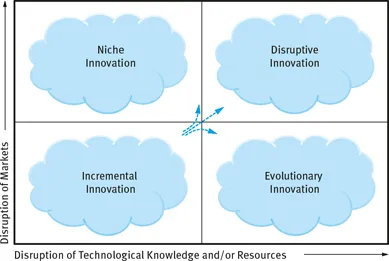 | |
| Figure 1: A “Transilience Map” Illustrating Abernathy and Clark’s Forms of Technological Innovation and Their Influence on an Organization’s Prior Technological Knowledge and Resources (horizontal axis) and on the Competitive Marketplace (vertical axis). | |
| ABG Model | See Triple Helix Model. |
| Ab Initio | In science and engineering, the Latin term ab initio generally refers to developing models and/or making calculations based on first principles; without experimental data (other than fundamental physical constants). |
| Absorptive Capacity | See Technology Acceptor Capacity. |
| Academic Revolution | See Second Mission, Entrepreneurial University. |
| Accelerator | See Business Accelerator. |
| Acceptance Threshold | The transition realm of customer perceptions, between considering a technology to be unacceptable (or unattractive, or not useful) and acceptable (or attractive, or useful). Unacceptable technologies can sometimes be turned into acceptable technologies through an “itemized response” process of analyzing each negative or unacceptable feature (whether real or perceived) of a technology and finding ways to change or address each such drawback. Also termed Threshold of Acceptance. See also Technology Readiness Index, Technology Acceptance Model. |
| Acquisition of Technology | The purchase of, or barter for, externally derived knowledge of how to effectively use a product, process, or service (knowhow), a way of conducting or controlling a manufacturing activity (a practice or process), or a thing to be manufactured, used, or consumed (product). Two broad categories are sometimes distinguished in this context: embodied and disembodied technology. Embodied technology refers to technology that is acquired indirectly because it is embedded in machines, instruments, new employees, or contractors that incorporate or contain the knowledge. Disembodied technology refers to technology that resides in trade secrets, books and other publications, patents, licenses, trademarks, software, and the like. See also Knowledge, Embedded Knowledge. |
| Active Materials | See Smart Materials. |
| Activities | (Innovation) Any or all scientific, engineering, technological, organisational, financial, or commercial activities that lead, or are intended to lead, to development and deployment of innovation(s). Innovation activities include R&D plus subsequent activities such as experimental development, prototyping, pilot testing, demonstration, and preproduction. See also Inputs, Outcomes, Outputs, Reach, Research and Development, Metrics, Impacts. Reference [6]. |
| Adapt and Adopt | See Adopt and Adapt. |
| Adjacent Innovation | The commercialization of a p... |
Table of contents
- Cover
- Title
- Copyright
- Table of Contents
- Figures
- Tables
- About the Author
- Acknowledgments
- Introduction and Historical Evolution
- Numeric
- Glossary of Terms
- References
Trusted by 375,005 students
Access to over 1.5 million titles for a fair monthly price.
Study more efficiently using our study tools.
Frequently asked questions
Yes, you can cancel anytime from the Subscription tab in your account settings on the Perlego website. Your subscription will stay active until the end of your current billing period. Learn how to cancel your subscription
No, books cannot be downloaded as external files, such as PDFs, for use outside of Perlego. However, you can download books within the Perlego app for offline reading on mobile or tablet. Learn how to download books offline
Perlego offers two plans: Essential and Complete
- Essential is ideal for learners and professionals who enjoy exploring a wide range of subjects. Access the Essential Library with 800,000+ trusted titles and best-sellers across business, personal growth, and the humanities. Includes unlimited reading time and Standard Read Aloud voice.
- Complete: Perfect for advanced learners and researchers needing full, unrestricted access. Unlock 1.5M+ books across hundreds of subjects, including academic and specialized titles. The Complete Plan also includes advanced features like Premium Read Aloud and Research Assistant.
We are an online textbook subscription service, where you can get access to an entire online library for less than the price of a single book per month. With over 1.5 million books across 990+ topics, we’ve got you covered! Learn about our mission
Look out for the read-aloud symbol on your next book to see if you can listen to it. The read-aloud tool reads text aloud for you, highlighting the text as it is being read. You can pause it, speed it up and slow it down. Learn more about Read Aloud
Yes! You can use the Perlego app on both iOS and Android devices to read anytime, anywhere — even offline. Perfect for commutes or when you’re on the go.
Please note we cannot support devices running on iOS 13 and Android 7 or earlier. Learn more about using the app
Please note we cannot support devices running on iOS 13 and Android 7 or earlier. Learn more about using the app
Yes, you can access Innovation Technology by Laurier Schramm in PDF and/or ePUB format, as well as other popular books in Tecnología e ingeniería & Negocios en general. We have over 1.5 million books available in our catalogue for you to explore.