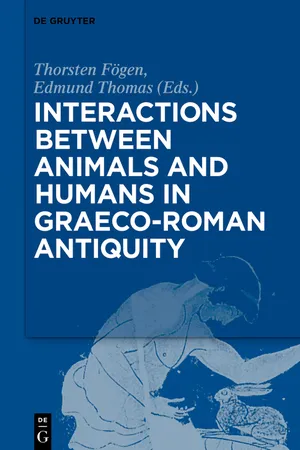
The seventeen contributions to this volume, written by leading experts, show that animals and humans in Graeco-Roman antiquity are interconnected on a variety of different levels and that their encounters and interactions often result from their belonging to the same structures, 'networks' and communities or at least from finding themselves together in a certain setting, context or environment – wittingly or unwittingly. Papers explore the concrete categories of interaction between animals and humans that can be identified, in what contexts they occur, and what types of evidence can be productively used to examine the concept of interactions. Articles in this volume take into account literary, visual, and other types of evidence. A comprehensive research bibliography is also provided.
eBook - ePub
Interactions between Animals and Humans in Graeco-Roman Antiquity
- 506 pages
- English
- ePUB (mobile friendly)
- Available on iOS & Android
eBook - ePub
Interactions between Animals and Humans in Graeco-Roman Antiquity
About this book
Information
Indices (compiled by Thorsten Fögen)
Index rerum
- affection: see ‘love for animals’
- affordance: 1, 2, 3, 4 n. 5
- agency: 1, 2, 3, 4, 5, 6 n. 7, 8, 9, 10
- ager Laurens: 1
- agriculture: 1, 2, 3, 4, 5, 6 n. 7, 8, 9, 10, 11 n. 12, 13, 14, 15, 16, 17, 18, 19, 20, 21, 22, 23
- Ahuramazda: 1
- Alexander mosaic: 1
- Alexander sarcophagus: 1
- Alexandria: 1, 2 n. 3, 4, 5 n. 6, 7
- altruism: 1 n. 2, 3
- Amazon: 275, 1, 2 n. 3, 4, 5, 6, 7, 8, 9, 10, 11, 12, 13, 14
- amicitia: see ‘friendship’
- ἀναγνώρισις: see ‘recognition’
- ἀνατομή: see ‘vivisection’
- ἀνδρεία: see ‘courage’
- anecdotes: 1, 2 n. 3, 4, 5 n. 6, 7, 8 n. 9, 10, 11, 12, 13, 14, 15, 16, 17, 18, 19, 20
- animal literacy: 1, 2
- animal skins: 1, 2, 3, 4, 5, 6 n. 7, 8, 9, 10, 11, 12, 13, 14, 15, 16, 17, 18, 19, 20 n. 21
- anthropocentrism: 1, 2, 3, 4, 5, 6, 7, 8
- anthropomorphism (anthropomorphisation): 1, 2 n. 3, 4, 5, 6, 7, 8, 9, 10, 11, 12, 13, 14, 15, 16, 17, 18, 19
- anthrozoology: 1 n. 2, 3, 4
- antler: 1, 2, 3, 4, 5 n. 6 (see also ‘horn’)
- Apadana reliefs: 1, 2, 3, 4, 5
- apkallu (‘sage’): 1, 2, 3, 4, 5, 6
- appropriation: see ‘οἰκείωσις’
- aristocracy: 1, 2, 3, 4, 5, 6, 7, 8, 9, 10 (see also ‘status’)
- arthritis: 1, 2, 3
- Athenian cavalry archive: 1
- autobiography: 1, 2 (see also ‘biography’)
- Babylon: 11, 1, 2, 3, 4 n. 5, 6, 7, 8
- ‘barbarians’: 1, 2, 3, 4, 5
- bardocucullus: 1
- behaviourism: 1, 2, 3 n. 4
- Beijing: 1, 2, 3, 4
- bestiality: 1, 2, 3 (see also ‘zooerasty’ and ‘zoophilia’)
- biography: 1, 2, 3, 4 (see also ‘autobiography’)
- blood: 1 n. 2, 3, 4, 5, 6, 7, 8, 9, 10, 11 n. 12, 13, 14, 15, 16, 17, 18, 19, 20 n. 21
- bone: 1, 2, 3, 4 n. 5, 6, 7, 8, 9, 10, 11
- boundaries: 1, 2, 3 n. 4, 5, 6 n. 7, 8, 9, 10, 11, 12, 13, 14, 15, 16, 17, 18, 19
- bucolic world: 1, 2, 3, 4, 5
- cage: 1, 2, 3, 4, 5, 6, 7 n. 8, 9, 10, 11, 12 (see also ‘stable’)
- Campana reliefs: 1
- Carthage: 1
- Casa dei Casti Amanti: 1
- Casa dei Ceii: 1
- Casa dei Dioscuri: 1, 2
- Casa del Cinghiale: 1
- Casa del Fauno: 1, 2, 3
- Casa del Forno: 1
- Casa del Menandro: 1, 2
- centaur: 1, 2, 3 n. 4, 5, 6, 7, 8, 9, 10, 11, 12, 13, 14, 15, 16
- ceratophagia: 1
- children: 22, 1, 2, 3, 4, 5, 6, 7, 8, 9, 10, 11, 12, 13, 14, 15, 16, 17, 18, 19, 20, 21, 22 n. 23, 24 n. 25
- cinaedus: 1
- claw: 1, 2, 3
- clay lamps: 1
- cockfight: 1, 2, 3, 4, 5, 6, 7
- combat: 1, 2, 3, 4 n. 5, 6, 7, 8, 9, 10, 11, 12, 13 n. 14, 15, 16, 17, 18, 19 (see also ‘warfare’)
- comedy: 1, 2, 3, 4
- communication: 4, 1, 2, 3, 4, 5, 6, 7, 8 n. 9, 10, 11
- congeniality: 1, 2, 3, 4
- co-operation: 2, 1, 2, 3, 4, 5, 6, 7, 8
- courage: 1, 2, 3 n. 4, 5, 6, 7
- cruelty: 1, 2, 3, 4, 5, 6, 7 n. 8, 9, 10, 11, 12, 13, 14, 15, 16, 17, 18
- cyborg: 1 n. 2
- Delphi: 1, 2
- Derveni krater: 1 n. 2
- δικαιοσύνη: see ‘justice’
- dirge: see ‘epicedion’
- domestication: 19, ...
Table of contents
- Cover
- Title Page
- Copyright
- Preface
- Table of Contents
- Introduction
- A lifetime together? Temporal perspectives on animal-human interactions
- Greek and Latin words for human-animal bonds: Metaphors and taboos
- Pet and image in the Greek world: The use of domesticated animals in human interaction
- Lives in interaction: Animal ‘biographies’ in Graeco-Roman literature?
- Philosophers’ pets: Porphyry’s partridge and Augustine’s dog
- Psychological, cognitive and philosophical aspects of animal ‘envy’ towards humans in Theophrastus and beyond
- “Animal literacy” and the Greeks: Philoctetes the hedgehog and Dolon the weasel
- Cultured animals and wild humans? Talking with the animals in Aristophanes’ Wasps
- Human-animal interactions in Plutarch as commentary on human moral failings
- Fish or man, Babylonian or Greek? Oannes between cultures
- Fighting animals: An analysis of the intersections between human self and animal otherness on Attic vases
- Keeping and displaying royal tribute animals in Ancient Persia and the Near East
- Urban geographies of human-animal relations in classical antiquity
- ‘Wild men’ and animal skins in Archaic Greek imagery
- Galen on the relationship between human beings and fish
- Why avoid a monkey: The refusal of interaction in Galen’s Epideixis
- Animals in Graeco-Roman antiquity: A select bibliography
- Contributors
- Indices
Trusted by 375,005 students
Access to over 1.5 million titles for a fair monthly price.
Study more efficiently using our study tools.
Frequently asked questions
Yes, you can cancel anytime from the Subscription tab in your account settings on the Perlego website. Your subscription will stay active until the end of your current billing period. Learn how to cancel your subscription
No, books cannot be downloaded as external files, such as PDFs, for use outside of Perlego. However, you can download books within the Perlego app for offline reading on mobile or tablet. Learn how to download books offline
Perlego offers two plans: Essential and Complete
- Essential is ideal for learners and professionals who enjoy exploring a wide range of subjects. Access the Essential Library with 800,000+ trusted titles and best-sellers across business, personal growth, and the humanities. Includes unlimited reading time and Standard Read Aloud voice.
- Complete: Perfect for advanced learners and researchers needing full, unrestricted access. Unlock 1.5M+ books across hundreds of subjects, including academic and specialized titles. The Complete Plan also includes advanced features like Premium Read Aloud and Research Assistant.
We are an online textbook subscription service, where you can get access to an entire online library for less than the price of a single book per month. With over 1.5 million books across 990+ topics, we’ve got you covered! Learn about our mission
Look out for the read-aloud symbol on your next book to see if you can listen to it. The read-aloud tool reads text aloud for you, highlighting the text as it is being read. You can pause it, speed it up and slow it down. Learn more about Read Aloud
Yes! You can use the Perlego app on both iOS and Android devices to read anytime, anywhere — even offline. Perfect for commutes or when you’re on the go.
Please note we cannot support devices running on iOS 13 and Android 7 or earlier. Learn more about using the app
Please note we cannot support devices running on iOS 13 and Android 7 or earlier. Learn more about using the app
Yes, you can access Interactions between Animals and Humans in Graeco-Roman Antiquity by Thorsten Fögen, Edmund V. Thomas, Thorsten Fögen,Edmund V. Thomas, Thorsten Fögen, Edmund Thomas in PDF and/or ePUB format, as well as other popular books in History & Ancient History. We have over 1.5 million books available in our catalogue for you to explore.