The much-acclaimed present-day philosophical turn to the letters of Saint Paul points to a profound consonance between ancient and modern thought. Such is the bold claim of this study in which scholars from contemporary continental philosophy, new testamentary studies and ancient philosophy discuss with each other the meaning Paul's terms pistis, faith. In this volume, this theme discusses in detail the threefold relation between Paul and (1) continental thought, (2) the Graeco-Roman world, and (3) political theology. It is shown that pistis does not only concern a mode of knowing, but rather concerns the human ethos or mode of existence as a whole. Moreover, it is shown that the present-day political theological interest in Paul can be seen as an attempt to recuperate Paul’s pistis in this comprehensive sense. Finally, an important discussion concerning the specific ontological implications and background of this reinterpretation of pistis is examined by comparing the ancient ontological commitments to those of the present-day philosophers. Thus, the volume offers an insight in a crucial consonance of ancient and modern thought concerning the question of pistis in Paul while not forgetting to stipulate important differences.
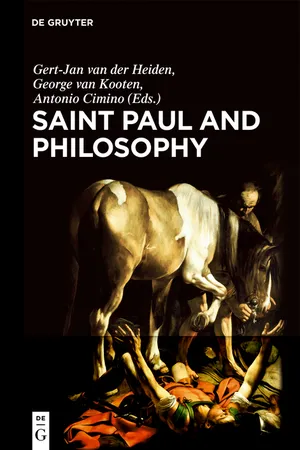
eBook - ePub
Saint Paul and Philosophy
The Consonance of Ancient and Modern Thought
- 382 pages
- English
- ePUB (mobile friendly)
- Available on iOS & Android
eBook - ePub
Saint Paul and Philosophy
The Consonance of Ancient and Modern Thought
About this book
Information
Topic
FilosofiaSubtopic
Filosofia antica e classica
Part I.Philosophical Portraits of Paul and Πίστις
Andrew Benjamin
Reading, Seeing and the Logic of Abandonment: Rembrandt’s Self-Portrait as the Apostle Paul
Abstract: In this essay, Andrew Benjamin investigates the significance of images of Paul. The author striking notes every image of Saint Paul is an attempt to singularize or at the very least to secure an identity, and thus an identity as a singularity, for Paul. Consequently, Paul as image therefore continues to stage, in different ways and with different emphases, the network of relations of which Paul, his image, is always the after-effect. Benjamin explores this impact of the image by seeing, contemplating, and reading a number of paintings of Paul with special attention to Rembrandt’s Self-Portrait as the Apostle Paul. In particular, he discusses how the play of light in some of these paintings stages the fundamental moment of Paul’s conversion, as Benjamin interprets: “The lit face is therefore the sign of conversion.” Yet, unlike what authors such as Badiou seem to suggest, this conversion does not come out of nowhere. It entails, and can only occur in accordance with, an implied logic of abandonment, of a turning away from the past so that the converted face can show itself as and in light. With this first exploration of what it means to offer an image of Paul, and to paint his picture, this volume turns to fifteen images, sculpted or painted with the tools of theology, philosophy, and philology, to deepen our understanding of Paul, the importance of his letters, and in particular the specific sense of his account of faith.
1
What is an image of Saint Paul? Even if this question is addressed, if only initially, within the space opened by the suspension of the question of the image as it occurs within Paul’s own writings, what continues to insist is the presence of Paul. To return to the beginning therefore: What is identified within an image of Paul? Once the image becomes the locus of consideration, what cannot be avoided is the question both of the image and the way that examination is itself to be understood.4 As a beginning there is Paul. Hence, the answer to the question of the name’s identity, the name Paul, necessitates developing the logic within which this particular name appears. While that name generates an inevitable conflict concerning its precise determination, it is also the case that the name provides a setting within which that conflict can occur. Indeed, conflict, which is the result here of Paul’s indeterminate presence, is created by a setting that nonetheless yields forms of coherence. Coherence is not a mere formal quality of a work. Coherence marks the necessity that images have an ideational content; a content that is itself staged by the work of paint thus color, line, light, etc. One works with and through the other. In sum form is always informed.5 Within such a setting every image of Paul is an attempt to singularize or at the very least to secure an identity, and thus an identity as a singularity, for Paul. Paul as image therefore continues to stage, in different ways and with different emphases, the network of relations of which Paul, his image, is always the after-effect.
Rubens’ early painting The Conversion of Saint Paul (1602; Fig. 1) presents Paul—constructs Paul thereby allowing Paul to figure—through its creation of the space of “conversion.”6 Within it the motif of Paul takes on a determined quality.7 Paul’s image cannot be thought other than in relation to light. Light, which is the work of paint and thus paint’s formal presence, brings with it the question of what precisely informs form. Here, in Rubens’ painting the light beneath the Christ figure dramatizes the dark within which “Paul” is located. In moving from the dark to the light, Saul will become Paul. The event withinart’s work is held by—if not structured by—a relation between light and dark. In other words, the painting allows a motif of Paul to figure, a motif that is positioned within and as the work of art. Unseated from his horse, his having fallen he becomes, as a result, the presentation of a state that presages. No longer standing he will be able to stand again (and anew). Standing no longer as Saul, a positioning within the context of the painting that is the fallen state, the state that is obscured, he will, nonetheless, come to stand. That standing, which has to be understood as an emergence into being, (interplaying stare and stand) is an emerging from that which obscures. Light is directed from the figure of Christ standing forth from the dark of the clouds within a form of radiance and illumination that is not just carried by the body of the horse directly beneath him, the direction of the traces of light is itself repeated by the direction taken by the horse’s twisting head.8 They reinforce each other creating what here is light’s overall force. Color and movement combine. This combination, thus this moment within the work’s work, is interrupted by the color of the cloak worn by the boy trying to subdue the horse from which Saul has fallen. Not only does the color as present recall the color of the cloak worn by the Christ figure, it is also the case that this interruption stops the play of light that would have reached the body of Saul. That body is obscured. As a result, it is darkened. And yet, light plays on his face. This is the decisive point since it allows the now lit face to rise from obscurity while maintaining its relation to the obscure. One works with the other. As a consequence, it is as though his lit face is rising from the obscurity. The lit face is therefore the sign of conversion. Recalled here is of course the other Paul, Paul the writer of text, and thus recalled with that name is the decisive passage from 2 Corinthians in which what is central is the lit face of Christ:

For God, who said, “Let light shine out of darkness,” made his light shine in our hearts to give us the light of the knowledge of God’s glory displayed in the face of Christ. (ὅτι ὁ Θεὸς ὁ εἰπών Ἐκ σκότους φῶς λάμψει, ὃς ἔλαμψεν ἐν ταῖς καρδίαις ἡμῶν πρὸς φωτισμὸν τῆς γνώσεως τῆς δόξης τοῦ Θεοῦ ἐν προσώπῳ Χριστοῦ.)9
Paul’s face is not the face of Christ. (In addition, in these lines there is no statement of a Pauline conception of the image even though, as will be developed at a later stage, the use of the term “glory (δόξα)” refers to the setting in which it does occur.) Rather the lit face is always already related to the face of Christ. As is clear, what is central to that face is God’s “glory (δόξα).” The latter has to be identified with its presence in the lit face. Hence Paul’s face is glorified. This is form informed. Moreover, this is what it means, in this context, for the face of Paul to appear; appearing as an emerging, thus appearing to stand over Saul. The prone figure has therefore a doubled presence insofar as Paul’s conversion is Saul’s abandonment. Here it is essential to be clear. The contention is that there cannot be one without other. Conversion and abandonment are interconnected. Hence what is at work is what might best be described not as a conversion but more accurately as a logic of abandonment in which that conversion is inscribed. That logic constructs the Pauline event.10 The event is anoriginally doubled; abandoning leaves its traces in the identity it founds and that identity has to be understood as related to the abandoned as abandoned. The event that is founded in the case of Rubens’ painting is given in the face; the face is marked in advance therefore by its having a foundational position.

The form of complexity present in Rubens’ scene of conversion is however not there in Caravaggio’s painting—a work with the “same” set of relations—which is located in the Cerasi Chapel in the Church of Santa Maria del Popolo in Rome, namely the Conversion on the Way to Damascus (1601; Fig. 2).11 In this particular painting whilst there is the work of light, light works in another way. Form is informed differently.What is of significance therefore is how the differences in question are to be understood. The work of light within Caravaggio’s painting is such that Saul is already Paul. The motif of Paul figures differently precisely because the work of light stages a transition that has already taken place. What occurs here is a different point in the overall narrative. This is the light that dominates. The entire body is lit. Obscurity therefore has a different role. In Rubens’ painting the body of Paul was divided. Here in Caravaggio’s the division is located elsewhere. Rather than the body of Saul/Paul being a divided and thus present as a transitional body, in this instance division as the work of light only really pertains to the man holding the horse. In this painting of triumphant conversion, he is no longer part of Paul’s accompaniment (even though he is accompanying Paul). He is both there and not there. Retained as abandoned he becomes therefore what might be described as the figure of abandonment. It is as though Rubens is more concerned with the way the logic of abandonment has constructed the motif of Paul, rather than with its triumphant aftereffect. And yet, it is not as though the after-effect is itself unaffected by the presence of that logic. Indeed, if it can be argued that the motifs of Paul are produced by that logic’s work, then what gives ideational coherence to these paintings of Paul is way the work of that logic acquires specificity. (This has to be the case since at play here is a logic that does not have an already determined and thus singular form.) Hence in Caravaggio’s painting the event cannot be seen except in relation to the ineliminability of the obscured figure who is present and thus who is the presence of the abandoned. Caravaggio’s painting retains the abandoned by positioning it within obscurity—leaving it there, positioning it, qua figure, within the necessity of its own abandonment and thus its already having been abandoned.

The complex logic of abandonment, which is the Pauline event, sets the scene allowing for an approach to another motif of Paul, specifically, here, Rembrandt’s Self-Portrait as the Apostle Paul (1661; Fig. 3).12 Not only is the image of Paul fundamental, what cannot be avoided is the link established by Rembrandt between that image (Paul) and his own self-image. Rembrandt continued to paint himself. Self-portraiture forms a fundamental part of his overall project.13 If there is a final point that needs to be made prior to turning to Rembrandt then it concerns how the formal arrangement of the figures within a painting is to be understood. While there may be a compositional set of relations that might establish an affinity between Caravaggio and Rembrandt on the one hand, and while therefore there may be a commensurability of project between paintings of Paul in both Rubens and Caravaggio on the other, the overriding interpretive claim is that despite the presence of purely formal relations once there is an insistence on art’s material presence, that is as a beginning the work of color, line, light, and so on—and working with the assumption that it is art’s material presence and thus its mattering that produces meaning, form endures as informed—then what emerges as of interest are the differences that the image of Paul creates; in other words, the creation of the discontinuous continuity of Paul as motif. It is within that setting that the particularity of Rembrandt’s Paul appears. Part of the argument to come is that in Rembrandt’s Paul the logic of abandonment, while present, is staged in terms of a complex of relations between seeing, reading and blinding.
2
It is always a question of what is seen. And yet, once posed as a question, seeing as a question, then its contents, the set of demands that are being made and which pertain to the seen, are far from as clear as may first have appeared. The painting—Self-Portrait as the Apostle Paul—is seen.14 Viewing occurs. Viewing takes place within it. Paul/Rembrandt looks out. He looks out seeing. He lifts his head from a book that is, as a consequence, within the staged set of relations that comprise this particular painting, no longer seen. What is seen, viewed, stages a relation to seeing even though what counts as seeing is problematized and as a result emerges as a question. The presence of a book that had been seen, is now—in the “now” of the painting—no longer seen; the status and nature of this book becomes a locus of inquiry and thus are a setting to which a return must be made. As his head looks out seeing has a relation to the not seen. The face is given within that relation and thus given with the staging of the logic of abandonmen...
Table of contents
- Cover
- Title Page
- Copyright
- Acknowledgments
- Table of Contents
- Introduction: On the Philosophical Affiliations of Paul and Πίστις
- Part I. Philosophical Portraits of Paul and Πίστις
- Part II. Paul and Πίστις in the Greco-Roman World
- Part III. The Political Theologies of Paul
- Index of Ancient Sources
- Index of Names and Subjects
Trusted by 375,005 students
Access to over 1.5 million titles for a fair monthly price.
Study more efficiently using our study tools.
Frequently asked questions
Yes, you can cancel anytime from the Subscription tab in your account settings on the Perlego website. Your subscription will stay active until the end of your current billing period. Learn how to cancel your subscription
No, books cannot be downloaded as external files, such as PDFs, for use outside of Perlego. However, you can download books within the Perlego app for offline reading on mobile or tablet. Learn how to download books offline
Perlego offers two plans: Essential and Complete
- Essential is ideal for learners and professionals who enjoy exploring a wide range of subjects. Access the Essential Library with 800,000+ trusted titles and best-sellers across business, personal growth, and the humanities. Includes unlimited reading time and Standard Read Aloud voice.
- Complete: Perfect for advanced learners and researchers needing full, unrestricted access. Unlock 1.5M+ books across hundreds of subjects, including academic and specialized titles. The Complete Plan also includes advanced features like Premium Read Aloud and Research Assistant.
We are an online textbook subscription service, where you can get access to an entire online library for less than the price of a single book per month. With over 1.5 million books across 990+ topics, we’ve got you covered! Learn about our mission
Look out for the read-aloud symbol on your next book to see if you can listen to it. The read-aloud tool reads text aloud for you, highlighting the text as it is being read. You can pause it, speed it up and slow it down. Learn more about Read Aloud
Yes! You can use the Perlego app on both iOS and Android devices to read anytime, anywhere — even offline. Perfect for commutes or when you’re on the go.
Please note we cannot support devices running on iOS 13 and Android 7 or earlier. Learn more about using the app
Please note we cannot support devices running on iOS 13 and Android 7 or earlier. Learn more about using the app
Yes, you can access Saint Paul and Philosophy by Gert Jan van der Heiden, George Henry van Kooten, Antonio Cimino, Gert Jan van der Heiden,George Henry van Kooten,Antonio Cimino in PDF and/or ePUB format, as well as other popular books in Filosofia & Filosofia antica e classica. We have over 1.5 million books available in our catalogue for you to explore.