- 236 pages
- English
- ePUB (mobile friendly)
- Available on iOS & Android
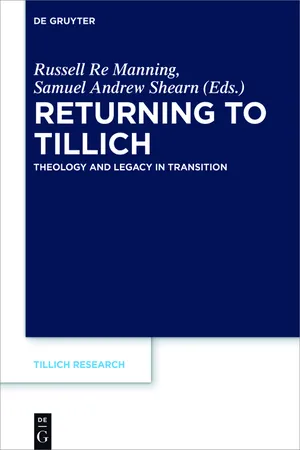
Returning to Tillich
About this book
Fifty years after his death in 1965 the essays in this collection return to Paul Tillich to investigate his theology and its legacy, with a focus on contemporary British scholarship. Originating in a conference held in Oxford in 2014, the book contains 16 original contributions from a mixture of junior and more established scholars, most of whom have a connection to Britain.
The contributions are diverse, but four themes emerge throughout the volume. Several essays are concerning with a characterisation of Tillich's theology. In dialogue with recent emphases on the radical Tillich, some essays suggest a more conservative estimation of Tillich's theology, rooted in the Idealist and classical Christian platonic traditions, whilst in constant engagement with changing existential situations.
Secondly, and perhaps reflecting the context of religious diversity and theories of religious pluralism in Britain, many essays engage Tillich's approach to non-Christian religions. Thirdly, some essays address the importance of existentialist philosophy for Tillich, notably via an engagement with Sartre. Finally, a number of essays take up the diagnostic potential of Tillich's theology as a resource for engaging contemporary challenges.
Tools to learn more effectively

Saving Books

Keyword Search

Annotating Text

Listen to it instead
Information
Chapter 1
1The Third Critique hypothesis
1.1Jacob Friedrich Fries and the neo-Friesian school of Göttingen
Table of contents
- Cover
- Title Page
- Copyright Page
- Table of Contents
- Abbreviations
- Acknowledgements
- Foreword
- Introduction: Returning to Tillich
- Chapter 1
- Chapter 2
- Chapter 3
- Chapter 4
- Chapter 5
- Chapter 6
- Chapter 7
- Chapter 8
- Chapter 9
- Chapter 10
- Chapter 11
- Chapter 12
- Chapter 13
- Chapter 14
- Chapter 15
- Epilogue: A Dinner Speech
- Contributors’ Details
- Bibliography
- Index
Frequently asked questions
- Essential is ideal for learners and professionals who enjoy exploring a wide range of subjects. Access the Essential Library with 800,000+ trusted titles and best-sellers across business, personal growth, and the humanities. Includes unlimited reading time and Standard Read Aloud voice.
- Complete: Perfect for advanced learners and researchers needing full, unrestricted access. Unlock 1.4M+ books across hundreds of subjects, including academic and specialized titles. The Complete Plan also includes advanced features like Premium Read Aloud and Research Assistant.
Please note we cannot support devices running on iOS 13 and Android 7 or earlier. Learn more about using the app