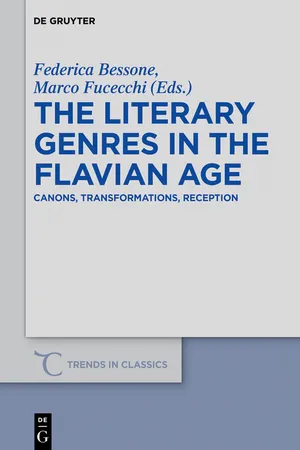
eBook - ePub
The Literary Genres in the Flavian Age
Canons, Transformations, Reception
- 368 pages
- English
- ePUB (mobile friendly)
- Available on iOS & Android
eBook - ePub
The Literary Genres in the Flavian Age
Canons, Transformations, Reception
About this book
No detailed description available for "The Literary Genres in the Flavian Age".
Information
Bibliography
Abbamonte, Giancarlo (2009), “Discorsi alle truppe: documenti, origine e struttura retorica”, in: G. Abbamonte / L. Miletti / L. Spina (eds.), 29‒46.
Abbamonte, Giancarlo / Miletti, Lorenzo / Spina, Luigi (eds.) (2009), Discorsi alla prova, Napoli.
Adamietz, Joachim (1986), “Quintilians Institutio oratoria”, in: ANRW II 32.4, 2226‒2271.
Agnesini, Alex (2012), “Lepos, mores, pathos, furor, risus… Per una ‘ri-sistemazione’ di alcuni carmina catulliani”, in: A.M. Morelli (ed.), Lepos e mores. Una giornata su Catullo, Atti del convegno internazionale, Cassino, 27 maggio 2010, Cassino, 171‒202.
Ahl, Frederick M. (1986), “Statius’ Thebaid. A reconsideration”, in: ANRW II 32.5, 2803‒2912.
Ahl, Frederick M. (1989), “Homer, Vergil, and complex narrative structures in Latin epic: an essay”, in: ICS 14, 1‒31.
Ahl, Frederick / Davis, Martha A. / Pomeroy, Arthur (1986), “Silius Italicus”, in: ANRW II 32.4, Berlin, 2492‒2461.
Albrecht, Michael von (1964), Silius Italicus: Freiheit und Gebundenheit römischer Epik, Amsterdam.
Albrecht, Michael von (1999), Roman Epic: an Interpretative Introduction, Leiden.
Anderson, William B. (ed. and transl.) (1936, 19652), Sidonius Apollinaris, Poems and Letters, I, Cambridge, MA.
André, Jean-Marie (1966), L’Otium dans la vie morale et intellectuelle romaine des origines à l’époque augustéenne, Paris.
Argentieri, Lorenzo (2007), “Meleager and Philip as Epigram Collectors”, in: P. Bing / J.S. Bruss (eds.), Brill’s Companion to Hellenistic Epigram, Leiden-Boston, 147‒164.
Aricò, Giuseppe (1972), Ricerche Staziane, Palermo.
Aricò, Giuseppe (1981), “Contributo alla ricostruzione degli Skyrioi euripidei”, in: I. Gallo (ed.), Studi salernitani in memoria di R. Cantarella, Salerno, 215‒230.
Aricò, Giuseppe (1986), “L’Achilleide di Stazio: tradizione letteraria e invenzione narrativa”, in: ANRW II 32.5, 2925‒2964.
Aricò, Giuseppe (1991), “La vicenda di Hypsipyle in Valerio Flacco e Stazio”, in: M. Korn / H.J. Tschiedel (eds.), Ratis Omnia Vincet: Untersuchungen zu den Argonautica des Valerius Flaccus, München, 197‒210.
Aricò, Giuseppe (1996), “Rileggendo l’Achilleide”, in: F. Delarue / S. Georgacopoulou / P. Laurens / A.-M. Taisne (eds.), Epicedion. Hommage à P. Papinius Statius 96‒1996, Poitiers, 185‒199.
Aricò, Giuseppe (2008), “Leves libelli. Su alcuni aspetti della poetica dei generi minori da Stazio a Plinio il Giovane”, in: CentoPagine 2, 1‒11.
Ariemma, Enrico (2010), “Fons Cuncti Varro Mali: The Demagogue Varro in Punica 8‒10”, in: A. Augoustakis (ed.), 241‒276.
Arrighetti, Graziano (1965), Epicuro, Opere, Torino.
Ash, Rhiannon (1999), “An Exemplary Conflict: Tacitus’ Parthian Battle Narrative (Annals 6.34‒35)”, in: Phoenix 53, 114‒135.
Ash, Rhiannon (2002), “Epic encounters? Ancient historical battle narrative and the epic tradition”, in: D.S. Levene / D.P. Nelis (eds.), Clio and the Poets: Augustan Poetry and the Traditions of Ancient Historiography, Leiden, 253‒274.
Auerbach, Erich (1965), Literary Language and its Public in late Latin Antiquity and the Middle Ages, transl. R. Mannheim, London.
Augoustakis, Antony (2003), “Rapit infidum victor caput: Ekphrasis and Gender Role Reversal in Silius Italicus’ Punica 15”, in: P. Thibodeau / H. Haskell (eds.), Being There Together: Essays in Honor of Michael C.J. Putnam on the Occasion of his Seventieth Birthday, Minnesota, 110‒127.
Augoustakis, Antony (2010a), Motherhood and the Other. Fashioning Female Power in Flavian Epic, Oxford.
Augoustakis, Antony (ed.) (2010b), Brill’s Companion to Silius Italicus, Leiden-Boston.
Augoustakis, Antony (2010c), “Silius Italicus. A Flavian Poet”, in: A. Augoustakis (ed.), 3‒23.
Augoustakis, Antony (2011), “sine funeris ullo ardet honore rogus: Burning Pyres in Lucan and Silius Italicus’ Punica”, in: P. Asso (ed.), Brill’s Companion to Lucan, Leiden-Boston, 185‒198.
Augoustakis, Antony (2012), “Daphnis’ deductum nomen / carmen in Silius’ Sicilian Pastoral (Pun. 14.462‒76)”, in: TiC 4, 132‒152.
Augoustakis, Antony (ed.) (2013), Ritual and Religion in Flavian Epic, Oxford.
Augoustakis, Antony (ed.) (2014), Flavian Poetry and Its Greek Past, Leiden-Boston.
Augoustakis, Antony (2015), “Campanian Politics and Poetics in Silius Italicus’ Punica”, in: ICS 40, 155‒169.
Augoustakis, Antony (2016), “Burial and Lament in Flavian Epic: Mothers, Fathers, Children”, in: N. Manioti (ed.), 276‒300.
Austin, Roland G. (ed.) (1965), Quintiliani Institutionis oratoriae liber XII, Oxford (19481).
Ax, Wolfram (1986), Laut, Stimme, Sprache – Studien zu drei Grundbegriffen der antiken Sprachtheorie, Göttingen.
Ax, Wolfram (ed.) (2011), Quintilians Grammatik (inst. orat. 1, 4‒8), Berlin-Boston.
Bäblitz, Leanne (2009), “The selection of advocates for repetundae trials. The cases of Pliny the Younger”, in: Athenaeum 97, 197‒208.
Baehrens, Aemilius (ed.) (18932), Catulli Veronensis Liber, II, Commentarius, nova ed. a K.P. Schulze curata, Lipsiae.
Bailey, Cyril (ed.) (1949), Lucretius, De rerum natura, ed. with trans. and comm., Oxford.
Bailey, Cyril (ed.) (1975), Epicurus, The Extant Remains. With short critical apparatus, translation, and notes, Hildesheim-New York.
Barchiesi, Alessandro (1995), “Figure dell’intertestualità nell’epica romana”, in: Lexis 13, 49‒67.
Barchiesi, Alessandro (1996), “La guerra di Troia non avrà luogo: il proemio dell’Achilleide di Stazio”, in: AION 18, 45‒62.
Barchiesi, Alessandro (2001), “Genealogie letterarie nell’epica imperiale. Fondamentalismo e ironia”, in: E.A. Schmidt (ed.), L’histoire littéraire immanente dans la poésie latine (Entretiens sur l’Antiquité Classique 47), Vandoeuvres-Genève 21‒25 août 2000, Genève, 315‒354 and “Discussion”, 355‒362.
Barchiesi, Alessandro (2005a), “Masculinity in the 90’s: the education of Achilles in Statius and Quintilian”, in: M. Paschalis (ed.), Roman and Greek Imperial Epic, Rethymnon, 47‒75.
Barchiesi, Alessa...
Table of contents
- Cover
- Title Page
- Copyright
- Table of Contents
- Introduction
- I Genres and Literary History
- II Encyclopaedism and Oratory
- III Tradition and Poetics of the Epigram
- IV Occasional Poetry and Literary Genres
- V Models and Transformations of the Epos
- VI War and Generic Tensions
- VII Epic and Other Genres
- Bibliography
Trusted by 375,005 students
Access to over 1.5 million titles for a fair monthly price.
Study more efficiently using our study tools.
Frequently asked questions
Yes, you can cancel anytime from the Subscription tab in your account settings on the Perlego website. Your subscription will stay active until the end of your current billing period. Learn how to cancel your subscription
No, books cannot be downloaded as external files, such as PDFs, for use outside of Perlego. However, you can download books within the Perlego app for offline reading on mobile or tablet. Learn how to download books offline
Perlego offers two plans: Essential and Complete
- Essential is ideal for learners and professionals who enjoy exploring a wide range of subjects. Access the Essential Library with 800,000+ trusted titles and best-sellers across business, personal growth, and the humanities. Includes unlimited reading time and Standard Read Aloud voice.
- Complete: Perfect for advanced learners and researchers needing full, unrestricted access. Unlock 1.5M+ books across hundreds of subjects, including academic and specialized titles. The Complete Plan also includes advanced features like Premium Read Aloud and Research Assistant.
We are an online textbook subscription service, where you can get access to an entire online library for less than the price of a single book per month. With over 1.5 million books across 990+ topics, we’ve got you covered! Learn about our mission
Look out for the read-aloud symbol on your next book to see if you can listen to it. The read-aloud tool reads text aloud for you, highlighting the text as it is being read. You can pause it, speed it up and slow it down. Learn more about Read Aloud
Yes! You can use the Perlego app on both iOS and Android devices to read anytime, anywhere — even offline. Perfect for commutes or when you’re on the go.
Please note we cannot support devices running on iOS 13 and Android 7 or earlier. Learn more about using the app
Please note we cannot support devices running on iOS 13 and Android 7 or earlier. Learn more about using the app
Yes, you can access The Literary Genres in the Flavian Age by Federica Bessone, Marco Fucecchi, Federica Bessone,Marco Fucecchi in PDF and/or ePUB format, as well as other popular books in Literature & Ancient & Classical Literary Criticism. We have over 1.5 million books available in our catalogue for you to explore.