Die Theologische Bibliothek Töpelmann bietet ein Forum für wissenschaftliche Arbeiten in Systematischer Theologie und Religionsphilosophie. Die Reihe steht allen Aspekten einer weit verstandenen Systematischen Theologie offen, insbesondere Forschungen zu Dogmatik, Ethik, allen Epochen der Theologiegeschichte und Religionsphilosophie sowie auch solchen Arbeiten, die bibelwissenschaftliche Perspektiven mit theologischen Fragen verbinden. Der Name der Reihe erinnert an das Erbe des einflussreichen Verlegers Alfred Töpelmann (1867-1954).
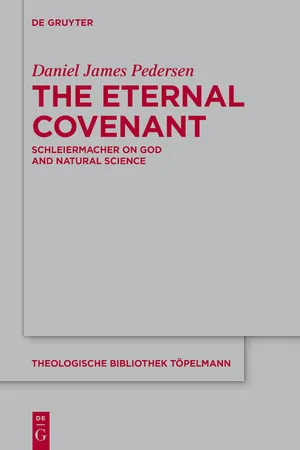
- 199 pages
- English
- ePUB (mobile friendly)
- Available on iOS & Android
eBook - ePub
About this book
Information
Topic
Theology & ReligionSubtopic
Christian TheologyChapter 1Introduction: The Eternal Covenant
“All men, Socrates, who have any degree of
right feeling, at the beginning of every
enterprise, whether small or great, call upon
God. And we too, who are going to discourse on
the nature of the universe, how created or how
existing without creation, if we be not
altogether out of our wits, must invoke the aid
of Gods and Goddesses and pray that our words
be acceptable to them and consistent with
themselves.”
- Plato, Timaeus
These days it is fashionable to believe, especially in the face of the encroachments of modern science, that there is no freedom without indeterminacy, and no love without indeterminate freedom. This, it is supposed, is as true for God as it is for creatures.
It is remarkable how far this assumption extends. In contemporary conversations on theology-and-science, theorizing a way for God to act within the forces and powers of the natural world, without interrupting them, has become its own cottage industry.1 That this is even a genuine problem is far from obvious, and yet the solutions keep coming. Almost inevitably they trade on an indeterminist reading of quantum theory, reified into a really indeterminate universe.2 God, on this account, need not topple the structures of the universe because those structures are already open. God has elbow room to work, unrestrained by God’s own design. The effort to secure the universe as indeterminate is in part an effort to secure divine freedom of a certain kind, the freedom to act within or upon a world from which, it is assumed, divine activity would otherwise be absent.
The assumption that indeterminacy is a necessary condition of divine freedom is not limited to theology and science specialists. It also permeates much of last century’s work on the doctrine of God. From philosophers of religion to scholars in the recent trinity and election debates, there is a running assumption that indeterminate divine action of the divine essence is as necessary to secure freedom within God’s own life as indeterminacy in nature is to secure free divine interaction with the world.3 Indeterminate divine action, it is assumed, is the only alternative to compulsion. It is indeterminate divine freedom that makes God’s grace genuinely free, and so, genuinely grace, and it is this free grace, this grace which needn’t have been, that secures the love of God as love. For, it is assumed, what you cannot decline to love, you cannot genuinely love. While some theologians worry about divine action being constrained by the world, other theologians worry about divine action being constrained by the divine nature itself.
For more than a century, many theologians and their interlocutors have taken the bait, but it was not always so. In a similar situation, and facing remarkably similar assumptions, Friedrich Schleiermacher gave an account of the Christian faith and its relation to natural science which required none of the indeterminacy which contemporary accounts of many kinds judge essential. On Schleiermacher’s account, the “problem” of how to secure divine freedom through indeterminacy, in either the world or in the divine life itself, is a false problem. In fact, he argues the opposite: that the indeterminacy which both advocates and critics judge necessary for God is both incoherent and impious. Indeterminacy is instead an imperfection of the definite action of a definite God: a failure of divine power, divine wisdom, or both. And, in fact, not only are worries over both questions of divine action—divine intervention vis-à-vis the world, or indeterminacy vis-à-vis the divine nature—equally problematic, they are problematic in the same way because they are simply two facets of one and the same false problem. Schleiermacher’s alternative account transcends both at once. And, as an account which explicitly proceeds from piety, it does not admit of dead forces, or blind necessity, and least of all the superfluity of the Supreme Being, but insists instead that criticism of this sort is not only compatible with piety, but necessitated by it. The following chapters unpack each of these claims in turn.
It might sound unbelievable to pair the seemingly disparate problems of such different interests together. It might sound even more unbelievable to promise one and the same solution to all. Yet this is exactly what Schleiermacher himself did when he proposed his “eternal covenant” between the Christian faith and natural science. What exactly that covenant amounts to, and how exactly it is supported, is the subject of this work. Schleiermacher’s account, as we will see, is not only the consequence of method, or of obeisance paid to the cultural prestige of natural science, but the result of leveraging commitments shared by both the Christian faith and natural science. For his case, he summons shared principles and deploys philosophical and theological arguments, many of which have not been fully appreciated, and some of which have not even been recognized. The eternal covenant, is the result of this intricate effort.
The Eternal Covenant in the Letters to Lücke
In his open Letters to Lücke, Schleiermacher famously proposed an “eternal covenant between the living Christian faith, and completely free, independent, scientific inquiry, so that faith does not hinder science and science does not exclude faith.”4 In itself, this neither amounts to an argument, nor even a clear program. In consequence, a good deal of labor has been devoted to clarifying what Schleiermacher meant when he proposed this eternal covenant, and how what he meant solves the issues at hand—if it is a solution at all. While there are important insights in each of these interpretations, none are wholly adequate.
The existing work on the eternal covenant often resolves Schleiermacher’s proposal into two generalized camps, most clearly explained by Andrew Dole as the “segregation model” and the “accommodation model.”5 The former, represented by Richard Brandt’s reading,6 secures the compatibility of theology and science by, as the type suggests, segregating them. Theology and science can never, in principle, conflict because they have nothing to do with each other. On this reading, Schleiermacher’s eternal covenant amounts to something like Stephen Jay Gould’s proposal for “nonoverlapping magisteria,” or NOMA.7 It is a riff on the fact-value divide of positivism, where feeling, or religious experience, is substituted for aesthetic or moral value. The idea that “faith does not hinder science, and science does not exclude faith,”8 suggests two fields having less to do with each other, not more: as Schleiermacher puts it a few lines later, “that [the Christian consciousness] remain free from entanglements with science.”9 The segregation model is, at least on the face of things, a natural interpretation of the eternal covenant.
There are, however, problems with the segregation model. As Dole points out, it fails to make sense of Schleiermacher’s proposal in his intellectual context: “The segregation model misses this fact that Schleiermacher’s call for an eternal covenant was directly addressed to an intensifying conflict between the liberalism of which he had become a well-known proponent and an explicitly protectivist and anti-intellectual neopietism.”10 Schleiermacher’s proposal would, in the segregation model, support an identical position to his opponents’. Demarcation along these lines heightens, rather than resolves, conflict between disciplines. Theologians of all kinds would become those very barbarians who, “fence themselves in with weapons at hand to withstand the assaults of sound research […].”11 In the final analysis, such a reading is too ironic to be likely.
In place of the segregation model, Dole suggests his own interpretation: the accommodation model.12 This model, “sees Schleiermacher, first, refusing to place any limitations on scientific investigation and, second, imposing upon the religious an obligation to understand themselves and their religion in terms compatible with the sciences—in a word, accommodating to the past and future deliverances of natural-scientific research.”13 This interpretation has obvious advantages over the segregation model: it has no trouble situating Schleiermacher’s proposal within his context, and it is clearly an alternative to the view of his opponents. Further, it acknowledges the authority Schleiermacher gave to natural science. In practice, it amounts to Christianity ceding as much as it can to the claims of natural science while nevertheless maintaining “a series of claims over and above but not in conflict with either the actual or the anticipated deliverances of natural-scientific investigation.”14 Concrete support for this latter aspect of the accommodation model can be found in Schleiermacher’s rejection of miracles, and even a beginning of creation itself, where he seems to put this program to practice.15 On these grounds and others, the accommodation model is a more plausible interpretation of the eternal covenant than the segregation model.
Dole is not the only reader of Schleiermacher to uphold to the accommodation model, or something like it. Less-developed versions of Dole’s reading are standard in recent scholarship. Julia Lamm, for instance, claims that, “in the Glaubenslehre, [Schleiermacher’s] concern is to show there is no contradiction between science and religion. Science, he says, sets certain limits to what can be said in the dogmatic enterprise.”16 Likewise, Robert Sherman describes Schleiermacher’s project as “dissecting, purging, and rejoining” some dogmatic claims, so that others might be “rooted in assumptions not antithetical to science […].”17 With these descriptions, a pattern begins to emerge. The covenant is, on each count, attempting to avoid contradiction. Such contradictions are avoided by abandoning the commitments which generate them. And, in the accommodation model, it is at least largely the responsibility of the Christian faith to resolve conflicts with natural science by dispensing with its less important beliefs, beliefs which have become burdensome to itself and repugnant to others. Against the segregation model, this is much more plausible; as above, Schleiermacher calls for something like this in the Letters to Lücke. And, insofar as this interpretation is able to make sense of the instances where Schleiermacher does abandon commitments in potential conflict with natural science, the accommodation model is the superior model.
However, in spite of the superiority of the accommodation model, some puzzles remain. Both the segregation model and the accommodation model are methodological or programmatic resolutions to the problem. That is, they purport to solve conflict between the Christian faith and natural science with a procedure, a blueprint, a plan of action. However, it is not obvious that what Schleiermacher meant was restricted to a methodological solution, and, even if it is what he meant, it is not clear that it would be a good idea.
Methodological readings of the eternal covenant might imply that the covenant itself is a methodological proposal. That means that not only is the covenant best summed up in a generalized procedure, but it was actually proposed by Schleiermacher just as such a procedure. If so, as a starting point, the eternal covenant would amount to rules for avoiding or resolving conflict. Further, at least some of the conflict mentioned by Schleiermacher, and nearly always the conflict assumed by his interpreters, is a conflict between different authorities more than concrete beliefs. The conflict to be avoided or resolved is between natural science and the Christian faith writ large. Particular beliefs are adjusted subsequent to the right ordering of authorities in the hierarchy. Moreover, those authorities are not individual, but collective: the authority of disciplines as disciplines, the authority of natural science, and the authority of the Christian faith as guilds. If so, the eternal covenant is primarily political, not conceptual. In other words, the motivation for such an eternal covenant is not first and foremost that the claims and reasons of natural science bear on traditional theological claims, challenging them sometimes to the point of those claims’ obsolescence, but instead that natural science as a discipline should be ceded intellectual territory in advance of whatever it may claim. Since, in the Letters to Lücke, Schleiermacher is concerned with resolving exactly this kind of public controversy, the eternal covenant is surely at least partly political. And yet the interpretation of the eternal covenant as primarily a program for resolving political conflicts between disciplines is both implausible and unsatisfying.
It is not obvious that such a political solution would have been either desirable or persuasive in context. If Schleiermacher’s eternal covenant was no more than a rule for disciplines to arbitrate authority, then it—the covenant itself—could have no warrant in higher claims. Parties would have to begin by agreeing that the covenant, as a scheme for carving up intellectual territory, was a common good. But on what basis could they agree to this? Any basis would have to include reasons held in common, and any agreement sought would have to be on the basis of prior agreement. But in the segregation model, neither natural science nor the Christian faith can share common reasons. And although in the accommodation model they can share reasons, they cannot share authority. If the two disciplines somehow began by agreeing to the covenant, then fine, they would have agreed. But that then would render the covenant superfluous, since the purpose of the covenant is to mediate differences. But, if faith and science did not agree, what then? In that case, there would be no common basis to convince one another. Since the eternal covenant was proposed in a context of conflict and disagreement, its results cannot have been assumed from the start. And since both ‘barbarian’ Christians and ‘unbelieving’ scientists were already actively trying to deny one another authority, mutual regard could not even be assumed. If the eternal covenant involved a political solution—which it surely did in part—it could not have been a starting point. Just as Dole rightly argues that the segregation model is implausible when considered in context, since Schleiermacher’s theological (not to mention scientific) opponents desired segregation, so the acco...
Table of contents
- Cover
- Title Page
- Copyright
- Dedication
- Contents
- Abbreviations
- Chapter 1 Introduction: The Eternal Covenant
- Chapter 2 The Science of Schleiermacher’s World, the World of Schleiermacher’s Science: Natural Science in the early Nineteenth Century
- Chapter 3 Divine Wisdom and the Order of the World: Leibniz and Schleiermacher on the Perfection of Nature
- Chapter 4 The World and Miracles: Schleiermacher on the Nature System
- Chapter 5 Divine Power and the Necessity of the World: Spinoza and Schleiermacher on the Perfection of Nature
- Chapter 6 The Self Presentation of the Divine Essence: Schleiermacher on the World as the Artwork of God
- Chapter 7 Conclusion: The Essential Identity of Ethics and Natural Philosophy
- Bibliography
- Index of Names
- Index of Subjects
Trusted by 375,005 students
Access to over 1.5 million titles for a fair monthly price.
Study more efficiently using our study tools.
Frequently asked questions
Yes, you can cancel anytime from the Subscription tab in your account settings on the Perlego website. Your subscription will stay active until the end of your current billing period. Learn how to cancel your subscription
No, books cannot be downloaded as external files, such as PDFs, for use outside of Perlego. However, you can download books within the Perlego app for offline reading on mobile or tablet. Learn how to download books offline
Perlego offers two plans: Essential and Complete
- Essential is ideal for learners and professionals who enjoy exploring a wide range of subjects. Access the Essential Library with 800,000+ trusted titles and best-sellers across business, personal growth, and the humanities. Includes unlimited reading time and Standard Read Aloud voice.
- Complete: Perfect for advanced learners and researchers needing full, unrestricted access. Unlock 1.5M+ books across hundreds of subjects, including academic and specialized titles. The Complete Plan also includes advanced features like Premium Read Aloud and Research Assistant.
We are an online textbook subscription service, where you can get access to an entire online library for less than the price of a single book per month. With over 1.5 million books across 990+ topics, we’ve got you covered! Learn about our mission
Look out for the read-aloud symbol on your next book to see if you can listen to it. The read-aloud tool reads text aloud for you, highlighting the text as it is being read. You can pause it, speed it up and slow it down. Learn more about Read Aloud
Yes! You can use the Perlego app on both iOS and Android devices to read anytime, anywhere — even offline. Perfect for commutes or when you’re on the go.
Please note we cannot support devices running on iOS 13 and Android 7 or earlier. Learn more about using the app
Please note we cannot support devices running on iOS 13 and Android 7 or earlier. Learn more about using the app
Yes, you can access The Eternal Covenant by Daniel James Pedersen in PDF and/or ePUB format, as well as other popular books in Theology & Religion & Christian Theology. We have over 1.5 million books available in our catalogue for you to explore.