eBook - ePub
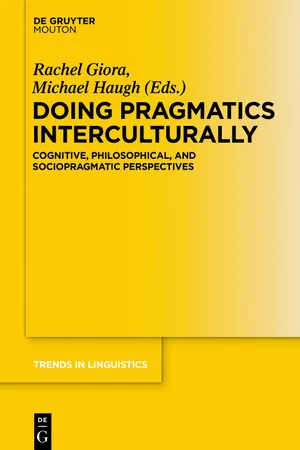
Doing Pragmatics Interculturally
Cognitive, Philosophical, and Sociopragmatic Perspectives
- 432 pages
- English
- ePUB (mobile friendly)
- Available on iOS & Android
eBook - ePub
Doing Pragmatics Interculturally
Cognitive, Philosophical, and Sociopragmatic Perspectives
About this book
Intercultural Pragmatics is a large and diverse field encompassing a wide range of approaches, methods, and theories. This volume draws scholars together from a broad range of cognitive, philosophical, and sociopragmatic perspectives on language use in order to lay the path for a mutually informing and enriching dialogue across subfields and perceived barriers to doing pragmatics interculturally.
Information
Subtopic
Linguistics
Part I:Socio-cognitive and experimental pragmatics
Raymond W. Gibbs, Jr. and Herbert L. Colston
2The emergence of common ground
1The emergence of common ground
One of the most contentious debates in the study of linguistic pragmatics concerns whether or not people possess common ground knowledge and beliefs that are readily accessed during speaking and listening. Most people certainly share information (i.e., their “shared knowledge”), such as that the earth is round, people die, and the Pope is Catholic. However, sharing information is not the same as two or more people understanding, explicitly or implicitly, that both of them possess some information or belief implicitly or explicitly as part of their “common ground” (e.g., the belief that my sister and I share, and know that we share, about my father’s birthday). Common ground generally refers then to information, beliefs, attitudes that some select group of individuals both share and mutually recognize that they possess in common.
The ways people produce and interpret language often requires that people possess common ground information. Consider the following simple exchange:
| (1) | Mary: “Are you going to Peter’s party tonight?” |
| Sally: “Didn’t you hear that Chris will be there?” |
Sally’s response to Mary’s question with a rhetorical question signals to Mary something about Sally’s belief about Chris, enough so as to help Mary infer that Sally does not want to attend Peter’s party (e.g., because Chris is Sally’s old boyfriend who she does not want to see at a party). In this case, then, Mary and Sally both understand, and tacitly recognize that they both understand, what Sally feels about Chris. The mere mention of Chris by Sally activates this common ground information which then assists Mary in drawing the authorized conversational implicature from Sally’s rhetorical question, namely that she will not go to Peter’s party.
Linguistic pragmatic studies, including research in linguistics, philosophy and psychology, have long debated (a) whether it is even possible for two or more people to possess common ground information, (b) how people infer what is, or is not, part of their common ground with others, and (c) whether people automatically recruit common ground information as part of the context for pragmatic language use (Kecskés and Mey 2008). For example, scholars offer a range of opinions about the process by which people determine that some belief is truly established as common ground (e.g., the infinite regress problem), and whether common ground guides early language production and comprehension, as opposed to only being referred to at a later, non-obligatory moment in the course of speaking and listening.
This chapter explores these debates over common ground and acknowledges István Kecskés’s unique contributions to understanding how common ground provides the background for, and emerges from, conversational interactions. Our agenda is to advance discussion on how dynamical-systems theory, and principles of self-organization, can explain the varieties of common ground experience in human cognition and communication. We first discuss Kecskés’s scholarly ideas on common ground in a theory of linguistic pragmatics, review some of the extensive empirical and experimental research on how common ground may shape speaking and listening, and then finally offer our spin on a self-organizing approach to the emergence of common ground. Our conclusions are, to varying extents, consistent with Kecskés’s writings on this complex problem.
2István Kecskés’s contributions to common ground theory
István Kecskés, often in collaboration with Fenghui Zhang, has offered a unique perspective on the debates over common ground in human communication. Kecskés and Zhang (2009, 2013) maintain that advocates for the necessity of common ground in linguistic behavior too often implicitly assume a model of communication-as-transfer-between-minds. Under this view, communicative intentions are seen as pre-existing psychological entities that are transferred from one mind (i.e., the speaker) to another (i.e., the listener) via the conduit of language. Listeners or readers must unpack the language encountered to infer what speakers’ or writers’ pre-existing intentions must have been given their personal understandings of the common ground existing at that very moment.
Kecskés (2008) has advanced an alternative framework for the theory of linguistic communication, called the “dynamic model of meaning” (DMM). This approach highlights the interplay of intention and attention given a socio-cultural background, which arises from prior and current experiences, all of which are essentially socio-cultural. In this manner, debates about when and how common ground operates in interpersonal interaction depend on the ways that intention and attention arise from socio-cultural factors. They go on to claim that common ground has two parts: core common ground (e.g., the relatively static, generalized common beliefs that exist within a certain speech community) and emergent common ground (e.g., the relatively dynamic, particularized knowledge that is co-constructed during the course of any conversation).
For example, consider two exchanges between Jill and John (Kecskés and Zhang 2013: 380):
| (2) | Jill: | “I need some money.” |
| John: | “There is an ATM over there.” |
John’s use of “ATM” is based on his and Jill’s “core” common ground given that ATMs are widely recognized as places to get cash in most countries, as well as John’s understanding of Jill’s declaration as a report of an immediate problem to be solved and not as a general statement about her financial status or as a request to John for a loan.
“Emergent” common ground depends on the actual situation, and is exhibited in the following conversation, from a British sitcom (Kecskés and Zhang 2013: 381):
| (3) | Jill: | “I met someone today.” |
| Jane: | “Good for you.” | |
| Jill: | “He is a police officer.” | |
| Jane: | “Are you in trouble?” | |
| Jill: | “Oh no…” |
Meeting a police officer may be typically regarded as a bad thing. Nonetheless, one possible interpretation of Jill and Jane’s exchange is that Jill’s meeting a man who is a police officer was not a problem, and even implies some possible romantic connection between Jill and the police officer. This example illustrates how some common ground emerges from the conversational interaction and is not just part of the prior knowledge speakers and listeners rely on when understanding one another.
Much of Kecskés and Zhang’s efforts have been directed toward explicating the different sources and computations of common ground. One argument they make is that speakers can be both egocentric and cooperative at the same time. Thus, when Jill says, “He is a police officer”, she is speaking egocentrically given her more complete understanding of the officer as someone who is not investigating her for being in any legal difficulty. Jane did not have access to this privileged information, which led to her question “Are you in trouble?” based on the culturally salient view of what often happens when encountering a police officer. Still, it would be a mistake to conclude that Jill was being entirely egocentric in her conversational style, as she clearly wanted Jane to construe her comments about the police officer in a positive manner, something that was soon made clear in Jill and Jane’s conversational exchange.
A key part of Kecskés and Zhang’s general approach is that communication is “more like a trial-and-error process that is co-constructed by participants” rather than “an ideal transfer of information” (Kecskés and Zhang 2009: 337). Meaning is constructed “on the spot” from conversational interaction rather than being buried inside speakers’ minds and then fully expressed in the language they use. There may be occasions, then, when speakers do not necessarily seek to further modify and establish new common ground, and may be much more egocentric in what they say.
3The interdisciplinary challenge
One reason for the lack of consensus over the role that common ground may play in communication is scholars’ diverse disciplinary backgrounds. Contributions from cognitive science, cognitive psychology, social psychology and related fields, for instance, ground their arguments in phenomena from the mainstream literatures of those disciplines that may not be greatly familiar to scholars from other areas. Conversely, the linguistic, psychological and philosophical underpinnings of interpersonal communication may not always have impacted experimental psychologists as they attempt to define and measure common ground and its possible impact on linguistic interaction.
For example, establishing and relying upon common ground is actually modulated by a range of factors, as suggested by various studies in experimental psychology (Colston 2008, 2015). People tend to rely more on information that is first mentioned than on materials presented later on in both reading and listening. Most people will also tend to recall information in a more schematic manner than how it was originally presented. In some cases, people will even falsely remember some event as occurring, which they personally witnessed, when, in fact, this event was only imagined or verbally mentioned by another person in a different context. Speakers will also be biased toward remembering information that is most consistent with their current emotional or cognitive state, and fail to recall material that is inconsistent with what they now feel or think. Finally, people may falsely recall something as previously occurring when this possibility was only inferred, but not explicitly stated, from some earlier conversational interaction.
These, and many other, experimental findings on human memory suggest that there is no single way in which information is stored and accessed as part of people’s common ground during interpersonal interaction. Even when people both assume to know that something is clearly mutually known, the process by which this knowledge is accessed will differ depending on the dynamics of the specific situation and the particular task that two or more people are engaged in. People may appear to be operating in a more or less egocentric or collaborative manner depending on some of the variations in human memory performance.
In addition to these various complexities about memory and common ground, we must also recognize a greater range of ways in which people typically converse with one another (Colston 2008). For instance, people are not always equally focused on the task when...
Table of contents
- Cover
- Title Page
- Copyright
- Preface
- Contents
- List of contributors
- Introduction
- Part I: Socio-cognitive and experimental pragmatics
- Part II: Philosophical and discourse pragmatics
- Part III: Interpersonal and societal pragmatics
- Index
Trusted by 375,005 students
Access to over 1.5 million titles for a fair monthly price.
Study more efficiently using our study tools.
Frequently asked questions
Yes, you can cancel anytime from the Subscription tab in your account settings on the Perlego website. Your subscription will stay active until the end of your current billing period. Learn how to cancel your subscription
No, books cannot be downloaded as external files, such as PDFs, for use outside of Perlego. However, you can download books within the Perlego app for offline reading on mobile or tablet. Learn how to download books offline
Perlego offers two plans: Essential and Complete
- Essential is ideal for learners and professionals who enjoy exploring a wide range of subjects. Access the Essential Library with 800,000+ trusted titles and best-sellers across business, personal growth, and the humanities. Includes unlimited reading time and Standard Read Aloud voice.
- Complete: Perfect for advanced learners and researchers needing full, unrestricted access. Unlock 1.5M+ books across hundreds of subjects, including academic and specialized titles. The Complete Plan also includes advanced features like Premium Read Aloud and Research Assistant.
We are an online textbook subscription service, where you can get access to an entire online library for less than the price of a single book per month. With over 1.5 million books across 990+ topics, we’ve got you covered! Learn about our mission
Look out for the read-aloud symbol on your next book to see if you can listen to it. The read-aloud tool reads text aloud for you, highlighting the text as it is being read. You can pause it, speed it up and slow it down. Learn more about Read Aloud
Yes! You can use the Perlego app on both iOS and Android devices to read anytime, anywhere — even offline. Perfect for commutes or when you’re on the go.
Please note we cannot support devices running on iOS 13 and Android 7 or earlier. Learn more about using the app
Please note we cannot support devices running on iOS 13 and Android 7 or earlier. Learn more about using the app
Yes, you can access Doing Pragmatics Interculturally by Rachel Giora, Michael Haugh, Rachel Giora,Michael Haugh in PDF and/or ePUB format, as well as other popular books in Languages & Linguistics & Linguistics. We have over 1.5 million books available in our catalogue for you to explore.