Die Buchreihe Trends in Medieval Philology nimmt zentrale Themen der aktuellen mediävistischen Forschungsdebatte auf und gibt wegweisenden Forschungsdiskursen einen Ort in der Fachliteratur. Sie versteht sich als ein interdisziplinär ausgerichtetes Forschungsforum mit höchstem Qualitätsanspruch. Die Reihe bietet besonders auch jüngeren und internationalen Forscher:innen und Forschergruppen die Möglichkeit, innovative Studien und Diskussionen der Fachwelt zu präsentieren.
- 208 pages
- English
- ePUB (mobile friendly)
- Available on iOS & Android
eBook - ePub
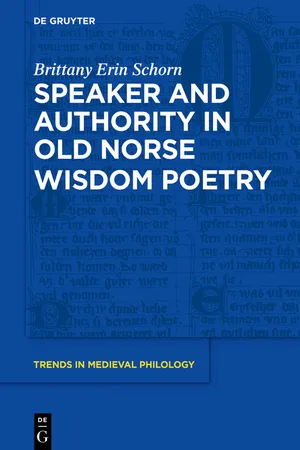
Speaker and Authority in Old Norse Wisdom Poetry
About this book
Information
Subtopic
German Literary CriticismIndex
Literature1Introduction: a Word to the Wise
This book concerns the presentation of compilations of wisdom in Old Norse eddic poetry: how it was that the dozen poems one might classify, however tentatively, as wisdom poetry legitimized and put across their content. The poems include diverse scenes of interaction between men, gods and other supernatural beings, often of an antagonistic or confrontational nature, inviting the question of how audiences satisfied themselves of the answer to the speaker’s own challenge in Hávamál: ‘how can his word be trusted?’1
1.1Wisdom and Wisdom Literature
The impulse to collect wisdom – the crystallized, condensed knowledge of life, the universe and everything employed by numerous societies to pass on and validate valued information – appears to be virtually universal. It may be seen everywhere from modern popular music such as ‘Everybody’s Free (to Wear Sunscreen)’ to cuneiform inscriptions from ancient Mesopotamia.2 Such a broad phenomenon naturally embraces a near infinite array of content, setting the world into as many different frames as there have been purveyors of wisdom. In itself the content of wisdom can shed light on a culture, but just as important is what lent the sources of wisdom their authority. The incarnations of wisdom texts are as diverse as their contents, and there is of course no set form for the laying out of ‘wisdom’ which encompasses all cultures and literatures. As the distilled advice of a particular society, the presentation of wisdom – be it as agonistic discourse, authoritative monologue or mysterious revelation – was naturally shaped by the society in which it developed. In other words, studying the means of legitimizing wisdom in a culture provides as revealing an insight into its values and world-view as the subject matter of the wisdom itself.
Despite being widespread, wisdom literature is a difficult genre for modern audiences to appreciate. This is not simply a matter of antiquity, since other genres and literatures have enjoyed more long-lasting popularity. Indeed, some of the literature surviving from early medieval Europe has enjoyed continued popularity with both readers and critics.3 It is not hard to understand the appeal of the morally ambiguous heroics of Beowulf or the bleak realism of the Íslendingasǫgur, of which the poet Ted Hughes wrote that ‘the subsequent seven centuries have produced no other work so timelessly up-to-date, nothing with such a supreme, undistorted sense of actuality, nothing so tempered and tested by such a formidable seriousness of life’.4 These works owe their success in modern times above all to the universal nature of their concerns, but also to a coincidental conformity to modern tastes and ideals. Yet there is always a danger, when reading such texts, in assuming that the features that modern audiences find most congenial would have also been the focus of the authors who composed them and the audiences for which they were originally intended. Changing ideals, institutions and cultural conditions inescapably hold many works at some remove from modern understanding. Though now read more as fiction than history, Geoffrey of Monmouth’s De gestis Britonum was extremely popular and widely relied upon down to, and in some cases after, the sixteenth century.5 Saints’ lives too appear to have been read and accepted much more widely in the medieval period than they are today. The most popular saints’ lives – such as those of St Cuthbert, St Martin and St Anthony – exist in a great many manuscript copies produced over a long period of time and across a large geographical area.6 This large sample of saints’ lives has the advantage of allowing informed discussion of questions of genre and taste. It is also helpful that the institution largely responsible for the cultivation and transmission of this kind of literature, the medieval Christian church, is relatively well evidenced and understood.7
Other types of literature, however, remain difficult to access, as they are not products of well-documented social institutions, circumstances or milieux,8 and do not correspond closely with any popular modern genre. Literature with a primarily instructive function comprises one such category that is particularly common in the medieval period. Didactic texts and works of outmoded learning are some of the most obvious victims of the passage of time. Rather than resist their natural sympathies, readers of these texts must engineer a somewhat artificial sympathy by trying to imagine the original conditions which might have rendered the material more meaningful: what original audiences valued in it, and why they did so. The potential danger for distortion this process creates is possibly just as great as that inherent in analysing more popular texts. In order to consider their purpose and aesthetics we must assume that they achieved what they set out to. This is not too great an assumption to make about some texts, even though ultimately the engagement of reader with author, even in the immediate period of writing, involves a certain amount of distance, and (in the words of Walter Ong) ‘fictionalisation’ on both sides: the author writes for an absent reader, albeit perhaps recalling with more or less exactitude orally transmitted material and imagining a scene of oral discourse in a real or otherworldly setting, while readers (or those who hear a text read aloud) can find themselves conjured into new roles and frames of reference by a clever author’s artifices.9 Such possibilities were magnified when the author’s own identity – as often in the case of wisdom literature – was masked. Without information about the original purpose and audience of didactic literature it is especially difficult to make sense of, appreciate, or establish a theoretical framework for its interpretation based on its contemporary context. Again, we can come closest to understanding, if not always appreciating, works when they represent a product of the relatively well-attested tradition of Latin learning. Thus the purpose of grammars is, on the whole, relatively well understood, although they contain much that is by modern standards obscure, irrelevant and even false.10 Yet within this category there remain some works that are still more difficult to account for, such as the Epistulae and Epitomae of Virgilius Maro Grammaticus.11 Virgilius’s work – now usually identified as a product of Ireland in the middle of the seventh century – is so outlandish that it fails to fit comfortably into the medieval grammatical genre as it is understood, and consequently has been read by various critics as clever satire, incompetent scholarship or even heretical critique.12
Vivien Law classified Virgilius’ writings as ‘wisdom literature’. This genre of didactic literature is generally considered to be outmoded, and has attracted widely diverging scholarly judgement.13 Commonly highlighted features of wisdom literature include a general tendency towards didactic tone and proverbial content, and the presentation of an ordered world-view that could embrace elements of society, nature, the world and morality in a single whole. This broad description papers over the huge diversity in form and subject matter that makes wisdom literature intrinsically very hard to define, much less characterize and fully understand. The concept of wisdom literature as a single, distinct genre originates in Hebrew scholarship on the biblical books of wisdom14 – which in themselves had a deep impact on medieval conceptions of wisdom – and has since been applied to a large body of material across a great number of early cultures which was felt by various scholars to be somehow analogous to the biblical texts. But even within Hebrew scholarship, the effort to define wisdom literature specifically has been something of an ‘elusive quest’.15 The difficulties are only compounded when definitions of wisdom derived from the extant corpora of wisdom literature are compared across societies, as it becomes apparent that wisdom can carry quite different connotations in various cultural contexts.
This was evident to Wilfred Lambert in his 1960 study of Babylonian wisdom literature, in which he observed that while the emphasis of Hebrew wisdom literature is frequently on ‘pious living’, Babylonian texts have little moral content and are more concerned with skill in cult and magic lore.16 Yet the continued use of the term ‘wisdom literature’ is defended by more recent scholars like Roland Murphy, who argues that for all that it is a ‘term of convenience’ it does provide a helpful way of characterizing literature primarily concerned with wisdom because ‘certain genres and themes are common to these works and so give a semblance of unity to them’.17 Broadly speaking, this coincidental similarity between the literature of related and unrelated cultures has been clearly accounted for by anthropologists and other students of oral cultures.18 Knowledge had to be passed on from person to person, to be learned and respected through long usage: similar strategies for doing so could naturally evolve independently. Walter Ong writes that ‘human beings in primarily oral cultures … do not study [but] … learn by apprenticeship, by listening, by repeating what they hear, by mastering proverbs and ways of combining and recombining them, by assimilating other formulary materials, by participating in a kind of corporate retrospection’.19 Transmission of knowledge in this way did not of course leave written traces until brought into contact with a literary culture. Old Norse wisdom poetry is one of many genres which emerge during a transitional period between oral and written tradition. Oral composition and transmission, as well as a fluid and vibrant textual culture, appear to have left important imprints on the presentation, content and preservation of Old Norse wisdom texts, as I shall explore in more detail below.
1.2Approaching Old Norse Wisdom Poetry
Beyond the impact of an often oral background, however, it has proven impossible for scholarship to offer a clear definition of Old Norse wisdom poetry that is both meaningfully specific and broad enough to include all examples felt to belong to the genre. There exists considerable variety in both the form and content of such literature, creating a chain of overlap that connects some very diverse texts that often have more in common with works normally assigned to other genres than with each other. The underlying difficulty is that while wisdom literature may be, broadly speaking, the product of a particular stage of any culture’s development, individual works of literature cannot be divorced from their specific cultural context.20 The extent to which wisdom literature may even be said to exist as a separate and distinct genre varies between cultures, just as the overlap in form and content between wisdom l...
Table of contents
- Cover
- Title page
- Copyright
- Foreword
- Contents
- List of Tables
- 1 Introduction: a Word to the Wise
- 2 Gáttir allar, áðr gangi fram, um scoðask scyli: Approaching Wisdom in Eddic Poetry
- 3 Mankind and the Supernatural World in Eddic Wisdom Verse
- 4 Speaker and Situation in the Mythological Frames of Wisdom Poetry
- 5 Traditional Forms and Christian Authority
- 6 The Authority of Wisdom
- 7 Abbreviations
- 8 Bibliography
- 9 Index
Trusted by 375,005 students
Access to over 1.5 million titles for a fair monthly price.
Study more efficiently using our study tools.
Frequently asked questions
Yes, you can cancel anytime from the Subscription tab in your account settings on the Perlego website. Your subscription will stay active until the end of your current billing period. Learn how to cancel your subscription
No, books cannot be downloaded as external files, such as PDFs, for use outside of Perlego. However, you can download books within the Perlego app for offline reading on mobile or tablet. Learn how to download books offline
Perlego offers two plans: Essential and Complete
- Essential is ideal for learners and professionals who enjoy exploring a wide range of subjects. Access the Essential Library with 800,000+ trusted titles and best-sellers across business, personal growth, and the humanities. Includes unlimited reading time and Standard Read Aloud voice.
- Complete: Perfect for advanced learners and researchers needing full, unrestricted access. Unlock 1.5M+ books across hundreds of subjects, including academic and specialized titles. The Complete Plan also includes advanced features like Premium Read Aloud and Research Assistant.
We are an online textbook subscription service, where you can get access to an entire online library for less than the price of a single book per month. With over 1.5 million books across 990+ topics, we’ve got you covered! Learn about our mission
Look out for the read-aloud symbol on your next book to see if you can listen to it. The read-aloud tool reads text aloud for you, highlighting the text as it is being read. You can pause it, speed it up and slow it down. Learn more about Read Aloud
Yes! You can use the Perlego app on both iOS and Android devices to read anytime, anywhere — even offline. Perfect for commutes or when you’re on the go.
Please note we cannot support devices running on iOS 13 and Android 7 or earlier. Learn more about using the app
Please note we cannot support devices running on iOS 13 and Android 7 or earlier. Learn more about using the app
Yes, you can access Speaker and Authority in Old Norse Wisdom Poetry by Brittany Erin Schorn in PDF and/or ePUB format, as well as other popular books in Literature & German Literary Criticism. We have over 1.5 million books available in our catalogue for you to explore.