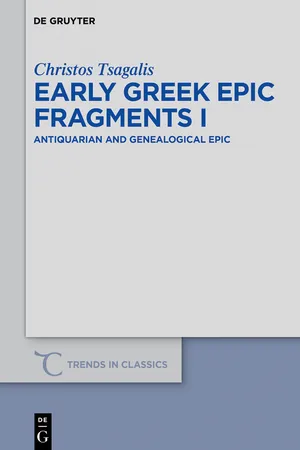
This book offers a new edition and comprehensive commentary of the extant fragments of genealogical and antiquarian epic dating to the archaic period (8th-6th cent. BC). By means of a detailed study of the multifaceted material pertaining to the remains of archaic Greek epic other than Homer, Hesiod, and the Homeric Hymns, it provides readers with a critical reassessment of the ancient evidence, allows access to new material hitherto unnoticed or scattered in various journals after the publication of the three standard editions now available to us, and offers a full-scale commentary of the extant fragments. This book fills a gap in the study of archaic Greek poetry, since it offers a guiding tool for the further exploration of Greek epic tradition in the archaic period and beyond.?????
- 487 pages
- English
- ePUB (mobile friendly)
- Available on iOS & Android
eBook - ePub
About this book
Information
Subtopic
Ancient HistoryIndex
LiteratureComparatio Numerorum1807
Eumelos: Titanomachy

Eumelos: Korinthiaka

Eumelos: Europeia

Eumelos: fragmenta incerti carminis et fragmentum sine ascriptione fortasse ad Titanomachiam pertinens

Minyas

Fragmenta dubia fortasse ad Minyadem pertinentia

Carmen Naupactium

Phoronis

1 I indicate the relevant volume of PEG only in the case of Orphic fragments (i.e. PEG II.1 or II.2).
2 Bethe, vols. i–iii (1914–1927), vol. ii (19292).
3 Debiasi through a series of detailed studies has been by far the strongest representative of this trend.
4 Snell (1937) 579–80; Körte (1938) 80; Merkelbach (1955) 4; West (1962) 178; Debiasi (2004) 74 n. 23.
5 (2015) 209–12.
6 Adespota Papyracea Hexametra Graeca, vol. I (forthcoming with De Gruyter).
7 See bibliography.
8 (1958) 115–17. See also P.Köln III 126 (= P.Colon. inv. 5604).
9 See (2006) 476 and n. 21; see also Finglass (2014a) 77.
10 See Kaibel (1887) vii–viii; Arnott (2000) 42–50; Olson (2006) xvi; Finglass (2014a) 78.
11 See Dickey (2007) 27–8.
12 (2002) 111–12.
13 I include discussion of testimonia concerning authorship in the separate section devoted to each poet that precedes the discussion of the individual fragments. This is the only class of testimonia worth analyzing as far as archaic Greek epic poets are concerned. Since all the rest contain fragments, it is better to treat them under ‘fragments’ and, in this way, avoid repetition.
14 This is the case with Eum. Kor. fr. 18.
15 On this point, see Conte (2013) 14.
16 (1892) 252 n. 22 (translation by West 2013, 51).
17 (2013) 51.
18 Translation by Frazer (1921) with some modifications.
19 The transmitted reading Γιγαντομαχίαν is generally regarded as an error of the scholiast on Apollonios for Τιτανομαχίαν; see West (2002) 117; also Eum. Tit. fr. 3 EGEF (ap. Σ Ap. Rh. 1.1165c [p. 106.1–3 Wendel]).
20 The numbering in the critical apparatus is based on the entire quotation, not just the metrical citation. The same practice is followed in the entire volume.
21 The translation is by Olson (2008) with some modifications.
22 Cf. Paus. 2.4.6.
23 Differences in abbreviations between the commentary and the critical apparatus are due to the use of Latin forms in the latter (e.g. Lyk. vs Lyc. for Lykophron). Explanation of sigla used in this critical apparatus: Σ Β Pind. = Vat. 1332, C = Par. 2774 (C1 = correction made by the first scribe, C3 = reading added by the third scribe), E = Laur. 32, 37 (E1 = correction made by the third scribe), Q = Laur. 32, 35, v = textus vulgatus (from the editio Romana to the editions of Heyne and Boeckh), h = Heyne (ed. Heyniana 1817); Σ Α Eur. = Vat. 909, B = Par. 2713; Σ C Lyc. = Par. gr. 2723, Tz. in Lyc. = scholia by Tzetzes as part of the Σ Lyk. edited by Scheer; the siglum ] indicates words or parts of words that were once written in the manuscripts but cannot be read now.
24 In the translation I indicate in parenthesis the differences between Σ Eur. Med. 9 and 11.
25 Paus. 2.1.1: ἐπεὶ Εὔμηλός γε (Siebelis : ἐπεὶ δὲ εὔμηλός τε β) ὁ Ἀμφιλύτου τῶν Βακχιδῶν (Βακχιαδῶν β Va) καλουμένων, ὃς καὶ τὰ ἔπη λέγεται ποιῆσαι, φησὶν ἐν τῆι Κορινθίαι συγγραφῆι — εἰ δὴ Εὐμήλου γε ἡ συγγραφή —.
26 Chron. Ol. 5.2 (760/759 BC): Eumelus poeta, qui Bugoniam et Europiam … composuit … agnoscitur (test. 3 EGEF); 9.1 (744/743 BC): Eumelus Corinthius versificator agnoscitur et Sibylla Erythraea. See also Cyrill. Contra Iulian. 1.12 (Patrol. Gr. lxxvi. 520D): ἐννάτηι Ὀλυμπιάδι Εὔμηλον (Marcksch. : Θύμηλον cod.) ἐποποιὸν γενέσθαι φασὶ καὶ Σίβυλλαν τὴν Ἐρυθραίαν (test. 4 EGEF). On the connexion between Eumelos and Sibyl, see Bowra (1963) 147, who argues that ‘the connexion between Eumelus and the Erythraean Sibyl may be not so accidental as it looks, since she must have come from Erythrae and may have been connected with the early days of colonization in the West. It is also perhaps worth noting that the previous entry in Eusebios-Jerome in Ol. 8.3 (745 B.C.) says Lacedaemonii contra Messenios vicennale bellum habebant, and it looks as if Eusebios had in mind some association between Eumelos and the First Messenian War’.
27 Strom. 1.131.8: Σιμωνίδης μὲν οὖν κατὰ Ἀρχίλοχον φέρεται, Καλλῖνος...
Table of contents
- Cover
- Title Page
- Copyright
- Dedication
- Contents
- Preface
- Introduction
- Eumelos of Corinth
- Commentary
- Kinaithon
- Commentary
- Asios
- Commentary
- Hegesinous
- Commentary
- Chersias
- Commentary
- Danais
- Commentary
- Minyas
- Commentary
- Carmen Naupactium
- Commentary
- Phokais
- Phoronis
- Commentary
- Bibliography
- Index of Subjects
- Index of Greek
- Index of Sources by Author or Poem
- Comparatio Numerorum
Trusted by 375,005 students
Access to over 1.5 million titles for a fair monthly price.
Study more efficiently using our study tools.
Frequently asked questions
Yes, you can cancel anytime from the Subscription tab in your account settings on the Perlego website. Your subscription will stay active until the end of your current billing period. Learn how to cancel your subscription
No, books cannot be downloaded as external files, such as PDFs, for use outside of Perlego. However, you can download books within the Perlego app for offline reading on mobile or tablet. Learn how to download books offline
Perlego offers two plans: Essential and Complete
- Essential is ideal for learners and professionals who enjoy exploring a wide range of subjects. Access the Essential Library with 800,000+ trusted titles and best-sellers across business, personal growth, and the humanities. Includes unlimited reading time and Standard Read Aloud voice.
- Complete: Perfect for advanced learners and researchers needing full, unrestricted access. Unlock 1.5M+ books across hundreds of subjects, including academic and specialized titles. The Complete Plan also includes advanced features like Premium Read Aloud and Research Assistant.
We are an online textbook subscription service, where you can get access to an entire online library for less than the price of a single book per month. With over 1.5 million books across 990+ topics, we’ve got you covered! Learn about our mission
Look out for the read-aloud symbol on your next book to see if you can listen to it. The read-aloud tool reads text aloud for you, highlighting the text as it is being read. You can pause it, speed it up and slow it down. Learn more about Read Aloud
Yes! You can use the Perlego app on both iOS and Android devices to read anytime, anywhere — even offline. Perfect for commutes or when you’re on the go.
Please note we cannot support devices running on iOS 13 and Android 7 or earlier. Learn more about using the app
Please note we cannot support devices running on iOS 13 and Android 7 or earlier. Learn more about using the app
Yes, you can access Early Greek Epic Fragments I by Christos Tsagalis in PDF and/or ePUB format, as well as other popular books in Literature & Ancient History. We have over 1.5 million books available in our catalogue for you to explore.