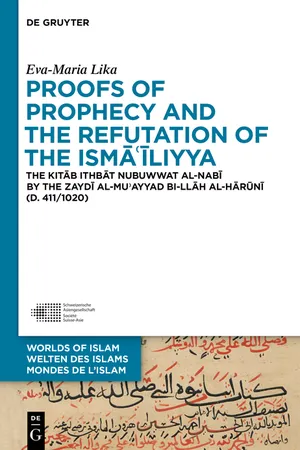
Proofs of Prophecy and the Refutation of the Isma'iliyya
eBook - ePub

Proofs of Prophecy and the Refutation of the Isma'iliyya

The Kitab Ithbat nubuwwat al-nabi by the Zaydi al-Mu'ayyad bi-Ilah al-Haruni (d. 411/1020)

  1. 338 pages
  2. English
  3. ePUB (mobile friendly)
  4. Available on iOS & Android
eBook - ePub

Proofs of Prophecy and the Refutation of the Isma'iliyya

The Kitab Ithbat nubuwwat al-nabi by the Zaydi al-Mu'ayyad bi-Ilah al-Haruni (d. 411/1020)

About this book

Al-Mu'ayyad bi-llah al-Haruni (d. 411/1020) was a representative of the intellectual center of the Zaydiyya in Northern Iran and a student of the leading Mu?tazilite theologians of the time. In his Kitab Ithbat nubuwwat al-nabi he presents a proof of prophecy of Mu?ammad and a refutation of the Isma'ilyya.The present volume explores the historical and intellectual context of the oeuvre and includes a partial critical edition of the text.

Frequently asked questions

Yes, you can cancel anytime from the Subscription tab in your account settings on the Perlego website. Your subscription will stay active until the end of your current billing period. Learn how to cancel your subscription.
No, books cannot be downloaded as external files, such as PDFs, for use outside of Perlego. However, you can download books within the Perlego app for offline reading on mobile or tablet. Learn more here.
Perlego offers two plans: Essential and Complete
  • Essential is ideal for learners and professionals who enjoy exploring a wide range of subjects. Access the Essential Library with 800,000+ trusted titles and best-sellers across business, personal growth, and the humanities. Includes unlimited reading time and Standard Read Aloud voice.
  • Complete: Perfect for advanced learners and researchers needing full, unrestricted access. Unlock 1.4M+ books across hundreds of subjects, including academic and specialized titles. The Complete Plan also includes advanced features like Premium Read Aloud and Research Assistant.
Both plans are available with monthly, semester, or annual billing cycles.
We are an online textbook subscription service, where you can get access to an entire online library for less than the price of a single book per month. With over 1 million books across 1000+ topics, we’ve got you covered! Learn more here.
Look out for the read-aloud symbol on your next book to see if you can listen to it. The read-aloud tool reads text aloud for you, highlighting the text as it is being read. You can pause it, speed it up and slow it down. Learn more here.
Yes! You can use the Perlego app on both iOS or Android devices to read anytime, anywhere — even offline. Perfect for commutes or when you’re on the go.
Please note we cannot support devices running on iOS 13 and Android 7 or earlier. Learn more about using the app.
Yes, you can access Proofs of Prophecy and the Refutation of the Isma'iliyya by Eva-Maria Lika in PDF and/or ePUB format, as well as other popular books in Theology & Religion & Middle Eastern History. We have over one million books available in our catalogue for you to explore.

Information

IVIntellectual Defence 1: Criticism of the Ismāʿīliyya

1Earlier Refutations of the Ismāʿīliyya

1.1Earlier Refutations of the Ismāʿīliyya Cited in the Ithbāt

Introduction
Al-Muʾayyad bi-llāh was in good company. The Ismāʿīlī threat from without and within the ʿAbbāsid caliphate provoked a harsh reaction from various Islamic groups fighting Ismāʿīlism with polemics. Samuel Stern describes the anti-Ismāʿīlī activities as a true “campaign conducted in an unscrupulous way”139. A symbol of this campaign became the Baghdad manifesto of 402/1011 promoted by the ʿAbbāsid caliph al-Qādir (r. 381/991–422/1031), in which he accused the Fāṭimids of forging of their ʿAlid ancestry and condemned Ismaʿīlīs as enemies of Islam. The leading scholars were forced to sign the manifesto.140 Furthermore, the caliph commissioned intellectuals to write refutations of the Ismāʿīliyya, of which ʿAlī b. Saʿīd al-Iṣṭakhrī (d. 403/1013)141 and Abū Bakr al-Bāqillānī (d. 403/1013)142 are only two examples. Other writers from various religious affiliations and geographical destinations felt compelled to compose refutations of the Ismaʿīliyya in those days.143
In his presentation, al-Muʾayyad could draw on earlier anti-Ismāʿīlī writings. He mentions four authors by name – Abū Zayd al-ʿAlawī, Ibn Qiba al-Rāzī, Ibn Rizām and Ibn ʿAbdak – and refers to others in general: “[…] shuyūkhunā (raḥimahum Allāh) min al-ashrāf wa-l-ʿulamāʾ”.144 In the following I will gather the available information on the cited authors and their books, all of which are lost. Then, additional anti-Ismāʿīlī texts that could have served al-Muʾayyad as a source are listed.
Abū Zayd al-ʿAlawī (d. 326/937–8)
The first author mentioned is Abū Zayd ʿIsa b. Muḥammad al-ʿAlawī al-Ḥusaynī (d. 326/937–8).145 He was a Shīʿite theologian and important ḥadīth transmitter from Rayy. Al-Muʾayyad identifies him as a Sharīf, thus expressing that his genealogical links trace back to the Prophet Muḥammad, via Imām Zayd b. ʿAlī, the great-grandson of ʿAlī and Fāṭima and eponym of the Zaydiyya.146 In Kufa al-ʿAlawī studied with well-known Zaydī ḥadīth transmitters, such as Aḥmad b. ʿĪsā b. Zayd (d. 247/861)147 and Muḥammad b. al-Manṣūr b. Yazīd al-Murādī (d. 290/903)148, who belongs to the tradition of Imām al-Qāsim b. Ibrāhīm. Abū Zayd al-ʿAlawī also studied with Aḥmad b. Sahl al-Rāzī (fl. end of 3rd/9th century), a Zaydī scholar and author of the historiographical work Akhbār Fakhkh wa-khabar Yaḥyā b. ʿAbd Allāh149, Abū ʿAbd Allāh al-Ḥusayn b. ʿAlī al-Miṣrī (d. 320/932–3), the brother of the Zaydī imam al-Nāṣir al-Uṭrūsh, and the Shāfiʿī traditionist Abū ʿAwāna al-Isfarāʾīnī (d. 316/928–9)150. One of al-ʿAlawī’s students in the field of Shīʿite teachings was Abū l-ʿAbbās al-Ḥasanī151, who later instructed the two Hārūnī brothers. In his Kitāb Sharḥ al-Aḥkām, al-Ḥasanī transmitted many ḥadīths collected by his teacher Abū Zayd al-ʿAlawī.152
Al-ʿAlawī’s refutation of the Ismāʿīliyya, which al-Muʾayyad mentions in the Ithbāt, is not extant. Only a short passage referring to the Ismāʿīliyya found in al-ʿAlawī’s Kitāb al-Ishhād offers a rough idea of his preoccupation with their teachings. The Kitāb al-Ishhād is a refutation of the Imāmiyya and their doctrine of the occultation of the imam.153 In a passage on the disagreement among different Shīʿite sects concerning the identity of the imam, al-ʿAlawī lists the Ismāʿīliyya and the Qarāmiṭa with the following words:
“And these Faṭḥites (al-Faṭḥiyya) claimed the imamate for Ismāʿīl b. Jaʿfar through inheritance and will from his father, and before that, they maintained the imamate of ʿAbd Allāh b. Jaʿfar [al-Ṣādiq]. Today they are called the Ismāʿīliyya because no one is left of those who believed in the imamate of ʿAbd Allāh b. Jaʿfar. A group of the Faṭḥites who are called Qarmaṭians (al-Qarāmiṭa) maintain the imamate of Muḥammad b. Ismāʿīl b. Jaʿfar through inheritance and will. Those people who stop with Mūsā b. Jaʿfar claim that the imamate belongs to Mūsā and are awaiting his return.”154
This rather general statement by al-ʿAlawī reflects the inner-Ismāʿīlī differences regarding the succession in the imamate that existed at the time. The Faṭḥiyya were a Shīʿite group that maintained that after Jaʿfar b. Ṣādiq the imamate belonged to Jaʿfar’s eldest son ʿAbd Allāh.155 After ʿAbd Allāh’s death, most of the Faṭḥites claimed the imamate for Jaʿfar’s other son, Mūsā al-Kāẓim (as did the Imāmīs).156 According to al-ʿAlawī, apparently some of the former Faṭḥites also joined the Ismāʿīlīs. The Qarāmiṭa indeed believed in Muḥammad b. Ismāʿīl b. Jaʿfar, but they did not emerge as a subgroup from the Ismāʿīlīs.157 In the Ithbāt, the question of the imamate plays only a marginal role.158
Ibn Qiba (d. before 319/931)
The second author referred to by al-Muʾayyad is Abū Jaʿfar Muḥammad b. ʿAbd al-Raḥmān b. Qiba al-Rāzī.159 Ibn Qiba was a theologian, who was mostly active in Qum and died in Rayy before 319/931. There is not much information about his life, but the entries in some biographical dictionaries, including those of al-Najāshī (d. 450/1058–59) and al-Ṭūsī (d. 460/1067), inform us that Ibn Qiba was originally a Muʿtazilī and later converted to Imāmism.160 Ibn Qiba joined the Imāmiyya at a time when philosophy-minded Shīʿite theologians had begun to introduce Muʿtazilite points of view into traditional Imāmī thinking. It seems he was one of the pioneers of a new school of Imāmī theology and actively engaged in sectarian debates.161 He is praised for his knowledge and erudition in the disciplines of kalām and ḥadīth. Ibn Qiba’s most important contribution was a refined theory of the imamate. He exchanged letters on the imamate with the Muʿtazilī theologian Abū l-Qāsim al-Balkhī (d. after 350/962) and his ideas were discussed by Qāḍī ʿAbd al-Jabbār.162 As mentioned, al-Muʾayyad wrote a refutation of Ibn Qiba which seems to have been lost.163
The refutation of the Ismāʿīliyya referred to in the Ithbāt is not found in another reference.164 As was the case with al-ʿAlawī, we can only get a general idea of Ibn Qiba’s critique of the Ismāʿīlīs from a passage of his partially transmitted Naqḍ kitāb al-ishhād li-Abī Zayd al-ʿAlawī:
“As for the Faṭḥites (al-Faṭḥiyya), the evidence against them is so clear that it cannot be concealed, for Ismāʿīl died before Abū ʿAbd Allāh [Jaʿfar al-Ṣādiq], and a dead person cannot succeed a living person; the only possibility is that a living person succeeds a dead person. However, the group blindly followed its leaders and turned away from the proofs. This matter does not need to be dwelt upon any further because it is obviously wrong and its shortcoming can clearly be noted.
As for the Qarmaṭians (al-Qarāmiṭa), they contradicted Islam, letter by letter, as they abolished the acts of the sharīʿa and brought all kinds of sophistry (safsaṭāʾiyya). The only need for an imam is for religion and the establishment of the rule of the sharīʿa. Then, if the Qarmaṭians come and claim that Jaʿfar b. Muḥammad or his legatee appointed someone as his successor who called for the nullification of Islam and the sharīʿa and for leaving behind the normal behaviour of the members of the community, their own contradictions and vain contentions will be proof enough of their falsehood.”165
Ibn Qiba refers to the same two Ismāʿīlī groups as al-ʿAlawī does, the difference being that he does not count the Qarāmiṭa among the Faṭḥiyya. Critiques of the Qarāmiṭa include the abolishment of the law and Islam as a whole. These are common accusations addressed against the Ismāʿīliyya in anti-Ismāʿīlī texts and they are likewise repeated by al-Muʾayyad.166 Ibn Qiba’s critique addressed against “all kinds of sophistry” introduced by the Qarāmiṭa, supposedly referred to the continuous effort on the part of contem...

Table of contents

  1. Cover
  2. Title Page
  3. Copyright
  4. Table of Contents
  5. Acknowledgements
  6. I Introduction
  7. II Description of the Manuscripts and the Principles of Edition
  8. III The Historical Context
  9. IV Intellectual Defence 1: Criticism of the Ismāʿīliyya
  10. V Intellectual Defence 2: Prophetology
  11. VI Conclusion
  12. Bibliography
  13. Index
  14. Introduction and Chapter One
  15. Index