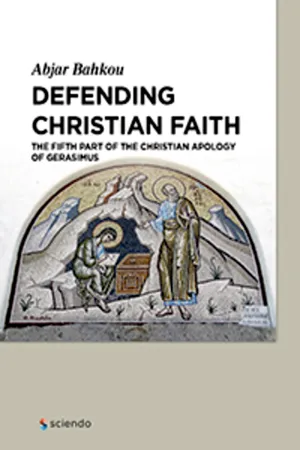
The book by Abjar Bakhou presents Medieval Christian author Gerasimus and his discussion with Islam. His aim was to show that Christian teachings are not irrational, but rather subtle and complex. As a Christian philosopher and theologian, Gerasimus used the experiences of those of the past to facilitate his own response to critics. However, two important differences separated him from earlier apologists, which demand his own insight and innovation. First, the new language of intellectual discourse was Arabic, which was not accommodating for expressing traditional Christian doctrine, and required the development of a vocabulary out of terms already heavily influenced by the Qur'anic worldview. Second, the new religion challenging Christianity was one of absolute monotheism, which shared neither a common scriptural nor cultural heritage, and rejected the very possibility of a Trinity and Incarnation. Although a common theme in early Christian apologetics was the refutation of Judaism, the debate generally centered on the interpretation of the Old Testament, showing that Jesus was indeed the Messiah. The Qur'an, while acknowledging Jesus as the Messiah, explicitly rejects the Christian doctrines of the Incarnation and the Trinity, and presents itself as the revelation, which supersedes all previous revelation. Thus, although Christians and Muslims share certain themes and figures (such as Creation and the Last Judgement, Abraham, Moses, Mary and Jesus), Muslims refuse evidence contrary to the Qur'an, leaving Christians without recourse to traditional scripture-based arguments. Gerasimus, as a Christian apologist and mutakallim, accepted these challenges and began the process of explaining and translating his faith in the new milieu to make it coherent and rational. In his treatise, Gerasimus reveals himself to be a full participant in this important period of intellectual history; he sets down the basic points of controversy and outlines a response to them in a form that would be an excellent introduction to Christian theology written for the Muslim environment. Gerasimus was also a mutakallim in his own right, the Christian counterpart to those Islamic scholars who sought to defend their faith through rational arguments. In an effort to argue the legitimacy of Christianity, Gerasimus attempts to create a common language that influences the meaning of terminology and concepts of intellectual development in Muslim - Christian debates. Such language would set the stage for centuries to come. This is certainly his greatest contribution.
According to Joseph Nasrallah, Yūsuf Šammās, Louis Cheikho, and Georg Graf, Gerasimus was head of the monastery of Saint Simeon the Wonderworker, or Simeon the Stylite, and wrote a book entitled, Kitāb al-Kāfī fī al-Ma
nā al-Šāfī (The Complete Book of the Healing Meaning).4 Graf dates Gerasimus to the 13th century,5 while Cheikho places him in the 12th or 13th century.6 Nasrallah believes that Gerasimus lived at the end of the 13th century.7 Based on the list of the scribes at Saint Saba’s Monastery in Palestine, which includes the name Gerasimus, René Khawam concludes that this was the same Gerasimus who authored the work we are analysing here, that he studied there at Saint Saba’s, and that he was thus a follower of the teachings of John of Damascus.8 The scribes who worked on the manuscripts mention that Gerasimus was the superior of the Monastery of Saint Simeon the Stylite, though it is not entirely clear which monastery that would have been.9 Khawam believes that this is not Monastery of Saint Simeon in Aleppo, but rather the Saint Simeon Church in Antioch which was established after the Arab invasion by the disciples of Saint Simeon from Aleppo.10
Khalil Samir divides the writing of Christian Arabic apologies into four phases,11 of which Gerasimus’s Apology belongs to the fourth phase (11th-13th centuries), characterized by a spiritual humanistic approach. The Apology presents the Christian faith in a clear logical manner using Greek Aristotelian philosophy. Gerasimus skillfully combines the biblical-homiletical tradition and the logical-philosophical approach.
1.1 Manuscripts
I was able to acquire copies of all the known manuscripts of The Apology except Jerusalem, Holy SepulcherAr. 101 (17th-18th century). I examined a total of six manuscripts. Four of them contain the complete Apology; only Bierut, Bibliothèque Orientale, Ar. 548, ff. 243-271 andBeirut, Bibliothèque Orientale, Ar. 552, ff. 98-169, are incomplete, containing only portions of Parts 4 and 5 of the text, respectively. The following is the list of the manuscripts used here:
Gerasimus’s writings are divided into two major parts or volumes. The first of these is Kitāb al-Kāfī fī al-Ma
nā al-Šāfī (of which the fifth part is the subject of this thesis). The second includes theological essays on the resurrection of our Lord Jesus Christ and the Christian sacraments: Eucharist, Baptism, and Chrismation (mayrūn).
1.2 Common Features of Manuscripts
The six manuscripts I examined are similar in their features, page numbering, and use of margins and vocalizations. In manuscripts F, B, L and H part 4 of the apology has insertions from other portions of the text mixed in. These include portions of Gerasimus’s argument regarding baptism, the final paragraphs of the sixth objection from part 5 and arguments from the conclusion of the book. This creates a series of thematic leaps in the text which may cause some confusion in the mind of the reader. S2 is the only manuscript which presents the argument without such leaps. After careful reading, however, in which the various pieces of the argument are put into their respective places, the text becomes much easier to follow.
The margins are treated as essential to the text. First, they are used for the réclame with which the scribes begin the recto side of each folio.12 Second, the margin is used to finish a word, as in the addition of “ “ب”in “الآب” or “ت” in “الشّقيات. Third, the scribes use the margins to fill in what they found missing in the body of the text. The scribe of L is the only scribe who uses the margins to write his own notes and observations. (See my comments on manuscript L below.) Fourth, the margins contain the folio number.
The scribes vocalize some words that need to be clarified to the reader, introducing especially the šadda and kasra when needed; nouns and verbs اتّخذهُ لنفسهِ، الشّأن، السّلطان are vocalized. The hamza is not utilized with consistency. For example, though they write “قايد” instead of “قائد” and “طايفة “instead “طائفة” the hamza does occasionally appear as in السماء. The most common treatment of the hamza is substituting “ي” or “ى” for it as in “اسراييل” instead of “اسرائيل” The distinction between madda and hamza is not clear, as the scribes tend to put them together; they write “ارآ ء” instead of “أراء” Such confusion is found in other letters such as “ض” and .”ظ”They write “المظلة” instead of “”الْمُضِلَّة and uses “ ى” and “ي” as “الي” instead of “الى”.
Manuscript 548 (S1) (28 folios) contains Part 4 of the Apology, comprised of the testimonies (Šawāhid) and prophecies of the life, death and resurrection of Jesus Christ from the Old Testament, the Qur’an, the books of the Sabians (pagans), and the Greek philosophers. The scribe did not write out the biblical prophecies of the Old Testament because, as he stated in the second manuscript, folio 122-123,
أما كتب العتيقة والحديثة فهي موجودة عندنا. وأمّا شواهد المسلمين والوثنيين ليست عندنا وها نحن نكتبها بعون الل...
Table of contents
Cover
Defending Christian Faith
Title
Copyright
Dedication
Acknowledgments
Foreword
Contents
Introduction
1 Author and Manuscripts
2 An Overview of the Apology
3 Analysis of the Analogies Used in the Apology
4 An Analysis of Part 5
The Text in Arabic
English Translation
General Conclusion
Index of the Most Important Words in Arabic
Bibliography
Back Cover
Trusted by 375,005 students
Access to over 1.5 million titles for a fair monthly price.
Study more efficiently using our study tools.
Frequently asked questions
Yes, you can cancel anytime from the Subscription tab in your account settings on the Perlego website. Your subscription will stay active until the end of your current billing period. Learn how to cancel your subscription
No, books cannot be downloaded as external files, such as PDFs, for use outside of Perlego. However, you can download books within the Perlego app for offline reading on mobile or tablet. Learn how to download books offline
Perlego offers two plans: Essential and Complete
Essential is ideal for learners and professionals who enjoy exploring a wide range of subjects. Access the Essential Library with 800,000+ trusted titles and best-sellers across business, personal growth, and the humanities. Includes unlimited reading time and Standard Read Aloud voice.
Complete: Perfect for advanced learners and researchers needing full, unrestricted access. Unlock 1.5M+ books across hundreds of subjects, including academic and specialized titles. The Complete Plan also includes advanced features like Premium Read Aloud and Research Assistant.
Both plans are available with monthly, semester, or annual billing cycles.
We are an online textbook subscription service, where you can get access to an entire online library for less than the price of a single book per month. With over 1.5 million books across 990+ topics, we’ve got you covered! Learn about our mission
Look out for the read-aloud symbol on your next book to see if you can listen to it. The read-aloud tool reads text aloud for you, highlighting the text as it is being read. You can pause it, speed it up and slow it down. Learn more about Read Aloud
Yes! You can use the Perlego app on both iOS and Android devices to read anytime, anywhere — even offline. Perfect for commutes or when you’re on the go. Please note we cannot support devices running on iOS 13 and Android 7 or earlier. Learn more about using the app
Yes, you can access Defending Christian Faith by Abjar Bahkou in PDF and/or ePUB format, as well as other popular books in Theology & Religion & Islamic Theology. We have over 1.5 million books available in our catalogue for you to explore.