In the 21st century, an accelerated pace of global movements of people, goods, capital, technology and ideas has led to ambivalence regarding cultural identity for individuals, as well as collectives like neighbourhoods and cities. While the preparation, availability and consumption of diverse foods have become symbolic of the very openness of a place, there are concerns that this is only reflective of a superficial and consumerist form of middle class cosmopolitanism.
Using food-oriented case studies centred on Australian cities and media, Bonding Over Food argues for a processual understanding of cosmopolitanism. Such an approach helps us understand various kinds of social bonds formed over food as 'convivial' practices that are potentially ethical and/or reflexive as opposed to being driven by 'othering' discourses.
- 176 pages
- English
- ePUB (mobile friendly)
- Available on iOS & Android
eBook - ePub
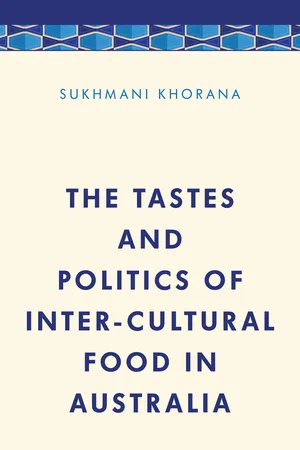
The Tastes and Politics of Inter-Cultural Food in Australia
About this book
Information
Part 1
White Australians on Food Adventures
Chapter 1
First Encounters: Exploring Markets and Food Tours
This chapter considers primarily Anglo-Australian encounters with urban and suburban farmers’ markets, food-oriented street markets and festivals and food tours of iconic markets. The analysis of these encounters is undertaken through a mixed methods approach – I use my own habituated experiences as a market-goer, participant observation at markets to which I was hitherto unexposed and discourse analysis of popular Australian food bloggers’ posts on markets. Food-based markets have been chosen in this instance because they function in a similar way to Amanda Wise’s (2011) observation about the banality of ‘ethnic’ food consumption in the food courts of big and small suburban malls. In other words, Anglo-Australians are likely to come across a variety of food, unfamiliar ingredients, ethnic diversity in the demographic make-up of market-goers and thereby opportunities for conviviality with traders and co-shoppers in an everyday setting. Such sites may also be associated with a sense of ‘buzz’ that is characteristic of cosmopolitan markets such as the Borough Market in London or market bazaars in parts of Asia and the Middle East. Commenting on the Borough Market, Benjamin Coles (2014) describes this buzz as affective and multisensory, and as giving the market a unique sense of place. The above notion of creating an affective sense of place or ‘place-making’ is critical to the opportunities for conviviality being explored in this chapter. This is because it is patterns of interaction and belonging, constitutive of conviviality, that contribute to turning markets into community hubs.
While food markets are entwined with the history of urban human settlement, this was under threat in the industrialised West as supermarkets became popular (see Basil 2012). Farmers’ markets have been making a comeback since the 1970s, especially in inner-city precincts where ethical consumption is simultaneously an alternative to big stores, and a marker of gentrification. These negotiations between placemaking and exclusion, and between habit and tourism, form the basis of the project of cosmopolitanisation with regard to the foods encountered in the context of markets. The ethnographic work in this chapter is modelled on Alex Rhys-Taylor’s (2014, 44) study of food-based street markets in inner-city London, where the production of identity for new and old residents often takes place through a changing sensuous relationship with the city. Accounts of shifting affective relationships with the city due to the presence of certain food products and practices are crucial in terms of understanding how an ethical disposition may come about in relation to food diversity (and the change in demographic it implies) in urban contexts.
Encountering ‘Other’ Foods
In popular discourses of diversity and multiculturalism, food is often used as a convenient, yet aestheticised, way of connecting peoples and cultures. At the same time, there is recognition among scholars interested in more reflexive intercultural encounters over food that there isn’t necessarily a cause-effect relationship between food diversity and a convivial culture, and that we need to move beyond mere appreciation of other cultures. For instance, in her work on anti-colonial eating, Lisa Heldke (2015, 177–78) attempts to ask how a more meaningful interaction could come about in an ‘ethnic’ restaurant in the United States:
The question is not, what would such restaurants be like in the absence of whites altogether? The issue is not cultural purity. I’m asking what it would be like if restaurants emerged in contexts of cultural interaction not fundamentally shaped by colonizing – [bell] hooks’s and [Aimé] Cesaire’s question. This is a significant thing for self-questioning food adventurers to ask, not because many of us will ever be third-world restaurateurs, or because any of us will live in a world free of the dynamics of colonialism, but because it can give eaters ideas and inspiration about how to be in ethnic restaurants.
Heldke’s example of ethnic restaurants, one of the first sites where Anglo-Australians may also encounter food of other cultures, is relevant here because some of the same conditions are also prevalent in food markets. The question of how white people should be in a market which is likely to sell everything – from a kebab to a crepe, from dragonfruit to truffle oil – is one that could get to the heart of what makes conviviality possible in particular sites.
As ethical benchmarks for practising anti-colonial eating while remaining open to other cultures, Heldke (2015, 168) suggests that the challenge is to ‘develop ways of approaching food that foster a respect for one’s own traditions without advocating isolationism, and that cultivate an openness to other traditions without objectifying them or treating them as resources from which to support one’s own lifestyle’. Given this, a strategic deployment of authenticity is proposed as a way in which a cuisine could be made flexible, but not infinitely so. However, Heldke is of the view that ‘stragetic authenticity’ is an inadequate strategy in the realm of food. She adds that this is because it is important for primarily white food adventurers who are concerned with anti-colonial eating to also understand food as inhabiting contexts (204). It is in this vein that agriculture comes up as a tangible route to forge relationships with food. While establishing direct relationships with farmers and producers is a well-recognised practice in discourses of environmentalism and ethical consumption, it may also be worth examining in the case of convivial eating which transcends ethnic and class barriers. In this light, farmers’ markets could be seen as a way of ‘knowing’ where hitherto unfamiliar produce is locally grown, and thereby supporting neighbourhood businesses with global inflections.
Food, Festivals and Diversity
In many cases, local food is ‘showcased’ not only in farmers’ markets and food-oriented street markets, but also in community festivals. This is particularly the case in some of Australia’s regional centres that happen to have a critical mass of long-term ‘ethnic’ residents. For instance, the town of Woolgoolga, located at the northern end of the state of New South Wales, has the largest regional Sikh/Punjabi community in Australia (‘Woopi History’, 2017), and this heritage is celebrated annually through a festival called Curryfest. The festival is even featured on the Woolgoolga community’s official website, which describes it as having over one hundred stalls of ‘curries from around the world, exotic spices, multicultural cuisine, Woolgoolga’s famous blueberries, mindfulness and meditation, music, dancing and cultural performances’ (‘Woolgoolga Curryfest’ 2017). This description gives the impression that the festival is designed not just for Woolgoolga’s Punjabi community, but is also intended as a site of encounter for a range of visitors, particularly those open to culinary adventures and local produce. In their study of Curryfest, Lisa Milner and Mandy Hughes (2012, 130) observe that the festival is not needed to maintain Sikh culture per se; rather, it is outward-looking and intended as a showcase of the town’s multifaceted cultural identity which happens to be differentiated by curry.
It could be argued that food markets operate as a similar showcase of the multiplicity of the local and to engage those in the community, as well as visitors of various descriptions. In their special issue of the journal Continuum on ‘Bazaar Encounters’, Jean Duruz et al. (2011, 599) argue that city markets also act as spaces in which ‘rigid, racialised identities are disrupted by physical intimacy and exchanges, and where older colonial forms are being reworked and recaptured to reflect new cosmopolitan experiences’. As an instance of such mingling and disruption, Susan Luckman (2011: 653) offers the example of Darwin’s food markets. The city of Darwin is the capital of the Northern Territory, which is a federal Australian territory that is sparsely populated and covers the central and central northern regions of the country. Darwin itself, considered the regional centre of the ‘Top End’, is a site of racial disruption, primarily because it is positioned close to Australia’s Asian neighbours, and has ‘long been a key site for the cosmopolitan circulation of people, cultures, and hence food practices’. According to the city’s official website (City of Darwin 2017), ‘It’s closer to the Indonesian capital of Jakarta than it is to Canberra and is about the same flying time from Singapore and Manila as it is from Sydney and Melbourne’. Consequently, it appears that Darwin’s food markets are more demographically mixed than is likely to be the case in other Australian capital cities (Luckman 2011, 658).
Farmers’ markets in other Australian cities, as will be explored in the subsequent section, may have become more middle class, but their history is often entwined with that of the working class, including new migrants. For instance, Kirsten Seale (2016, 77) notes that in the case of the Sydney markets, ‘The market trade provided employment for large numbers of Chinese migrants arriving in the mid-nineteenth century’. In the present day, iconic markets such as Adelaide’s Central Markets are seen as diverse and convivial, even if not to the same extent as is the case in Darwin. Susan Parham (2015, 95) notes that these markets have thus far managed to both attract those looking for inexpensive produce and also be seen as a place for meaningful social and cultural exchange for locals:
Buyers at the market are attracted by a very wide variety of specialty foodstuffs, organic and artisan produce, and low prices for fresh fruit and vegetables, but this is not simply a utilitarian space. The Central Market has long been a convivial centre for social life, with cafes such as Lucia’s and The Athens Continental Delicatessen next door to well-known Adelaide landmarks where market frequenters can be sure of experiencing unplanned meetings with friends and acquaintances.
While a close examination of what is on offer at farmers’ markets, the cycles of ‘ethnic’ food trends and what is excluded are not the focus of this chapter, it is worth noting that such phenomena are also reflective of broader cultural shifts (or lack thereof). Despite being appreciative of the conviviality of Darwin’s Mindil Beach Night Market, for instance, Luckman (2011, 662) observes that Aboriginal foods are largely absent from this site. This absence is of significance because the Larrakia – the traditional Indigenous custodians of the present-day city of Darwin – used the Mindil beach for food gathering and eating for millennia. She adds that such an oversight is likely because in our construction of ‘multicultural food cosmopolitanism, “bush tucker” is most comfortably located as a non-urban performance by “primitive” others on country as part of a prescribed (and circumscribed) cultural tourism experience outside of the quotidian urbanity of a suburban market’ (665). This exclusion also warrants an examination of what constitutes the urban quotidian of contemporary farmers’ markets, how they make a place (or not) and facilitate conviviality.
Markets, Memories and Placemaking
When I arrived as an international student in Adelaide, the capital city of the state of South Australia nearly fifteen years ago, food became a route for both nostalgia and adventure. As I formed new affective associations with the city, I also started to appreciate the fresh produce of its iconic Central Market. It is the largest fresh produce market in the southern hemisphere, with about eighty stalls of fruit and vegetable, meat and poultry, gourmet cheeses, freshly ground coffee, café food and multicultural cuisine under one roof. When I visited the markets, it was not only to buy my weekly groceries on a budget, but also to experience the mixing of the smells, tastes and sounds; a tasting of brie here, a roasting of Colombian beans there and a shopping break at the Greek yoghurt counter. Revisiting from interstate has now become an indulgence, and a hunt to discover the newest stalls.
Despite initially feeling alienated in the city of Brisbane (the capital of the state of Queensland), where I moved a few years later for work, I gradually embraced the city’s outdoor market culture. I grew particularly fond of the Davies Park Market in the inner-city suburb of West End. Set by the Brisbane River, and with a reggae band usually playing on the hill, these markets have a sunny, relaxed vibe. Over time, they became both a Saturday morning ritual and a mode of introducing visiting family and friends to the food and culture of the city. Now a resident of Sydney, I occasionally visit the Carriageworks Market in Redfern, or the Addison Road Market in Marrickville. However, these visits have not become habitual. This has made me interested in whether the habitus of the Sydney-based markets is markedly different from those I experienced before. As harbingers of gentrification to inner-city areas like Redfern and Marrickville – previously known for their Indigenous and migrant inhabitants, respectively – are they less able to facilitate inter-ethnic and inter-class conviviality?
While habitually browsing through the property alert on my email, I open the link to an apartment in the inner western suburb of Marrickville (where I currently rent). In a moment of aspirational fantasy, I decide to look at the pictures despite the asking price being way above than anything I should reasonably borrow from a financial institution. What comes forth when I enlarge said photos is not just the pointy architecture of the complex, fashionably called ‘Aperture’, but also shots of people strolling at a farmers’ market and of a woman’s arm fondly holding heirloom tomatoes at a market stall. While it is now commonplace for real estate agents in Sydney to highlight the desirability of certain areas by including photos of nearby cafés, train stations and parks, these are usually an add-on, and never the primary feature. It appears therefore, that, in the case of the advertising for Aperture, the sense of place invoked by the developers and agents had come to stand in for the space of the apartment itself.
According to the US-based ‘Project for Public Spaces’ (a non-profit planning, design and educational organisation), placemaking works best when it has input from the citizens who will be most affected by new developments. Their website (Project for Public Spaces 2009) contextualises the current usage of the term, and how it has been co-opted by the corporate sector:
Today, the term ‘Placemaking’ is used in many settings – not just by citizens and organizations committed to grassroots community improvement, but also by planners and developers who use it as a ‘brand’ to imply authenticity and quality, even if their projects don’t always live up to that promise. But using ‘Placemaking’ in reference to a process that isn’t really rooted in public participation dilutes its potential value. Making a place is not the same as constructing a building, designing a plaza, or developing a commercial zone. As more communities engage in Placemaking and more professionals come to call their work ‘Placemaking’, it is important to preserve the meaning and integrity of the process. A great public space cannot be measured by its physical attributes alone; it must also serve people as a vital community resource in which function always trumps form. When people of all ages, abilities, and socio-economic backgrounds can not only access and enjoy a place, but also play a key role in its identity, creation, and maintenance, that is when we see genuine Placemaking in action.
Applying the definition of ‘placemaking’ outlined above, it becomes clear that its usage by many property developers, real estate agents and planners may not be aligned with a community-minded approach. This is a vital observation for the farmers’ markets being examined in this chapter, and it is an important criterion to ascertain whether or not they are facilitators of convivial exchanges for locals and visitors. In the next two sections, I look at the revival of interest in outdoor food markets, and then use posts on markets by popular Australian food bloggers to determine what kind of placemaking is taking place, and if it varies in different cities and neighbourhoods.
Placemaking and Market Revival
In her book on food and urbanism, Parham (2015, 74) notes that markets have been fundamental to urban settlement. She adds that this is because the settlement of cities became possible only when there was ‘an adequate supply of food from agriculture and trade to support a non-agricultural population’. This means that markets have historically been a crucial element of urban space, even though this function began to be replaced by homogenous supermarkets in the twentieth century. However, there is now renewed interest in urban and suburban food markets due to the emergence of social movements such as ‘Slow Food’ and ‘Slow Cities’, and the popularity of farmers’ markets and hybrid market forms like Borough in London (83). Parham’s fieldwork interviews in markets around the world also suggest ‘a longing for urban food space to create convivial outdoor rooms’ (83). It therefore appears that markets are in demand again due to both their sustainable and convivial functions.
In the era of market revival, markets can be related to wider urban regeneration, used explicitly as a placemaking device or relocated to a different site due to expansion. As Seale (2016, 70) puts it:
The regeneration of the market is the regeneration of the area. The second way is to establish a brand new market as a gentrifying or placemaking device in support of an urban renewal project… . The third way is to repurpose residual infrastructure from markets that have been relocated or closed down because they have ‘outgrown’ their site.
Of these three possibilities, I am primarily interested in the contemporary role of markets in placemaking because in most sites, it appears to act as a counter-force to urban transformation in globalising economies, and relatedly promote conviviality over suburban isolation. At the same time, as noted in the previous section, planners and developers can use a version of placemaking for their own ends. For instance, citing the case of the Bondi Junction Village Market in Sydney, Seale (2016) notes that these are located next to a shopping centre, and hence function as ‘a placemaking device that deploys consumption as a way of encouraging people to visit and linger in a public space that is usually used as a thoroughfare’. She traces this to the history of Sydney’s market culture, which tends to be atomised and hence rendered marginal to the mainstay that is the retail sector. The implication, therefore, is that markets are a supplementary option, and regulated as per the needs of other more important stakeholders in Sydney’s urban landscape (74). While Bondi Junction is a thoroughfare due to its positioning as a transport hub for the eastern suburbs of Sydney, the Saturday farmers’ market at Bondi Beach itself tell a different story. Located at the beachfront grounds of a public school, it has retained its community orientation despite widespread gentrification in surrounding suburbs.
Like most cities in the Global North, Sydney has witnessed a growth in farmers’ markets and street food markets (Seale 2016), as well as the use of ‘placemaking’ terminology by a range of stakeholders. A novel example of the latter phenomenon is the website of Organic Food Markets (that run markets in Marrickville, French Forest and other areas of Sydney) as it advertises their ‘placemaking’ services. These services are particularly targeted to property developers in the following terms:
As the Market Industry’s leaders for over 25 years, Organ...
Table of contents
- Acknowledgements
- Introduction: Food Cosmopolitanism and Contemporary Urban Australia
- Part 1: White Australians on Food Adventures
- Part 2: New Arrivals and Settling In
- Part 3: New Becomes Old, Everyday (and Hip)
- Bibliography
- Index
- About the Author
Trusted by 375,005 students
Access to over 1.5 million titles for a fair monthly price.
Study more efficiently using our study tools.
Frequently asked questions
Yes, you can cancel anytime from the Subscription tab in your account settings on the Perlego website. Your subscription will stay active until the end of your current billing period. Learn how to cancel your subscription
No, books cannot be downloaded as external files, such as PDFs, for use outside of Perlego. However, you can download books within the Perlego app for offline reading on mobile or tablet. Learn how to download books offline
Perlego offers two plans: Essential and Complete
- Essential is ideal for learners and professionals who enjoy exploring a wide range of subjects. Access the Essential Library with 800,000+ trusted titles and best-sellers across business, personal growth, and the humanities. Includes unlimited reading time and Standard Read Aloud voice.
- Complete: Perfect for advanced learners and researchers needing full, unrestricted access. Unlock 1.5M+ books across hundreds of subjects, including academic and specialized titles. The Complete Plan also includes advanced features like Premium Read Aloud and Research Assistant.
We are an online textbook subscription service, where you can get access to an entire online library for less than the price of a single book per month. With over 1.5 million books across 990+ topics, we’ve got you covered! Learn about our mission
Look out for the read-aloud symbol on your next book to see if you can listen to it. The read-aloud tool reads text aloud for you, highlighting the text as it is being read. You can pause it, speed it up and slow it down. Learn more about Read Aloud
Yes! You can use the Perlego app on both iOS and Android devices to read anytime, anywhere — even offline. Perfect for commutes or when you’re on the go.
Please note we cannot support devices running on iOS 13 and Android 7 or earlier. Learn more about using the app
Please note we cannot support devices running on iOS 13 and Android 7 or earlier. Learn more about using the app
Yes, you can access The Tastes and Politics of Inter-Cultural Food in Australia by Sukhmani Khorana in PDF and/or ePUB format, as well as other popular books in Sciences sociales & Anthropologie culturelle et sociale. We have over 1.5 million books available in our catalogue for you to explore.