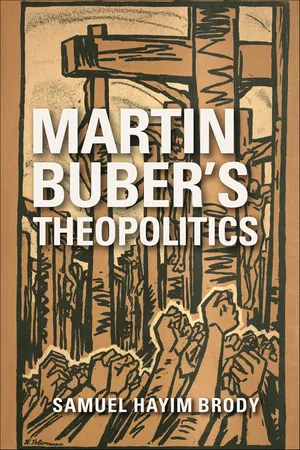
How did one of the greatest Jewish thinkers of the 20th century grapple with the founding of Israel and the Israeli-Palestinian conflict—one of the most significant political conflicts of his time? Samuel Hayim Brody traces the development of Martin Buber's thinking and its implications for the Jewish religion, for the problems posed by Zionism, and for the Zionist-Arab conflict. Beginning in turbulent Weimar Germany, Brody shows how Buber's debates about Biblical meanings had concrete political consequences for anarchists, socialists, Zionists, Nazis, British, and Palestinians alike. Brody further reveals how Buber's passionate commitment to the rule of God absent an intermediary came into conflict in the face of a Zionist movement in danger of repeating ancient mistakes. Brody argues that Buber's support for Israel stemmed from a radically rich and complex understanding of the nature of the Jewish mission on earth that arose from an anarchist reading of the Bible.
- English
- ePUB (mobile friendly)
- Available on iOS & Android
eBook - ePub
Martin Buber's Theopolitics
About this book
Information
Topic
PhilosophySubtopic
Philosophy of ReligionPART I
FROM ANARCHISM TO ANARCHO-THEOCRACY: THE BIRTH OF THEOPOLITICS
O, personality of man! Can it be that for sixty centuries you have groveled in this abjection? You call yourself holy and sacred, but you are only the prostitute, the unwearied and unpaid prostitute, of your servants, of your monks, and of your soldiers. You know it, and you permit it. To be GOVERNED is to be kept in sight, inspected, spied upon, directed, law-driven, numbered, enrolled, indoctrinated, preached at, controlled, estimated, valued, censured, commanded, by creatures who have neither the right, nor the wisdom, nor the virtue to do so.… To be GOVERNED is to be at every operation, at every transaction, noted, registered, enrolled, taxed, stamped, measured, numbered, assessed, licensed, authorized, admonished, forbidden, reformed, corrected, punished. It is, under the pretext of public utility, and in the name of the general interest, to be placed under contribution, trained, ransomed, exploited, monopolized, extorted, squeezed, mystified, robbed; then, at the slightest resistance, the first word of complaint, to be repressed, fined, despised, harassed, tracked, abused, clubbed, disarmed, choked, imprisoned, judged, condemned, shot, deported, sacrificed, sold, betrayed; and, to crown all, mocked, ridiculed, outraged, dishonored. That is government; that is its justice; that is its morality.
—Pierre-Joseph Proudhon, The General Idea of the Revolution in the Nineteenth Century
Socialism is the attempt to lead man’s common life to a bond of common spirit in freedom, that is, to religion.
—Gustav Landauer
1 The True Front
Buber and Landauer on Anarchism and Revolution
Me? I’m the king of the twentieth century. I’m the boogeyman. The villain … The black sheep of the family.
—V to Evey, V for Vendetta
These anarchists are not anarchic enough for me.
—Gustav Landauer, “Anarchic Thoughts on Anarchism”
Introduction: Anarchism by Any Other Name
Martin Buber and Gustav Landauer met in Berlin circa 1900 at a gathering of the Neue Gemeinschaft (New Community), a mystical society that Landauer would shortly quit. The two men maintained a mutually beneficial intellectual and personal relationship for many years, often seeing each other nearly daily. They had a falling out during the Great War, when Landauer pilloried Buber’s naïve exaltation of the supposedly noble spirit of sacrifice prevailing in Europe. This criticism led to an about-face in which Buber reexamined his previous philosophical commitments, beginning the process that would eventually lead to the publication of Ich und Du (I and Thou) in 1923. Before that happened, however, Landauer was murdered in May 1919 by the Freikorps (Free Corps) paramilitary troops sent from Berlin to put down the short-lived Bavarian Council Republic, and Buber honored his memory as the literary executor of his estate.
This narrative of friendship, told most definitively by Paul Mendes-Flohr, has been adopted by nearly every scholar since.1 Ordinarily, however, this story is invoked to say something about the origins of Buber’s dialogic philosophy. Here, I attend more to the political implications of Buber’s friendship with Landauer than to the gradual changes in his philosophical vocabulary, and I ask different questions: What does it mean that Buber spent nearly two decades as the close confidante of perhaps the most important German anarchist of the century? How should we understand the fact that, with the exception of Buber’s interest in Palestine as a site for the realization of their shared ideals, and in the “Jewish movement” (of which Zionism was one part) as a potential vehicle for this realization, there is little to no daylight between the two men’s political outlooks? This was especially true after 1916, when in the wake of Landauer’s denunciation of Buber’s war politics, Buber began to stress the dangers of nationalism and imperialism attendant on the Zionist effort.
It is not that Mendes-Flohr plays down these affinities. For example, he shows that Buber’s 1918 essay Der Heilige Weg (The Holy Way) “indicates a considerable debt to Landauer, in particular to his political anarchism,” and he notes that “the very first essays that mark this volte-face focus on the problem of the state.”2 Nonetheless, later scholars have hesitated to fully develop these indications, and politics is underplayed in the secondary literature. Not only do scholars hesitate to describe Buber as an anarchist; some find it difficult to even admit that he has a politics at all.3 Maurice Friedman, for example, bases his claim that Buber was “neither a pacifist nor an anarchist like Gustav Landauer” on an exchange in August 1963 between Buber and a young student of the kibbutz movement, Hermann Meier-Cronemeyer.4 Having read Buber’s work Paths in Utopia (1947), and his essay “Society and the State” (1951), Meier-Cronemeyer wrote to ask Buber why he did not refer to his politics of “the social principle” as “anarchism.” Was it fear of the dubious reputation of the term? Buber responded that the term “anarchism” did not speak to him because “it means an overcoming of relations of power—which is impossible as long as the nature of man is what it is.”5
One could argue that this is ample evidence to justify Friedman’s claim that Buber is not an anarchist, since he never explicitly avows anarchism, and on at least this one occasion he disavows it.6 One historian of anarchism, Peter Marshall, agrees: “Buber ultimately parted company with the anarchists by arguing that the State can in some circumstances have a legitimate role.”7 However, as another historian of anarchism, George Woodcock, has shown, there has been an increasing tendency over the years for anarchists to embrace the view “that human beings are improvable but not … perfectible. We must accept the probability of imperfection and limit anti-sociality where it impinges on the lives of others.… The more we build and strengthen an alternative society, the more the state is weakened.”8 By these lights, the precise view in the name of which Buber disavowed anarchism is declared to be anarchism.9 Acceptance of this wider understanding of anarchism, developed partially under the influence of renewed readings of Landauer himself, explains why other scholars since the 1970s have felt little need to justify calling Buber an anarchist.10 In uncritically accepting Buber’s distinction between his own politics and anarchism, however, Friedman continuously describes Buber’s political orientation using awkward euphemisms and neologisms, such as “the politics of the social principle.”11
Yet Buber himself set the precedent for these vague, cumbersome labels. He knew well, for example, that Landauer understood his own anarchism not to entail any kind of final, idyllic “overcoming of power-relations.” On the contrary, Landauer argued in a work commissioned and published by Buber himself that “no revolution will ever achieve its goals.”12 In his 1947 work Paths in Utopia, Buber praises Landauer for declining to formulate “the absolute goal,” for understanding that “all true socialism is relative,” and for his insight that “socialism is not the invention of anything new but the discovery of something actually present, of something that has grown.”13 As Buber explains, Paths in Utopia is structured progressively, unfolding a core idea from its beginnings: “In the history of utopian socialism three pairs of active thinkers emerge, each pair being bound together in a peculiar way and also to its generation: Saint-Simon and Fourier, Owen and Proudhon, Kropotkin and Gustav Landauer.”14 Buber here places Landauer at the end of an intellectual lineage that includes the classical anarchist theorists Pierre-Joseph Proudhon (1809–1865) and Peter Kropotkin (1842–1921), arguing that he makes essential improvements on this line of thought, from within it.15 He also, however, designates this line of thought as “socialism” or “utopian socialism.” Buber is aware that “socialism” is a term that, like “democracy,” allows for variants, and the purpose of Paths in Utopia is to discern a particular line within that term. Despite the fact, however, that those whom he treats in the book’s central chapters all referred to themselves as anarchists, and used “anarchism” and “socialism” interchangeably (from Proudhon on this is a defining trait of “utopian socialism” as against its “scientific” cousin, Marxism), he declines to use this term himself but alternates between assorted alternatives. This sets the precedent for all the vagaries in the secondary literature, which reference Buber’s “social philosophy” rather than his political thought, or his “decentralized federalism” or espousal of “anocracy” rather than his relationship to anarchism.16 Meier-Cronemeyer may have been right to suggest that Buber was afraid to be tarred with the anarchist brush, hoping to have more success with utopian socialism.17
If, however, there is little to no difference between Buber and Landauer on the plane of political and social theory, then this deserves greater recognition. In the end, such recognition might lead one to remove Landauer from the list of anarchist authors rather than add Buber to it. Yet for scholars to argue that Buber has no politics, or to take him at his word in distinguishing his politics from anarchism, without investigating his relationship to Landauer and other anarchist thinkers, is to take sides unwittingly in a dispute among socialists. Moreover, there is a sense in which terminology is destiny. There is an anarchist “canon,” in which William Godwin (1756–1836), Proudhon, Mikhail Bakunin (1814–1876), and Kropotkin, along with Alexander Berkman (1870–1936), Rudolf Rocker (1873–1958), and Emma Goldman (1869–1940), number among the classics. For the most part, this canon receives little academic attention as compared to its Marxist “big brother,” and it is studied today primarily by those personally attracted to anarchism.18 Buber demonstrates in Paths in Utopia that he knows this literature well, often thanks to Landauer’s translations, but Buber scholars have shown little interest in contextualizing their understanding of Buber through independent exploration of anarchist thought. Consequently, the general perception of his politics follows the nebulous lines that Friedman, following Buber himself, laid down.
Landauer before Buber: Anarchist Activism, 1890–1899
When he met Buber, Landauer already had a long record of radical agitation behind him. In fact, at that very moment he was embroiled in a highly politicized libel case, which would result in a six-month prison sentence.19 Moritz von Egidy, a former lieutenant colonel who became a Christian anarchist and pacifist, had asked Landauer’s help in securing a retrial for Albert Ziethen, a prisoner whom von Egidy believed to have been railroaded. In February 1898, Landauer published an article in his newspaper, Der Sozialist, accusing a Berlin police official of manufacturing evidence in the case, and he repeated the charges in a letter to members of the Reichstag and the state’s attorney’s office.20 But von Egidy died before the trial, and Landauer dedicated the entire January 1899 issue of Der Sozialist to his memory.21 In that issue Landauer quotes this passage by von Egidy, which he could have easily written himself: “Unthinking men connect the idea of ‘Anarchy’ with the idea of disorder; that, however, is contained neither in the word nor in the strivings of those who call themselves anarchists. On the contrary: a more complete order, an order that rests upon self-discipline and self-rule; an order without force.”22 A month later, still in mourning for his friend, Landauer attended the meeting of the Neue Gemeinschaft at which he met his second wife, Hedwig Lachmann, and other future collaborators, possibly including Buber.
Commenting on the early years of Buber and Landauer’s friendship, Mendes-Flohr contends that “Buber’s earlier intellectual relationship with Landauer was found[ed] on common aesthetic and metaphysical concerns; political and social questions were almost entirely absent from their prewar relationship.”23 I would qualify this judgment in two ways: first, at the moment that Landauer and Buber first met, the former was on the cusp of a withdrawal from his stormy public political career, which would persist for the first eight years of their acquaintance. Second, I emphasize different elements of Buber’s 1904 essay on Landauer’s thought. These steps will help us determine the extent to which Buber and Landauer agreed politically before the outbreak of the Great War, in order to contextualize their subsequent relationship. However, we have to consider Landauer’s li...
Table of contents
- Cover
- Title Page
- Copyright
- Dedication
- Contents
- Preface
- Acknowledgments
- Note on Translation and Transliteration
- List of Abbreviations
- Introduction: What Is Theopolitics?
- Part I. From Anarchism to Anarcho-Theocracy: The Birth of Theopolitics
- Part II. The Anointed and the Prophet: Theopolitics in Israel from Exodus to Exile
- Part III. Theopolitics and Zion
- Conclusion: The Narrow Ridge, the Razor’s Edge
- Appendix: Martin Buber to Hans Kohn, October 4, 1939
- Selected Bibliography
- Index
Trusted by 375,005 students
Access to over 1.5 million titles for a fair monthly price.
Study more efficiently using our study tools.
Frequently asked questions
Yes, you can cancel anytime from the Subscription tab in your account settings on the Perlego website. Your subscription will stay active until the end of your current billing period. Learn how to cancel your subscription
No, books cannot be downloaded as external files, such as PDFs, for use outside of Perlego. However, you can download books within the Perlego app for offline reading on mobile or tablet. Learn how to download books offline
Perlego offers two plans: Essential and Complete
- Essential is ideal for learners and professionals who enjoy exploring a wide range of subjects. Access the Essential Library with 800,000+ trusted titles and best-sellers across business, personal growth, and the humanities. Includes unlimited reading time and Standard Read Aloud voice.
- Complete: Perfect for advanced learners and researchers needing full, unrestricted access. Unlock 1.5M+ books across hundreds of subjects, including academic and specialized titles. The Complete Plan also includes advanced features like Premium Read Aloud and Research Assistant.
We are an online textbook subscription service, where you can get access to an entire online library for less than the price of a single book per month. With over 1.5 million books across 990+ topics, we’ve got you covered! Learn about our mission
Look out for the read-aloud symbol on your next book to see if you can listen to it. The read-aloud tool reads text aloud for you, highlighting the text as it is being read. You can pause it, speed it up and slow it down. Learn more about Read Aloud
Yes! You can use the Perlego app on both iOS and Android devices to read anytime, anywhere — even offline. Perfect for commutes or when you’re on the go.
Please note we cannot support devices running on iOS 13 and Android 7 or earlier. Learn more about using the app
Please note we cannot support devices running on iOS 13 and Android 7 or earlier. Learn more about using the app
Yes, you can access Martin Buber's Theopolitics by Samuel Hayim Brody in PDF and/or ePUB format, as well as other popular books in Philosophy & Philosophy of Religion. We have over 1.5 million books available in our catalogue for you to explore.