As cinema industries around the globe adjusted to the introduction of synch-sound technology, the Soviet Union was also shifting culturally, politically, and ideologically from the heterogeneous film industry of the 1920s to the centralized industry of the 1930s, and from the avant-garde to Socialist Realism. In The Voice of Technology: Soviet Cinema's Transition to Sound, 1928–1935, Lilya Kaganovsky explores the history, practice, technology, ideology, aesthetics, and politics of the transition to sound within the context of larger issues in Soviet media history. Industrialization and centralization of the cinema industry greatly altered the way movies in the Soviet Union were made, while the introduction of sound radically altered the way these movies were received. Kaganovsky argues that the coming of sound changed the Soviet cinema industry by making audible, for the first time, the voice of State power, directly addressing the Soviet viewer. By exploring numerous examples of films from this transitional period, Kaganovsky demonstrates the importance of the new technology of sound in producing and imposing the "Soviet Voice."
- English
- ePUB (mobile friendly)
- Available on iOS & Android
eBook - ePub
About this book
Information
chapter five
“LES SILENCES DE LA VOIX”
Dziga Vertov’s Three Songs of Lenin
The essential characteristic of orthographic (called phono-logic) writing is the exactitude of the recording of the voice rather than the exactitude of the recording of the voice: it is a matter of recording rather than voice.
—Bernard Stiegler, Technics and Time: Disorientation
WHAT DIFFERENCE DOES SOUND MAKE to Three Songs of Lenin? What do we lose or gain with the removal of the sound track? In 1932, after making his last three feature films in Ukraine for the VUFKU film studio, Dziga Vertov was commissioned by Mezhrabpom-fil'm to make a jubilee film about Lenin to commemorate the ten-year anniversary of Lenin’s death. The resulting film—Three Songs of Lenin (Tri pesni o Lenine, 1934)—has a complex history of both production and release. During production, Vertov and his film crew ran into every kind of obstacle, including persecution from RAPP (Russian Association of Proletarian Writers), lack of resources and finances, and extreme physical deprivations, including hunger, typhus, and the like.1 Originally scheduled to premiere at the Bolshoi Theater on the anniversary of Lenin’s death on January 21, 1934, Three Songs of Lenin was not released in Soviet theaters until November 1935 (almost a full year after it was completed), and pulled from the screens after only one week. At the same time, a silent version edited by Vertov and prepared for Soviet cinemas without sound projection, was shown widely across the USSR, while the sound version was “shelved.” In 1938, bending to political pressure, Vertov reedited both the sound and the silent versions of Three Songs of Lenin, recutting the original negatives.2 Thus, as far as we know, no copy of the original 1934/1935 versions survive and we can only speculate from Vertov’s own writings, the film’s critical reception, metrics, censorship notes, and montage lists what the film may have looked like before it was recut and new footage added in the late 1930s.3
In 1970, Three Songs of Lenin was reedited again—this time, by Vertov’s assistants Elizaveta Svilova, Ilya Kopalin, and Semiramida Pumpianskaia—for a posthumous release to mark the hundredth anniversary of Lenin’s birth. The three editors called this version a “restoration” because it removed some of the extra footage added in 1938, but they could not put back the shots or sequences that had been cut by Vertov to make the 1938 variants. Thus, the new reedit/restoration produced yet a third sound version of the film (and a fifth version all together), and this is the film most of us know as Three Songs of Lenin. This was the version used for releases on VHS and DVD in the West and in Russia, assumed to be closest to the original 1934 film compared to the “Stalinist” edit of 1938. Produced during three quite different political moments—the inauguration of Stalin’s “personality cult” and the consequent waning of Lenin’s during the first part of the 1930s; the height of the Stalin cult in the purge years of 1937–1938; and the ongoing anti-Stalinist revisionism of the early “stagnation” period (1969–1970)—each version of Three Songs of Lenin marks in some way its historical moment, not only political, but also technological and artistic.4 Vertov’s ideas about documentary filmmaking and about the relationship between image and sound continued to evolve even at the point when he was no longer allowed to make films independently, when his career was reduced to the editing of news reels. In particular, in his diaries and notes, Vertov returned time and again to Three Songs of Lenin as the film that fulfilled for him the requirements of the new sound documentary, the organic link of sound and image on screen.
Up to now, the 1970 variant has served as the definitive text of Three Songs of Lenin, both because of its availability, and because it removed many of the shots of Stalin assumed to have been introduced in the 1938 edit.5 Yet, at the same time, the restoration kept some of the other sequence added after 1934—such as shots of the manned drifting ice station (North Pole-1), first opened in May 1937, images of the Spanish Communist Dolores Ibarruri, and the female combatants from the Spanish Civil War—creating a hybrid text.6 Thus, the history of Three Songs is the history of “the transition into (and out of) ‘Stalinist culture’,” as John MacKay has argued, and the presence or absence of “Stalin” and “Stalinism” must figure centrally in any interpretation of the film.7 Yet, because of the instability of the filmic text, those presences and absences are hard to trace with any certainty. The film, as it is available to us, is not one thing, but many, its multiple iterations producing a kaleidoscopic or palimpsestic effect. Because we do not have access to the original 1934/1935 films, and because in 1970 there was no longer any need to produce a silent version of Three Songs of Lenin, it is worth paying closer attention to the discredited 1938 “Stalinist” variants to see how Vertov handled a different kind of problem—not the problem of the cult of personality (of either Lenin or Stalin), but the problem of sound, and more specifically, of voice.8 Using the 1938 sound and silent releases of Three Songs of Lenin (as well as the restored viewing copy held at the Russian State Film Archive, Gosfil'mofond), this chapter focuses on Dziga Vertov’s synchronous and asynchronous sound practices in his second sound film, Three Songs of Lenin, and Vertov’s resistance to the imposition of a singular, nondialogic voice that after 1934 comes to dominate sound cinema. The multiple versions of Three Songs of Lenin—specifically, the two silent releases of 1935 and 1938—challenge the expected relationship of sound to the visual image, forcing us to ask in what ways sound functioned in the original composition and how its absence colors our reception of the film.
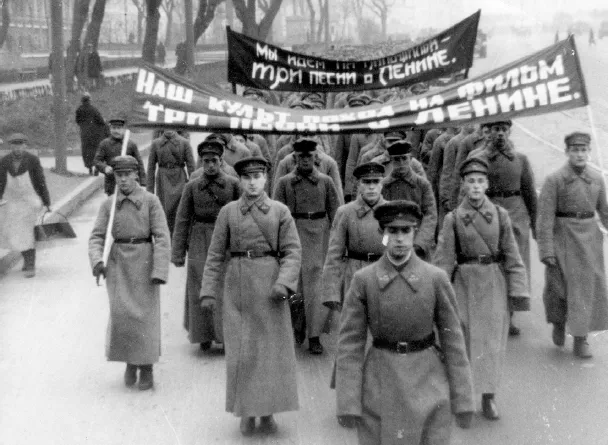
Figure 5.1. “We are going to hear Three Songs of Lenin” (Pravda, 1934, Muzei kino)
LE SON
In retrospect, already in 1934 Three Songs of Lenin signaled a turning point in Vertov’s career.9 This is the last film that could still be included in the canon of his work from the twenties, a work that still bears signs of avant-garde documentary filmmaking and a desire to capture “truth” on film, although it is a very different film even compared to the 1930 Enthusiasm: Symphony of the Donbass (Entuziazm. Simfoniia Donbassa). As Yuri Tsivian notes, while Vertov’s sound films were groundbreaking, “these were not films made by a kinok, in the old sense.”10 Despite some initial success—Three Songs premiered to great acclaim at the 2nd Venice Film Festival in August 1934, and in 1935 Vertov was awarded the Order of the Red Star—and despite the dissolution of RAPP, which was openly hostile to Vertov, after 1935, Vertov found himself increasingly isolated from filmmaking; his requests for a film laboratory, for equipment and materials, for the opportunity to shoot events as they happen were consistently denied by administrators. As is clear from Vertov’s diaries, despite the positive reception, Three Songs did not help Vertov’s career or mitigate the charges of “formalism” and “documentalism” levied against him during the next decade, as he strove to combine his faith in documentary practice with the exigencies of Stalinist Socialist Realism. His consistent marginalization and exclusion from the Soviet cinema industry finally culminated in the “Open Party Session of the Central Studio of Documentary Films” on March 14–15, 1949, with 200 people attending, where, as part of the antisemitic campaign of the late 1940s–1950s, Vertov was charged with “cosmopolitanism” and accused of continuing to undermine Soviet documentary cinematography with his formalist tricks and his “love” of the machine.11
Nevertheless, as Martin Stollery points out, Three Songs of Lenin can be seen and listened to as “one of the last examples of early European film modernism.”12 Vertov conceived Three Songs of Lenin as a sound film first and foremost, and this meant to him much more than simply the addition of music, dialogue, or sound effects to the image track. His experiment with the sound camera in Enthusiasm had already taught him the possibilities and limitations of sound recording and editing, producing a film that while remarkable for its breakthrough uses of sound, remained to some degree an experiment, an exercise in exploring the possibilities of the new sound technology. Three Songs—while it contains no dialogue and very little diegetic sound—was envisioned by Vertov from the beginning as a sound film, that is to say, a film in which sound and image would be “organically” linked, so as to make it impossible to remove the one without sacrificing the other. Sound informs every part of the film, starting from the title; the three “songs” that make up Three Songs of Lenin place the emphasis on melody as the primary organizing principle of the film. And while a number of scholars have noted the irony of a film dedicated to an oral tradition giving us writing in place of speech (Bulgakowa13), or have reconceived the film’s structure in a visual form, such as the triptych (Michelson14), it is nonetheless notable that for Vertov, the film was a “song of songs,” a musical composition in which sound (voice, music, song) was the structuring force by which the other visual elements of the film were organized and constrained.15 As Elizabeth Papazian notes, the reference to “songs” in the title extends Vertov’s play throughout his career with generic designations. Both Man with a Movie Camera (Chelovek s kinoapparatom, 1929) and Enthusiasm were referred to, grandly, as “symphonies,” while the later, more doctrinaire Stalinist film Lullaby (Kolybel’naia, 1937) bears a simpler, folksier designation. The Russian title Tri pesni o Lenine is also a reference to the oral epic poetic tradition, such as, for example, Pushkin’s Pesn' o veshchem Olege (The Song of Wise Oleg, 1822).16
Yet, at the same time—or perhaps because of all these overlapping and overdetermined generic conventions—Three Songs of Lenin is not a sound film or a sound documentary in any standard sense. It has no voice-over, no dialogue, and almost no spoken text. The songs of the Far East are performed in various Turkic languages, with translations provided on screen through Russian intertitles.17 The musical track brings together Eastern folk songs and melodies with Western classical music (including Richard Wagner’s funeral music from The Ring of the Nibelungs cycle and Frédéric Chopin’s Marche funèbre), Soviet patriotic marches, the “Internationale,” and Yuri Shaporin’s “March of the Shock Workers,” written for the film. Noises, such as the bell toll of the Kremlin clock, gunshots, cannons, factory sirens, ships’ horns, explosions, and the like, compete with the different kin...
Table of contents
- Cover
- Title Page
- Copyright
- Dedication
- Contents
- Acknowledgments
- Note on Translation and Transliteration
- Prologue
- Introduction: The Long Transition: Soviet Cinema and the Coming of Sound
- one: The Voice of Technology and the End of Soviet Silent Film: Grigori Kozintsev and Leonid Trauberg’s Alone
- two: The Materiality of Sound: Dziga Vertov’s Enthusiasm and Esfir Shub’s K.Sh.E.
- three: The Homogeneous Thinking Subject, or Soviet Cinema Learns to Sing: Igor Savchenko’s The Accordion
- four: Multilingualism and Heteroglossia in Aleksandr Dovzhenko’s Ivan and Aerograd
- five: “Les Silences de la voix”: Dziga Vertov’s Three Songs of Lenin
- Conclusion: Socialist Realist Sound
- Works Cited
- Index
Trusted by 375,005 students
Access to over 1.5 million titles for a fair monthly price.
Study more efficiently using our study tools.
Frequently asked questions
Yes, you can cancel anytime from the Subscription tab in your account settings on the Perlego website. Your subscription will stay active until the end of your current billing period. Learn how to cancel your subscription
No, books cannot be downloaded as external files, such as PDFs, for use outside of Perlego. However, you can download books within the Perlego app for offline reading on mobile or tablet. Learn how to download books offline
Perlego offers two plans: Essential and Complete
- Essential is ideal for learners and professionals who enjoy exploring a wide range of subjects. Access the Essential Library with 800,000+ trusted titles and best-sellers across business, personal growth, and the humanities. Includes unlimited reading time and Standard Read Aloud voice.
- Complete: Perfect for advanced learners and researchers needing full, unrestricted access. Unlock 1.5M+ books across hundreds of subjects, including academic and specialized titles. The Complete Plan also includes advanced features like Premium Read Aloud and Research Assistant.
We are an online textbook subscription service, where you can get access to an entire online library for less than the price of a single book per month. With over 1.5 million books across 990+ topics, we’ve got you covered! Learn about our mission
Look out for the read-aloud symbol on your next book to see if you can listen to it. The read-aloud tool reads text aloud for you, highlighting the text as it is being read. You can pause it, speed it up and slow it down. Learn more about Read Aloud
Yes! You can use the Perlego app on both iOS and Android devices to read anytime, anywhere — even offline. Perfect for commutes or when you’re on the go.
Please note we cannot support devices running on iOS 13 and Android 7 or earlier. Learn more about using the app
Please note we cannot support devices running on iOS 13 and Android 7 or earlier. Learn more about using the app
Yes, you can access The Voice of Technology by Lilya Kaganovsky in PDF and/or ePUB format, as well as other popular books in History & Russian History. We have over 1.5 million books available in our catalogue for you to explore.