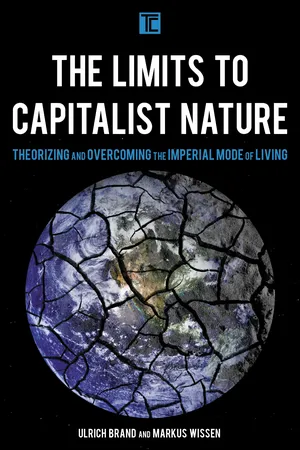
eBook - ePub
The Limits to Capitalist Nature
Theorizing and Overcoming the Imperial Mode of Living
- 208 pages
- English
- ePUB (mobile friendly)
- Available on iOS & Android
eBook - ePub
The Limits to Capitalist Nature
Theorizing and Overcoming the Imperial Mode of Living
About this book
The book provides for a historical-materialist understanding of the multiple crises of capitalism, focusing on the ecological crisis and its interaction with other crisis phenomena (financial crisis, crisis of democracy, economic crisis). Drawing on political ecology, Gramscian theory of hegemony, critical state theory and the regulation approach, it introduces the concept of an imperial mode of living in order to better understand the everyday practices and perceptions as well as the social relations of forces and institutional constellations that facilitate environmentally destructive patterns of production and consumption. Furthermore, it develops a historical-materialist critique of the green economy concept that has been propagated in recent years as a solution not only for the ecological but also for the economic crisis. Finally, the book proposes a democratisation of societal nature relations as a way out of the crisis that requires overcoming capitalist property relations and the exclusive forms of controlling nature guaranteed by them.
Information
Chapter 1
Theorizing the Imperial Mode of Living
An Introduction
In recent years, progressive forces in many parts of the world have been confronted with a new opponent: authoritarian populism. The rise of Trump in the United States, the UK Independence Party in the United Kingdom, Front National in France and the AfD (Alternative for Germany), the fundamentalist backlash against the Arab Spring as well as the apparent end of the cycle of progressive governments in Latin America signal that it is not simply a neo liberal capitalism anymore that the left has to fight. Instead, an even more dangerous enemy has emerged out of a conservative-neo liberal bloc that for a long time dominated the political, social and economic development of countries in the global North, and that now, in a situation of still unresolved multiple crises (of the economy, state finance, political representation, social reproduction, environment, including climate change, energy, food), does not seem capable anymore to cope with the contradictions that it itself has intensified.
The neo liberal business as usual, consisting in the subordination of ever more social spheres under the rule of the capitalist market and thereby worsening the living conditions of millions or even billions of people, is no longer considered as the normal way things have to go. We do not understand neo liberalism primarily as policy reforms (as the concept of the neo liberal Washington Consensus suggests; see Williamson 1990) but as profound societal transformation including the logics of power relations that are inscribed into relations of states, (world) markets and civil society, of class and gender structures, of subjectivities and societal nature relations. The neo liberal counter-revolution since the 1970s, for instance, was a shift not just in economic policies but also in societal class and power relations, of dominant logics (Harvey 2006; Plehwe, Walpen and Neunhöffer 2006; Springer, Birch and MacLeavy 2016).1 The ‘post-democratic’ domestication of social conflicts in many countries, through which neo liberalism managed to present itself as a quasi-natural order to which there is no alternative, does not seem to be viable anymore (Crouch 2004; Blühdorn 2013a,b). Instead, it is politicized in a reactionary manner that makes things even worse, particularly for those without the ‘right to have rights’ (Hannah Arendt 1994: 296), that is, the majority of refugees who fled their home countries in search for a better life or even for the purpose of their mere survival.
But what exactly is it that the authoritarian and neo liberal right has successfully addressed (Bruff 2016), where does it obtain its strength from and why has the left in many countries not been able to politicize the crisis since 2007/2008 in a progressive way? Responding to these questions is not only crucial in order to understand the fundamental transformations that the world is currently going through and the social forces that are struggling over the direction these transformations may take. But it is also important in a political-strategic sense, that is, as a precondition for progressive forces to regain momentum. This is to what the book at hand aims to contribute.
THE IMPERIAL MODE OF LIVING AND THE LIMITS TO CAPITALIST NATURE
We want to add to the existing literature, by introducing and further developing, the concept of the imperial mode of living. By this we aim to understand both the persistence and, at the same time, crisis-deepening patterns of production and consumption that are based on an – in principle – unlimited appropriation of the resources and labour capacity of both the global North and the global South and of a disproportionate claim to global sinks (like forests and oceans in the case of CO2).
We argue that the increase of productivity and material prosperity in the capitalist centres depends on a world resource system and international division of labour that favours the global North and is rendered invisible through the imperial mode of living, so that the domination and power relations it implies are normalized. Since the beginning of industrial capitalism, the imperial mode of living gained certain stability and hegemony at the cost of environmental destruction and the exploitation of labour. Societal relations as well as societal nature relations were stabilized, especially during Fordism, due to its environmentally and socially unsustainable character (Schaffartzik et al. 2014). Manifold societal institutions, like the capitalist market and the capitalist state, assure a certain hegemony of destructive societal nature relations. Fordist forms of mass production and consumption, more or less functioning social compromises and stable welfare institutions have become strong and attractive orientations in societies of the global North. Social hierarchies along class, gender and race were stabilized through uneven access to the means of living, a predominant understanding of well-being that focused on income and (status) consumption as well as respective subjectivities and criteria of ‘success’ (we elaborate this more systematically in Brand and Wissen 2017a). The ‘post-Fordist’ process of capitalist globalization is largely based on fossilist resources and energy regimes, too. And it reproduces itself through manifold hierarchies and forms of inclusion and exclusion (see Biesecker and Hofmeister 2010 for a feminist perspective). Furthermore, since the 1980s, the imperial mode of living has been increasingly spreading beyond the upper classes of the countries of the global South to the middle classes.2 Whereas in the global North it has contributed to safeguarding social stability, for example by helping to keep the costs of the reproduction of labour power relatively low, it provides a hegemonic orientation of development in many societies of the global South.3
However, its persistence in the global North and its spread to the rapidly emerging countries of the global South have plunged global environmental politics into a severe crisis, fostering more openly (neo-)imperialist strategies of powerful national states and supranational entities with respect to natural resources and sinks. Regardless of apparent progresses like the adoption of the Sustainable Development Goals by the General Assembly of the United Nations in 2015 and the Paris Climate Agreement in the same year, capitalist competition and growth strategies have been intensified as a means to overcome the economic crisis. They are at the core of an increasing demand for what Jason Moore (2014) has called the ‘four cheaps’: labour power, food, energy, raw materials. Capital accumulation essentially rests on the availability of these cheaps, which however is increasingly difficult to guarantee to the same degree that ever more societies become dependent on it. In other words, due to the imperial mode of living and its global spread, societies seem to be approaching the limits to capitalist nature.
This does not necessarily mean that the imperial mode of living is leading into a great crash. The limits are not absolute. Instead, they can be shifted in time and space, and there are several ways to cope with the ecological contradictions of capitalism in more or less exclusive ways. One way is the authoritarian stabilization of the imperial mode of living. This is exactly what the social and political right promises to do and which contributes to explaining the latter’s current rise. Authoritarian populism draws its strength not least from proclaiming that it is able to defend the (threatened) privileges of the middle and partially also of the working class – not by addressing the root causes of the (perceived) social decline, that is, the class struggle from above but by blaming those who (must) leave their home countries. Those who intend to migrate to countries of the global North do this precisely, because their living conditions have been destroyed by the imperial mode of living of the global North. They simply cannot, or are not willing, to bear this anymore and, instead, they want to participate in the wealth the imperial mode of living has brought to large parts of the global North at the expense of the global South.
It is the promise to keep these people with their fears and desires beyond the borders of the developed capitalist countries and to exclusively stabilize a mode of living against the claims of those who are no longer willing to just bear the latter’s cost that makes the right strong. And the right can make this promise in a much more credible way than ‘normal’ conservatives and neo-liberals who have made people believe that there is no alternative to the social consequences of an unleashed capitalism and that everybody will be better off only in the long run.
As we will see in the following chapters, the authoritarian stabilization of the imperial mode of living is not the only strategy to cope with the multiple crises and to shift the limits to capitalist nature in an exclusive manner. Another one, on which we will put more emphasis in this book, is the selective ecological modernization of the imperial mode of living which may result in what can be called a green capitalism (Koch 2012; Newell 2012; Tanuro 2013; cf. chapter 4). It is similar to the authoritarian stabilization (and may indeed include authoritarian elements, too) as well as to its Fordist and post-Fordist predecessors, to the extent that it also depends on an external sphere from where it gets its resources and to which it can shift its socio-environmental costs. The resource base however is different, with fossil fuels playing a decreasing role and metals and biomass gaining importance. Capitalism – this is the idea behind our discussion of a possible green-capitalist formation – can cope with biophysical scarcities and environmental destruction by discovering and valorizing new resources, substituting old ones and opening up new territorial and social spaces for capital accumulation. This takes place in an exclusive manner, too. Our main argument is that the regulation of inner-societal and international relations as well as of societal nature relations – that is, the dealing with domination, contradictions and regular crises – occurs predominantly through the imperial mode of living.
We will argue throughout the book that the imperial mode of living has the effect of making the crisis more acute, just as it makes it processable in a socially and spatially limited dimension. The normality of the imperial mode of living acts as a filter to the awareness of the crisis and as a corridor for its management. At least in the global North, the ecological crisis is primarily perceived as an environmental problem and not as a comprehensive societal crisis. That promotes a certain form of public politicization that tends towards the catastrophic: the ecological crisis is a catastrophe caused by the fact that ‘humankind’ or ‘human civilization’ is ignoring its ‘natural limits’. Such a perspective hides the root causes, that is, capitalist, imperial and patriarchal dynamics, of the crisis and related power relations by assumingly putting everybody in the same place. And it represents nature as something ‘out there’ (e.g., climate, biodiversity, global fresh water) and opposed to social-economic and political relations.
ON THIS BOOK
The purpose of this book is to understand and assess the current crises, transformation processes, potential outcomes and new distortions in the form of a new capitalist formation, social forces struggling for dominance and hegemony as well as progressive alternatives. The imperial mode of living is our key concept in this respect. Theorizing it and applying it empirically implies to explore why and how the domination and the exploitation of labour power and nature within the global political economy and within societies work and are stabilized. The threat of inequality and the destruction of nature as a problem of capitalist development are diffused, especially by postponing negative preconditions and consequences into the future or externalizing them across space. This will be shown later in the book by drawing on various theoretical approaches, particularly on regulation theory (Lipietz 1988, cf. chapters 2 and 4 of this book), materialist state theory (Poulantzas 2002; Jessop 2007, chapter 3) and a Gramscian theory of hegemony (Buckel and Fischer-Lescano 2007, chapter 5), all of which are presented and applied in a political-ecological perspective (Görg 2011, cf. chapter 3 of this book).
Chapter 2 introduces the concept of the imperial mode of living and demonstrates how it helps to understand the persistence of resource- and energy-intensive everyday practices and their social and ecological consequences in a North-South context. Our principal theoretical point of reference is the regulation approach. We introduce those regulationist categories on which the imperial mode of living relies, mainly the norm of production and the norm of consumption. Drawing on the work particularly of Michel Aglietta (1979), we develop an understanding of the latter that goes beyond its mere treating in terms of its functionality or dysfunctionality for the creation of macroeconomic coherence, that is, we stress the ‘relative autonomy’ of the consumption sphere in the context of capital accumulation. Taking into account the imperial mode of living – also in historical perspective – thus helps to understand the concurrency of persistence and crisis of the neo-liberal-imperial constellation as well as to identify the starting points for counter-hegemonic struggles.
Chapter 3 aims to better understand the discrepancy between a relatively high level of awareness of the ecological crisis on the one hand and insufficient political and social change on the other. This discrepancy causes a crisis of what we call the Rio model of politics. We approach the problem from the perspective of the concept of ‘societal nature relations’ (in German: gesellschaftliche Naturverhältnisse), which can be situated in the framework of political ecology and, in this chapter, is combined with insights from Marx, regulation theory and critical state theory. We also develop the concept of the ‘regulation of societal nature relations’ and a more comprehensive understanding of the current crisis. The empirical analysis identifies fossilist patterns of production and consumption as the heart of the problem. These patterns are deeply rooted in everyday and institutional practices as well as societal orientations and the “mental infrastructures” (Welzer 2011) of people in the global North, and they imply a disproportionate claim on global resources, sinks and labour power. They form the basis of the imperial mode of living. With the rapid industrialization of countries such as India and China, fossilist patterns of production and consumption are generalized. As a consequence, the ability of developed capitalism to fix its environmental contradictions through the externalization of its socio-ecological costs is put into question. Geopolitical and economic tensions increase and result in a crisis of international environmental governance. Strategies like green economy have to be understood as attempts to make the ecological contradictions of capitalism processable again.
In chapter 4, we argue that key capitalist actors, on the terrain created by social movements in an earlier stage, are refocusing production along the lines of various green economy proposals. By employing the regulation approach, particularly the regulationist category of a mode of development, this leads us to venture that at least in the global North these projects may result in a green capitalism that, like its Fordist predecessor, remains within a certain bandwidth maintained by various regulatory practices and as a result may come to define the coming epoch. However, a greening of the economy will, at the best, process but not overcome the contradictions and relationships of domination and exploitation inherent to capitalism. Since it does not imply a fundamental change of production and consumption patterns, a green capitalism, like its predecessors, will rely on an external sphere to which its socio-ecological costs can be shifted. It will thus have an exclusive character with benefits and costs divided unevenly along class, gender, race and North-South lines.
In chapter 5 we address the recent tendency of further valorizing and financializing nature as a driver and component of a possible green-capitalist formation (the chapter also highlights the difference between commodification and valorization). The valorization and financialization of nature has been intensified during the current multiple crises. It has gained importance given an ongoing over-accumulation, problems with the enhanced reproduction of capital and the problems resulting from the valorization and financialization of other sectors (such as housing). The chapter aims to contribute to the debate on the valorization of nature from the perspective of political ecology, the Gramscian theory of hegemony and the critical theory of the (internationalized) state. We argue that the valorization and financialization of nature (1) is part of a class strategy which attempts to overcome the current crisis in the sense of a passive revolution, (2) is politically mediated in a process in which the internationalized state plays an important role and (3) is based on the imperial mode of living of the global North and thus shapes societal nature relations. The financialization and commodification of nature is part of an emerging green-capitalist hegemonic project. The social and ecological costs of such a project are high, as it is linked to massive dispossession, land-use conflicts and further ecological degradation.
Chapter 6 is the first of three subsequent chapters where we assess concepts and strategies that go beyond a mere ecological modernization of the imperial mode of living and that combine a fundamental critique of this mode with the perspective of overcoming it. The first of these concepts is socio-ecological transformation. Our discussion of it starts with the observation that transformation is the very mode of operation of capitalist societies. Capitalism’s predominant logic is making profit, accumulating capital, expanding economic activities and thereby maintaining itself through permanent change. By following this logic, capitalism produces ever stronger and less controllable crises. The concept of socio-ecological transformation, as we understand it, breaks with this logic. It implies a new model of prosperity, other forms of alimentation, mobility, energy supply, communication, housing, clothing and so on. And it takes into account ecological restrictions with all related implications for the distribution of power and wealth.
A societal transformation of this depth cannot be achieved by market forces and technological solutions alone or even in principle. Instead, it requires a fundamental democratization of many spheres of social life, particularly of those which up to now have been dominated by economic decision-making driven by the aim to maximize profits. Chapter 7 addresses the issue of democratization as a driver of a fundamental socio-ecological transformation with respect to energy generation and provision. Starting from the observation by Timothy Mitchell (2011) that historically the democratization of Western societies has rested on the availability of cheap fossil energy and thus on environmental destruction, we try to identify the conditions under which democracy, social equality and ecological sustainability cannot only be reconciled but even become mutually constitutive. In other words, we will analyse to what extent the dismantling of social relations of power and domination via the democratization of production and reproduction is a key to develop more reflexive and equal societal nature relations.
The concluding chapter 8 discusses the political implications of transformation and democratization as a means to overcome the imperial mode of living. The question here is how alternatives could become viable and which social forces, or alliances of forces, could bring them to the fore. We will particularly address the labour movement and the trade unions as its representatives, that is, actors who have been largely neglected in recent debates about degrowth and the commons. Their role is ambivalent: On the one hand, the perception that wealth increases require an (environmentally destructive) economic growth, since this is the only way to enhance the possibilities for distribution, is deeply anchored in trade union politics. On the other hand, recent studies have shown that there is a strong notion of moral economy (E. P. Thompson 1968) which has not been absorbed by processes of neo liberal subjectivation but, in contrast, could be a starting point to confront the latter as well as to question the imperial mode of living. A precondition for this, however, is that new links are drawn between production and reproduction, between the labour movement and other social movements and between the everyday experience of crisis and the attractiveness and viability of a progressive alternative that would not only overcome the imperial mode of living but ...
Table of contents
- Acknowledgements
- 1 Theorizing the Imperial Mode of Living: An Introduction
- 2 The Crisis of Global Environmental Politics and the Imperial Mode of Living
- 3 Crisis and Continuity of Capitalist Societal Nature Relations
- 4 Strategies of a Green Economy, Contours of a Green Capitalism
- 5 The Valorization and Financialization of Nature as Crisis Strategy
- 6 Socio-Ecological Transformation as the Horizon of a Practical Critique of the Imperial Mode of Living
- 7 Towards the Democratization of Societal Nature Relations
- 8 Overcoming the Imperial Mode of Living: Political and Strategic Implications
- Notes
- References
- Index
- About the Authors
Trusted by 375,005 students
Access to over 1.5 million titles for a fair monthly price.
Study more efficiently using our study tools.
Frequently asked questions
Yes, you can cancel anytime from the Subscription tab in your account settings on the Perlego website. Your subscription will stay active until the end of your current billing period. Learn how to cancel your subscription
No, books cannot be downloaded as external files, such as PDFs, for use outside of Perlego. However, you can download books within the Perlego app for offline reading on mobile or tablet. Learn how to download books offline
Perlego offers two plans: Essential and Complete
- Essential is ideal for learners and professionals who enjoy exploring a wide range of subjects. Access the Essential Library with 800,000+ trusted titles and best-sellers across business, personal growth, and the humanities. Includes unlimited reading time and Standard Read Aloud voice.
- Complete: Perfect for advanced learners and researchers needing full, unrestricted access. Unlock 1.5M+ books across hundreds of subjects, including academic and specialized titles. The Complete Plan also includes advanced features like Premium Read Aloud and Research Assistant.
We are an online textbook subscription service, where you can get access to an entire online library for less than the price of a single book per month. With over 1.5 million books across 990+ topics, we’ve got you covered! Learn about our mission
Look out for the read-aloud symbol on your next book to see if you can listen to it. The read-aloud tool reads text aloud for you, highlighting the text as it is being read. You can pause it, speed it up and slow it down. Learn more about Read Aloud
Yes! You can use the Perlego app on both iOS and Android devices to read anytime, anywhere — even offline. Perfect for commutes or when you’re on the go.
Please note we cannot support devices running on iOS 13 and Android 7 or earlier. Learn more about using the app
Please note we cannot support devices running on iOS 13 and Android 7 or earlier. Learn more about using the app
Yes, you can access The Limits to Capitalist Nature by Ulrich Brand,Markus Wissen in PDF and/or ePUB format, as well as other popular books in Economics & Political Economy. We have over 1.5 million books available in our catalogue for you to explore.