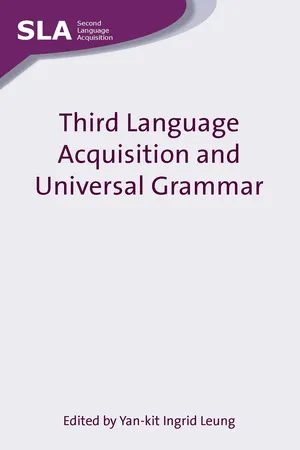
Third Language Acquisition and Universal Grammar contains nine chapters on adult third language (L3) or multilingual acquisition from the Universal Grammar (UG) perspective. A variety of languages other than English are involved in the studies reported in the papers, including Cantonese Chinese, French, German, Italian, Japanese, Kazakh, Mandarin Chinese, Norwegian, Russian, Spanish, Tagalog, and Thai, with acquisition cases taking place in a number of different geographical locations, such as Canada, Germany, Hong Kong, Norway, Taiwan, Thailand, the UK and the USA. This volume will appeal to those studying L3 acquisition from a variety of theoretical perspectives and should encourage scholarly exchange between the fields of bi-/multilingualism and SLA.
- English
- ePUB (mobile friendly)
- Available on iOS & Android
eBook - ePub
Third Language Acquisition and Universal Grammar
About this book
Information
Chapter 1
The Acquisition of Spanish Middle and Impersonal Passive Constructions from SLA and TLA Perspectives
Introduction1
This chapter is the compendium of two studies on the acquisition of middle and impersonal passive constructions in Spanish as a foreign language.2 Initially the subject was approached from the generative perspective of second language acquisition (SLA), but later the study was framed within the newer field of third language acquisition (TLA) studies. In both cases, the question of the full transfer from the first language (L1) is approached, although with differing theoretical assumptions and implications according to each theoretical structure.
The generative perspective on SLA is a research field that has been developed based on Chomsky's proposal (1965, 1995) on the existence of a universal system of principles, called the Universal Grammar (UG), which interacts with the lexical parameters of each language. This UG, that is proper to humans only, is presumed to provide the child with a capacity to fully acquire the grammar of his L1 regardless of the poverty of stimulus encountered. The child subsequently develops the ability to gradually restructure such innate UG principles according to the different parameters of the input. Following these premises, generative SLA researchers argue that the second language (L2) learner maintains full or partial access to UG throughout the L2 acquisition process, and as he is being exposed to the L2, he develops an ‘interlanguage state’ consisting of a series of systematic errors that respond to a rule-governed behavior determined by UG. The concept of interlanguage was originally proposed by Adjémian (1976), Corder (1967) and Selinker (1972), and as one of the pillars of generative SLA research, it has motivated scholars to look into the UG principles evidenced in it. In the initial states of interlanguage, it is considered that UG is continuous, since it remains from the L1 acquisition process, and that it controls the L2 grammatical representations of the learner. There is abundant debate regarding the nature of the interlanguage grammar in this state, although three main hypotheses lead the discussion. The Full Transfer Full Access hypothesis, proposed by Schwartz and Sprouse (1994, 1996), argues that the initial state of L2 acquisition is the final steady state of L1, which allows the learner to fully transfer from the L1 into the L2 the totality of the grammatical parameters that the L1 exhibits. This hypothesis also assumes that subsequent restructurings governed by full access to UG will take place in the interlanguage, due to the need of the learner to assign a representation to the input data, as the acquisition process evolves. A second proposal is the Minimal Trees hypothesis by Vainikka and Young-Scholten (1994, 1996), where the claim is that only lexical categories – not functional – are present in the earliest stages of both L1 and L2 acquisition, and that during the acquisition process, the functional categories may develop in succession. According to this hypothesis, the initial states of learners with different L1s may also be different, given that such states are closely determined by the lexical specifications of each language. Still, the authors fail to indicate the nature and features of what they propose as ‘functional projections’, which has lessened the research applications of the hypothesis. A third major proposal was made by Eubank (1996), named the Valueless Features hypothesis, according to which the initial state of L2 grammar is determined only in part by L1 grammar. Eubank maintains that there is only a ‘weak transfer’ of the L1 functional categories into the L2 initial state, since feature strength is to be determined at later periods of acquisition according to the input. Following to this view, we would expect to find variability in the raising of verb features such as negation, but such behavior has not yet been reported in the literature (White, 2003).
Regarding the analysis of grammars beyond the initial state, generative SLA researchers have followed two major theoretical points of view. The first deals with the breakdown of the parametric systems. For Clahsen and Hong (1995), Neelman and Weerman (1997) and Bley-Vroman (1997) there is a total lack of parameters in the interlanguage grammars, which would imply a total lack of access to UG by L2 learners. However, other researchers have found evidence that there is partial access to UG, which is reflected in the difficulties of the L2 learner to reset feature strength (Beck, 1998; Eubank, 1996). An alternative viewpoint maintains that interlanguages fully respond to UG constraints, although the resetting of the parameters is strictly determined by the properties of L1 parameters. Here, full access to UG is assumed, and transfer from the L1 is actually the point of debate. Researchers have argued for the possibility of parameter resetting due to full transfer from the L1 (Bruhn de Garavito & White, 2002; Schwartz & Sprouse, 1998) and for the impossibility of parameter resetting, due to the constraints imposed by the L1 (Hawkins & Chan, 1997; Smith & Tsimpli, 1995).
As noted above, the generative perspective on generative SLA research provides great variability in terms of premises and approaches, as it attempts to respond to the profusion of morphosyntactic variability observed across interlanguage itself. But an alternative account has recently been offered by scholars who consider that the premise of encompassing all foreign language learners in a homogeneous group needs revisiting. Within the field of TLA research, it is argued that there are substantial differences between L2 learners, L3 learners, L4 learners and so forth (Dewaele, 1998; Hammarberg, 2001). The activation of different skills and analytical methods in multilingual learners, compared to bilingual learners, provides evidence for an alternative regrouping, according to the chronological order of acquisition of any other languages additional to the L1. Apart from aiming to determine the nature of interlanguage grammars, TLA researchers focus on the cognitive, linguistic and sociolinguistic effects of multilingualism. Herdina and Jessner (2002) have pointed out the dynamic nature of multiple language acquisition processes, which may be influenced not only by the operational effects of crosslinguistic influences, but also by personal affective factors and multiple social identities that the learner is exposed to. Unlike generative SLA studies, TLA research does not assume that there is necessarily a dominant language within the linguistic spectrum of the multilingual speaker, or a weaker language. Neither is it presupposed that linguistic transfer is predetermined by the parameters of the L1 or that it is unidirectional toward the foreign languages. For TLA researchers, any language within the language spectrum of a multilingual speaker may play a dominant role according to a particular communicative function of the speaker in specific circumstances. In the same way, the multidirectional processes of crosslinguistic influences may be reflected in the foreign language performance (s) as well as in the L1 performance. Based on these foundations, the TLA research field has concentrated mainly on the areas of the psycholinguistic dynamics of multilingual language systems, crosslinguistic influences and lexical acquisition. More recently, younger scholars have embarked on the exploration of areas such as the sociolinguistics of multilingualism, the phonological aspects of trilingual speakers and the pedagogical implications of multilingual settings.
Regarding the psycholinguistic dynamics of multilingual individuals, Herdina and Jessner (2002) have proposed the Dynamic Model of Multilingualism that makes it possible to account for processes of acquisition, maintenance and/or attrition of one or multiple languages across the life span of the speaker. This model is based on sinusoidal curves, which represent the language acquisition process as a non-linear experience depending on the individual competences and life experiences, in the same way that biological developments take place. Another relevant model is the Bilingual/Multilingual Production Model (Clyne, 2003; De Bot, 2004), which has centered on the segmentation of the acquisition process into three subsystems: the conceptualizer, the formulator and the articulator. This model assumes that the multilingual speaker may integrate multiple identities within a single framework, depending on the social and motivational factors he faces.
In the area of crosslinguistic influences, the interaction between three or more linguistic systems is being approached from a descriptive point of view. The analysis of the different types of lexical transfer lead Ringbom (2001) to identify that there are both: (1) transfers of form, expressed as language switches, and deceptive cognates; and (2) transfers of meaning, represented by calques and semantic extensions. Ringbom argues that the comprehension of the formal interlinguistic similarities is the starting point of the learning process, while the accuracy of the production involving the semantics and morphosyntax will be indicative of more developed linguistic stages.
Unlike generative SLA studies, TLA research looks into the extent of crosslinguistic influences at the morphological, lexical, semantic and cognitive levels, with the purpose of identifying the underlying principles that might determine the learner's preferences at a given time for borrowing an element crosslinguistically. In this respect, Hammarberg (2001: 22–23) specified various factors that have been subsequently taken as grounds for testing in particular cases of multilingualism:
(1) Typological similarity: Morphosyntactic as well as cultural similarities between the languages previously acquired, and the one in process of being acquired, enhance the acquisition of the L3.
(2) Proficiency: A higher level of command of the L2 seems to facilitate the acquisition of the L3.
(3) Recency: As the term implies, if the L2 has ‘recently’ been activated, it remains more accessible as a linguistic reference for the learner.
For Cenoz et al. (2001), linguistic typology proximity is the priming factor for determining crosslinguistic influences. In the case of English L3 learners with Spanish and Basque backgrounds, she found that lexical and syntactic transfers into English came invariably from Spanish regardless of whether this language was the learner's L1 or L2. Based on Kellerman and Sharwood Smith (1978, 1983, 1986) who first showed that learners tend to transfer more elements from the L1 when it is typologically close than when it is a more distant language, Cenoz points out that the crosslinguistic influences may be found along a continuum of two extremes: Interactional Strategies and Transfer Lapses. The former are conscious decisions to use...
Table of contents
- Cover
- Title Page
- Copyright
- Contents
- Acknowledgements
- Contributors
- Introduction
- 1 The Acquisition of Spanish Middle and Impersonal Passive Constructions from SLA and TLA Perspectives
- 2 Language Transfer in the Acquisition of the Semantic Contrast in L3 Spanish
- 3 Multilingual Universal Grammar as the Norm
- 4 UG and L3 Acquisition: New Insights and More Questions
- 5 Transfer in L3 Acquisition: The Role of Typology
- 6 L3 Enhanced Feature Sensitivity as a Result of Higher Proficiency in the L2
- 7 Third Language Acquisition of Norwegian Objects: Interlanguage Transfer or L1 Influence?
- 8 Null Objects in L1 Thai–L2 English–L3 Chinese: An Empiricist Take on a Theoretical Problem
- 9 The L3 Acquisition of Cantonese Reflexives
- Appendix 1
- Appendix 2
- Appendix 3
Trusted by 375,005 students
Access to over 1.5 million titles for a fair monthly price.
Study more efficiently using our study tools.
Frequently asked questions
Yes, you can cancel anytime from the Subscription tab in your account settings on the Perlego website. Your subscription will stay active until the end of your current billing period. Learn how to cancel your subscription
No, books cannot be downloaded as external files, such as PDFs, for use outside of Perlego. However, you can download books within the Perlego app for offline reading on mobile or tablet. Learn how to download books offline
Perlego offers two plans: Essential and Complete
- Essential is ideal for learners and professionals who enjoy exploring a wide range of subjects. Access the Essential Library with 800,000+ trusted titles and best-sellers across business, personal growth, and the humanities. Includes unlimited reading time and Standard Read Aloud voice.
- Complete: Perfect for advanced learners and researchers needing full, unrestricted access. Unlock 1.5M+ books across hundreds of subjects, including academic and specialized titles. The Complete Plan also includes advanced features like Premium Read Aloud and Research Assistant.
We are an online textbook subscription service, where you can get access to an entire online library for less than the price of a single book per month. With over 1.5 million books across 990+ topics, we’ve got you covered! Learn about our mission
Look out for the read-aloud symbol on your next book to see if you can listen to it. The read-aloud tool reads text aloud for you, highlighting the text as it is being read. You can pause it, speed it up and slow it down. Learn more about Read Aloud
Yes! You can use the Perlego app on both iOS and Android devices to read anytime, anywhere — even offline. Perfect for commutes or when you’re on the go.
Please note we cannot support devices running on iOS 13 and Android 7 or earlier. Learn more about using the app
Please note we cannot support devices running on iOS 13 and Android 7 or earlier. Learn more about using the app
Yes, you can access Third Language Acquisition and Universal Grammar by Yan-kit Ingrid Leung in PDF and/or ePUB format, as well as other popular books in Languages & Linguistics & Linguistics. We have over 1.5 million books available in our catalogue for you to explore.