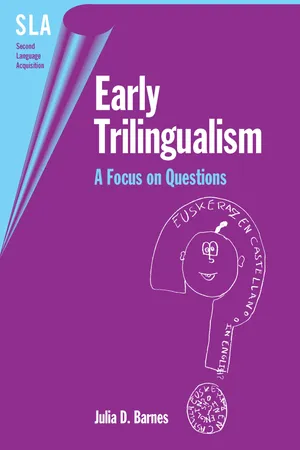
The book describes how a trilingual child in the Basque Country, where Spanish and Basque are the languages of the community, is able to successfully acquire English at home through interaction with her mother. It focuses on her acquisition of the form and function of English questions.
- English
- ePUB (mobile friendly)
- Available on iOS & Android
eBook - ePub
About this book
Information
Part 1
Theoretical Perspectives
Chapter 1
Bilingual and Trilingual Acquisition
Owing to lack of research findings, the phenomena of trilingual and multilingual language acquisition are often explained from the point of view of what is known about early bilingual acquisition. Hoffmann and Widdicombe (1999: 52) point out that ‘in the absence of any theoretical underpinning of our understanding of trilingualism as a distinct linguistic configuration, most of us are working within the theoretical framework of bilingualism’. In many cases trilingualism is explained as an extension of bilingualism (Hoffmann, 2001). On the other hand, Jessner (1997) views multilingualism holistically, proposing a framework (the Dynamic Model of Multilingualism) which stresses the multi-competence of a bilingual or multilingual speaker and in which languages may vary in proficiency according to an individual’s needs.
Studies of children acquiring more than one language may cover different periods but a number of them commence at around the age of two (e.g. Deuchar & Quay, 2000: 10-11). Meisel (2001:19) comments that he starts his analyses at ‘the point of development where children start using multiword utterances containing verbal elements, usually at around age 1;101 approximately at MLU2 1.75’. Such studies tend to be longitudinal case studies on a range of differing subjects and languages and employ varied methods of data collection and analysis. This variety has, in many cases, made it difficult to compare the results - see De Houwer (1990) for a detailed discussion of the problems. Studies that focus on acquisition before age 1;11 or beyond age 3;6 or on language combinations that are not relevant have therefore been omitted from the present discussion.
Definition of Early Bilingualism and Early Trilingualism
McLaughlin (1978,1984) makes a distinction between simultaneous and successive acquisition of two languages. Simultaneous acquisition occurs when a child has been exposed to two languages before the age of three, and successive acquisition occurs when exposure to the second language has taken place after the age of three. This is also the view of Taeschner (1983). Padilla and Lindholm (1984), however, consider that simultaneous acquisition refers to exposure to two languages from birth.
For a number of reasons, De Houwer (1990) rejects the term simultaneous acquisition and proposes Meisel’s (1989) term ‘bilingual first language acquisition’. According to De Houwer (1995: 222) bilingual language acquisition or infant bilingualism refers to ‘the result of the very early, simultaneous, regular and continued exposure to more than one language’. De Houwer distinguishes between bilingual first language acquisition (Meisel, 1989) - also termed ‘simultaneous development of bilingualism’ or 2L1 (Meisel, 2001) - in which a child is exposed to two languages from birth, and ‘bilingual second language acquisition’ De Houwer, 1987) in which exposure to a second language takes place between the age of one month and the age of two. De Houwer (1990: 4) considers that it is vital to know the exact time of first exposure to more than one language since ‘although it is quite possible that differences in ... exposure patterns are irrelevant to the acquisition process ... (they) might well be important’. Starting from birth also allows for full comparison with the monolingual acquisition process. De Houwer (1990) maintains that exposure to a second language at the age of one month is too late for acquisition to qualify as bilingual first language acquisition.
Quay (2001: 179) in her study on a trilingual child argues that there is ‘no empirical support for the one-month-after-birth distinction’ for Bilingual First Language Acquisition proposed by De Houwer (1990, 1995). Quay claims that the results of her study provide evidence that exposure to three languages before first words are produced in them may also be termed ‘trilingual first language acquisition’. However, following McLaughlin (1978, 1984) and his interpretation of simultaneous bilingualism as occurring before age three, we suggest ‘early trilingualism’ as a broader term.
Some children are exposed to three or more languages from birth, even though this does not occur as often as early bilingualism. Early multilingualism is not uncommon in some parts of the world (such as Asia and Africa), and is becoming increasingly frequent in Europe and elsewhere as a result of greater population mobility and international communications (Cenoz, 2000: 43). In early multilingualism, different patterns of language input and use can affect a child’s developing languages. Cenoz (2000: 40, 43) describes the acquisition order of the languages in early trilingualism in a formula Lx + Ly + Lz, in which contact with the different languages takes place simultaneously but in different situations. Numerous situational variations are possible (see Arnberg, 1987; Barron-Hauwaert, 2004; Cenoz, 2000; Harding & Riley, 1986; Hoffmann, 2001), but a common one is when each parent speaks just one language to the child following the principle of ‘one-parent-one-language’ and a third or fourth language is used in the community or in schooling. The language that the parents choose to speak to each other is also crucial in determining the child’s language patterns. It may be a factor in the degree of trilingualism shown by the child since if, for example, the parents use a non-community language to each other this will be an additional source of input to the child.
Other acquisition orders are possible if the child is exposed to the different languages at different times. A child might simultaneously acquire two languages at home with a third added later, for example on entering kindergarten; this can be represented in the following formula (Lx/Ly → L3) (Cenoz, 2000: 40). If four languages are involved, the complexity of possible combinations is even greater.
Language Separation in Bilingual Acquisition
One system or two
An area of much interest in the field of bilingual language acquisition is that of language separation, or whether the bilingual child develops one or more language systems for his or her languages. Volterra and Taeschner (1978) and Taeschner (1983) proposed a three-stage model of bilingual development that argues that initially the languages (in this case, German and Italian) are mixed and that gradually the languages form individual lexical and syntactic systems. The model states that:
(1) The child has one lexical system that includes words from both languages.
(2) The child distinguishes two different lexicons, but applies the same syntactic rules to both languages.
(3) The child has two linguistic codes, differentiated in both lexicon and in syntax, but each language is exclusively associated with the person using that language.
Several early studies support the one-system hypothesis. Redlinger and Park (1980) describe the language mixing of 4 two-year-old children, all of whom have German fathers and whose mothers are French, English and Spanish. They provide evidence that nouns are most frequently substituted, and that function words tend to be more frequently substituted than content words, and use this evidence in support of the one-system hypothesis. Vihman (1985) examined the acquisition of English and Estonian between the ages of 1;1 and 2;00, and focused on aspects of language mixing, particularly functors. She recognises that there is a relationship between early language mixing and code-switching in mature bilinguals and claims that the languages showed evidence of an initial single system. However, this evidence has been questioned by Pye (1986) and by Genesee (1989).
Criticism of the one-system hypothesis
The ‘single system hypothesis’ has sparked academic debate particularly in relation to Stages I and II (De Houwer, 1990; Genesee, 1989; Meisel, 1989). One major criticism has been on methodological grounds, relating to data collection and the size of the corpus on which the hypotheses are based (De Houwer 1995: 231). De Houwer (1995: 231) argues that the claim (Volterra & Taeschner, 1978) that a single system exists depends on the ‘absence of certain forms rather than their presence’. This stage is also explained by Meisel (2001: 15) in terms of a fusion hypothesis whereby ‘children create a new system (randomly?)3 combining elements of the two or more systems’.
It is claimed (Taeschner, 1983) that in Stage I the lexical items used by the child have no equivalence in the other language, so one undifferentiated system of words is used for both languages. Quay’s re-analysis (1995) of the data from Volterra and Taeschner (1978) and Taeschner (1983) seems to disprove the original theory by revealing instances of equivalent pairs. Quay (1995) describes the development of language choice and the bilingual lexicon in a Spanish/English infant bilingual from birth until age 1;10, and finds that translation equivalents make language choice possible from the beginning of speech. This contradicts the findings of Volterra and Taeschner (1978) and shows that in Quay’s own Spanish/English data a number of cross-linguistic equivalents were present.
Jekat (1985) carried out a similar study to that of Taeschner (1983) using German/French subjects and was unable to decide whether or not equivalent pairs were present. Hayashi (1992) did not find conclusive evidence for the Stage I theory in Danish/English subjects, and suggests that the input may be responsible for the appearance or otherwise of equivalents. Arguments against Stage I have also been put forward by Genesee (1989), Mikès (1990), De Houwer (1990), Genesee et al. (1995), Nicoladis and Genesee (1996a) and Köppe (1997), at least for once grammatical differentiation has taken place. Meisel (2001:23), despite also rejecting the hypothesis, suggests that a single system comprising elements that are from neither language may be an option at a pre-grammatical stage - if such a stage exists.
Stage II of the single-system hypothesis (Volterra & Taeschner, 1978), which claims that morpho-syntactic rules also comprise a single system at their emergence, has also been criticised for inconsistencies and has become a source of controversy. Meisel and Mahlau (1988), like Quay (1995) above, consider that the evidence produced by Volterra and Taeschner (1978) contradicts their own arguments and in fact supports the idea of early bilingual separate development (see De Houwer, 1995: 233-234).
More recently, Deuchar and Quay (1998) re-examine the issue, arguing that there is a single rudimentary grammar in bilingual children before two years of age, the approximate time around which the linguistic systems become differentiated (Paradis & Genesee, 1996). Based on evidence taken from a Spanish/English bilingual infant (see also Deuchar, 1989) Deuchar and Quay argue that between the ages of 1;7 and 1;9 mixed utterances can ‘be attributed largely to limited lexical resources rather than to an initial syntactic system’ (Deuchar & Quay, 1998: 233). In their view, language-specific utterances can be identified as soon as morphological marking appears and they find evidence of this in samples from the same child at 1;8 to 2;3. Deuchar (1999) reports on the development of the ability to make language choices in Spanish and English contexts. She examines mixed utterances in the same Spanish/English bilingual child between the ages of 1;7 and 1;9, which correspond to the child’s first two-word utterances. The study focuses specifically on function words, and finds that they are not language-specific in early bilingual two-word utterances. Content words, on the other hand, match the language context more frequently, and are therefore more language-specific. Deuchar and Quay (1998) and Deuchar (1999) claim that their results show that early bilingual children have one initial morpho-syntactic system prior to differentiation. Meisel (2001: 25) questions the findings of these two studies on some methodological grounds and the way rudimentary syntax is defined. In his view (Meisel, 2001: 26), more empirical and theoretical support is needed to support Deuchar and Quay’s position.
Evidence of two systems
In seeking evidence of two systems (Ingram, 1981; Meisel & Mahlau, 1988), it has been suggested that the best way to investigate how children acquire their language systems, and whether these systems are separate, is to foc...
Table of contents
- Cover
- Title page
- Copyright
- Contents
- Acknowledgements
- Introduction
- Part 1: Theoretical Perspectives
- Part 2: The Acquisition of English Question Form and Function in a Trilingual Child
- References
- Author Index
- Subject Index
Trusted by 375,005 students
Access to over 1.5 million titles for a fair monthly price.
Study more efficiently using our study tools.
Frequently asked questions
Yes, you can cancel anytime from the Subscription tab in your account settings on the Perlego website. Your subscription will stay active until the end of your current billing period. Learn how to cancel your subscription
No, books cannot be downloaded as external files, such as PDFs, for use outside of Perlego. However, you can download books within the Perlego app for offline reading on mobile or tablet. Learn how to download books offline
Perlego offers two plans: Essential and Complete
- Essential is ideal for learners and professionals who enjoy exploring a wide range of subjects. Access the Essential Library with 800,000+ trusted titles and best-sellers across business, personal growth, and the humanities. Includes unlimited reading time and Standard Read Aloud voice.
- Complete: Perfect for advanced learners and researchers needing full, unrestricted access. Unlock 1.5M+ books across hundreds of subjects, including academic and specialized titles. The Complete Plan also includes advanced features like Premium Read Aloud and Research Assistant.
We are an online textbook subscription service, where you can get access to an entire online library for less than the price of a single book per month. With over 1.5 million books across 990+ topics, we’ve got you covered! Learn about our mission
Look out for the read-aloud symbol on your next book to see if you can listen to it. The read-aloud tool reads text aloud for you, highlighting the text as it is being read. You can pause it, speed it up and slow it down. Learn more about Read Aloud
Yes! You can use the Perlego app on both iOS and Android devices to read anytime, anywhere — even offline. Perfect for commutes or when you’re on the go.
Please note we cannot support devices running on iOS 13 and Android 7 or earlier. Learn more about using the app
Please note we cannot support devices running on iOS 13 and Android 7 or earlier. Learn more about using the app
Yes, you can access Early Trilingualism by Julia D. Barnes in PDF and/or ePUB format, as well as other popular books in Languages & Linguistics & Linguistics. We have over 1.5 million books available in our catalogue for you to explore.