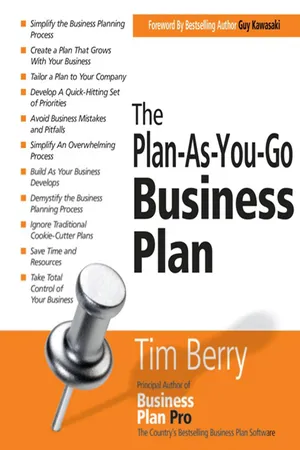
The principal author of Business Plan Pro, the country’s bestselling business plan software, simplifies the business planning process and reveals how to create business plans that grow with the business. Providing adequate guidance for every situation and every stage of business, readers are trained to ignore the traditional, formal cookie-cutter plans that other business planning resources offer and to focus on tailoring a plan to their company; allowing them to literally plan as they go and to, ultimately, steer their business ahead while saving time. Clear-cut instructions help business owners quickly build the type of plan that works for them—one that helps them take total control of their business, improve profits, raise capital, operate a profitable enterprise, and stay ahead of the competition. Very comprehensive, yet easy-to-understand, this business tool offers more than just the nuts and bolts of writing a business plan—the author also provides invaluable insight through real-life examples illustrating key points and avoidable mistakes as well as cutting-edge information for the 21st century entrepreneur. This guide is designed to be a reliable tool for those entering into the world of starting and owning their own business.
- 270 pages
- English
- ePUB (mobile friendly)
- Available on iOS & Android
eBook - ePub
The Plan-As-You-Go Business Plan
About this book
Information
CHAPTER 1
About This Book
This is a new approach to business planning. It’s new and different because it takes what’s most important about the traditional business plan idea and applies it better to today’s world. And it’s a lot better than the traditional business plan—quicker, easier, more flexible, more practical, and more useful.
It’s been a long time coming. I’ve been working with business plans for about 30 years now. Startup plans for new companies that didn’t yet exist, growth plans, strategic plans, action plans, feasibility plans, lots of plans. One of my startup plans became Borland International, which went public less than four years after it started and made me a lot of money. I did annual plans for Apple Latin America, then Apple Pacific, and then Apple Japan for a combined total of 12 years. I’ve used business plans to grow my own company to 40 employees and 70 percent market share without outside investment.
Through all these years, I’ve seen how business planning can be the secret of success for new companies and growing companies. I’ve seen how the best companies understand planning and regularly develop plans and manage them. Good companies plan.
I’ve seen how the best companies understand planning and regularly develop plans and manage them.
I’ve also seen how myths and misunderstandings get in the way. People think—wrongly—that having a plan means getting locked into doing something that doesn’t make sense, mindlessly, because it’s in the plan. People think—wrongly—that rapid changes make planning less useful, when in fact good planning is one of the best ways to manage change. People think—and this is one of the most damaging misconceptions—that a business plan is hard to do and set in stone with a long list of necessary parts, a ponderous and pompous formal exercise.
The plan-as-you-go business plan is what you need and only what you need. It can be as simple as a 60-second strategy summary that can be delivered in an elevator. For smaller companies it might be that plus a review schedule, milestones table, measurement notes, and a sales forecast. And as companies grow, their plans can grow. Then, when you need the big plan document, you add the additional parts you need and create the document. But you are always planning, and you are never without a plan.
This is not the first business plan book I’ve done. Unfortunately, I now hate the title of my last business plan book, the most successful, because it sets up exactly the wrong idea: the business plan as hurdle. The book is titled Hurdle: The Book on Business Planning . What’s wrong with this is that business planning isn’t supposed to be like a hurdle that stands in the way; instead, it’s a powerful tool for managing your company better, controlling your business destiny, establishing accountability, and developing teamwork. You should never think of it as a hurdle. It’s not an obstacle you overcome; it’s a technique that always helps you manage your company better.
dp n="14" folio="3" ? IMPATIENT? THEN JUMP IN
I understand. Enough of the explanations and positioning; let’s get working on a plan. So go ahead, just jump in and do it.
• Most people like to start with the heart of the plan. Jump to Chapter 3 now, and you’ll see what I mean. It’s about what really drives your business. Your target market, your business offering, your strategic focus. And don’t worry about format; write it, speak it, use bullet points, slides, or whatever.
• My personal favorite is the plan review schedule. This makes it very clear that you’re after planning, and better management, not just a plan. (See page 104.)
• Another very good starting point is the sales forecast. Some people like to get to the numbers first, and many people do the conceptual thinking while they work the numbers. Your target market, your business offering, your strategic focus are all in your head as you make your sales forecast. That’s not a bad way to proceed. (See page 131.)
• Maybe you want to start with an expense budget instead. Estimate your payroll on an average month. Calculate your burn rate, a very important number, meaning how much money you have to spend per month. (See page 155.)
• If you’re planning to start a business, startup costs are a good place to get going. Make lists of what you need in money, goods, locations, and so forth. (See page 161.)
• Particularly when you have a team, a SWOT (strengths, weaknesses, opportunites, and threats) analysis is a great way to start. You can jump to the section on SWOT analysis now and begin there. (See page 80.)
• Some people like to set the scene better, with the mission statement, vision, mantra, objectives, or keys to success. That gives your plan a framework to live in, if you like. (See page 73.)
However, there are some things in business planning, even plan-as-you-go planning, that have to happen in a certain order. For example, you can’t really just start with the cash flow statement without having done your sales forecast, burn rate, and some asset and liabilities assumptions.
Still, you can get started fast. I don’t blame you. Maybe you’ll jump back here to continue with the explanations after you’ve made some progress.
So don’t stop working. Don’t ever let the business plan stand between you and doing business. Get started, get going, and make the plan useful to you from the very first day.
You’ll find that strategy in this book. I want you to get started. I expect that you’ll be able to do something today that will already be helping your business tomorrow.
TIPS & TRAPS
THE BIG PLAN, ALL AT ONCE
You can also do the big plan all at once! I understand. This new approach is great, but never mind, you need the formal plan. You’ve been asked for it by somebody who might invest, or a bank loan manager, or a boss. Maybe you’re doing it for a business school class. I call these business plan events. When you need the old-fashioned full document, so be it; there’s a business need, so let’s get it done.
We’ll get there in this book. You can jump to Chapter 5 right now, and start writing things down, section by section. I’d rather have you develop your core plan first, then get the essentials, including the who, what, when, how much, the sales forecast, and the burn rate (the amount of money that flows out of the business each month); but that’s up to you. “Get started and get going” means you can also do it the old-fashioned way if you want.
What’s Different About This Book?
A Live Book: Web Links
Some things change more often than a book is printed, so I keep the content alive and refreshed on the web. You’ve got the book as a guide, but let’s optimize.
If you’re near a computer, go to planasyougo.com.
This is the 21st century. I’m not pretending this book lives alone. As I wrote this, I was also working on three blogs myself and contributing to three others as a guest expert. I only recently stopped running a company that lives and breathes web traffic, download sales, conversion rates, page views, visitors, and Google analytics. I was working with Microsoft Office on four computers and on three different office substitutes in the web world, where my documents live online, and I visit them from whichever computer I’m on.
If you’re near a computer, go to planasyougo.com and you’ll see what that means for you. It’s a new world now; everything changes so quickly. Happily, most of what I have to say will last but there will also be updates, new ideas, tools, and of course new stuff on my blogs and associated websites. Join me there. That’s your portal to what else is happening in plan-as-you-go business planning.
I don’t expect this book to sit static on the shelf—I expect you to use it. And I don’t expect it to sit static as it is—I expect to update it constantly on the web, on my blogs, and as it flows through the world into other books, magazines, software, and so on.
Chapter Updates
Please do check in at planasyouago.com because I will be updating some chapters from time to time. After all, if we’re doing plan-as-you-go planning, isn’t it also logical that we do write-as-you-go authorship? Things change, not just in your business, but also in the business of business planning.
dp n="17" folio="6" ?Information Sources
Resources and references that appear in this book can also change; once again, we’re living in the real world here, so we have to deal with change. I’ll keep you updated through the planasyougo.com.
The plan-as-you-go business plan isn’t big on supporting information that slows down your process, but it is required in so...
Table of contents
- Title Page
- Foreword
- Preface
- CHAPTER 1 - About This Book
- CHAPTER 2 - Attitude Adjustment
- CHAPTER 3 - The Heart of the Plan
- CHAPTER 4 - Flesh and Bones
- CHAPTER 5 - Dressing and Growing
- CHAPTER 6 - Planning Process
- Index
- Subscribe to Entrepreneur Magazine
- Copyright Page
Trusted by 375,005 students
Access to over 1.5 million titles for a fair monthly price.
Study more efficiently using our study tools.
Frequently asked questions
Yes, you can cancel anytime from the Subscription tab in your account settings on the Perlego website. Your subscription will stay active until the end of your current billing period. Learn how to cancel your subscription
No, books cannot be downloaded as external files, such as PDFs, for use outside of Perlego. However, you can download books within the Perlego app for offline reading on mobile or tablet. Learn how to download books offline
Perlego offers two plans: Essential and Complete
- Essential is ideal for learners and professionals who enjoy exploring a wide range of subjects. Access the Essential Library with 800,000+ trusted titles and best-sellers across business, personal growth, and the humanities. Includes unlimited reading time and Standard Read Aloud voice.
- Complete: Perfect for advanced learners and researchers needing full, unrestricted access. Unlock 1.5M+ books across hundreds of subjects, including academic and specialized titles. The Complete Plan also includes advanced features like Premium Read Aloud and Research Assistant.
We are an online textbook subscription service, where you can get access to an entire online library for less than the price of a single book per month. With over 1.5 million books across 990+ topics, we’ve got you covered! Learn about our mission
Look out for the read-aloud symbol on your next book to see if you can listen to it. The read-aloud tool reads text aloud for you, highlighting the text as it is being read. You can pause it, speed it up and slow it down. Learn more about Read Aloud
Yes! You can use the Perlego app on both iOS and Android devices to read anytime, anywhere — even offline. Perfect for commutes or when you’re on the go.
Please note we cannot support devices running on iOS 13 and Android 7 or earlier. Learn more about using the app
Please note we cannot support devices running on iOS 13 and Android 7 or earlier. Learn more about using the app
Yes, you can access The Plan-As-You-Go Business Plan by Tim Berry in PDF and/or ePUB format, as well as other popular books in Business & Small Business. We have over 1.5 million books available in our catalogue for you to explore.