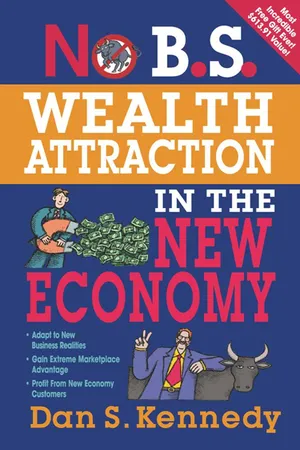
The old economy is shattered, and GONE FOREVER. It’s never coming back as it was, and in its place a generally tougher, more demanding marketplace is emerging. HOWEVER, when it comes to wealth, one instrumental reality is unchanged: No matter the economic conditions—booms or recessions, including the fast-emerging New Economy—there is wealth. And who better to show you how to lure, bait, attract, and become a magnet for it than “Millionaire Maker” Dan S. Kennedy? Kennedy covers: • How to experience The Phenomenon --- attract more wealth in the next 12 months than in the previous 12 years! • Wealth Inhibition—do you suffer from it? • Why Positive Thinking alone is worthless • Your #1 Entrepreneurial Responsibility • Is there a ‘dirty little secret’ behind many wealthy entrepreneurs? • The worst of all wealth-defeating habits • Are you an ‘opportunity thinker’ --- or are you guilty of ‘outcome thinking’? • “ Do what you love and the money will follow” B.S. that’s hazardous to your wealth • How to Stop playing Blind Archery • 12 Ways To Increase Your ‘Personal Value’ • Why you must STOP thinking about Income! • The 90 Day Experiment that may change your life forever
- 252 pages
- English
- ePUB (mobile friendly)
- Available on iOS & Android
eBook - ePub
No B.S. Wealth Attraction In The New Economy
About this book
Information
SECTION I
WEALTH MAGNETS
dp n="27" folio="" ?dp n="28" folio="3" ? 
Wealth Magnet 1
No Guilt
Most people’s world view of wealth is as a zero-sum game. A big impediment to attraction of wealth is the idea that the amount of wealth floating around to be attracted is limited. If you believe it’s limited, then you believe that each dollar you have came to you at someone else’s expense, your gain another’s loss. That makes your subconscious mind queasy. So it keeps your wealth attraction power turned down. Never to full power. To let it operate at full power would be unfair and harmful to others. If you are a decent human being, and you have this viewpoint, then you will always modulate your wealth attraction power. If too much starts pouring in too easily, guilt is produced as if it were insulin being produced by the pancreas after pigging out on a whole pizza. You can’t help it. Your wealth magnetism will be turned down for you.
dp n="29" folio="4" ?Think about the words “fair share.”
They are powerful, dangerous words.
As an ethical, moral person, you probably think—“hey, I don’t want more than my fair share.” But that reveals belief that wealth is limited. If you believe wealth is unlimited, there’s no such thing as a share of it. Everybody’s share is unlimited. There’s nothing to have a share of. There’s only unlimited. Your fair share is all you can possibly attract. As is anybody and everybody else’s.
In business, there’s a similar idea: market share. But again that presumes a finite, limited market, instead of an infinitely expandable market.
In the New Economy, market share is one of the most antiquated of concepts. Boundaries are broken—even the smallest of businesses can be global in reach, thanks largely to the internet. Consumers have access to a multiplied and multiplying range of choices, so classic brand loyalty has been replaced by search for and expectation of the thing that is precisely, perfectly appropriate. The market for all manner of goods and services is greater than ever before yet the fragmentation of the market itself is greater and more complex than ever before. The attraction of wealth in this environment has little to do with somehow “locking up” a limited portion of a limited market and everything to do with directly connecting with individuals and meeting their needs and interests. When you think in terms of being in the business of creatively meeting the needs and interests of individuals, it’s obvious that the size of the market available to you is limited only by your own creativity and initiative. Further, that whatever connection you create and accomplish has no relationship to what anyone else does, whether a lot or a little. Clinging to old ideas of limitation blocks access to new opportunity!
A Tale of Two Teenagers
Imagine being a teenager in a family in severe financial trouble. Money is very scarce. There’s you, two brothers, father and mother. When everybody sits down to dinner and Mom puts the food on the table, you know that’s all the food there is. The bowl of mashed potatoes is all the mashed potatoes there are. You are hungry. You really want a big second helping of mashed potatoes. The bowl is right in front of you, within easy reach. But instead of just reaching out, dragging it over, and scooping out a pile of potatoes, you stop to look around and see who has potatoes on their plate. You look to see if your father’s had plenty of potatoes. You hold back from fulfilling your desire out of concern that others may not yet have had their fair share, may be hungrier than you. You do not want someone else going hungry as a result of your appetite.
I don’t have to imagine that. I lived it.
Now imagine being a teenager in a family living an abundant life, with great prosperity. When Mom puts dinner on the table, you know there’s plenty more where it came from. The refrigerator’s full of food. So are the cupboards. There are always leftovers after dinner. You are hungry. You really want a big second helping of mashed potatoes. The bowl is right in front of you, within easy reach. Without a second thought, you reach out, drag the bowl over, and scoop out all the potatoes you want.
In these examples, of course, you’re acting consciously. In the first case, in the financially troubled family, you consciously hold back, sacrifice, do not take what is right in front of you for the taking.
Similarly but subconsciously, if you believe, at all, on any level, that wealth is limited, that there’s not plenty to go around, you will hold back, you won’t take everything that’s right in front of you. Your emotions about wealth will be cautious, measured, restricted, suppressed, timid.
If you can make every last smidgen of belief that wealth is limited go away, your attraction of wealth will suddenly, automatically, go from modulated, limited, and suppressed to full power, and opportunity, money, and wealth will quickly flow to you in greater quantities and at greater speed than you’ve ever before experienced.

“I’ve called the family together to announce that, because of inflation, I’m going to have to let two of yougo.”
©The New Yorker Collection 1974 Joseph Farris from cartoonbank.com. All rights reserved.
People get ingrained in their heads that money taken from Person A and moved to Person B enriches Person B at the expense of Person A. Certainly, the liberal politicians either believe it or pander to it, one or the other. Some religious doctrines and religious leaders posit this idea. There are lots of ways this belief might be firmly planted in your head; maybe even in elementary school math class. If Johnny has 4 pieces of candy and gives 2 of them to Jim, how many does Johnny have left? The answer needed to ace the quiz is 2. But the “problem” ignores the fact that Johnny can simply open his hand and have as many pieces of candy appear in it as he’d like. After all, there’s no global shortage of candy. When you actually understand wealth, you know that Johnny can have 4 pieces, give Jim 2 pieces, but then have 42 pieces.
What’s even weirder and tougher for math teachers is that Johnny is much more likely to have 42 if he does give away 2 of the 4 than if he hoards the 4. But that’s another topic for a different place in this book. For now, let’s keep it simple:
The opposite of wealth attraction is wealth inhibition.
Most people are so wealth-inhibited they never even think in terms of getting wealthy. Their thoughts on this subject are limited to buying a lottery ticket or fantasizing about some unknown, long-lost uncle leaving them a fortune in his will. But there are a lot of people who do, at some point, start seriously trying to figure out how they might convert their knowledge, ability, time, energy, and effort into real wealth. You may be in that group—it may be the reason you were attracted to and purchased this book. So, a warning: the majority of people in this group never get traction, never get going, never get wealthy because they suffer from wealth inhibition.
If you believe wealth is limited, if you view it as a zero-sum game, you are inhibited. This inhibition affects all sorts of things you do or don’t do, such as what you’ll charge, for example, or who you’ll ask for money.
I’ve spent a lot of time working with people in sales. Those who identify themselves as salespeople, like folks selling insurance, cars, fire alarms, as well as those who don’t identify themselves as salespeople but are, like dentists and psychologists. Two things are true for all of them that reflect wealth inhibition.
One has to do with price. Most fear discussion of price, fearraising prices, are paranoid about pricing higher than their competitors. I have had to work long and hard to get some people to raise their prices or fees far beyond present levels, industry norms, or competitors’ prices, in order to charge what their service and expertise is really worth to their clientele. In numerous cases, I’ve forced fee or price increases of 200% to 2,000% with absolutely no adverse impact—that’s how far underpriced a lot of people are! In these situations, we are not dealing with practical issues. We are dealing with the businessperson’s own inhibitions and fears.
Because this is such an important subject that can lead to such huge breakthroughs in a business, I developed an entire seminar on the subject of PRICE ELASTICITY, which you can take as an online course. Get details at www.DanKennedy.com.
Second is pulling the punch when closing the sale. I sometimes joke about one of my own businesses—freelance advertising copywriting—where I routinely charge fees of $100,000.00 to $150,000.00 or more for a complete project, no less than $25,000.00 for a single ad or sales letter. Plus royalties. I say that the primary requirement for getting such fees has little to do with my prowess as a copywriter and everything to do with my ability to keep a straight face and voice free of stammer when quoting the fee! This may be the reason a lot of art and antique dealers write the price down on a piece of stationery and slide it across the desk to you. There’s truth in the joke. When the dentist quotes his $70,000.00 case to the patient, when the private residence club quotes the $215,000.00 membership fee, when anyone speaks any price or fee, there is the tendency for tremors, the temptation to discount without ever even being asked, out of fear, inhibition, and presumption. In short, to pull the punch.
Consider the salesman who goes into a person’s home to sell fire alarms. (I have a corporate client in this industry.) The fire alarm salesman with the stuffed Dalmatian under his arm and the burning house DVD marches in and discovers that he is in a place of relative poverty—at least by his standards. The two kids are on a thread-bare carpet in the living room. They probably have a good television, but pretty much everything else in the house is obviously hand-me-down, beat-up, falling apart, springs sticking up out of the couch seat. He can clearly see that these people aren’t doing well. Conversationally, he discovers Papa hasn’t worked in four months and one of the kid’s got some kind of problem that causes big medical bills, and on and on and on. The salesperson becomes increasingly queasy about closing these people on the $2,000.00 fire alarm sale. And, in many cases, he will not close the sale. He will subconsciously pull his punches, accept the first objection easily. Or he’ll consciously, deliberately throw the game at the end, toss that one aside, and get out of there.
This is an analogy to the way everybody behaves in all sorts of situations, if operating from a belief of limited wealth.
My friend Glenn Turner tells the story from his earliest selling days of actually being chased by somebody who was mad that he wouldn’t sell him a sewing machine. Glenn thought the person couldn’t afford it, shouldn’t go into debt to buy it, and obviously cut his presentation short and abruptly got up and left—only to be literally chased down the street and caught by the husband, who called him on not trying to make the sale. “How dare you think for me? I’ve got a right to buy that thing for my wife if I want to.”
dp n="35" folio="10" ?My speaking colleague Zig Ziglar has a similar story from his earliest days selling cookware, about the customer that was saving up the money to put in indoor plumbing. Discovering that they didn’t even have indoor plumbing, Zig backed off and didn’t try to close the sale on the cookware. And the people were annoyed, they really wanted the pots and pans. The husband said: We can put the plumbing in later. Mamma wants those pots now.
The queasiness about price, about whom somebody is selling to, about their ability to pay, their ability to afford it is all deadly. And the truth is, anytime you start to make those decisions for other people, it really reflects more about what’s going on internally with you than it does with anything else.
Oh, and by the way, if you were that fire alarm salesman who deliberately threw the sale, how would you feel about not exerting your best efforts if you turned on the TV news the next night and saw that family’s house burned to the ground and they had died in the fire? Oops.
There’s something else to get clear about the people who are without money, that you perceive to be disadvantaged for one reason or another and you question whether you should sell something regardless of whether you get any of their money or not—they’re going to be without money next week, too.
The reason they’re without money has absolutely nothing whatsoever to do with your existence, what you sell or fail to sell, nor does it have to do with the way money works in the real world. It has to do with them. And whether you take it, somebody else takes it, the liquor store takes it, the church takes it, whoever takes it, I promise you somebody’s getting it. Because if they’re without money now, they’re going to be without money again. And most of them are going to be without money permanently, because they never gain or act on an understanding of how money works.
I know that sounds harsh. And you may not be a face-to-face salesperson and never need to sit across a desk or table from someone you think “can’t afford it” and sell to them anyway. But the truth about this particular situation is the bigger truth about the entire world of money and wealth. That truth is, whatever amount you get has nothing to do with how much or how little anyone else has. Ever.
If you want your wealth attraction glowing and functioning at full power, you can’t have any queasiness. You can’t have any reluctance. You can’t have any inhibition. You can’t ever pull a punch. In the bigger sense, you have to understand that whatever financial position anyone you know is in, anyone you do business with is in, anyone, period, is in, has nothing to do with you. In the biggest sense, you have to understand that whatever the state of economic affairs in the world, it has ...
Table of contents
- WHAT PEOPLE ARE SAYING ABOUT NO B.S. WEALTH ATTRACTION IN THE NEW ECONOMY
- Title Page
- Some of the BIG IDEAS in this Book that Will Challenge You
- Acknowledgements
- Preface
- SECTION I - WEALTH MAGNETS
- SECTION II - BONUS CHAPTERS
- SECTION III - WEALTH RESOURCES
- About the Author
- Index
- Subscribe to Entrepreneur Magazine
- Copyright Page
Trusted by 375,005 students
Access to over 1.5 million titles for a fair monthly price.
Study more efficiently using our study tools.
Frequently asked questions
Yes, you can cancel anytime from the Subscription tab in your account settings on the Perlego website. Your subscription will stay active until the end of your current billing period. Learn how to cancel your subscription
No, books cannot be downloaded as external files, such as PDFs, for use outside of Perlego. However, you can download books within the Perlego app for offline reading on mobile or tablet. Learn how to download books offline
Perlego offers two plans: Essential and Complete
- Essential is ideal for learners and professionals who enjoy exploring a wide range of subjects. Access the Essential Library with 800,000+ trusted titles and best-sellers across business, personal growth, and the humanities. Includes unlimited reading time and Standard Read Aloud voice.
- Complete: Perfect for advanced learners and researchers needing full, unrestricted access. Unlock 1.5M+ books across hundreds of subjects, including academic and specialized titles. The Complete Plan also includes advanced features like Premium Read Aloud and Research Assistant.
We are an online textbook subscription service, where you can get access to an entire online library for less than the price of a single book per month. With over 1.5 million books across 990+ topics, we’ve got you covered! Learn about our mission
Look out for the read-aloud symbol on your next book to see if you can listen to it. The read-aloud tool reads text aloud for you, highlighting the text as it is being read. You can pause it, speed it up and slow it down. Learn more about Read Aloud
Yes! You can use the Perlego app on both iOS and Android devices to read anytime, anywhere — even offline. Perfect for commutes or when you’re on the go.
Please note we cannot support devices running on iOS 13 and Android 7 or earlier. Learn more about using the app
Please note we cannot support devices running on iOS 13 and Android 7 or earlier. Learn more about using the app
Yes, you can access No B.S. Wealth Attraction In The New Economy by Dan S. Kennedy in PDF and/or ePUB format, as well as other popular books in Business & Business General. We have over 1.5 million books available in our catalogue for you to explore.