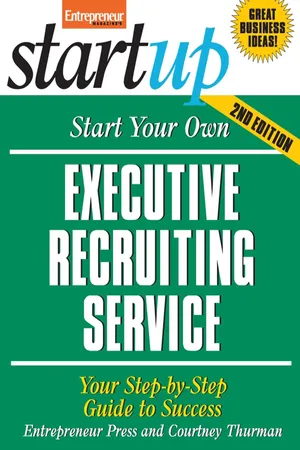
When companies go looking for top business talent, they hire a "headhunter”—an executive recruiter. Executive recruiters are experts at locating star job candidates, leaders and managers of a caliber rarely discovered by the usual recruitment sources. And because business is growing more competitive each day and becoming more demanding of top-flight leadership and decision-making skills, companies are increasingly turning to executive recruiters to help them find the talent they need to stay competitive. This comprehensive guide reveals the strategies used by the best executive search professionals in starting and running their own successful placement services. There are more tricks of the trade in this business than in many others—and we’ll reveal what you really need to know: • How to network for both client and candidate leads • The difference between contingency and retainer fees • How to approach prospective candidates • Little known characteristics to look for in executive job candidates • The latest industry trends and fee information Learn how to find the best talent for hire—and make good money doing it.
- 226 pages
- English
- ePUB (mobile friendly)
- Available on iOS & Android
eBook - ePub
About this book
Information
1
Recruiting Realities
A good analogy when looking at this industry might be that when employees change jobs they become professionally single and are looking to get back into the employment dating scene. The search begins and so can the excitement of finding the perfect match. The arrangement needs to work for both parties.
dp n="17" folio="2" ?Given how frequently employees change jobs, it should come as no surprise that executive recruiters, also commonly known as headhunters, are rapidly increasing in numbers. The more people change jobs, the more work there is for recruiters, and the more matches to be made. Unfortunately, this business is also terribly competitive for that reason.
In this chapter we’ll give you an idea of what the executive recruiting business is all about. We’ll start with an overview of the industry, including how much money a recruiter can hope to make and what the competition is like. We’ll also look back at how this business got started and take a peek into the future.
Recruiting 101
In a nutshell, a recruiter is someone who is hired by a company to find people qualified to fill a job opening—candidates. Often, companies hire recruiters only after they’ve tried to fill the positions themselves. Recruiters usually work on a project-byproject basis. The client company pays the recruiter a percentage—between 20 and 35 percent—of the annual salary of the candidate who accepts the position. While the recruiter finds and screens candidates for the job, the client company makes the final decision on which person to hire.
Recruiting is an unregulated business, so industry statistics are difficult to come by, but Paul Hawkinson, publisher of The Fordyce Letter, puts recruiting at a $10 billion—and growing—industry. There are about 5,000 recruiting firms in the United States, he says. A few very large firms dominate the industry, but most are very small: The average-size recruiting company has between two and three people.
One common assumption about the industry is that it’s just a matching business between employer and potential employee. Being a recruiter isn’t as much about finding candidates as much as it’s a sales job. You have to sell yourself to the client to get the job assignment before you can go looking for candidates. “This is a sales job, no matter how you cut it,” says Hawkinson.
Actually, there are three separate sales that need to be made before you earn any money as a recruiter. First, you need to sell the company on your ability to fill the open position, then sell the candidates on interviewing for the opening, and finally, sell the company on the candidates that you present. There are numerous recruiters are out there competing for these jobs and candidates, which is why many experts estimate the dropout rate within the first year is between 80 and 90 percent.

Bright Idea
Paul Hawkinson, editor of The Fordyce Letter, has written an excellent article titled, “So You Want to Be an Executive Recruiter,” which is available online. Visit www.fordyceletter.com to order this article. Click on the Special Reports link.
Contingency vs. Retained
Recruiters generally work in one of two ways: contingency or retained. If a recruiter works on contingency, it means they take an assignment on spec—a client asks them to fill an open position, but will pay them only if they find the candidate who eventually accepts the job. For recruiters who work on retainer, the client pays the recruiter before they start the search. A retained recruiter pretty much has to guarantee that he or she will fill the client’s position. Between two-thirds and three-quarters of the recruiters in the United States work on contingency. The rest are retained or a combination of retained and contingency.
Working on retainer is generally viewed as the more prestigious billing method, and client companies generally retain recruiters for filling those positions at the top of the corporate ladder. Contingency recruiting is the domain of new recruiters and those who place lower-level employees.
“The retained recruiters are considered the silk slipper people of the industry,” says Paul Hawkinson, editor and publisher of The Fordyce Letter, a newsletter for recruiters, “to the extent that they generally work these higher-level openings, and they’re dealing with CEOs and presidents and CFOs.”
A contingency job means you don’t get a dime until you place a candidate with a client. With contingency jobs, you will often be competing with other recruiters trying to fill the same position. Because contingency recruiters fill only a fraction of the positions they’re trying to fill, they will work on as many as 30 or 40 jobs at a time.
A retained assignment means the client pays you up front to start a search, usually in installments. With retainer jobs, also known as exclusives, you will be the only recruiter. Unlike contingency recruiters, retained recruiters work on just a few jobs at a time.
Some clients like to hire on a retained basis. Because the recruiter is paid up front, the client knows that the recruiter is less concerned with simply filling the position (so he or she will get paid) than with finding appropriate candidates. Also, because retained recruiters work on fewer assignments at a time, they can focus more of their efforts on each assignment, conducting more extensive background and reference checks than contingency recruiters.
Other clients prefer to use a contingency approach. This strategy lets them use several recruiters, who will bring in more candidates for the position than one recruiter will. Or the company may be doing its own recruiting, and if it succeeds in hiring someone, it won’t have to pay a recruiter. Also, a company may want to use a contingency approach to try out a new recruiter.
While some clients always prefer to go with big name recruiting companies, many others use smaller firms because of the usual advantages small businesses offer—more personal service and often a lower price. Also, the big firms generally use the retained payment struc ture, so clients who want contingency recruiters will use smaller firms.

Quick Quote
Entrepreneur Mark M. estimates that “Approximately 90 percent of executive recruiting companies are boutique firms.”
Recruiters tend to specialize in one industry, such as electrical engineering, finance, or law enforcement. Doing so allows them to understand one industry and the players in that industry thoroughly.
Why Use a Recruiter?
Recruiting is essentially a consulting business. A company doesn’t have to hire a recruiter, just as it doesn’t have to hire a management consultant; but a recruiter, like a consultant, can save the company time and money.
Executive recruiting entrepreneur Jeff H. of Chesterfield, Missouri, now runs his own executive recruiting group and also leads a few industry associations. “As a [former] foodservice executive, I never wanted to spend money with a recruiter, but we all want the best talent. Smart hires make us money and the better the talent, the more money we can put on the bottom line. With this in mind, recruiting fees are reasonably insignificant in the scope of a management employee’s term of employment. A good manager can make a company hundreds of thousands of dollars and as we all know, a bad manager can cost you that or more in a short period of time.”
Recruiters take over the job many managers don’t have time for—finding and screening candidates for a job. But more important, recruiters can find candidates quickly. They usually know so many people in their area of expertise that they can pick up the phone, ask who might be interested, and within a week or so get a list of names.
Recruiters also find quality candidates—again, they have so many contacts they’ll hear about the bad seeds that might interview well but have performance shortfalls. Conversely, they can refer candidates who don’t sell themselves well but make exceptional employees.
Jeff H. explains that “Roughly 5 percent of the workforce consists of unemployed workers who are actively looking for jobs, networking, answering ads, etc. You don’t necessarily need recruiters to find these candidates. Some 35 percent of the workforce is not happy with their current employment for various reasons, from nonperformance pressure, company instability, career ceiling, etc. You don’t necessarily need recruiters to find these candidates because they are also actively networking, answering ads, and using recruiters.”

Fun Fact
In case you are doing some research yourself, executive search fits under the category of “management consulting” in the U.S. Government’s Standard Industrial Classification (SIC) codes.
He continues, “But, what most people seem to forget is that roughly 60 percent of the workforce is happy with their current position, earning bonuses, being promoted, and very well thought of by their companies. These people are not networking, answering ads, or even considering leaving their current employer. These are the best candidates, and you will only find them with the assistance of a qualified professional recruiter.”
Recruiters provide an unbiased assessment of the candidates for the job. A manager’s opinion is often colored by the fact that a candidate attended the same school or enjoys the same hobbies, causing him or her to overlook the fact that the candidate has never managed a staff or made a sale.
Besides providing qualified candidates quickly, a recruiter can help a company throughout the hiring process. A recruiter can advise what salary the company can expect to pay its hires, how to better interview candidates, and how to negotiate hiring conditions. In short, a recruiter can act as a hiring consultant to companies.
Jeff H. says that, “The best recruiters can actually save a company money, by managing the process efficiently. Too often companies hire reduced-fee contingency recruiters who send them 15 or 20 resumes, of which the company interviews five candidates and many times hire none. A good recruiter will provide three or four candidates. You can pick the one or two best and hire one, saving substantial dollars in travel and other related interview costs, not to mention time. The rate of the fee is by no means a company’s true cost.”
It’s a Dog-Eat-Dog Business
One reason so many people try to get into recruiting is that the business can be exceptionally lucrative. Some recruiting entrepreneurs make as much as $3 to $4 million a year. Before your eyes drop out of their sockets, be aware that these people are very much the exception. The average recruiter makes between $100,000 and $125,000 a year. Not a bad salary, certainly, but keep in mind that there are also many who make $30,000 a year or less (it takes an awful lot of low earners to balance out those millionaires).
Another reason that people are attracted to the recruiting industry is that it requires no exams, no degrees, and very little money to get started. The industry is unregulated, so literally anyone can give the business a shot. Other than being knowledgeable about a particular field and having contacts in that field, all you really need to do the job is a minimal amount of equipment—likely what you already have...
Table of contents
- Additional titles in Entrepreneur’s Startup Series
- Title Page
- 1 - Recruiting Realities
- 2 - What It Takes to Succeed
- 3 - What Is the Day-to-Day?
- 4 - Plan Your Launch
- 5 - Taking Aim at Your Market
- 6 - Setting Up Shop
- 7 - Tools of the Trade
- 8 - Start-Up Your Business
- 9 - The Contract
- 10 - The Search
- 11 - Setting the Stage
- 12 - Protect Yourself
- 13 - Covering Your Bases
- 14 - Keeping in Shape
- 15 - All About Employees
- 16 - Advertising and Marketing
- 17 - Paying the Bills
- 18 - Staying on Top
- Appendix - Executive Recruiting Resources
- Glossary
- Index
- Subscribe to Entrepreneur Magazine
- Copyright Page
Trusted by 375,005 students
Access to over 1.5 million titles for a fair monthly price.
Study more efficiently using our study tools.
Frequently asked questions
Yes, you can cancel anytime from the Subscription tab in your account settings on the Perlego website. Your subscription will stay active until the end of your current billing period. Learn how to cancel your subscription
No, books cannot be downloaded as external files, such as PDFs, for use outside of Perlego. However, you can download books within the Perlego app for offline reading on mobile or tablet. Learn how to download books offline
Perlego offers two plans: Essential and Complete
- Essential is ideal for learners and professionals who enjoy exploring a wide range of subjects. Access the Essential Library with 800,000+ trusted titles and best-sellers across business, personal growth, and the humanities. Includes unlimited reading time and Standard Read Aloud voice.
- Complete: Perfect for advanced learners and researchers needing full, unrestricted access. Unlock 1.5M+ books across hundreds of subjects, including academic and specialized titles. The Complete Plan also includes advanced features like Premium Read Aloud and Research Assistant.
We are an online textbook subscription service, where you can get access to an entire online library for less than the price of a single book per month. With over 1.5 million books across 990+ topics, we’ve got you covered! Learn about our mission
Look out for the read-aloud symbol on your next book to see if you can listen to it. The read-aloud tool reads text aloud for you, highlighting the text as it is being read. You can pause it, speed it up and slow it down. Learn more about Read Aloud
Yes! You can use the Perlego app on both iOS and Android devices to read anytime, anywhere — even offline. Perfect for commutes or when you’re on the go.
Please note we cannot support devices running on iOS 13 and Android 7 or earlier. Learn more about using the app
Please note we cannot support devices running on iOS 13 and Android 7 or earlier. Learn more about using the app
Yes, you can access Start Your Own Executive Recruiting Service by in PDF and/or ePUB format, as well as other popular books in Business & Small Business. We have over 1.5 million books available in our catalogue for you to explore.