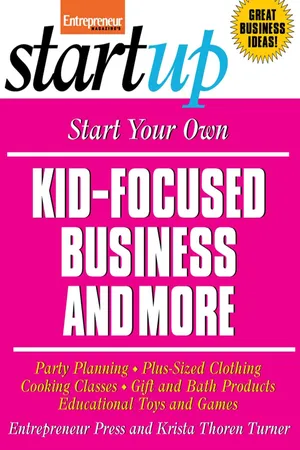
Party Planning, Cooking Classes, Gift and Bath Products, Plus-Sized Clothing, Educational Toys and G
,
226 pages
English
ePUB (mobile friendly)
Available on iOS & Android
eBook - ePub
Start Your Own Kid Focused Business and More
Party Planning, Cooking Classes, Gift and Bath Products, Plus-Sized Clothing, Educational Toys and G
,
About this book
Are you inventive? Fun? Have you been called a kid at heart? If so, let us introduce you to an up-and-coming, fresh-faced market with unbelievable purchasing power—meet today’s kids! An ever-growing market, kids offer a world of business possibilities for inspired entrepreneurs like you! From party planning and gift products to cooking classes and clothing, Entrepreneur covers the hottest businesses within the flourishing kid-focused industry. Providing insider advice, tips and tricks along the way, our experts take you step by step and show you how to discover your specialty, legally and financially establish your business, manage day-to-day operations and so much more! Learn how to: • Discover your specialty within one of five hot areas of interest—party planning, cooking classes, gift and bath products, plus-sized clothing, educational toys and games • Choose the best location and sales avenues to effectively reach your consumers • Efficiently manage inventory and supplies for easy order fulfillment • Create a support staff who help you succeed • Use effective marketing and advertising tools to gain exposure and get the word out • Build positive customer and vendor relationships • Plan for future growth Kids are spending record amounts of their own money—grab your share of this multi-billion-dollar market today!
Once you’ve decided what kind of business you’re going to start, it’s time to look at where the money to fund your startup will come from. You’ll also need to figure out what your startup costs will be, how much money you might be able to make the first year, how you’ll price your goods or services, and how you’ll accept payment.
dp n="153" folio="138" ?
Acquiring Startup Funds
To pull together the necessary startup financial resources, you should carefully consider all avenues, some more traditional than others. We cover both types in this section.
Traditional Sources
You may want to try the classic routes first. Traditional sources of seed money include the following:
• Yourself: This is the number-one form of financing used by most entrepreneurs. You are the best, most reliable source of funding for your business. And if you don’t believe in your company enough to invest, why should anyone else? Keep in mind that other potential investors will want to know how much of your own capital you’re putting into the venture.
Do a thorough inventory of your assets. What savings accounts, real estate equity, retirement accounts, vehicles, or equipment could you use? Nearly all entrepreneurs we interviewed used at least some of their own money. MerriBella Fashions owner LeRona Johnson used her own savings to fund half her $20,000 startup costs.
• Friends and family: This is another time-honored source of funds. Don’t be too proud to ask people who care about you if they’re willing to invest. You can even offer them something in return. “When we first started, we offered family an opportunity to buy some stock,” says Andrea Barthello, co-owner of ThinkFun in Alexandria, Virginia.
• Banks: Home equity loans or lines of credit are relatively low-interest options. You could apply for other kinds of bank loans, too, especially if you find a bank (frequently a local one) more receptive to small businesses. Be aware, however, that consumer goods are typically not banks’ favorite products to invest in, according to toy industry expert Carol Rehtmeyer. “The market is fickle,” she says. You could also open a personal line of credit, even if only to use as backup. Johnson did this before opening her clothing store. “I made sure I had extra money,” she says, “more than I was contemplating needing.”
Dollar Stretcher
Forget trying to impress potential investors. When you start with little funding, go the classic small-business route—operate on a shoestring. During a startup, never spend money you don’t have to.
Venturing Forth
Andrea Barthello, co-owner of ThinkFun in Alexandria, Virginia, says their interview with a potential source of venture capital didn’t go quite as planned. “Our dog was sick the night before,” she explains, “so we were up all night at the animal hospital, and we didn’t have a chance to finish anything. So we went in there, just us and our sick dog with us, in blue jeans and T-shirts to the venture capital guy... and we just clicked.
“I don’t know why they invested in us,” she laughs—except, she says, he liked their passion for their products and their business.
Other Possibilities
You may want to try other avenues as well. These include the following:
• Venture capitalists: These are professionals who invest money from venture capital firms. Unfortunately, getting this kind of financing is an extreme long shot for a kids-related business. But it could work for you. It did for Barthello and her husband. “Be fully involved,” advises Barthello. “You want to be passionate about your business and stick to the rules of reporting to them.”
You can increase your odds by being able to demonstrate a demand for your product. If, for example, you’ve made some preliminary sales at fairs or trade shows and can show that people are interested in your product, that may help. Similarly, if you’ve already planned parties or given some cooking classes, that can make a difference to potential investors.
• Angel investors: These are people who invest their own money in an entrepreneurial company. Despite popular belief, most angels aren’t millionaires. There are quite a few of them out there. Try first to get an investor who knows you in some capacity or who shares a mutual acquaintance with you. Business associates, fellow church members, suppliers, and other entrepreneurs are only some of the possibilities.
Bright Idea
Lost your job and want to start a business? See if your state has a self-employment program as part of its unemployment insurance system. If you qualify, you’ll get entrepreneurial training, and you’ll be able to use unemployment benefits for your startup.
Bright Idea
If you’re starting a kind of business with which many people are not familiar, such as a kids’ cooking business, you may want to go to some extra effort to reassure potential investors. Having some cooking and teaching credentials, as well as a really good presentation, may tip the balance in your favor.
• Commercial finance companies: The SBA can help you find companies more willing to look beyond numbers and assets. For the SBA’s list of banks and finance companies friendly to small businesses, visit sba.gov/advo/stats/lending.
• Credit cards: This avenue should usually be a last resort, as interest rates are high. However, some entrepreneurs take advantage of introductory no- or low-interest cards they get in the mail. When the sixmonth trial period is over, they pay off the balance. If your startup needs are low and you’re good at juggling payments, this strategy might work for you, as it did for Johnson, who funded half the startup of her plus-size clothing store this way. “I knew the best thing I could do for myself was keep my credit good, and make it better,” she says.
Whatever startup funding sources you decide to pursue, you’ll need a solid business plan (covered in Chapter 2) and complete information about what your startup costs and first-year income are likely to be. So read on.
Startup Costs and Income Ranges
How much money will you need to launch your business? And how much can you expect to make from it? In the following sections, we explore the answers to these questions for each of the five types of kids-related businesses in this book. Each type has its own chart listing startup expenses for hypothetical businesses in that industry. As you read the details about your kind of business, fill in the “My Own” spaces in the appropriate chart to estimate what it might cost to start your business.
Smart Tip
When calculating startup costs and launch time for your business, remember that it’s typically human nature to estimate low. Try using the “three times” rule—everything will cost three times more and take three times longer than you anticipated.
Kids’ Party Planning
Your startup costs will vary tremendously, depending on where you locate, what your insurance costs will be, and what kind of equipment you decide to buy. For a sample, look at the startup chart on page 142, which lists preopening costs for two hypothetical party-planning businesses. The low-end business is homebased with no employees. The sole proprietor already has a computer, online access, a printer/ copier/fax machine, a cell phone, a digital camera, and office furniture. She used her startup money to buy liability insurance, event-planning software, and business cards. She also paid for licenses, taxes, and website design, for which she employed a computer science major. She needs $3,520 to launch her business.
The higher-end business is an LLC. It occupies 800 square feet of office space in a large city. Its owner has a full-time planner and a part-time bookkeeper. She upgraded her computer equipment, bought office furniture, and added a phone line and a professionally designed website. She also bought high-priced liability insurance because of her location in the greater Los Angeles area, which has experienced terrorist activity. She invested in business cards, stationery, and an ad in the Yellow Pages. Her startup total is $29,183.
Both owners derive their income from pretax net profit. Annually, these businesses will gross $70,000 and $200,000, respectively, after the first year or two.
So how much can you expect to bring home in the first year from a kids’ party-planning business? Keep in mind that it will probably take you two to three years to ...
Table of contents
Start Your Own
Title Page
2 - Creating a Plan
3 - Kids’ Party Planning
4 - Kids’ Gift and Bath Products
5 - Kids’ Educational Toys and Games
6 - Kids’ Plus-Size Clothing
7 - Kids’ Cooking Classes
8 - Sales Avenues
9 - Legal Work
10 - Financial Health
11 - Location
12 - Equipment and Supplies
13 - Packaging, Storage, and Fulfillment
14 - Teamwork
15 - Getting the Word Out
16 - Success Strategies
Appendix - Kids’ Businesses Resources
Glossary
Index
Subscribe to Entrepreneur Magazine
Copyright Page
Trusted by 375,005 students
Access to over 1.5 million titles for a fair monthly price.
Study more efficiently using our study tools.
Frequently asked questions
Yes, you can cancel anytime from the Subscription tab in your account settings on the Perlego website. Your subscription will stay active until the end of your current billing period. Learn how to cancel your subscription
No, books cannot be downloaded as external files, such as PDFs, for use outside of Perlego. However, you can download books within the Perlego app for offline reading on mobile or tablet. Learn how to download books offline
Perlego offers two plans: Essential and Complete
Essential is ideal for learners and professionals who enjoy exploring a wide range of subjects. Access the Essential Library with 800,000+ trusted titles and best-sellers across business, personal growth, and the humanities. Includes unlimited reading time and Standard Read Aloud voice.
Complete: Perfect for advanced learners and researchers needing full, unrestricted access. Unlock 1.5M+ books across hundreds of subjects, including academic and specialized titles. The Complete Plan also includes advanced features like Premium Read Aloud and Research Assistant.
Both plans are available with monthly, semester, or annual billing cycles.
We are an online textbook subscription service, where you can get access to an entire online library for less than the price of a single book per month. With over 1.5 million books across 990+ topics, we’ve got you covered! Learn about our mission
Look out for the read-aloud symbol on your next book to see if you can listen to it. The read-aloud tool reads text aloud for you, highlighting the text as it is being read. You can pause it, speed it up and slow it down. Learn more about Read Aloud
Yes! You can use the Perlego app on both iOS and Android devices to read anytime, anywhere — even offline. Perfect for commutes or when you’re on the go. Please note we cannot support devices running on iOS 13 and Android 7 or earlier. Learn more about using the app
Yes, you can access Start Your Own Kid Focused Business and More by in PDF and/or ePUB format, as well as other popular books in Business & Small Business. We have over 1.5 million books available in our catalogue for you to explore.