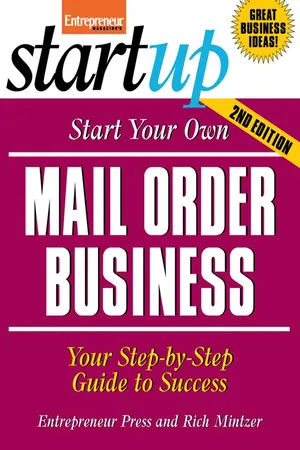
Your Complete Package for Success—Signed, Sealed and Delivered! Busy families no longer need to take the time to run to the mall and shop for the perfect item. They simply click their mouse and have their treasures delivered from any corner of the country right to their doorstep. Shopping has never been so convenient and the opportunity for starting and running a successful mail order business has never been so great! If you want to work from home, running a lucrative business that costs little to start and requires no specialized skills, mail order may be for you. Working from a kitchen table, you can take orders, process payments and dispatch shipments picked up by a parcel service from a remote warehouse run by yet another vendor. This exclusive guide to mail order takes you step by step covering every aspect of startup and operations, including hard-won advice and helpful hints from successful mail order entrepreneurs. Learn how to: • Stay on top of market and industry trends • Choose products that sell • Set your pricing and other policies • Fulfill orders • Build an internet presence • Create a winning catalog or brochure • Choose a high-response mailing list • Use the best resources and tools in the industry With the boom in online shopping, mail order businesses are more profitable than ever, and Entrepreneur gives you everything you need to get started. Don’t wait! Start your mail order business today!
- 266 pages
- English
- ePUB (mobile friendly)
- Available on iOS & Android
eBook - ePub
About this book
Information
1
Mail Order Mania
Mail order is one of the hottest industries right now. It’s not new—in fact, it can be traced back more than a century. But it’s in demand, by consumers and entrepreneurs alike. Why? Reasons abound, both personal and commercial.
dp n="17" folio="2" ?This chapter explores the flourishing business of mail order—a sort of in-your-lap TV news magazine report without the commercials. We’ll delve into the steadily rising economic success of the field and dip into the secrets of America’s mail order industry.
Wish Fulfillment
Everybody loves to get something in the mail—except, of course, those pesky bills. A letter—or especially a package—delivered to your door is like a birthday gift any time of the year. It’s wish fulfillment. Even if the contents are something as mundane as kitchen towels or a car mat, that package makes you feel like you’ve received something special and exciting. So it’s no wonder that mail order is in demand.
The venerable Sears Roebuck catalog, a pioneer mail order piece, was dubbed “The Wish Book” because it gave people the power to choose whatever they wanted and have that wish granted simply by sending off an order form and a payment. Sears, however, was not the first mail order company.
Mail Order’s Dad
The title of “Father of Mail Order” goes to Aaron Montgomery Ward, a savvy traveling salesman who, in 1872, decided that direct mail was a terrific way to get quality merchandise to rural Americans who frequently suffered at the mercy of substandard goods. The 28-year-old entrepreneur founded his company—and America’s shop-by-mail industry—with a single sheet of paper listing 163 products, the cornerstone of what would become the Montgomery Ward catalog.
Sears, Roebuck and Co., founded by former railway station agent Richard W. Sears and watchmaker Alvah C. Roebuck, came into being about 20 years later. By 1895, the Sears catalog weighed in at a hefty 532 pages, crammed with everything a shopper could want, from shoes and buggies to fishing tackle and furniture. A few years later, you could even buy a house from the Sears catalog.

Stat Fact
According to a recent report by the National Mail Order Association, annual U.S. mail order sales have topped the $415 billion mark.
Today, mail order is still an exciting, highdemand source of merchandise. The Direct Marketing Association (also known as the DMA) estimates that each year more than 200 million Americans order a product or service by phone, mail, or the internet.
Why are we including phone sales in our mail order figures? Because mail order is actually an inaccurate moniker for direct marketing, which includes any form of shop-at-home-or-office order placement, from mail to phone to e-mail. Because most people use the term “mail order” to cover these broad bases, we’ll continue to do so within these pages.
What makes mail order so hot today? One reason remains the same as when Aaron Ward had his brainstorm—the convenience of shopping from home. Ward, however, based his marketing strategy on the fact that his customers were rural and did not have access to the higher-quality goods available in urban areas. Today, there is a wider range of reasons why people in all areas, including major cities, find that shopping at home is an easy means of buying items.
Off-Duty Shopping
In today’s marketplace, most customers can easily access any number of retail stores but don’t necessarily have the time. More and more Americans are part of a twoincome household, stretched between work and child raising, with scant time for leisure—much less shopping. Single parents, stretched even further to be in several places at once, have reached the conclusion that ordering from home can simply be easier than dragging the kids to the mall.
So mail order fulfills wishes, as well as meets people’s needs. It grants consumers the ability to shop in the privacy of their own homes, saving on gas and time spent looking for parking. It also lets you shop at midnight if you so choose.
Yes, you can leisurely browse through the pages of mail order catalogs that offer just about everything you can imagine—with your feet up, a cup of coffee at hand, with the TV on if you so choose, while listening to a CD, or in peace and quiet. Perhaps you prefer cruising the pages of an online catalog on your laptop. However, you choose to browse, you can still do it in the comfort of your own home.
If you have questions, you pick up the phone, key in a number (usually toll-free), and talk to a knowledgeable customer assistant. No more frustration trying to track down elusive store clerks who often don’t have the answers anyway. When you’re ready to buy, you order by phone, mail, internet, or e-mail in minutes. No more standing in line! And, of course, there’s no worry about pickpockets or purse snatchers. No wonder mail order is the modern shopper’s paradise!
The Flip Side
What’s the flip side to mail order’s advantages? Although we’d be lying if we said there wasn’t one, mail order’s negative points are few. One is that consumers can’t handle the merchandise until after they’ve paid for it. As a buyer, you have to rely on photos and text to give you the full flavor of the goods. You can never be entirely sure of the size, color, or quality until it shows up at your home. Of course, if you don’t like what you get, you can almost always return it, but this takes a certain amount of effort and eliminates most of the fun, especially if you need (or want) the product right away. The socialization of shopping is also lost through mail order, since you are not as likely to get three friends together to browse a catalog as you are to walk through the mall. In fact, many people still enjoy shopping excursions, then come home and order via the internet. Why? Sometimes they find a better price, and other times they just didn’t feel like carrying heavy merchandise home.

Fun Fact
It is believed by some that Benjamin Franklin, along with his numerous other achievements, was the first actual cataloger. He created a mail order catalog in 1744 that sold scientific and academic books.
Another mail order minus is the time element, since you have to wait until the item shows up, whereas if you ran out to the mall, you could have the merchandise in your home the same day. Most mail order companies will ship your goodies overnight by FedEx if you’re willing to pay extra for the service, but if you’re not, you face a certain lag time. And if those goodies happen to be the wrong fit or the wrong color, there’s an even greater delay while you send them back and wait—again—for the replacements to arrive or to receive a credit or refund.
The last mail order negative is a sort of stigma bearing the word “scam.” Although many mail order companies, from L.L. Bean to Lands’ End to Lillian Vernon have sterling reputations, the idea persists in some minds that mail order is a hotbed of phony merchandise hawkers. Because there were (and still are) some wolves devouring customer lambs, the Federal Trade Commission created the Mail Order Merchandise Rule (now called the Mail or Telephone Order Merchandise Rule) in 1975 to regulate direct-marketing businesses. Let’s just say that Big Brother is watching out for mail order customers and that the majority of mail order businesses are legit.
Brain Cell Application
So far, we’ve examined mail order from the consumer’s perspective. Now let’s take a look at the industry from the businessperson’s point of view. What do we see? An industry that is potentially lucrative for the savvy, hardworking entrepreneur and that has the advantage of requiring relatively little in the way of startup expenses, specialized skills, or intensive apprenticeship—as opposed to, say, professions like medicine, law, high rise construction, or restaurant management.
Bear in mind, however, that this does not mean you can make a fortune without lifting a finger or applying a brain cell. In order to be successful in mail order, you’ll need a generous measure of hard work, a concerted and constant study of the industry as a whole as well as your particular niche, and the ability to roll with the punches. You’ll also need to be prepared to have a lot of fun!
So let’s take a look at the reasons entrepreneurs love mail order. One is that it is as convenient for the direct marketer as it is for the consumer. Since your customers’ visits are all virtual, you can work from home—basing your operations in a spare bedroom, at the kitchen table, or even in a corner of the garage, if necessary, until your efforts bear enough fruit to furnish a “real” office. Many of the most successful catalogs, such as Lillian Vernon, began at a kitchen table, in a spare bedroom, or in someone’s garage.
Mail Order Moonlighting
Mail order offers the option of starting as a part-time business, which allows you to get your feet wet without jumping into the pool. In fact, many direct marketers insist that moonlighting is the wisest way to go. John Schulte, chairman of the National Mail Order Association (NMOA), believes traditional and internet-based mail order are the last frontiers for the little guy. “You can find ways to make things happen part-time from your kitchen table,” says Schulte.
Competition in the mail order biz is tough. But if you start out part-time, you can allow yourself on-the-job training without on-the-job financial anxieties. And if you don’t want to sever the ties with your full-time employer until you know you can make it on your own, mail order is an ideal business for you.
What else makes mail order shine for the startup entrepreneur? You don’t need a lot of inventory. You can sell merchandise through a drop-ship arrangement. No, we aren’t suggesting that you parachute goods to customers like in the Berlin Airlift. Drop shipping is an arrangement in which a third party, such as a manufacturer or wholesaler, sells you the merchandise while keeping it in their warehouse until you make the sale. Then it is shipped from them to your customer. Or you can start out with one product or service, rather than go the L.L. Bean 16,000-products route, and keep your inventory manageable as you grow.
Keep in mind that mail order lends itself to services as well as merchandise. You can offer everything from antique appraisal to desktop publishing to genealogical research—and for most services, your inventory list will be minimal.

Fun Fact
L.L. Bean Inc., a premier mail order retailer, was born in 1912 when Leon Leonwood Bean, a 40-year-old Maine outdoorsman, decided he’d had just about enough of having cold, wet feet while tramping around in the woods. The resourceful Mr. Bean created the Maine Hunting Shoe, which he not only wore but also sold exclusively by mail, and which became the “sole” of today’s 16,000-product mail order operation.
Yet another mail order plus: You don’t need to ship the product until your customer’s check or credit card clears the bank. Unlike your store-bound retail colleagues, you’ve got no bounced-check worries.
The Top Contender
What are mail order’s minuses from the business owner’s viewpoint? Again, there are few, with the top contender being the tough competition from all the other direct marketers out there. As a mail order maven, you’ll have to be clever, creative, and persistent—and this book will help.
Another major minus from the direct marketer’s side of the fence is the old “scam” stigma we mentioned earlier. Customers who wouldn’t hesitate to hand over their money in a retail store can balk at sending it through the mail or giving their credit card information over the phone or the internet. With the increase in identity theft, customers are leery of shopping at places that are unfamiliar. For this reason, you need to work overtime to establish a reputation as trustworthy and have an infrastructure in place that cannot be tampered with by scammers, spammers, or web savvy thieves. Encryption technology and privacy pages explaining that you are protecting your customers right are extremely important today.
Wind Beneath Your Wings
Here’s the big secret to keeping the wind in your sails and beneath your wings as a mail order moonlighter: Offer a product or service that appeals to a well-defined market segment—for example, horse lovers or off-road vehicle buffs. Targeting a specific aud...
Table of contents
- Additional titles in Entrepreneur’s Startup Series
- Title Page
- 1 - Mail Order Mania
- 2 - Mail Order 101
- 3 - Products, Customers, and Market Research
- 4 - Packaging Your Business: Choosing a Name and a Structure
- 5 - Into the Money Bag: Figuring Your Finances
- 6 - Signed, Sealed, Delivered: Daily Operations
- 7 - Inventory and Shipping
- 8 - Sorting through Business Equipment
- 9 - Your Business Location and Your Employees
- 10 - Pushing the Envelope, Part I: Direct-Mail Advertising
- 11 - Pushing the Envelope, Part II: Advertising, Promotion, and Marketing
- 12 - The Check is in the Mail: Money Management
- 13 - Happy Mailings or Empty Envelopes?
- Appendix - Mail Order Resources
- Glossary
- Index
- Subscribe to Entrepreneur Magazine
- Copyright Page
Trusted by 375,005 students
Access to over 1.5 million titles for a fair monthly price.
Study more efficiently using our study tools.
Frequently asked questions
Yes, you can cancel anytime from the Subscription tab in your account settings on the Perlego website. Your subscription will stay active until the end of your current billing period. Learn how to cancel your subscription
No, books cannot be downloaded as external files, such as PDFs, for use outside of Perlego. However, you can download books within the Perlego app for offline reading on mobile or tablet. Learn how to download books offline
Perlego offers two plans: Essential and Complete
- Essential is ideal for learners and professionals who enjoy exploring a wide range of subjects. Access the Essential Library with 800,000+ trusted titles and best-sellers across business, personal growth, and the humanities. Includes unlimited reading time and Standard Read Aloud voice.
- Complete: Perfect for advanced learners and researchers needing full, unrestricted access. Unlock 1.5M+ books across hundreds of subjects, including academic and specialized titles. The Complete Plan also includes advanced features like Premium Read Aloud and Research Assistant.
We are an online textbook subscription service, where you can get access to an entire online library for less than the price of a single book per month. With over 1.5 million books across 990+ topics, we’ve got you covered! Learn about our mission
Look out for the read-aloud symbol on your next book to see if you can listen to it. The read-aloud tool reads text aloud for you, highlighting the text as it is being read. You can pause it, speed it up and slow it down. Learn more about Read Aloud
Yes! You can use the Perlego app on both iOS and Android devices to read anytime, anywhere — even offline. Perfect for commutes or when you’re on the go.
Please note we cannot support devices running on iOS 13 and Android 7 or earlier. Learn more about using the app
Please note we cannot support devices running on iOS 13 and Android 7 or earlier. Learn more about using the app
Yes, you can access Start Your Own Mail Order Business by in PDF and/or ePUB format, as well as other popular books in Business & Small Business. We have over 1.5 million books available in our catalogue for you to explore.