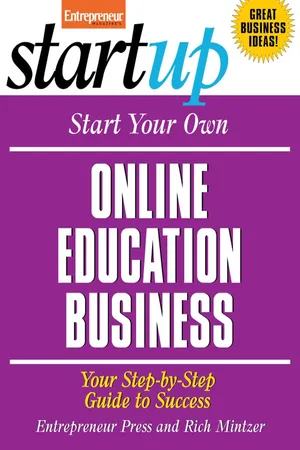
Online education is experiencing a huge growth spurt. The number of students taking online classes increased 24 percent in the past year—and this growth is only expected to continue. Don’t let this lucrative opportunity pass you by. Take your teaching global by offering courses online. Learn everything you need to know to set up a successful online education business: • Find financing, write a business plan, choose a business structure and learn other business basics • Develop exciting courses in the four most popular areas—IT, health care, education and business—as well as niche markets • Promote your business and attract students through online newsletters, search engine optimization and other innovative techniques • Design a user-friendly website and provide high-quality tech support • Train instructors in this new education medium, or teach courses yourself • And more! Real-life stories from successful entrepreneurs show you exactly what you need to do to set up and run a profitable business. Now’s the perfect time to get started with an online education business—and with this book, you’re well on your way to success.
- 178 pages
- English
- ePUB (mobile friendly)
- Available on iOS & Android
eBook - ePub
About this book
Information
1
Learning for a Better Life
Knowledge is the coin of this realm. Unless you’re a movie star, professional athlete, or perhaps the inventor of some amazing new product, what you know is far more important than just about anything else in the business game. To hold your own in the marketplace, you’ve got to keep learning—everything from changing social norms to the latest management theories to mastery of technologies that didn’t even exist a few years ago. That’s true in boon times and in bad times.
From business learning to courses that keep the mind sharp and active, there are a wide range of markets for online education. In this chapter, we’ll look at the circumstances that make education so important and how these circumstances open up opportunities for you, the entrepreneur.
A Degree of Confidence
At the beginning of the 20th century, if you had just some high school education, you could get a fairly good job. After World War II, a high school education became a necessity. Through the 1960s, if you had a little college—not necessarily even a full degree, but some post-secondary training—you enjoyed an edge that would get you a white-collar job. Now, a college degree is just the ante you must have to gain meaningful employment—and ongoing education is a must for many professions.
Job applicants today find it advantageous to show that they have some specific experience in the job for which they are applying. An increasing number of students supplement their college degrees with post-graduate work, technical certifications, and specialty training such as management seminars. Today, ongoing education and letters after your name can make a great deal of difference in competitive fields. And getting degrees, certificates, and ongoing education is no longer strictly for the younger set. It’s a prerequisite for professionals of all ages looking to continue climbing the ladder. In most industries, there are degrees and certificates available that show expertise in specific areas within the broader profession. It is this ongoing need for education that has been the impetus for the steadily growing online education industry, fueled largely by the increased pace of technology.
The online education entrepreneur has many options today. Companies need to make sure employees at all levels are up to speed on job requirements. That may mandate technical training, guidance on meeting regulatory standards, or management courses on issues such as sexual harassment and/or hiring/firing.

Smart Tip
U.S. corporations planned to spend over $2 billion in 2007 on web-based learning, according to market researcher Adventures. Catering to corporations represents a home-run opportunity for an online education entrepreneur, simply because of the size of each deal. Selling a course to a corporation can touch thousands of employees and lead to follow-up sales. The sale, however, will not be quick.
Ongoing education can be as ambitious as getting your MBA, or it can be very fine-grained. “A lot of the online training is just getting people familiar with Microsoft Word®,” says John Dalton, analyst with Forrester Research, a technology analysis firm. “It’s not high-level stuff.”
Training can be refreshers on basic material, since “the basics” often change every year. For instance, software tools are constantly being upgraded, with new versions of familiar products as well as new tools for building advanced web pages. There are numerous options. You can resell products. You can broker classes on behalf of other businesses, resell CD-based courses, or engage in other middleman activities in the e-learning economy.
Ongoing training, however, is in no way limited to computers or even technology. While online education is delivered over the internet, it need not be about the internet, or computers at all for that matter. Online education can provide college-level accredited courses for someone who left a traditional college early and never got his or her degree. It can take the form of additional resources and homework help for young students in the K–12 years. It can provide courses for nine to fivers looking to fulfill personal interests or to pursue a second career. It can also be learning option for seniors who want to keep their minds busy and active, or start a business venture.
Degrees can certainly help in various aspects of a career, but knowledge alone is still a winning proposition in a culture that has frequently lost sight of the importance of education in recent years.
Education Pays
Here are the median incomes of full-time workers aged 25 and older by educational attainment. Median individual income based on U.S. Census figures:
| Doctorate | $73,892 |
| Professional degree | $71,240 |
| Master’s degree | $58,708 |
| Bachelor’s degree | $48,724 |
| Associate degree | $36,348 |
| Some college, no degree | $33,950 |
| High school diploma | $30,316 |
| Some high school, no diploma | $21,268 |
Learning Goes Online
The seminal event for online education was the internet, which became a vital part of our culture almost overnight. Computer equipment had been applied to education for decades, but when everyone hooked their computers up to the same communication backbone, online learning really kicked into high gear.

Stat Fact
The median time on the job for the average worker is 3.5 years, according to the Bureau of Labor Statistics. Therefore, a typical 22-year-old college grad will change jobs eight times before age 32.
In a cover story, Business Week identified education as one of five sectors that would be revolutionized by the internet. There are more for-profit education ventures than ever before, but we’ve barely gotten off the ground. Distance learning has not even been fully explored and exploited, but it has changed the way education is created and presented. Students can now learn at a time and place of their own choosing, and at their own pace. They can utilize data and resources from numerous sources. Students can also enter virtual classrooms led by instructors in other parts of the country, or even the world, and take part in real-time courses from the comfort of their own homes.
Regular (traditional) classroom settings, of course, are not going away. However, the opportunity to learn online has opened up the door to many students who were stymied by time and travel constraints. The full-time work force can now get degrees and certifications or simply take classes for personal enrichment that they would never have had the time or opportunity for pre-internet.
In some cases, the best of both worlds can flourish. Often the most effective online education happens when combined with classroom teaching—often called blended learning. Online educational learning ventures have discovered that oneon-one contact with instructors is an important element of some courses or preferred by some students. For example, the 50,000-plus students at University of Phoenix Online can complete their entire graduate degrees online, including all administration, registration, and book buying if they wish. But the university also has developed a learning option in which students can meet for the first and last class of each course and complete the rest of their classes over the internet, thus providing them with the classroom dynamic as well as the benefits of online learning. Blended learning is discussed in Chapter 6.
What’s Your Role?
Online education is a multibillion-dollar market. And, there really are no limits to the subjects that can be delivered via the internet. People have a growing appetite for topics and interests that once seemed far beyond their reach, and companies have an insatiable need to keep employees up-to-speed.
You can pick among many roles in the online learning environment. You can specialize in teaching both large or small businesses, computer basics, management techniques, or high-end programming skills. You might create guides that help employees understand their firm’s idiosyncratic software, or interactive content that explains complicated products to customers.
There are endless variations in audience demographics, delivery methods, content, and learning styles. Online learning is wide open. Your ability to mine these opportunities depends on how well your skill set and delivery abilities match with these opportunities.
In the chapters that follow, we discuss how you prepare an online learning business, which entails technical, academic, marketing, and financial know-how. Of course, you need not have all of these skills. You can, instead, build a team around you to handle these aspects of the online education business.
Prior to starting any business venture, you will want to learn about the industry. Knowing what is happening in the online education market, as well as the key words and the various options open to you is discussed in Chapter 2.

Stat Fact
As many as 92 percent of employees say the ability to work from home is an important factor when deciding whether to accept a new job, according to the career web site True Careers (www.truecareers.com). It seems only logical, then, that many people want to learn from the comfort of their own homes.
2
Entering the Online Learning Market
In this chapter, we’ll give you an overview of the market, discuss how some online education entrepreneurs have approached the industry, and tackle the fundamentals of how you can go about finding your unique place.
dp n="23" folio="8" ?The Education Industry
In many respects, the pursuit of knowledge—including pre- and post-secondary schooling, job training, technical training, and continuing education of all stripes—hasn’t changed in decades. Online learning is simply a new, high-tech means of communicating knowledge, just as word processors and spreadsheets were new ways of satisfying the financial needs of businesses at the start of the PC era. The great news for you, the online education entrepreneur, is that this market is not a flash in the pan or a passing fad.
Online education breaks into four main markets, with considerable overlap among them.
1. Educating children and young adults. This is one of the largest industries. Some $100 billion a year is spent on this market, and the amounts continue to rise. If you add up all of the online educational products, systems, and services, and include that share of technological infrastructure and administration th...
Table of contents
- Additional titles in Entrepreneur’s Startup Series
- Title Page
- 1 - Learning for a Better Life
- 2 - Entering the Online Learning Market
- 3 - Start-Up Strategies
- 4 - Online Education Goes to School
- 5 - Tuning Up Knowledge Workers and IT Professionals
- 6 - Lifelong Online Learning
- 7 - Course Planning and Offerings
- 8 - Solid Foundations for Virtual Firms
- 9 - Putting Your Money Down
- 10 - Content and Delivery
- 11 - It’s All About the Software
- 12 - Finding the Finances
- 13 - Spreading the Word
- 14 - Failure and Success
- Appendix - Online Education Business Resources
- Glossary
- Index
- Subscribe to Entrepreneur Magazine
- Copyright Page
Trusted by 375,005 students
Access to over 1.5 million titles for a fair monthly price.
Study more efficiently using our study tools.
Frequently asked questions
Yes, you can cancel anytime from the Subscription tab in your account settings on the Perlego website. Your subscription will stay active until the end of your current billing period. Learn how to cancel your subscription
No, books cannot be downloaded as external files, such as PDFs, for use outside of Perlego. However, you can download books within the Perlego app for offline reading on mobile or tablet. Learn how to download books offline
Perlego offers two plans: Essential and Complete
- Essential is ideal for learners and professionals who enjoy exploring a wide range of subjects. Access the Essential Library with 800,000+ trusted titles and best-sellers across business, personal growth, and the humanities. Includes unlimited reading time and Standard Read Aloud voice.
- Complete: Perfect for advanced learners and researchers needing full, unrestricted access. Unlock 1.5M+ books across hundreds of subjects, including academic and specialized titles. The Complete Plan also includes advanced features like Premium Read Aloud and Research Assistant.
We are an online textbook subscription service, where you can get access to an entire online library for less than the price of a single book per month. With over 1.5 million books across 990+ topics, we’ve got you covered! Learn about our mission
Look out for the read-aloud symbol on your next book to see if you can listen to it. The read-aloud tool reads text aloud for you, highlighting the text as it is being read. You can pause it, speed it up and slow it down. Learn more about Read Aloud
Yes! You can use the Perlego app on both iOS and Android devices to read anytime, anywhere — even offline. Perfect for commutes or when you’re on the go.
Please note we cannot support devices running on iOS 13 and Android 7 or earlier. Learn more about using the app
Please note we cannot support devices running on iOS 13 and Android 7 or earlier. Learn more about using the app
Yes, you can access Start Your Own Online Education Business by in PDF and/or ePUB format, as well as other popular books in Business & Small Business. We have over 1.5 million books available in our catalogue for you to explore.