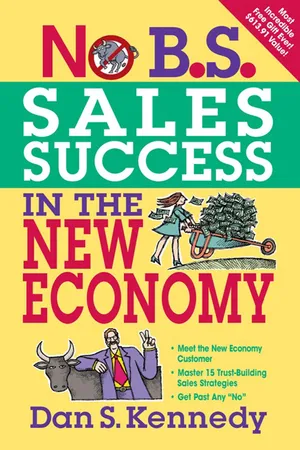
In The New Economy, only a select few will gain and keep membership in the elite sales fraternity enjoying the top incomes, the greatest security, the most independence and power, and the highest status. And, who better to show you how to get in than “Millionaire Maker” Dan Kennedy? Kennedy covers: • Adapting to The New Economy Consumer • How to STOP PROSPECTING Once And For All—and why you must • Put the awesome power of TAKEAWAY SELLING to work—in any environment • If you’re in a commodity business, get out!—how to Re-Position, escape commoditization, and safeguard price and profits in the heightened competition of The New Economy • The One Thing to do, to leverage The New Economy’s “Chaos of Choices” to your benefit • How Dumb Salespeople Work 10X Harder Than Necessary, by under-utilizing this one tool • The 6-Step No BS Sales Process: finally, a reliable system you can stick with! • 6 Ways Sales Professionals Sabotage Themselves • BS that Sales Managers shovel onto salespeople—beware! • How to switch from One-to-One to One-to-Many with Technical Tools • 8 Steps to getting past any “No” • How to CREATE TRUST (FAST) in the trust-damaged, post-recession world
- 262 pages
- English
- ePUB (mobile friendly)
- Available on iOS & Android
eBook - ePub
No B.S. Sales Success In The New Economy
About this book
Information
PART I

15 NO B.S. STRATEGIES FOR EXCEPTIONAL SUCCESS IN SALES, PERSUASION, AND NEGOTIATIONS
dp n="29" folio="" ?dp n="30" folio="3" ? CHAPTER 1
STRATEGY 1 IMMUNITY TO THE WORD “NO”
My first sales position (and the only time I’ve been employed by someone else) was a wonderful training ground. I learned a lot from my experiences in that position, and you’ll notice throughout this book that I refer to it several times. I now have nostalgia for these experiences, warm feelings for them that I, of course, did not have when living them. The ones I choose to write about in this book are not just “war stories” told because they are good or amusing stories—these are experiences that had lasting impact and have colored my strategic approach to advertising, marketing, and selling for more than 30 years and continue doing so today. They are not diminished in significance by age at all. In fact, I find them more relevant to The New Economy.
dp n="31" folio="4" ?I was so wet-behind-the-ears I dripped when I was hired as the central states sales representative for a Los Angeles-based book publisher. I was assigned Ohio, Kentucky, Indiana, Michigan, and Pennsylvania. My job was to call on all the bookstores, department store book departments, discount stores, gift shops, and other retailers in that territory to service existing accounts and open new ones. Most of the company’s books were humorous, impulse-purchase items. In many stores, the line of books was merchandised on the publisher’s six-foot-high spinner racks, which I had to inventory and stock.
One minor fact that was not discussed when I was hired was that my territory had been “orphaned,” and the established accounts had received no service of any kind for eight months or longer. I soon discovered that some of the customers were a trifle annoyed at having been sold this line of merchandise, promised service, and then ignored.
I was furnished with a computer printout of all the accounts and their purchase history. The first one I visited, a drugstore, provided a clue that things might not be well. I walked up to the owner, introduced myself as the new representative from the company, and watched a mild-mannered pharmacist turn into a raving lunatic. He grabbed me by the arm and dragged me into the back room where he showed me a pile of rack parts that had been shipped in, but that he had been unable to assemble. Surrounding that mess was a stack of boxes full of books. He told me that he had been invoiced for books and racks and had been dunned by a collector for payment, even though he had never had a chance to get the books on the floor to sell. He literally threw the rack parts out of the back door while screaming at me to take it all away.
In the next few weeks, I met with similar antagonism at almost every account I called on. I took a lot of racks and a lot of inventory out of stores. Besides being generally unpleasant and occasionally hazardous to my health, this situation was an economic disaster. I was being rated as a sales rep, and my bonuses were based on a “positive sales ratio” for the month. That means: sales less returns equal net sales.
The way I was going, I would have a negative sales figure for my first month—maybe my first year. I determined that something had to change, and I had to be the one to create the change.
That decision alone is an important tip about getting your own way. It doesn’t much matter whether we’re talking about selling, like the work I was doing, or negotiating business deals, or running a business. Anybody can look good and get good results when everybody else is cooperating and everything is going as it is supposed to. Under those conditions, just about anybody can have a good time and make a lot of money. And that is exactly what was happening, during the extended economic boom commencing with Ronald Reagan’s re-engineering of the near-Depression economy made by Jimmy Carter all the way through to President Bush #2, who, incidentally, presided over a record-breaking 55 consecutive months of job growth in this country, stock market rising to record highs, and all the rest. People frankly clueless about the businesses they were in; sales professionals who actually had no significant sales skills and even less dedication to either that craft or to effectively serving clients . . . they all found themselves rolling in easy money. This has happened a number of times before. When times are good, the CEO looks like a genius and the sales reps look like superstars. But when the first rough waters come along, these same people suddenly look like bumbling idiots.
Have they actually changed that much? No—they were never very sharp in the first place. And their blaming of everything on the economy is a giant, destructive lie. Denial and delusion. When the economy as a whole or isolated within a particular industry, field, or geographic area turns from overly generous and agreeable to miserly and grumpy, weakness, vulnerabilities, laziness, poor discipline, and shallow know-how is all exposed. The Wall Street expression is: you can’t see who’s naked . . . or be certain who is “inadequate” . . . until the tide goes out.
The blunt truth is this: if you insist on blaming anything but yourself for unsatisfactory results, you can’t exercise enough control to get satisfactory results. If you’re going to achieve high levels of success in selling, you’ve got to be able to produce positive results in any and all circumstances including those viewed by most as negative circumstances. You have to choose and decide, which kind of sales professional you are going to be: a fair weather salesperson or an all-weather salesperson.
Dan Kennedy’s #1 No B.S. Truth About Selling
If you’re going to achieve high levels of success in selling, you’ve got to be able to get positive results under negative circumstances.
Anyway, back to the war story. I made up my mind that I had to sell these angry, neglected customers on keeping our line in their stores and even buying more. I had to get positive results under these very negative circumstances. I had to face customers who had been lied to, inconvenienced, billed for merchandise they couldn’t sell, dunned for payment, and otherwise abused, and somehow get them to “forgive and forget.” In order to do this, I had to take my ego out of the way.
In different selling situations, different things get in the way. You can never actually remove those placed in your way by others—be they the boneheads in Washington running the economy, a tough competitor, or in this case, my own company’s management that permitted this awful situation to develop. But you can remove whatever obstacles you place in your own way. Those are almost always reactions to circumstances, and those are entirely within your control. Make a note.
Anyway, through all the work I’ve done training salespeople and working with sales executives struggling to get productivity from salespeople, I’ve discovered that the number one secret reason for failure in selling is ego. The person with an inflated ego or with very fragile self-esteem (the two are connected) perceives refusal as rejection. When someone says no to such a person, he or she takes it personally.
Confusing refusal with rejection makes selling painful, because more people say no than ever say yes. In a difficult economy, this can be truer; a “worse” ratio, as resistance to spending anything on anything sets in. In the emerging New Economy, that newly learned resistance will linger longer after actual recession has departed, just as it did for survivors of the first Great Depression. And, in The New Economy, customers will demand clearer, better, more “on target” value propositions, so there will be more rejection, at least en-route to the eventual sale. In my situation, of course, they were well beyond simple refusal to buy. Customers were calling me vile names, throwing things at me. I had to remember that it really had nothing to do with me. These people weren’t mad at me; they were mad at the previous rep, at the company, or at the situation—but not at me.
I’ve since learned that just about any time an individual disagrees with me, fails to accept an offer I present, says no to me, or otherwise interferes with my access to what I want, it very rarely has anything to do with me as a person, And since it isn’t personal, it doesn’t warrant any kind of an emotional reaction. Having control over your emotions gives you a very powerful advantage in selling.
dp n="35" folio="8" ?As I approached these hostile customers, I took my emotions out of the situation. No matter what they said, I interpreted it as reasonable, justifiable anger at other people and at a negative situation. I listened. I was patient. I was concerned. And I never got angry. I never got defensive. Finally, when the customer had vented and had nothing more to say, I asked for permission to respond. I stated the obvious: I had no control over the past. I could only exercise control over the present. My job now was to make handling the merchandise so profitable and pleasurable for the merchant that it made up for all the past problems and justified a renewed relationship. Then I shifted right into selling—just as if the customer was new and had never heard of the company, the books, or me. I’ve since learned, by the way, that in every situation, there is a point when the opportunity to shift into selling presents itself.
It worked. But even while it was working, many of the customers questioned my integrity. They wanted to know whether or not I was telling the truth. They asked whether I would keep my promises concerning service. They were skeptical and suspicious. If I had wanted to be thin-skinned, I could have gotten angry with them. How dare they question my honesty?
Again, I had to understand that this, too, was nothing personal. I chose to work for a company that had “done them wrong” once. I had to accept the consequences, including guilt by association. Again, I had to set my ego aside.
With this approach, I saved twice as many accounts as I lost. I even returned to that first drugstore and got the merchandise back in. I had discovered that initial refusal, even antagonism, was not necessarily the ultimate result. I discovered that I could change a no to a yes more often than not.
My favorite illustration of all this comes from my first call on the head buyer for the book departments of a major department store chain. I went with one of the company’s experienced salespeople, as an apprentice, to watch and learn. I was to carry the samples and keep my mouth shut.
dp n="36" folio="9" ?Keeping quiet was no problem; I sat in stunned silence as the other sales rep presented the buyer with one new title after another. As he looked at each book, the buyer kept saying: “This is crap. Do you know that? Why should I have this crap in my store? How can you show me this crap?” The buyer went on and on like that, and the sales rep did not say a word! Finally, the buyer picked up one sample after the other and barked: “Ship me ten dozen” or “Ship me 50.” This went on for nearly an hour and the sales rep rarely spoke. The buyer criticized and cussed each sample, then ordered. When it was over, the rep had written an order for close to $10,000.00—a very, very big order in that business. He and the buyer shook hands, exchanged pleasantries, and we left. I couldn’t believe what I had witnessed.
The sales rep said, “You know, he always does that. The first few times I went in there, years ago, I got mad at him. I got defensive. I argued with him. Finally he took pity on me. He asked me a great question: What do you care what I think of this stuff or say about this stuff as long as I buy a lot of it and my stores sell a lot of it and you make a lot of money?”
I have been a very serious student of Dr. Maxwell Maltz’ work since I was in my teens. Dr. Maltz’ best known book, Psycho-Cybernetics, has sold over 30 million copies worldwide. His works have had such important impact on me, several years ago I acquired all the rights to all his works, co-authored new ones, including The New Psycho-Cybernetics book. One of the key things I learned from “Psycho-Cybernetics” was how to develop a strong self-image bulletproof against all unimportant criticism. I have also long been a very serious student of first-generation millionaires and multi-millionaires who’ve gotten there by building businesses from scratch. I’ve had hundreds of these people as clients and associates, and developed my Renegade Millionaire System (www.RenegadeMillionaire.com) based on them. A commonality key in the majority: strong immunity to criticism. This is a theme you’ll find running through the top performers in selling as well. They care little about what people think; they care about what people buy.
No’s Turned into Yes’s, That’s What Master Salespeople Do
For ten years, concluded at my choice, I had the great privilege of touring North America, appearing as a speaker on the same seminar programs with legendary sales and success speaker Zig Ziglar, as well as Brian Tracy, Jim Rohn, Tom Hopkins, and numerous celebrities, addressing audiences of thousands to as many as 35,000 in each city. Zig is one of the “masters” I studied at the very beginning of my selling life. One of his stories, that stuck in my mind permanently features the sales woman who couldn’t hear a “no” shouted in her ear, but could hear a whispered “yes” from 50 paces. For years that was the right approach: simply ignoring the word “no.” In The New Economy, that...
Table of contents
- Praise
- Title Page
- Preface
- PART I - 15 NO B.S. STRATEGIES FOR EXCEPTIONAL SUCCESS IN SALES, PERSUASION, ...
- PART II - HOW TO STOP PROSPECTINGONCE AND FOR ALL
- PART III - A NO B.S. START-TO-FINISH STRUCTURE FOR THE SALE
- PART IV - DUMB AND DUMBERTHINGS THAT SABOTAGE SALES SUCCESS
- PART V - MY BIGGEST SECRET TO EXCEPTIONAL RESULTS IN SELLING: TAKEAWAY SELLING
- BONUS BOOK
- PART VI
- ABOUT THE AUTHOR
- ETERNAL TRUTHS
- Index
- Subscribe to Entrepreneur Magazine
- Copyright Page
Trusted by 375,005 students
Access to over 1.5 million titles for a fair monthly price.
Study more efficiently using our study tools.
Frequently asked questions
Yes, you can cancel anytime from the Subscription tab in your account settings on the Perlego website. Your subscription will stay active until the end of your current billing period. Learn how to cancel your subscription
No, books cannot be downloaded as external files, such as PDFs, for use outside of Perlego. However, you can download books within the Perlego app for offline reading on mobile or tablet. Learn how to download books offline
Perlego offers two plans: Essential and Complete
- Essential is ideal for learners and professionals who enjoy exploring a wide range of subjects. Access the Essential Library with 800,000+ trusted titles and best-sellers across business, personal growth, and the humanities. Includes unlimited reading time and Standard Read Aloud voice.
- Complete: Perfect for advanced learners and researchers needing full, unrestricted access. Unlock 1.5M+ books across hundreds of subjects, including academic and specialized titles. The Complete Plan also includes advanced features like Premium Read Aloud and Research Assistant.
We are an online textbook subscription service, where you can get access to an entire online library for less than the price of a single book per month. With over 1.5 million books across 990+ topics, we’ve got you covered! Learn about our mission
Look out for the read-aloud symbol on your next book to see if you can listen to it. The read-aloud tool reads text aloud for you, highlighting the text as it is being read. You can pause it, speed it up and slow it down. Learn more about Read Aloud
Yes! You can use the Perlego app on both iOS and Android devices to read anytime, anywhere — even offline. Perfect for commutes or when you’re on the go.
Please note we cannot support devices running on iOS 13 and Android 7 or earlier. Learn more about using the app
Please note we cannot support devices running on iOS 13 and Android 7 or earlier. Learn more about using the app
Yes, you can access No B.S. Sales Success In The New Economy by Dan S. Kennedy in PDF and/or ePUB format, as well as other popular books in Business & Business General. We have over 1.5 million books available in our catalogue for you to explore.